Lifestyle
2026 AI News Roundup: Highlights and Daily Life Applications from January to September
Organizing key AI news stories month by month from January to September 2026, linking to full analyses in five languages. Covering models, work tools, creation, costs, and transparency, explaining backgrounds, uses, and limits.
Updated: About 14 min read
From January to September 2026, AI news stretched from data center compute all the way to personal data, document work, images, video, and music. Verified as of 2026-09-14 and expanded several times since (most recently on 2026-10-04), this index brings together full analyses of key events, arranged from January through September. Each article preserves the news date and official sources, clarifying what was announced at the time, what practical uses exist, and which features remain restricted by plan, region, or rollout phase.
This special series is aimed at general readers in Taiwan and does not require prior familiarity with model specifications. You can review the monthly highlights first and then select articles relevant to your daily life. Vendor benchmarks are attributed to their publishers, while work, travel, and creative use cases are editorially designed examples for readers to verify on their own. The news reports originally published from late July through September are also integrated into this index, forming a continuous reading timeline alongside the pieces later added for January to July. On 2026-09-15 more were added: GPT-Live voice from July, and from September Gemini replacing Google Assistant, Anthropic's misuse threat report, the OpenAI Agents API, DeepSeek V4.1-Flash, Amodei's call to pace frontier AI, and Siri AI. On 2026-09-18 events not yet covered were added: from March, OpenAI's agreement to acquire Astral and its $122 billion funding round; from May, GPT-5.5 Instant becoming the default model, self-serve buying for ChatGPT ads and OpenAI's frontier governance framework; from June, the confidential S-1 draft and the Jalapeño chip; and from September, NVIDIA's agreement to acquire Hugging Face, ChatGPT for Financial Services, GPT-Live 1 in the API, the Habitat storage platform and Gemini 3.8 Live. Later additions cover the news of September 16 to 18: the Sponsored Agents test in ChatGPT ads, Mistral's model joining Firefox Smart Window, OpenAI's misalignment reporting framework, Anthropic's three frontier-AI metrics, Astra for Law, and the family version of Google's CC. Then came the new models of late September — Claude Opus 5.5, GPT-6 Sol and Luna, Claude Sonnet 5.5 and GPT-6.1 Sol — along with ChatGPT ads beginning to roll out in Taiwan and Google Vids opening free video generation with Gemini Omni 1.1, and, from October, Claude Code mods.
January: Compute and Personal Data Take Two Distinct Paths
January's updates can be divided into the supply side and the user side. NVIDIA Rubin addresses data center computing platforms, whereas ChatGPT Health and Gemini Personal Intelligence focus on personal data and context. The former does not mean you can immediately purchase a cheaper subscription, and the latter two should not lead one to assume features are open to Taiwan accounts based solely on feature names. When reading the news, first confirm whether you are looking at hardware supply, model capability, or a new service within an account.
For everyday users, understanding these shifts can begin with data organization. Organizing existing medical examination reports before a clinic visit is a very different task from asking a system to diagnose a medical condition; organizing travel emails also involves a very different data scope compared to granting a system access to read an entire inbox. The relevant articles use concrete scenarios to illustrate how to provide less data, retain original records, and confirm which judgments must still be left to yourself or qualified professionals.
February to March: Longer Contexts and More Complete Workflows
February's GPT-5.3-Codex, Claude Opus 4.6, Qwen3.5, and Gemini 3.1 Pro brought forward issues around work delivery, long context, open weights, and preview models, respectively. March followed with GPT-5.4, Claude's in-conversation interactive artifacts, and Lyria 3 Pro. These announcements do not represent sequential ranks on a single leaderboard: a model well-suited for processing long documents does not necessarily provide the application permissions you need at the same time.
When reading articles from this period, you can evaluate them against a single consistent task. For example, using the same club activity materials to organize a participant roster, identify schedule conflicts, generate an explanatory diagram, and finally compose an introductory music track will require completely different acceptance criteria for each step. Rosters must be checked for omissions, diagrams must ensure causal relationships are not inverted, and music must be auditioned across entire sections. Separating "successful generation" from "deliverable quality" makes it possible to discern whether model updates actually improve the truly time-consuming stages.
Open weights also deserve separate scrutiny. Being able to download files does not mean an ordinary laptop can run them smoothly; total parameters, active parameters per token, memory requirements, and usage licenses cannot be summarized by a single number. Likewise, a long context window does not guarantee that a model will retain every segment of data. The articles translate these specifications into understandable constraints, helping you decide whether to stick with cloud services or investigate local deployment further.
| Month | Reading Focus |
|---|---|
| January | Compute, health data, personalization |
| February | Code, long documents, open weights |
| March | Work, diagrams, music, developer tools, funding |
| April | Security, social, images, models |
| May | Video, background tasks, default model, ads, governance |
| June | Previews, access status, confidential filing, custom chip |
| July | Delivery, efficiency, pricing, voice |
| August | Transparency, reasoning, voice |
| September | Models, pricing, agents, security, assistants, voice, ads, video, infrastructure |
April to May: More Entry Points for Content Creation and Delegated Tasks
April included Project Glasswing, Meta Muse Spark, ChatGPT Images 2.0, and GPT-5.5. May followed with Gemini Omni and Gemini Spark. This stretch brought restricted cybersecurity initiatives, model upgrades inside social products, and entry points for images, video, and background execution simultaneously. Similar product names can easily mislead people into thinking everything is available right away; therefore, each article specifies initial rollout audiences and integrates subsequent updates back into the chronological context.
Articles covering images and video are best read side by side. First clarify what message you want to convey, then distinguish reference assets, modifiable regions, and mandatory information that must be preserved. When generating an event poster, verifying dates and sign-up methods word by word matters far more than visual ambiance; when producing short video clips, character consistency, shot continuity, and asset usage rights must also be confirmed separately. These are editorially designed use cases, not comparative product benchmarks conducted by this site.
The focus for background tasks lies in clearly defining boundaries. Organizing a to-do list carries very different implications from sending emails on your behalf; locating event venues versus completing payments should likewise require distinct checkpoints. When reading news on agent-style capabilities, pay attention to when a task kicks off, how insufficient information is handled, where outputs are placed, and whether users can redirect execution along the way. Increased capabilities can only be evaluated effectively when accompanied by transparent handoff mechanisms.
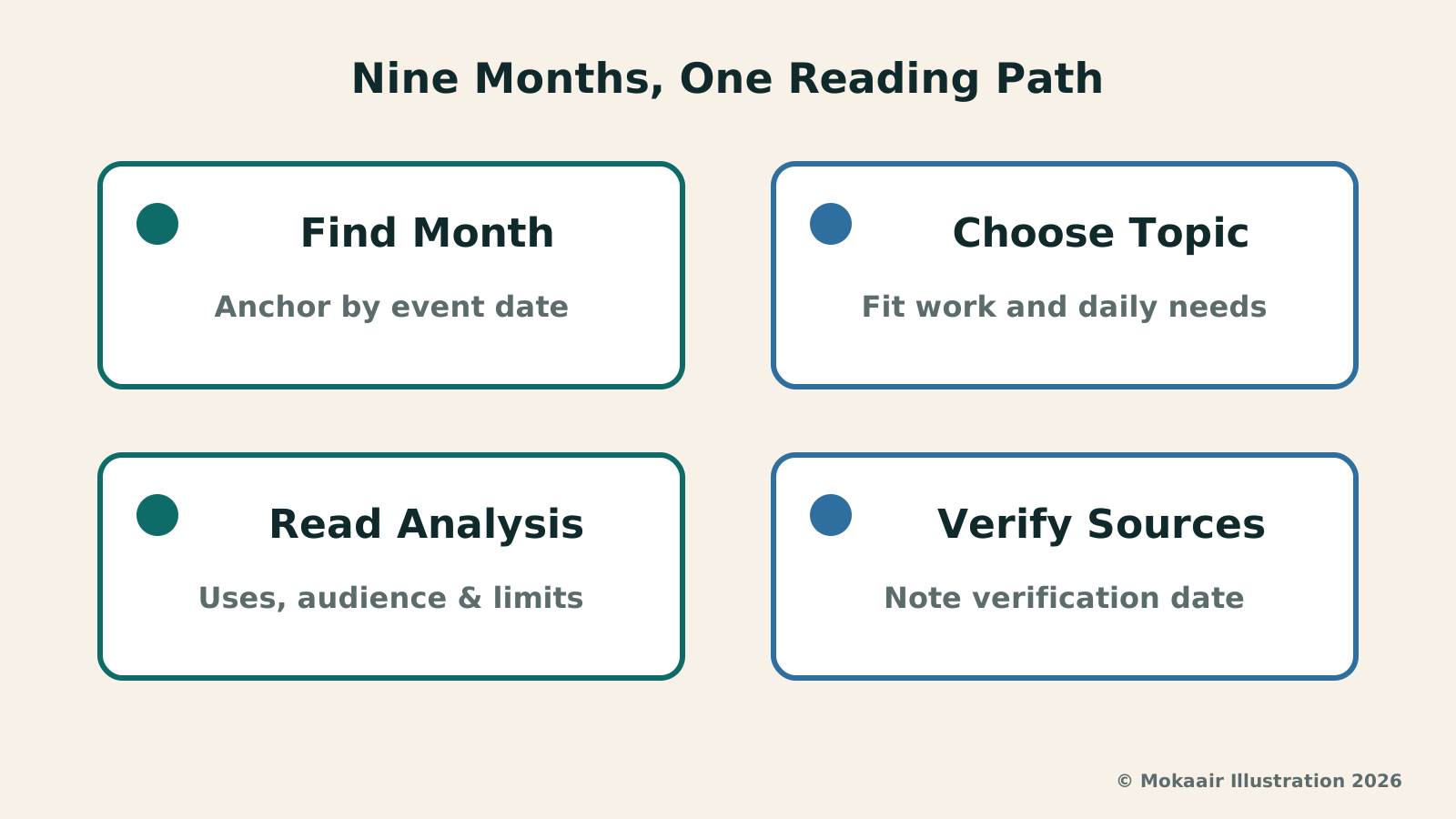
Read the full description
Find month: anchor by date; choose topic: fit needs; read analysis: uses & limits; check source: note date.
June to July: Access Status, Pricing, and Product Handoffs
In June, Claude Fable 5 went through rollout, suspension, and restoration of access, reminding us that "having been launched" does not mean access status remains static. That same month, the GPT-5.6 Sol preview and Claude Sonnet 5 also required reading alongside their target audiences, access portals, and dates. July brought ChatGPT Work, GPT-Live voice, Gemini 3.6 Flash, Claude Opus 5, as well as price adjustments for GPT-5.6 Luna and Terra. Earlier news retains its event dates, while subsequent shifts are explained directly in the main text.
Pricing articles differentiate between API usage billing and standard subscriptions. A US dollar rate per million tokens cannot be directly converted into a fixed monthly reduction in your bill; input length, output volume, retry counts, and manual verification hours will all alter total costs. If you only rewrite short messages occasionally, complex upfront estimates may not be necessary; if you need to process large batches of product or event data, you should compare the actual cost of acceptable outputs across a fixed sample set.
Cross-file work can be validated through output consistency. Suppose an event involves both a budget spreadsheet and a presentation; headcount, dates, and expenses must match across both documents. When assigning tasks, providing templates, sources, and unresolved questions first—and opening the generated files to inspect them afterward—is far more reliable than relying solely on completion notifications. The relevant articles discuss this mode of task delivery, rather than treating a model's name as proof that all tools are seamlessly connected.
August to September: Everyday Portals and Identifying Generated Content
August covered EU AI transparency regulations, ChatGPT free tier and reasoning updates, and Gemini Live's productivity features. September continued with Claude Fable 5.1 and Mythos 5.1, Gemini 3.8 Flash, GPT-6 Astra, Lyria 3.5, and ChatGPT Images 2.5, followed by Gemini replacing Google Assistant, Anthropic's threat report, the OpenAI Agents API, DeepSeek V4.1-Flash, the essay "We Must Pace the Frontier", and Siri AI. Late September brought Claude Opus 5.5, GPT-6 Sol and Luna, Claude Sonnet 5.5 and GPT-6.1 Sol one after another, ChatGPT ads beginning to roll out in Taiwan, and Google Vids opening free video generation with Gemini Omni 1.1. The articles previously published are fully retained, linked here within this index to the same comprehensive analyses, making it easy to track along specific models or use cases without duplicating identical content.
When evaluating regulatory news, look first at applicable jurisdictions, target entities, and mandatory requirements; when reviewing feature news, check your account tier, subscription plan, and interface access first. Disclosures and labels on generated content help clarify origin, but they cannot replace factual verification, nor do they guarantee that all asset rights have been settled. For everyday readers, the most practical reading approach is to pick a routine task first and observe differences against the verification checkpoints in each article, avoiding the need to relearn workflows with every release.
Read by Month, or Choose According to Your Needs
Below, the news reports are arranged chronologically by month, with each link leading to a full article. To explore work productivity, you can follow a path from February's Codex and March's GPT-5.4 to July's ChatGPT Work and September's Astra; to explore creative tools, you can trace March's music, April's imagery, May's video, and September's updates. These reading paths represent thematic connections and do not imply direct upgrade paths between products from different vendors.
This editorial feature was first compiled through 2026-09-14 and expanded several times since (most recently on 2026-10-04), selecting key events that hold explanatory value for general readers rather than serving as an exhaustive directory of every AI announcement. Full text is available in Traditional Chinese, Simplified Chinese, English, Japanese, and Korean, accessible via the on-page language switcher. Should products change further in the future, please consult both the verification date in the article and official sources, rather than treating this fixed-date index as a real-time status page.
January 2026 News Analyses
NVIDIA Rubin Unveiled at CES: How Will AI Compute Upgrades Affect Daily Services?NVIDIA Rubin Unveiled at CES: How Will AI Compute Upgrades Affect Daily Services?Analyzing the practical impact of the NVIDIA Rubin data center compute platform on daily cloud AI services, exploring the links between inference costs, queue latency, and actual enterprise billing.Read the full article
ChatGPT Health Launches Early This Year: Understanding Its Purpose and Boundaries Before Organizing Health DataChatGPT Health Launches Early This Year: Understanding Its Purpose and Boundaries Before Organizing Health DataChatGPT Health launched a dedicated space for organizing health data in January. This article explains regional restrictions from the initial launch and July update, using pre-consultation record preparation as an example to discuss sources, dates, family consent, and the boundaries of professional interpretation.Read the full article
Gemini Personal Intelligence: Where Does Convenience Come from After AI Connects Emails and Photos?Gemini Personal Intelligence: Where Does Convenience Come from After AI Connects Emails and Photos?Reviewing Google's 2026 beta launch of Gemini Personal Intelligence, analyzing personalization mechanisms across email and photo integration, potential misinterpretation risks, and key review principles.Read the full article
February 2026 News Analyses
Claude Opus 4.6 and Long Context: Reading Vast Data In, Retrieving It Accurately OutClaude Opus 4.6 and Long Context: Reading Vast Data In, Retrieving It Accurately OutAnalyzing application boundaries of long-context models for massive document sorting. Using a condo management committee's multi-year quotes as an example, we examine token metrics, grouped querying, and manual spot-check workflows.Read the full article
GPT-5.3-Codex Launched: How AI Coding Moves Toward Deliverable WorkGPT-5.3-Codex Launched: How AI Coding Moves Toward Deliverable WorkExploring how OpenAI's early 2026 release of GPT-5.3-Codex affects software delivery workflows for non-technical readers and small teams, offering clear requirement breakdown and acceptance methods.Read the full article
Qwen3.5 Open Weights: What Is the Difference Between a Downloadable Model and Running It on Your Own PC?Qwen3.5 Open Weights: What Is the Difference Between a Downloadable Model and Running It on Your Own PC?Reviewing the Qwen3.5-397B-A17B open-weight model released on 2026-02-16 to clarify differences between open weights, hardware demands, and cloud hosting, offering practical evaluation guidance for SMEs.Read the full article
Gemini 3.1 Pro Released: Turning Complex Questions into Verifiable AnswersGemini 3.1 Pro Released: Turning Complex Questions into Verifiable AnswersLooking back at Google's Gemini 3.1 Pro launch in 2026, exploring how to break down complex life decisions like course selection into verifiable reasoning steps and information verification workflows.Read the full article
March 2026 News Analyses
GPT-5.4 Combines Reasoning and Computer Use: What It Means for Everyday WorkersGPT-5.4 Combines Reasoning and Computer Use: What It Means for Everyday WorkersReviewing the technical integration of GPT-5.4 released in early 2026, analyzing how everyday workers handling spreadsheets and presentations can distinguish between reasoning judgment, tool operations, and human review boundaries.Read the full article
Claude Starts Drawing Interactive Visuals: Understand the Assumptions Before the ConceptClaude Starts Drawing Interactive Visuals: Understand the Assumptions Before the ConceptExploring Claude's interactive visual features launched in 2026, analyzing water tank inflow-outflow and dual-mode commute scenarios, and providing key chart verification methods across axes, boundary values, and accessibility semantics.Read the full article
OpenAI Announces It Will Acquire Astral: What’s Next for Open Source Tools uv, Ruff, and tyOpenAI Announces It Will Acquire Astral: What’s Next for Open Source Tools uv, Ruff, and tyOn March 19, 2026, OpenAI and developer-tools company Astral each published their own announcement on the same day: OpenAI said it will acquire Astral, and Astral said it will join OpenAI’s Codex team. Drawing on both official announcements, Astral’s official homepage, and uv’s page on PyPI, this article lays out the state of the open source tools uv, Ruff, and ty as of the day we checked, and how the official announcements describe the conditions for closing this deal.Read the full article
Lyria 3 Pro Extends AI Music Creation: From Short Clips to Structured CompositionsLyria 3 Pro Extends AI Music Creation: From Short Clips to Structured CompositionsAnalyzing structured long-audio composition with Lyria 3 Pro: using a community film festival soundtrack case study to explore workflows and review checkpoints across intros, verses, choruses, and voiceover clearance.Read the full article
OpenAI Raises $122 Billion: What the Announcement Promises, and What It Doesn'tOpenAI Raises $122 Billion: What the Announcement Promises, and What It Doesn'tOn March 31, 2026, OpenAI announced that it had closed a funding round of $122 billion in committed capital at a post-money valuation of $852 billion. Drawing on official announcements from OpenAI, SoftBank and Amazon, this article sets out who put up the money, how the committed capital is being paid in over time, and what the announcement does not promise — for example, whether ChatGPT will get faster or cheaper because of it. It offers no investment judgment. Checked on September 18, 2026.Read the full article
April 2026 News Analyses
Project Glasswing and Mythos Preview: After AI Finds Vulnerabilities, the Real Work BeginsProject Glasswing and Mythos Preview: After AI Finds Vulnerabilities, the Real Work BeginsReviewing Anthropic's 2026 launch of Project Glasswing and Claude Mythos Preview, exploring the standard maintenance workflow and website management essentials from identifying candidate vulnerabilities to deploying defensive patches.Read the full article
Meta Muse Spark Debuts: How In-App AI Assistants Reshape Search and InquiryMeta Muse Spark Debuts: How In-App AI Assistants Reshape Search and InquiryAnalyzing the practical boundaries of Muse Spark, Meta Superintelligence Labs' native multimodal reasoning model, in social contexts, focusing on outdoor gear organization, discerning information sources, and understanding privacy permissions.Read the full article
ChatGPT Images 2.0: Thinking Enters Image Generation, Demanding Clearer Design NeedsChatGPT Images 2.0: Thinking Enters Image Generation, Demanding Clearer Design NeedsReviewing the visual planning mechanisms established by the 2026 ChatGPT Images 2.0 release, exploring how brick-and-mortar bookstores can structure prompts, proofread Traditional Chinese details, and implement authenticity verification for promotional posters.Read the full article
GPT-5.5 Moves Toward Multi-Step Work: Turning Vague Needs into Verifiable DeliverablesGPT-5.5 Moves Toward Multi-Step Work: Turning Vague Needs into Verifiable DeliverablesReviewing the context of OpenAI's GPT-5.5 release in 2026, exploring how teams break down vague long-horizon tasks into verifiable deliverables while establishing clear human checkpoints and quality metrics.Read the full article
May 2026 News Analyses
GPT-5.5 Instant Becomes ChatGPT's Default Model: The Gains, Regressions, and New Features OpenAI AnnouncedGPT-5.5 Instant Becomes ChatGPT's Default Model: The Gains, Regressions, and New Features OpenAI AnnouncedOn May 5, 2026, OpenAI replaced GPT-5.3 Instant with GPT-5.5 Instant as ChatGPT's default model. Based on OpenAI's official announcement and system card, this article lays out the published factuality gains, the two safety regressions in gore and sexual content, who the new personalization features reach and when, the point on August 6 of the same year when OpenAI stated a new model would replace it, and why OpenAI says its figures do not represent everyday error rates.Read the full article
ChatGPT Ads Open Up to Self-Serve Buying: The Tools, Billing, and Targeting from OpenAI's May AnnouncementChatGPT Ads Open Up to Self-Serve Buying: The Tools, Billing, and Targeting from OpenAI's May AnnouncementOn May 5, 2026, OpenAI announced it was expanding how ChatGPT ads can be bought, adding a beta self-serve ad management tool, CPC bidding, and more measurement tools. Based on the announcement and OpenAI's developer documentation, this article covers the ad account, campaign, ad group, and ad structure, how the three campaign objectives are billed, bidding strategies, and region, platform, and context hints targeting, and notes how the documentation differs from the May 5 announcement.Read the full article
Gemini Omni Debuts at I/O: Conversational Video Edits Still Demand CareGemini Omni Debuts at I/O: Conversational Video Edits Still Demand CareReviewing Gemini Omni's conversational video editing unveiled at Google I/O. Using self-shot pottery clips as a case study, we examine shot continuity, multi-turn prompt drift, and asset licensing.Read the full article
Gemini Spark and Daily Brief: AI Moves from Morning Summaries to Background TasksGemini Spark and Daily Brief: AI Moves from Morning Summaries to Background TasksAnalyzing Google's 2026 technical context of Gemini Spark and Daily Brief, exploring the four-tier architecture, error magnification risks, and authorization check mechanisms of background cloud agents in daily scenarios such as volunteer scheduling.Read the full article
OpenAI's Frontier Governance Framework Goes Public: The 50-Person, $1 Billion Threshold, and Who Can Track ItOpenAI's Frontier Governance Framework Goes Public: The 50-Person, $1 Billion Threshold, and Who Can Track ItOn May 28, 2026, OpenAI published a 22-page Frontier Governance Framework addressing both California's Transparency in Frontier Artificial Intelligence Act and the EU's General-Purpose AI Code of Practice. Checked against the FGF, the Preparedness Framework, and California's current code, this article explains the 50-death, $1 billion risk threshold, what the three risk tiers say, who can track the document, and why it does not cover users in Taiwan.Read the full article
June 2026 News Analyses
OpenAI Confidentially Submits a Draft S-1: What the One-Line Announcement Doesn't SayOpenAI Confidentially Submits a Draft S-1: What the One-Line Announcement Doesn't SayOn June 8, 2026, OpenAI confirmed it had confidentially submitted a draft S-1 to the SEC, with no decision yet on timing. Based on OpenAI's announcement, the Securities Act of 1933's confidential-submission rules, and a May 2026 SEC proposed rule, this article explains what the announcement does and does not represent, and confirms by full-text search that, as of the check date, no public registration statement under OpenAI's filer name could be found.Read the full article
Claude Fable 5 Launch, Suspension, and Restoration: Availability CriteriaClaude Fable 5 Launch, Suspension, and Restoration: Availability CriteriaAnalyzing the suspension and restoration of Claude Fable 5, exploring how small research teams use neutral formats to preserve results and prepare alternatives amid availability shifts.Read the full article
OpenAI and Broadcom Unveil the Jalapeño Chip: The Official Stage, Division of Labor, and What's Not Yet AnnouncedOpenAI and Broadcom Unveil the Jalapeño Chip: The Official Stage, Division of Labor, and What's Not Yet AnnouncedOn June 24, 2026, OpenAI and Broadcom jointly unveiled the custom inference chip Jalapeño, calling it OpenAI's first Intelligence Processor. Based on both companies' official articles, this piece explains that the chip is still at the engineering-sample and lab-testing stage, with tape-out completed in nine months, that deployment timing and performance figures remain vendor statements, and why this should be treated separately from the 10-gigawatt deal announced in 2025.Read the full article
GPT-5.6 Sol Starts from Limited Preview: Why Announcement Differs from General AvailabilityGPT-5.6 Sol Starts from Limited Preview: Why Announcement Differs from General AvailabilityReviewing the June 26, 2026 milestone of the official GPT-5.6 Sol limited preview, examining the verification stages and enterprise adoption strategies between launch and general availability.Read the full article
Claude Sonnet 5: Balancing Capability and Cost in Daily WorkClaude Sonnet 5: Balancing Capability and Cost in Daily WorkUsing weekly customer service FAQ compilation as a scenario, this article explores Claude Sonnet 5's reasoning effort, retry rates, and trade-offs for qualified delivery costs.Read the full article
July 2026 News Analyses
GPT-Live Lets ChatGPT Voice Listen as It Talks: Interruptions, Plan Limits, RecordingsGPT-Live Lets ChatGPT Voice Listen as It Talks: Interruptions, Plan Limits, RecordingsOpenAI released GPT-Live in July 2026, letting ChatGPT Voice listen and speak at the same time and be interrupted, while search and reasoning are handed to a background model. Based on OpenAI's official documentation, this article covers how the flow of conversation changes, each plan's model and usage limits after the September adjustment, use cases such as cooking and speaking practice, and audio retention and training settings, with a brief note on API pricing.Read the full article
ChatGPT Work Officially Debuts: How to Clearly Delegate Cross-File TasksChatGPT Work Officially Debuts: How to Clearly Delegate Cross-File TasksAn analysis of cross-file delegation methods following the mid-2026 launch of ChatGPT Work. Using a reading community's events and budget organization as an example, this piece explores multi-tool consistency, tracking intervention points, and acceptance principles.Read the full article
Gemini 3.6 Flash and Flash-Lite: How to Divide Fast Model TasksGemini 3.6 Flash and Flash-Lite: How to Divide Fast Model TasksReviewing Google's July 2026 launch of Gemini 3.6 Flash and 3.5 Flash-Lite: analyzing fast vs. slow model task allocation, spot-checks, and cost control for bulk data.Read the full article
Claude Opus 5 Released: What Changes Matter Most for Everyday Work Users?Claude Opus 5 Released: What Changes Matter Most for Everyday Work Users?Anthropic released Claude Opus 5 on July 24, 2026, focusing on coding, knowledge work, and multi-step tasks. From the everyday office worker's perspective—document organization, proposal revisions, and task handoffs—this article covers the announced capability shifts, how to distinguish vendor benchmarks from real-world results, and how to set up data boundaries, acceptance criteria, and manual checkpoints before switching plans.Read the full article
GPT-5.6 Luna and Terra Price Cut: Which Usage Costs Are Affected?GPT-5.6 Luna and Terra Price Cut: Which Usage Costs Are Affected?OpenAI lowered usage prices for GPT-5.6 Luna and Terra on July 30, 2026, but monthly subscription fees and credit budgets were not reduced alongside them. This article separates API unit prices, ChatGPT Work and Codex credit consumption, and standard chat subscriptions into three distinct costs, using data processing and batch workflows to explain cost comparisons so you don't assume your bill will automatically decrease.Read the full article
August 2026 News Analyses
EU AI Transparency Rules Take Effect: How Are Chatbots and Generated Content Labeled?EU AI Transparency Rules Take Effect: How Are Chatbots and Generated Content Labeled?The European Commission announced that new transparency requirements under the AI Act apply as of August 2, 2026. This article explains chatbot identity disclosure, visible deepfake labeling, and machine-readable marks in plain language, clarifies the roles of providers versus deployers, and advises Taiwan creators on keeping production logs, verifying content, and checking platform rules without misconstruing EU laws as local obligations.Read the full article
ChatGPT Free Tier and Thinking Feature Updates: What Changes in Daily Use?ChatGPT Free Tier and Thinking Feature Updates: What Changes in Daily Use?On August 6, 2026, OpenAI announced updates to daily ChatGPT chats, expanding text chat and thinking features for free users while updating Sol for paid users. This guide explains quotas for text, files, and images, how to decide whether to spend extra thinking time based on complexity, and how to verify answers using itinerary, comparison, and writing scenarios—avoiding the misconception that better reasoning means always being correct.Read the full article
Gemini Live Productivity Update: Handling Emails and To-Dos with VoiceGemini Live Productivity Update: Handling Emails and To-Dos with VoiceOn August 26, 2026, Google announced productivity updates for Gemini Live, extending voice interactions to email, daily briefs, and multi-step tasks. This article outlines the differences between Spark, Daily Brief, and personal data connections, covers plan thresholds, and uses family notice and work note scenarios to show how to scope queries, confirm actions, and verify results, noting Taiwan availability requires separate confirmation.Read the full article
September 2026 News Analyses
Claude Fable 5.1 and Mythos 5.1: Capabilities, Access, and LimitsClaude Fable 5.1 and Mythos 5.1: Capabilities, Access, and LimitsAnthropic released Claude Fable 5.1 and Mythos 5.1 on September 1, 2026, sharing the same underlying model but with different safety measures and access methods. This guide outlines key differences for general users, explaining how to interpret long tasks, vendor evaluations, and data terms, while offering practical methods to choose tools, verify deliverables, and confirm permissions across document research and team workflows.Read the full article
Gemini 3.8 Flash Launched: What Model Upgrades Mean for Everyday ToolsGemini 3.8 Flash Launched: What Model Upgrades Mean for Everyday ToolsGoogle launched Gemini 3.8 Flash and restricted-access Flash Cyber on September 2, 2026, highlighting coding, agents, and multi-step reasoning. Exploring search, spreadsheets, and data organization, this article distinguishes model upgrades from product entry points, subscription access, developer promo pricing and deadlines, and why identical unit rates might still lead to differing total usage costs.Read the full article
GPT-6 Astra Announced: From Answering Questions to Completing Computer TasksGPT-6 Astra Announced: From Answering Questions to Completing Computer TasksOpenAI announced GPT-6 Astra on September 3, 2026, emphasizing computer use, multi-step workflows, and template-based document output. Focusing on general reporting, data organization, and admin tasks, this article explains the gap between model ability and tool permissions, how to draft verifiable tasks, set required confirmation checkpoints, and recognize phased rollouts without assuming launch demos are instantly available to every account.Read the full article
NVIDIA Announces Acquisition of Hugging Face: What the Announcement Doesn't SayNVIDIA Announces Acquisition of Hugging Face: What the Announcement Doesn't SayOn September 3, 2026, NVIDIA chief executive Jensen Huang announced in a company blog post that NVIDIA has agreed to acquire Hugging Face for $12,930,300,000. This article draws on the full announcement and Hugging Face's security-incident disclosures to lay out NVIDIA's promises, where the platform-scale figures come from, and what remains unstated: completion timeline, regulatory review and personnel included. We have not tested any product ourselves; this is not investment advice.Read the full article
Lyria 3.5 Joins Gemini: New Options for AI Music CreationLyria 3.5 Joins Gemini: New Options for AI Music CreationGoogle announced on September 4, 2026, that Lyria 3.5 is coming to the Gemini App and API, offering vocals, instrumentals, style templates, and flexible track lengths. Starting with birthday songs, travel video scores, and simple creative projects, this guide explains how to write usable prompts, compare versions, evaluate vocals and rhythm, and why generation capability doesn't automatically mean commercial or material clearance.Read the full article
Google Assistant Exits, Gemini Takes Over: Phone, Watch, and Car Checks Before and AfterGoogle Assistant Exits, Gemini Takes Over: Phone, Watch, and Car Checks Before and AfterGoogle announced in the Gemini help community that from September 4, 2026, most users can no longer use or switch back to Google Assistant on their phones or tablets, while paired watches, headphones, and Android Auto switch to Gemini as well. Based on official help pages, this article sorts out the affected devices and those not included, the features Gemini does not currently support, and the settings Taiwan users can check before and after the switch.Read the full article
ChatGPT Images 2.5: Image Generation, Inpainting, and Sketch UpdatesChatGPT Images 2.5: Image Generation, Inpainting, and Sketch UpdatesOpenAI released ChatGPT Images 2.5 on September 8, 2026, highlighting detailed images, targeted edits, Sketch, templates and image comments. This guide covers asset preparation, preserving unchanged areas and checking details in posters, travel photos and social images. It separates consumer tools from API models and vendor claims about speed and availability from hands-on tests.Read the full article
Anthropic's September Threat Report: Seven Kinds of AI Misuse and Targeted API KeysAnthropic's September Threat Report: Seven Kinds of AI Misuse and Targeted API KeysAnthropic published a threat intelligence report on September 10, 2026, covering seven categories of AI misuse it disrupted between December 2025 and August 2026. This article explains what the report says and what it does not, and how ordinary people can guard against AI-enabled scams, protect their accounts and API keys, limit AI agent permissions, and report suspicious use.Read the full article
OpenAI Agents API Public Beta: Know Billing and Data Location Before Commissioning AI WorkOpenAI Agents API Public Beta: Know Billing and Data Location Before Commissioning AI WorkOn September 10, 2026, OpenAI launched the Agents API in public beta, giving developers the agent harness that powers Codex. For people who use AI tools and may hire engineers or contractors for automation, this article covers how it differs from agents in ChatGPT and Codex, why costs are hard to estimate in advance, what US-only data residency and no Zero Data Retention support mean, and what to ask about permissions, logs, stopping, and budget before commissioning the work.Read the full article
DeepSeek-V4.1-Flash Launches, Mixed Word on V4-Pro: What to Watch When Models SwitchDeepSeek-V4.1-Flash Launches, Mixed Word on V4-Pro: What to Watch When Models SwitchDeepSeek launched V4.1-Flash on September 10, 2026, temporarily routing the old V4-Flash model names to it. The release announcement says V4-Pro would be rerouted from September 14; the change log and pricing page say it stays available after September 14. Using official pages, this article sets out the order of the two statements and the status when checked, and explains how people using DeepSeek indirectly through third-party tools can spot a model switch and read pricing and privacy terms.Read the full article
ChatGPT for Financial Services Launches: An AI Tool for Financial Institutions, Not Your Personal AccountChatGPT for Financial Services Launches: An AI Tool for Financial Institutions, Not Your Personal AccountOn September 10, 2026, OpenAI launched ChatGPT for Financial Services. OpenAI says it starts with investment banking and equity research: a customized ChatGPT Work edition with built-in financial data and GPT-6 Astra's reasoning, open to eligible institutions that contact sales. Checked September 18, 2026, this article covers what OpenAI's benchmark charts show and what price, region, and timeline details are missing; we have not used it, and nothing here is investment advice.Read the full article
GPT-Live 1 Comes to the API: Can It Take Customer Service Calls, Whose Voice Is It, Will It Record?GPT-Live 1 Comes to the API: Can It Take Customer Service Calls, Whose Voice Is It, Will It Record?On September 10, 2026, OpenAI’s API changelog noted that voice model GPT-Live 1 is now generally available in the API, so developers can wire it into phone support, apps, or their own products. Drawing on OpenAI’s developer documentation, this article covers the model’s API specs, how calls connect, the documentation’s note that outbound calls are not supported, its 12 named voices and unlisted spoken languages, and how recording and per-minute billing work; this site has not tested it.Read the full article
OpenAI Discloses Habitat Storage Architecture: The Scale and Limits Behind Over 1 Billion Weekly UsersOpenAI Discloses Habitat Storage Architecture: The Scale and Limits Behind Over 1 Billion Weekly UsersOn September 11, 2026, OpenAI published an engineering-blog post describing how its storage platform, Habitat, evolved from a Python client library into an independent service, and was rewritten in Rust in the second quarter of this year. This article sets out the request-volume, regional-coverage, and data-volume figures OpenAI states, plus the durability and regional details it omits; this site has not tested any of this and offers no advice on using or buying anything.Read the full article
Amodei Urges Pacing Frontier AI: What “We Must Pace the Frontier” Proposes and Its LimitsAmodei Urges Pacing Frontier AI: What “We Must Pace the Frontier” Proposes and Its LimitsAnthropic CEO Dario Amodei published “We Must Pace the Frontier” on September 12, 2026, arguing for slowing the advancement of AI capabilities so that risk prevention has time to keep up, with third-party evaluators confirming this. This article covers how “pacing” is defined and what it excludes, the three-step plan, how Altman, Hassabis, and Musk each responded, and what this advocacy piece actually means for everyday users.Read the full article
Siri AI Arrives with iOS 27 as an English Beta: What Can iPhone Users in Taiwan Use?Siri AI Arrives with iOS 27 as an English Beta: What Can iPhone Users in Taiwan Use?Apple released Siri AI in beta alongside iOS 27 on September 14, 2026, starting with English. Based on Apple's official information, this article covers which new features iPhone users in Taiwan can use with Traditional Chinese settings, the device, language, and region requirements for trying Siri AI, what the waitlist means, and what Apple says about how personal data is handled.Read the full article
Gemini 3.8 Live and Extended Thinking: New Voice Models, Can Your Account Use Them?Gemini 3.8 Live and Extended Thinking: New Voice Models, Can Your Account Use Them?On September 15, 2026, Google introduced two voice-dialogue models, Gemini 3.8 Live and Gemini 3.8 Live Extended Thinking. Drawing on Google's official model post, developer post, model card, and pricing page, this article lays out what developers, enterprises, everyday users, and Workspace subscribers can each access, how the pricing works, the knowledge cutoff date the model card states, and the availability regions the official pages do not specify.Read the full article
ChatGPT Ads Add Sponsored Agents: Testing in the US with Select Advertisers OnlyChatGPT Ads Add Sponsored Agents: Testing in the US with Select Advertisers OnlyOn September 16, 2026, OpenAI announced Sponsored Agents for ChatGPT ads: after opening an ad, a user can choose a separate conversation with the advertiser's own agent; the same day it also announced new Ads Manager AI tools. Checked September 18 against the announcement and OpenAI's ads pages: the feature is tested only in the US with select advertisers, the ad test shows only to logged-in adult users on Free and Go; on September 23 OpenAI announced ads beginning to roll out in Taiwan.Read the full article
Firefox Smart Window Adds a Mistral Model: Two Announcements, Two Different MarketsFirefox Smart Window Adds a Mistral Model: Two Announcements, Two Different MarketsOn September 16, 2026, Mistral and Mozilla each published their own announcement the same day: Firefox's AI browsing assistant Smart Window (beta) now also runs on a Mistral model. Drawing on both official posts, this article lays out where the two accounts diverge on markets, the model's name and data-handling promises, and what neither company states -- including Taiwan, other Asian markets, or a timeline for Traditional Chinese support. This article is not advice to use or adopt the feature.Read the full article
OpenAI Publishes a Misalignment Reporting Framework: All 6 Reports Come From TrainingOpenAI Publishes a Misalignment Reporting Framework: All 6 Reports Come From TrainingOpenAI's own page prints a publication date of September 16, 2026, U.S. time, which is already September 17 in Taipei time; the same day it also released 6 case reports. Checked against the framework announcement, the alignment.openai.com overview page, and two of the case reports, this article explains what stage and which models the 6 reports are marked with, what steps a disclosure goes through, and what each of the two published rates actually measures.Read the full article
Anthropic Publishes Three Frontier AI Metrics: 26% Is “Leads,” Not “Fully Autonomous”Anthropic Publishes Three Frontier AI Metrics: 26% Is “Leads,” Not “Fully Autonomous”On September 17, 2026, Anthropic published three metrics meant to let outsiders track R&D progress inside a frontier AI lab: how automated its research is, how AI agents are overseen, and how compute is allocated to safety. Fact-checked on September 18, 2026, this article explains why 26% “leads” is not full automation, why the 0.002% block rate carries its own caveat, and why these are still self-measured numbers with limited scope, as external evaluators are still being set up.Read the full article
Astra for Law Launches: OpenAI's Legal Tool Adds an Index, Not a New ModelAstra for Law Launches: OpenAI's Legal Tool Adds an Index, Not a New ModelOn September 17, 2026, OpenAI launched Astra for Law. OpenAI's own framing is that it configures GPT‑6 Astra into an AI foundation for law, adding a U.S. legal index, Trusted Access, and data terms, and it will be initially offered to selected law firms. Checked September 18, 2026, this article covers what OpenAI's benchmarks mean and what region and pricing details are still missing; we have not used it, and nothing here is legal advice.Read the full article
Google's CC Becomes a Family Agent: Its Own Account, and How Up to 6 People Share ItGoogle's CC Becomes a Family Agent: Its Own Account, and How Up to 6 People Share ItGoogle's official blog posted this on September 17, 2026 — already September 18 in Taipei time — saying CC, the AI agent from Google Labs, is expanding from a personal assistant into a version up to 6 people in one household can share, with its own Google account. Based on the blog post and the Gemini product page, this article covers how CC handles sharing and memory, the conditions Google lists — U.S., age 18+ — and what remains unexplained.Read the full article
Claude Opus 5.5 Launches: List Price Cut 20%, Paid Plans’ Five-Hour Limit Raised, 40% Is Anthropic’s Cost EstimateClaude Opus 5.5 Launches: List Price Cut 20%, Paid Plans’ Five-Hour Limit Raised, 40% Is Anthropic’s Cost EstimateOn September 22, 2026, Anthropic introduced Claude Opus 5.5, the first model in the new Claude 5.5 family; the announcement lists no region restrictions. This article separates three easily confused numbers — the 40% cost estimate and the 20% and 60% official price cuts — and lays out which paid plans get the five-hour limit increase and how model switching works (checked September 2026).Read the full article
GPT-6 Sol and Luna Launch: API Price Cuts, Available in Codex, Not Yet in ChatGPT-6 Sol and Luna Launch: API Price Cuts, Available in Codex, Not Yet in ChatOpenAI launched GPT-6 Sol and Luna in the early hours of September 23, 2026 Taipei time: Plus, Pro, Business, Enterprise, and Edu can use them in ChatGPT Work and Codex, and Free and Go can use Luna in the desktop app; Chat doesn't have them yet. API pricing is 50% cheaper than GPT-5.6 promotional pricing (verified September 2026).Read the full article
ChatGPT Ads Begin Rolling Out in Taiwan: Which Plans Will See Them, How to Control Them, and How Businesses Can BuyChatGPT Ads Begin Rolling Out in Taiwan: Which Plans Will See Them, How to Control Them, and How Businesses Can BuyOpenAI announced on September 23, 2026 that ChatGPT Ads have begun rolling out in Taiwan: users on the Free and Go plans may gradually start seeing ads, while ad-free plans such as Plus and Pro are unaffected. Businesses in Taiwan can also place ads on ChatGPT through the Ads Solutions team, agency partners, technology partners, or self-service Ads Manager if eligible (verified September 2026).Read the full article
Google Vids Opens Free Gemini Omni 1.1 Video Generation: Who Can Use It, How to Read the Quota, and What to Know FirstGoogle Vids Opens Free Gemini Omni 1.1 Video Generation: Who Can Use It, How to Read the Quota, and What to Know FirstIn the early hours of September 24, 2026, Taipei time (September 23, 2026, US time), Google let any Google account generate video for free in desktop Google Vids; its two official help pages disagree on the monthly quota, and neither the announcement nor the help pages say whether there is an age limit or whether Chinese-language prompts work (verified September 2026).Read the full article
Claude Sonnet 5.5 Launches: Same List Price as Sonnet 5, Available in the API, on Cloud Platforms and in Claude.aiClaude Sonnet 5.5 Launches: Same List Price as Sonnet 5, Available in the API, on Cloud Platforms and in Claude.aiAnthropic launched Claude Sonnet 5.5 on September 28, 2026. API list prices are the same as Sonnet 5 ($2 per million input tokens, $10 per million output tokens). It is available in Claude.ai, the API and several cloud platforms, and higher-risk cybersecurity requests fall back to Sonnet 5 (checked September 2026).Read the full article
GPT-6.1 Sol Launches: New Sol Version in the API, Codex and ChatGPT Work, Not in ChatGPT-6.1 Sol Launches: New Sol Version in the API, Codex and ChatGPT Work, Not in ChatOpenAI launched GPT-6.1 Sol on September 29, 2026, with the API name gpt-6.1-sol. The launch rollout covers Codex and ChatGPT Work on Plus, Pro, Business, Enterprise and Edu (Enterprise and Edu need an administrator to enable it); Free and Go are not included at launch, and it is not in Chat (checked September 2026).Read the full article
October 2026 News Analyses
Claude Code Adds mods: TypeScript Functions in Plugins Change Its Behavior and InterfaceClaude Code Adds mods: TypeScript Functions in Plugins Change Its Behavior and InterfaceOn October 1, 2026, Anthropic introduced Claude Code mods: TypeScript or JavaScript functions that ship inside a plugin and run in the Claude Code process, and can rewrite prompts, manage tool calls and draw new interface. Anthropic says they work in the CLI and the desktop app and are not sandboxed; the documentation says v2.1.287 or later is required (checked October 2026).Read the full article
Lifestyle
NVIDIA launches DGX Spark 64GB: on sale October 23 from $4,999, two units can be linked into 128GB
On October 2, 2026, NVIDIA announced a more affordable 64GB memory version of its DGX Spark personal AI computer, available from October 23 through six makers including Acer and ASUS. It is aimed mainly at developers and researchers who want to run AI models on their own machines. Below we summarize the specs NVIDIA published, its claims about linking two units, and what it means for general readers.
Lifestyle
Google Cloud Launches Spanner Queues: Putting Message Queues Inside Database Transactions to Make AI Agents More Reliable
Google Cloud has announced the general availability of Spanner queues, which make message creation part of a database transaction. The aim is to stop AI agents' "state" and "actions" from falling out of sync. This article covers Google Cloud's claims, the main features, and what it means for general readers.
Lifestyle
GPT-6.1 Sol Launches: New Sol Version in the API, Codex and ChatGPT Work, Not in Chat
OpenAI launched GPT-6.1 Sol on September 29, 2026, with the API name gpt-6.1-sol. The launch rollout covers Codex and ChatGPT Work on Plus, Pro, Business, Enterprise and Edu (Enterprise and Edu need an administrator to enable it); Free and Go are not included at launch, and it is not in Chat (checked September 2026).
Lifestyle
Claude Sonnet 5.5 Launches: Same List Price as Sonnet 5, Available in the API, on Cloud Platforms and in Claude.ai
Anthropic launched Claude Sonnet 5.5 on September 28, 2026. API list prices are the same as Sonnet 5 ($2 per million input tokens, $10 per million output tokens). It is available in Claude.ai, the API and several cloud platforms, and higher-risk cybersecurity requests fall back to Sonnet 5 (checked September 2026).
Articles that cite this one
- GPT-6.1 Sol Launches: New Sol Version in the API, Codex and ChatGPT Work, Not in Chat
- Claude Sonnet 5.5 Launches: Same List Price as Sonnet 5, Available in the API, on Cloud Platforms and in Claude.ai
- Claude Code Adds mods: TypeScript Functions in Plugins Change Its Behavior and Interface
- GPT-6 Sol and Luna Launch: API Price Cuts, Available in Codex, Not Yet in Chat
- Google Vids Opens Free Gemini Omni 1.1 Video Generation: Who Can Use It, How to Read the Quota, and What to Know First
- Claude Opus 5.5 Launches: List Price Cut 20%, Paid Plans’ Five-Hour Limit Raised, 40% Is Anthropic’s Cost Estimate
- ChatGPT Ads Begin Rolling Out in Taiwan: Which Plans Will See Them, How to Control Them, and How Businesses Can Buy
- OpenAI Publishes a Misalignment Reporting Framework: All 6 Reports Come From Training
Latest travel guides

GuideTokyo
Where to Stay in Tokyo: Comparing Shinjuku, Ueno, Tokyo Station, Shibuya, Asakusa, Ikebukuro, and Ginza, Plus Airport Access, Accommodation Tax, and Luggage Delivery
Where should you stay in Tokyo? Compare Shinjuku, Ueno, Tokyo Station, Shibuya, Asakusa, Ikebukuro, and Ginza by the same criteria: access from Narita and Haneda, transit routes, nearby attractions, neighborhood character, and who each area suits. Includes a comparison table, a Yamanote Line diagram, Tokyo’s accommodation tax as verified in 2026/9 (changing to 3% in 2027/4), and Airport TA-Q-BIN luggage shipping rules.
- Budget
- Hotels

GuideTokyo
How to Choose Tokyo Transit Passes: Are Suica, Welcome Suica, the Tokyo Subway Ticket, and the JR Pass Worth It?
On a first Tokyo trip, start with an IC card and pay per ride (Welcome Suica has no deposit and is valid for 28 days). If you take four or more subway rides in a day, add a 72-hour Tokyo Subway Ticket for 2,000 yen; a JR Pass is never worthwhile if you stay in Tokyo and do not go to Kansai. See what TOURIST PASMO, Suica on iPhone, and the Tokyo Metro day pass do and do not cover, with a decision chart. Prices verified in September 2026.
- Transport
- Budget

GuideTokyo
Tokyo Disneyland and DisneySea Guide: Ticket Prices, Fantasy Springs, Disney Premier Access (DPA), Standby Pass, and Which Park to Choose for Your First Visit
Tokyo Disney one-day Passport prices vary: most weekdays in 9/2026 cost ¥9,900 and weekends ¥10,900. At 14:00 daily, tickets go on sale for the same date two months later. Free Priority Pass is no longer on the official service list; only paid Disney Premier Access (¥1,000–3,500 per person per use) shortens waits. Covers hours, the 25th anniversary, Standby Pass, Entry Request, Fantasy Springs access and first-visit park choice; checked on the official site in 9/2026.
- Itineraries
- Family
Sources
- NVIDIA: Rubin Platform Announcement · Checked:
- Anthropic: Claude Opus 4.6 · Checked:
- OpenAI: GPT-5.4 Announcement · Checked:
- Anthropic: Project Glasswing · Checked:
- Google: Gemini Omni · Checked:
- Anthropic: Claude Fable 5 and Mythos 5 · Checked:
- OpenAI: ChatGPT Work Announcement · Checked:
- Anthropic: Detecting and countering misuse of AI: September 2026 · Checked:
- Apple Newsroom: Siri AI, a profoundly more capable and personal assistant, is here · Checked:
- OpenAI raises $122 billion to accelerate the next phase of AI · Checked:
- OpenAI announcement: GPT-5.5 Instant: smarter, clearer, and more personalized · Checked:
- NVIDIA to Acquire Hugging Face · Checked:
- Google: Introducing Gemini 3.8 Live and 3.8 Live Extended Thinking · Checked:
- OpenAI official announcement: Reimagining advertising with AI · Checked:
- Mistral x Mozilla: Private, Multilingual AI Browsing · Checked:
- OpenAI's official announcement in full: Our framework for reporting model misalignment · Checked:
- Anthropic: Measurements for Understanding the Pace of AI Development Inside Frontier Labs · Checked:
- Introducing Astra for Law · Checked:
- Google Keyword Official Blog: The new CC, an AI agent built for families · Checked: