Lifestyle
ChatGPT Ads Add Sponsored Agents: Testing in the US with Select Advertisers Only
On September 16, 2026, OpenAI announced Sponsored Agents for ChatGPT ads: after opening an ad, a user can choose a separate conversation with the advertiser's own agent; the same day it also announced new Ads Manager AI tools. Checked September 18 against the announcement and OpenAI's ads pages: the feature is tested only in the US with select advertisers, the ad test shows only to logged-in adult users on Free and Go; on September 23 OpenAI announced ads beginning to roll out in Taiwan.
Updated: About 13 min read
On September 16, 2026, OpenAI's official announcement 'Reimagining advertising with AI' rolled out four ChatGPT ads updates at once: the in-testing 'Sponsored Agents', the ability to create an ad by simply writing a few prompts in ChatGPT Work, new AI creative assistance and text customization in Ads Manager, and integrations with HubSpot and Shopify. This article focuses on the one that turns an ad inside ChatGPT into something you can open and talk to.
This article was fact-checked on September 18, 2026, drawing on the announcement itself, OpenAI's page describing the current state of the ads test, and the advertiser introduction page; all three URLs were re-read on the day of the check. This site has never logged into the ChatGPT ads dashboard, never opened a Sponsored Agent conversation, and never created or bought an ad, so it offers no purchasing or ad-placement advice. Everything here about how the feature works and who it is open to is OpenAI's own description.
Ads You Can Open and Talk To: What Was Announced on September 16
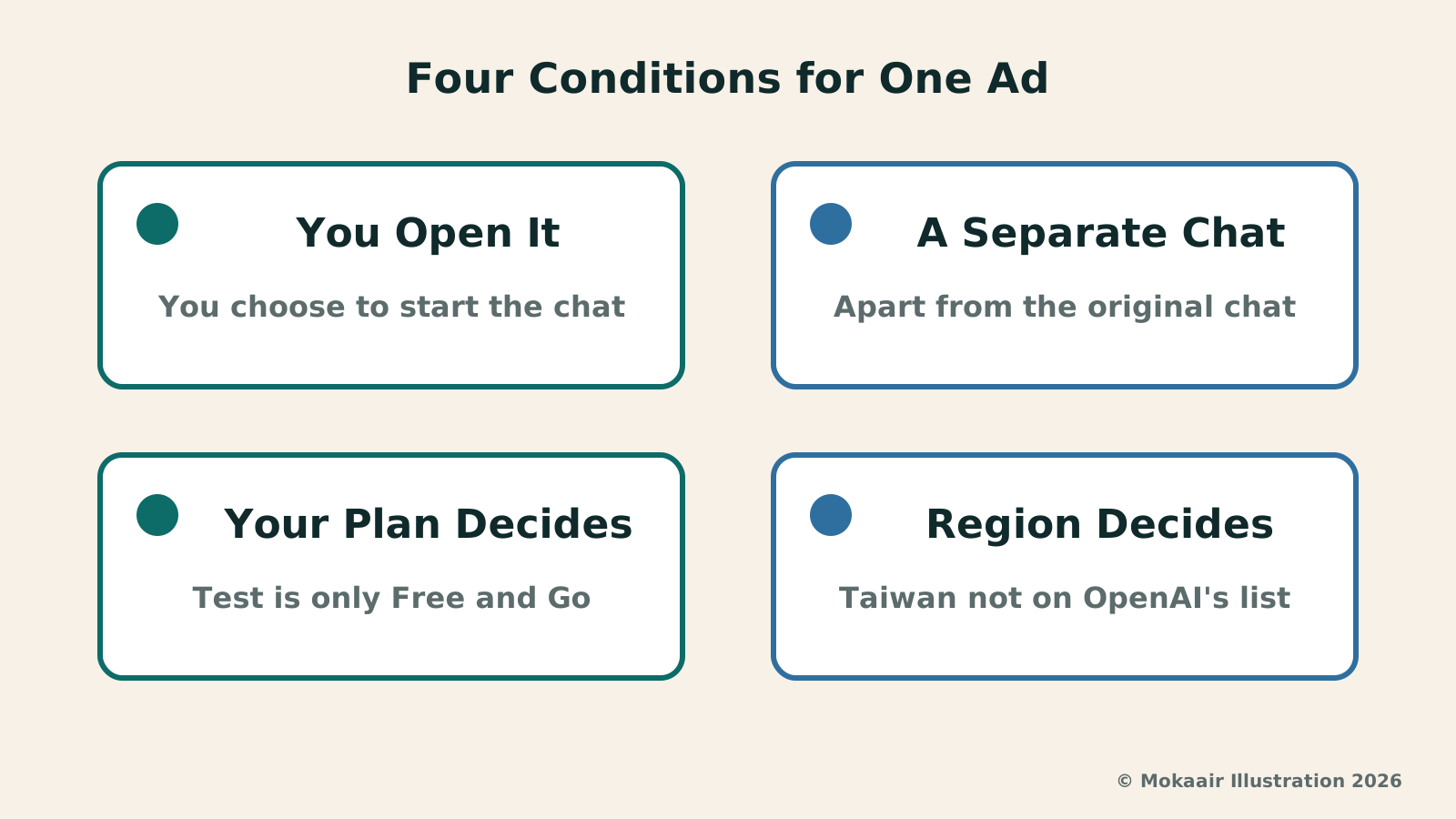
OpenAI describes Sponsored Agents in one sentence: after clicking an ad in ChatGPT, a user can start a conversation with an agent sponsored by a business. The verb OpenAI uses for this is 'testing'; the last sentence of that same section narrows the scope further, stating that this test is currently running only with select advertisers in the United States — 'testing', 'select advertisers', and 'the United States' are three conditions in that sentence, and the description is incomplete without any one of them.
OpenAI draws two boundaries around this conversation: it is kept separate from ChatGPT's usual answers, and separate from the conversation the user was already having. OpenAI writes that after seeing a relevant ad, the user can choose for themselves whether to start this clearly labeled conversation, with a link to the business's own website when needed.
The other three announcements are tools for the advertiser's side: the announcement's opening line says creating an ad takes just a few prompts in ChatGPT Work, while the paragraph on creating, updating, and analyzing campaigns states that this happens in ChatGPT through the Ads Manager plugin. Ads Manager also gained an AI tool that suggests copy and images based on the landing page and campaign objective. Ads also now connect to HubSpot and Shopify, which OpenAI calls its first CRM partner and first ecommerce partner. These are tools for how advertisers set things up, not the focus of this article — that topic, including the four-layer account structure, bidding methods, and region targeting, is covered in another article on this site.
The Boundaries OpenAI Draws, and This Round of Changes at a Glance
The advertiser introduction page spells the boundaries out more fully in three lines: ads are clearly identified, ads stay separate from ChatGPT's responses, and people control how their data is used for ads. These three lines are principles for the ChatGPT ads system as a whole, not commitments specific to Sponsored Agents.
The announcement also states that this update does not change its existing ads principles, and that protecting people's trust in ChatGPT remains its top priority. This is OpenAI's own statement, and this site cannot verify it independently.
For HubSpot, the announcement says a connection is available 'starting today', but that line does not say which regions it covers. Shopify comes in two steps: US-based merchants could use the ChatGPT Ads app in the Shopify app store starting the day of the announcement, and it is only 'starting September 23' that the app becomes available internationally — that sentence itself prints no year, and this article reads it as September 23, 2026 based on the announcement's own September 16, 2026 dateline; that is this article's own editorial reading, not something OpenAI wrote. And what opens up is 'markets where ChatGPT Ads are available', not every place ChatGPT is used.
Looked at together, the items announced this time differ in who they are open to, which region, and their current status; the table below summarizes the state as read on the day of the check.
| Item | Who it's for | Region | Status |
|---|---|---|---|
| Sponsored Agents | Select advertisers (test) | United States | Testing |
| Ads Manager prompts | Advertisers | Not stated | OpenAI says rolling out |
| AI creative suggestions | Advertiser reviews and edits | Not stated | OpenAI says rolling out |
| AI text customization | Advertiser opts in | Not stated | OpenAI says rolling out |
| HubSpot integration | Businesses using HubSpot | Not stated | Starting the day of the announcement |
| Shopify integration | US merchants | US; markets with ChatGPT Ads, starting Sept 23, 2026 | Starting the day of the announcement |
Who Sees Ads: Your Plan Sets the Threshold, Your Region Sets Whether You See Any
OpenAI's page on the current state of the ads test states this plainly, and that text is part of the page's original post from February 9, 2026, describing the scope of this test: only logged-in adult users on the Free or Go plan see ads; the five plans Plus, Pro, Business, Enterprise, and Education have no ads at all. The same page also gives two ways to avoid seeing ads: upgrading to Plus or Pro, or staying on the Free plan and trading fewer daily free messages for ads turned off. The page does not otherwise explain what kind of plan Go is, beyond grouping it with Free on the side that sees ads.
The same page stacks several updates, with the newest at the top, dated August 11, 2026: ChatGPT ads have now launched in the United Kingdom, Mexico, Brazil, Japan, and South Korea. Before that, an update from May 7 says that in the coming weeks OpenAI 'plans' to expand the ads pilot to those same five markets. Earlier still, the March 26 update says that in the coming weeks it would begin with pilots in Canada, Australia, and New Zealand; the earliest version, from February 9, 2026, is where the US test began. Stacked together, these dates show the covered regions being added one at a time, not opened all at once from the start.
None of the three pages checked for this article mentions Taiwan anywhere, and none carries an exclusion list either. Based on what was there as of the September 18, 2026 check, Taiwan is not among the markets OpenAI lists as open — but that is not the same as OpenAI saying it won't open there; the page itself says it is continuing to expand to more markets. Update, October 3: on September 23 OpenAI announced that ads were beginning to roll out gradually in Taiwan (see this reportChatGPT Ads Begin Rolling Out in Taiwan: Which Plans Will See Them, How to Control Them, and How Businesses Can BuyOpenAI announced on September 23, 2026 that ChatGPT Ads have begun rolling out in Taiwan: users on the Free and Go plans may gradually start seeing ads, while ad-free plans such as Plus and Pro are unaffected. Businesses in Taiwan can also place ads on ChatGPT through the Ads Solutions team, agency partners, technology partners, or self-service Ads Manager if eligible (verified September 2026).Read the full article); that announcement does not mention Sponsored Agents.
Ads That Rewrite Themselves: Customization and Automatic Translation
The announcement adds a feature advertisers can choose to turn on for themselves: AI text customization. OpenAI writes that once enabled, the system adjusts the advertiser's existing headline and description text to fit the conversation, and automatically translates the ad copy into the user's preferred language. In other words, the ad text a user sees may be a version the system has rewritten and translated; the announcement does not say whether advertisers can see or review these rewrites and translations beforehand.
OpenAI attaches one condition: the original text uses the phrase 'opt into', meaning advertisers must turn it on themselves. How translation quality is checked, which languages are supported, and whether users can see the original wording are not addressed in the announcement or the other two pages, and this article does not answer on OpenAI's behalf.
Another AI feature in Ads Manager is creative suggestions: the system suggests copy and images based on the landing page URL and campaign objective the advertiser enters. OpenAI states that what advertisers see are 'suggestions', which they can review and edit before deciding whether to add them to a campaign — OpenAI describes this step as remaining under the advertiser's control, not the system deciding automatically on the advertiser's behalf.
What OpenAI Doesn't Say, and Three Things Readers Can Check for Themselves
Reading the three pages together, there are things OpenAI does not say: the announcement does not state when this test ends, how many advertisers are involved, or how an advertiser would join this particular test; none of the three pages says whether Sponsored Agent conversations are used to train models or how long they are retained. On what advertisers can see, the status page has one passage written about ChatGPT ads generally: advertisers do not get a user's conversations, chat history, memories, or personal details, only aggregate performance numbers such as views and clicks — and that passage does not specifically mention Sponsored Agent conversations. Pricing does not appear anywhere either; this announcement lists no change to any fee or billing method.
In its March update, OpenAI made one claim about results in its own words: it says it is seeing no impact on user-trust metrics, a low ad-dismissal rate, and ongoing improvement in relevance; the page attaches no methodology, sample size, or time period, so this is OpenAI's own observation, not an externally verified result. The advertiser page separately names four brands — Newegg, Best Buy, Lowe's, and VistaPrint — saying advertisers are already seeing the benefits of AI-native advertising, but it publishes no figures for any of the four; the four names are listed participants, not evidence you can point to.
There are three things readers can check for themselves: if a Sponsored Agent conversation appears, look at how the clear labeling OpenAI describes is actually worded; check whether your own subscription plan is Free or Go; and remember that this site has never seen what Sponsored Agents looks like once opened — every sentence in this article comes from OpenAI's own pages, not hands-on experience.
Frequently asked questions
Can every ChatGPT user run into Sponsored Agents right now?
Not yet. OpenAI's own text reads 'now being tested with select advertisers in the United States', and that one sentence carries three conditions: still in testing, limited to select advertisers, and confined to the United States. The announcement does not say when the test will end, or whether it will later expand to other countries or advertisers.
Can people in Taiwan see these ads?
None of the three official pages checked for this article mentions Taiwan, and none lists Taiwan among the markets already opened. As read on September 18, 2026, this page's newest update (August 11, 2026) says ads have 'now launched' in the United Kingdom, Mexico, Brazil, Japan, and South Korea, and the test itself first began in the US on February 9. Canada, Australia, and New Zealand appear only in the March 26 update, described as pilots planned for 'the coming weeks'; no later update confirms an outcome for them, so they cannot be counted as part of the same list as the already-launched markets. OpenAI also states it will continue expanding to more markets, so 'not on the list' can only be written as not yet included — not as OpenAI saying it won't open there. Update, October 3, 2026: on September 23, 2026, OpenAI announced that ChatGPT ads were beginning to roll out in Taiwan, where Free and Go users may gradually see ads; that announcement does not mention Sponsored Agents.
Which subscription plans see ads?
For this test, OpenAI's status page states that only logged-in adult users on the Free or Go plan see ads; the five plans Plus, Pro, Business, Enterprise, and Education have no ads. The same page also gives two ways to avoid seeing ads: upgrading to Plus or Pro, or staying on the Free plan and trading fewer daily free messages for ads turned off. None of the three pages otherwise explains what kind of plan Go is.
Is the text in an ad always written by the advertiser themselves?
Not necessarily. OpenAI is also rolling out 'AI text customization', a feature advertisers can choose to turn on; once enabled, the system adjusts the advertiser's original headline and description to fit the conversation and automatically translates them into the user's preferred language. In other words, the ad text a user sees may be a version the system has rewritten and translated. OpenAI does not explain how this translation is quality-checked, which languages it supports, or whether users can see the original wording; nor does the announcement say how the agent's own replies are generated once you're inside a Sponsored Agent conversation.
Do ads affect the answers ChatGPT gives me?
OpenAI's status page states directly that ads do not affect the answers ChatGPT gives you. The advertiser page separately lists three principles: ads are clearly identified, ads stay separate from ChatGPT's responses, and people control how their data is used for ads; the announcement also states that a Sponsored Agent conversation is separate both from ChatGPT's own answers and from the conversation the user had already been having. These are all OpenAI's own statements; this site has not actually used this feature and cannot verify them independently.
Is Sponsored Agents the same technology as the earlier OpenAI Agents API?
The announcement does not say so. OpenAI does not explain what technology Sponsored Agents is built on, and none of the three pages checked for this article mentions the Agents API. Whether the two are related is a question OpenAI has not answered, and this article does not draw that connection on OpenAI's behalf.
2026 AI News Roundup: Highlights and Daily Life Applications from January to September2026 AI News Roundup: Highlights and Daily Life Applications from January to SeptemberOrganizing key AI news stories month by month from January to September 2026, linking to full analyses in five languages. Covering models, work tools, creation, costs, and transparency, explaining backgrounds, uses, and limits.Read the full article
ChatGPT Ads Open Up to Self-Serve Buying: The Tools, Billing, and Targeting from OpenAI's May AnnouncementChatGPT Ads Open Up to Self-Serve Buying: The Tools, Billing, and Targeting from OpenAI's May AnnouncementOn May 5, 2026, OpenAI announced it was expanding how ChatGPT ads can be bought, adding a beta self-serve ad management tool, CPC bidding, and more measurement tools. Based on the announcement and OpenAI's developer documentation, this article covers the ad account, campaign, ad group, and ad structure, how the three campaign objectives are billed, bidding strategies, and region, platform, and context hints targeting, and notes how the documentation differs from the May 5 announcement.Read the full article
Lifestyle
ChatGPT Ads Open Up to Self-Serve Buying: The Tools, Billing, and Targeting from OpenAI's May Announcement
On May 5, 2026, OpenAI announced it was expanding how ChatGPT ads can be bought, adding a beta self-serve ad management tool, CPC bidding, and more measurement tools. Based on the announcement and OpenAI's developer documentation, this article covers the ad account, campaign, ad group, and ad structure, how the three campaign objectives are billed, bidding strategies, and region, platform, and context hints targeting, and notes how the documentation differs from the May 5 announcement.
Lifestyle
Google's CC Becomes a Family Agent: Its Own Account, and How Up to 6 People Share It
Google's official blog posted this on September 17, 2026 — already September 18 in Taipei time — saying CC, the AI agent from Google Labs, is expanding from a personal assistant into a version up to 6 people in one household can share, with its own Google account. Based on the blog post and the Gemini product page, this article covers how CC handles sharing and memory, the conditions Google lists — U.S., age 18+ — and what remains unexplained.
Lifestyle
Firefox Smart Window Adds a Mistral Model: Two Announcements, Two Different Markets
On September 16, 2026, Mistral and Mozilla each published their own announcement the same day: Firefox's AI browsing assistant Smart Window (beta) now also runs on a Mistral model. Drawing on both official posts, this article lays out where the two accounts diverge on markets, the model's name and data-handling promises, and what neither company states -- including Taiwan, other Asian markets, or a timeline for Traditional Chinese support. This article is not advice to use or adopt the feature.
Lifestyle
NVIDIA launches DGX Spark 64GB: on sale October 23 from $4,999, two units can be linked into 128GB
On October 2, 2026, NVIDIA announced a more affordable 64GB memory version of its DGX Spark personal AI computer, available from October 23 through six makers including Acer and ASUS. It is aimed mainly at developers and researchers who want to run AI models on their own machines. Below we summarize the specs NVIDIA published, its claims about linking two units, and what it means for general readers.
Articles that cite this one
Latest travel guides

GuideTokyo
Where to Stay in Tokyo: Comparing Shinjuku, Ueno, Tokyo Station, Shibuya, Asakusa, Ikebukuro, and Ginza, Plus Airport Access, Accommodation Tax, and Luggage Delivery
Where should you stay in Tokyo? Compare Shinjuku, Ueno, Tokyo Station, Shibuya, Asakusa, Ikebukuro, and Ginza by the same criteria: access from Narita and Haneda, transit routes, nearby attractions, neighborhood character, and who each area suits. Includes a comparison table, a Yamanote Line diagram, Tokyo’s accommodation tax as verified in 2026/9 (changing to 3% in 2027/4), and Airport TA-Q-BIN luggage shipping rules.
- Budget
- Hotels
GuideTokyo
How to Choose Tokyo Transit Passes: Are Suica, Welcome Suica, the Tokyo Subway Ticket, and the JR Pass Worth It?
On a first Tokyo trip, start with an IC card and pay per ride (Welcome Suica has no deposit and is valid for 28 days). If you take four or more subway rides in a day, add a 72-hour Tokyo Subway Ticket for 2,000 yen; a JR Pass is never worthwhile if you stay in Tokyo and do not go to Kansai. See what TOURIST PASMO, Suica on iPhone, and the Tokyo Metro day pass do and do not cover, with a decision chart. Prices verified in September 2026.
- Transport
- Budget

GuideTokyo
Tokyo Disneyland and DisneySea Guide: Ticket Prices, Fantasy Springs, Disney Premier Access (DPA), Standby Pass, and Which Park to Choose for Your First Visit
Tokyo Disney one-day Passport prices vary: most weekdays in 9/2026 cost ¥9,900 and weekends ¥10,900. At 14:00 daily, tickets go on sale for the same date two months later. Free Priority Pass is no longer on the official service list; only paid Disney Premier Access (¥1,000–3,500 per person per use) shortens waits. Covers hours, the 25th anniversary, Standby Pass, Entry Request, Fantasy Springs access and first-visit park choice; checked on the official site in 9/2026.
- Itineraries
- Family