Lifestyle
Claude Opus 5.5 Launches: List Price Cut 20%, Paid Plans’ Five-Hour Limit Raised, 40% Is Anthropic’s Cost Estimate
On September 22, 2026, Anthropic introduced Claude Opus 5.5, the first model in the new Claude 5.5 family; the announcement lists no region restrictions. This article separates three easily confused numbers — the 40% cost estimate and the 20% and 60% official price cuts — and lays out which paid plans get the five-hour limit increase and how model switching works (checked September 2026).
About 12 min read
On September 22, 2026, Anthropic introduced Claude Opus 5.5, the first model in the new “Claude 5.5” family; the announcement page does not mention any region or country restriction. At the same time, Anthropic raised the five-hour usage limits on the Pro, Max, Team, and seat-based Enterprise plans and added one extra rate limit reset; as of the check date, though, claude.com’s pricing page plan comparison table lists the “Opus” series as “No” in the Free column.
This article’s information was checked on September 26, 2026, drawing on Anthropic’s announcement page, the Claude Help Center article on model switching, the claude.com pricing page, and the Opus 5.5 System Card; we have not tested this model ourselves, and this article offers no subscription or upgrade advice.
What happened on September 22: the new family launched on every platform first
Anthropic says Claude Opus 5.5 performs at the level of Claude Fable 5.1 on most work, with an estimated 40% lower cost to run than Opus 5 (conditions in the next section), and it is now available on all platforms, including Amazon Web Services, Google Cloud, and Microsoft Azure — this passage does not mention subscription plans or countries; on the Claude Platform, developers can get started with the model ID claude-opus-5-5.
On both the API and claude.ai, Opus 5.5 is only available with thinking enabled — it cannot be switched off; and claude.ai, the consumer product, is only available to users aged 18 or above.
Anthropic says this is its first release since it called for “pacing the frontier”; the announcement states that Claude Sonnet 5.5 and Claude Haiku 5.5 “will follow in the coming weeks,” with no date given, and as of the check date they have not yet launched.
Three numbers: what 40%, 20%, and 60% each actually measure
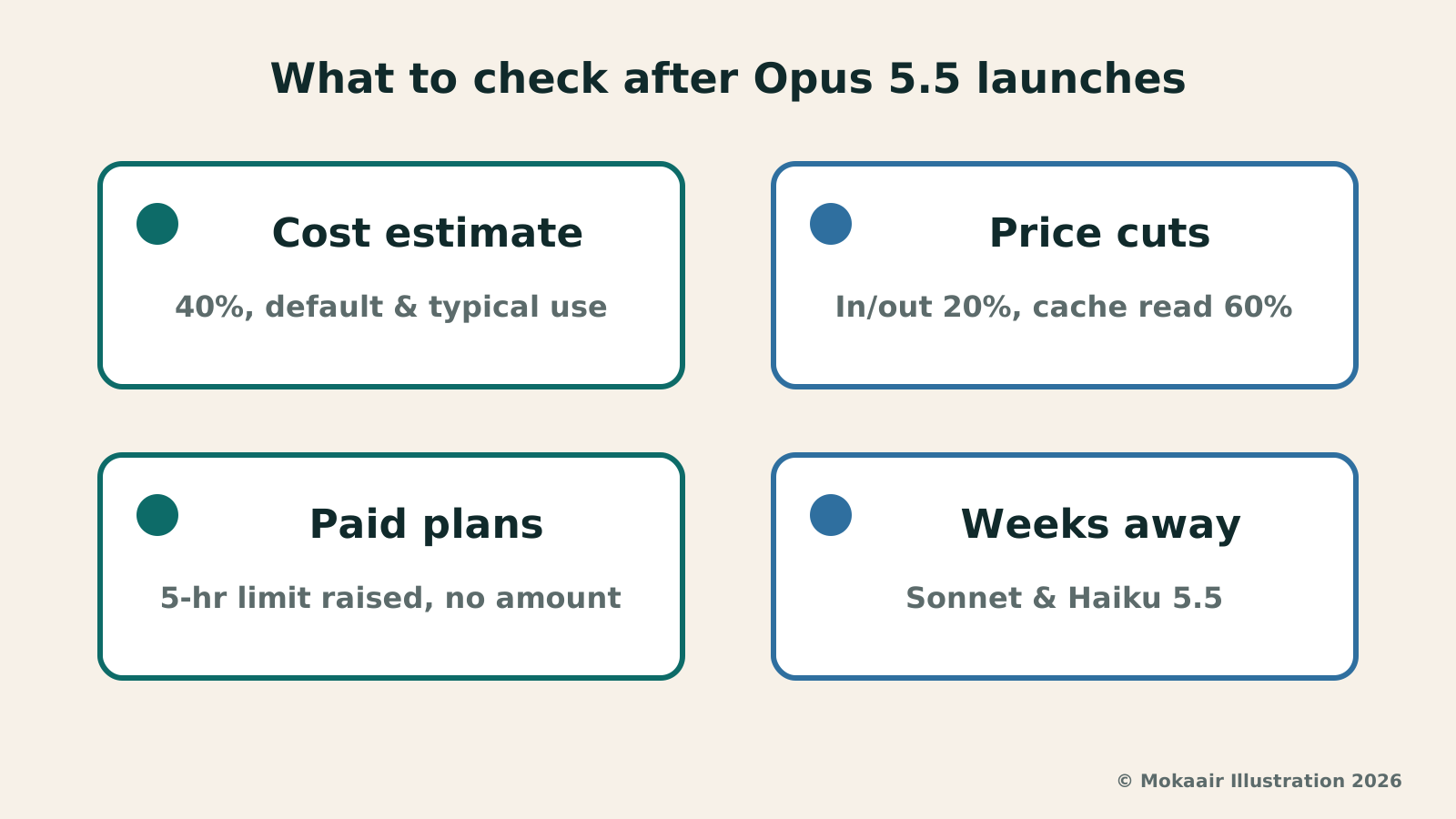
The 40% figure is Anthropic’s own cost estimate, measured “at default settings” on “typical workloads” — it is not a list-price cut; Anthropic explains it comes from Opus 5.5 costing less per token than Opus 5 and using fewer tokens per task, which nets out to a 40% drop in costs.
The 20% and 60% figures are the official list-price cuts: input and output tokens are $4 and $20 per million, 20% less than Opus 5; cache reads are $0.20 per million tokens, 60% less than Opus 5, and Anthropic notes that cache reads make up the majority of agentic and coding work costs.
Anthropic says Opus 5.5 generates output more than 30% faster than Opus 5; Fast mode is also available in Claude Code and the Claude Platform, with up to 2.5x speed, priced at $8 per million input tokens and $40 per million output tokens.
| Number | What it represents | Conditions |
|---|---|---|
| 40% | Anthropic’s estimated cost reduction | Default settings, typical workloads |
| 20% | Official price cut on input/output tokens | $4/$20, versus Opus 5’s $5/$25 |
| 60% | Official price cut on cache reads | $0.20, versus Opus 5’s $0.50 |
| 2.5x | Fast mode’s top speed-up | Available in Claude Code and the Claude Platform, $8/$40 |
What subscribers should know: the plan comparison table and usage limits
As of the check date, claude.com’s pricing page plan comparison table lists the “Opus” series as “No” in the Free column, and “Yes” across Pro, Max 5x, and Max 20x; Team and both Enterprise plans are also marked “Yes.” The table names the series, not the version number, and the page may change.
The basic rule for usage limits is that every plan has a session limit that resets on a rolling five-hour window, and paid plans add a weekly limit on top; activity on web, desktop, mobile, and Claude Code all draws from the same pool. This time, Anthropic raised the five-hour limit for the Pro, Max, Team, and seat-based Enterprise plans; the announcement doesn’t say by how much or whether it is permanent, and Free is not on the list.
Anthropic is also giving subscription users one rate limit reset, which they can save and use whenever they choose; current usage can be checked anytime under Settings > Usage. Individual plan pricing is $17 per month with the annual subscription discount ($200 billed up front) or $20 per month billed monthly for Pro, and Max starts from $100 per month; these prices don’t include tax and are subject to change.
Why a conversation might suddenly switch to a different model
The Claude Help Center notes that the checks review everything the model reads, not just the user’s latest message — including memory, content from connectors, web search results, and files. Requests flagged as potentially higher-risk offensive cybersecurity work (such as generating exploits or running penetration tests) may fall back from Opus 5 or Opus 5.5 to Opus 4.8, but secure coding work such as scanning source code for vulnerabilities or triaging security issues remains available on Opus 5.5.
Dual-use biology requests in areas like virology, toxicology, and molecular design fall back from Opus 5.5 to Opus 5; everyday health and educational questions (such as interpreting lab results, understanding symptoms, or learning about biology) remain available on Opus 5.5. The frontier LLM development classifiers apply only to Opus 5.5, routing a small number of capabilities related to developing frontier large language models to Opus 5, while general AI/ML development and coding are mostly unaffected. Distillation requests — attempts to extract a model’s internal reasoning — are blocked outright and don’t fall back to another model; asking Claude to explain its reasoning is generally unaffected.
All fallbacks are transparent: you’ll see a notice that the model switched, and the response is labeled with the model that answered. After a switch, the model picker stays on the less capable model for the rest of the conversation — you can switch back yourself from the picker, but if your original request is still part of the conversation, the same safeguards may trigger another fallback. To turn off automatic model switching, go to Settings > Capabilities (Config > MODEL & OUTPUT in Claude Code) and toggle off “Switch models when a message is flagged”; with it off, a flagged request pauses the conversation instead of switching models. The API works differently — automatic switching isn’t active by default, and API customers must opt into and configure the fallbacks themselves.
Vetted organizations can apply starting from the announcement day to the Life Sciences Verification Program to use Opus 5.5 for biology research; the Cyber Verification Program will expand “in the coming weeks,” and as of the check date Opus 5.5 is not yet part of it — most cybersecurity tasks are currently re-routed to Opus 4.8. On billing, requests in the biology, distillation, or frontier LLM development categories are billed when safeguards stop them or hand them to another model before any output; requests blocked before output in other categories are not charged.
How to read the benchmark numbers: who ran them, and what was switched on
Anthropic itself writes in the announcement that, at this level of capability, benchmark margins have become a less reliable guide to real-world differences; in its own use, the gap between Opus 5.5 and Fable 5.1 is narrower than the scores suggest. In the benchmark table, the Terminal-Bench 4.0 figures for GPT-6 Astra and GPT-5.6 Sol are as reported by OpenAI, not run by Anthropic; the AutomationBench score for Opus 5.5 comes from Zapier’s own evaluation during early access.
Opus 5.5 was evaluated with its production safeguards enabled; when they intervened, cybersecurity tasks were completed by Opus 4.8, and biology and frontier LLM development tasks were completed by Opus 5 (except on AutomationBench, which ran without a fallback model, so a safeguard intervention counted as a failure) — Anthropic says this may have lowered Opus 5.5’s benchmark scores. Anthropic also acknowledges seeing signs that Opus 5.5 often suspects it is being evaluated, which makes it harder to judge how the model will behave in real-world settings.
Anthropic says that on prompt injection attacks, Opus 5.5 matches or beats Opus 5 in every setting it tested, including coding, tool use, computer use, and web browsing. The System Card lists one regression, though: the model is more likely than previous models to follow malicious instructions embedded in text that a user pastes into their own prompt. Anthropic says the final snapshot of Opus 5.5, together with some product changes, has mitigated this issue, and it is adding features that remove invisible characters and mark pasted text. Pasting text written by someone else effectively lets that person control part of the prompt.
Frequently asked questions
Can Free-plan users use Claude Opus 5.5 right now?
The claude.com pricing page’s plan comparison table, checked as of September 26, 2026, lists the “Opus” series as “No” in the Free column, and “Yes” across Pro, Max 5x, and Max 20x; the table names the series, not the version number, and it may change later. The announcement itself does not say which subscription plans can select Opus 5.5 from the model picker.
Are the 40%, 20%, and 60% figures the same thing?
No. The 40% figure is Anthropic’s own cost estimate, measured at default settings on typical workloads, coming from cheaper per-token pricing plus fewer tokens used per task; 20% is the official list-price cut on input and output tokens; 60% is the official list-price cut on cache reads. The three figures have different definitions and conditions and shouldn’t be conflated.
Have Claude Sonnet 5.5 or Haiku 5.5 launched too?
Not as of the September 26, 2026 check. The announcement says Claude Sonnet 5.5 and Claude Haiku 5.5 “will follow in the coming weeks,” with no exact date given.
Can cybersecurity practitioners use Opus 5.5 for security work right now?
Most cybersecurity tasks are currently re-routed to Opus 4.8. As of September 26, 2026, the Claude Help Center says Opus 5.5 isn’t currently available in the Cyber Verification Program, and the announcement says the program will expand “in the coming weeks”; secure coding work such as scanning source code for vulnerabilities or triaging security issues can still use Opus 5.5.
Why did my conversation suddenly get answered by a different model?
Claude’s classifiers check everything the model reads, including memory, content from connectors, web search results, and files, not just the latest message. Different request types fall back to different models: potentially higher-risk offensive cybersecurity requests may fall back to Opus 4.8, dual-use biology requests fall back to Opus 5, and a small number of frontier LLM development capabilities also fall back to Opus 5; distillation requests — attempts to extract the model’s internal reasoning — are blocked outright and don’t fall back to another model. You’ll see a notice on screen, and the response is labeled with which model answered.
Can I turn off automatic model switching?
Yes — go to Settings > Capabilities (Config > MODEL & OUTPUT in Claude Code) and toggle off “Switch models when a message is flagged”; once it’s off, a request flagged by the classifiers pauses the conversation instead of getting answered by a different model. On the Claude API, automatic switching isn’t active by default, and customers must opt into and configure the fallbacks themselves.
Can Opus 5.5’s benchmark scores be compared directly with other companies’ models?
Treat them with caution. Some of the scores for OpenAI’s models on the benchmark table (such as Terminal-Bench 4.0) are self-reported by OpenAI, not run by Anthropic; the AutomationBench score for Opus 5.5 was run by Zapier itself during early access. Anthropic itself writes in the announcement that, at this level of capability, benchmark score gaps have become a less reliable guide to real-world differences.
2026 AI News Roundup: Highlights and Daily Life Applications from January to September2026 AI News Roundup: Highlights and Daily Life Applications from January to SeptemberOrganizing key AI news stories month by month from January to September 2026, linking to full analyses in five languages. Covering models, work tools, creation, costs, and transparency, explaining backgrounds, uses, and limits.Read the full article
Claude Opus 5 Released: What Changes Matter Most for Everyday Work Users?Claude Opus 5 Released: What Changes Matter Most for Everyday Work Users?Anthropic released Claude Opus 5 on July 24, 2026, focusing on coding, knowledge work, and multi-step tasks. From the everyday office worker's perspective—document organization, proposal revisions, and task handoffs—this article covers the announced capability shifts, how to distinguish vendor benchmarks from real-world results, and how to set up data boundaries, acceptance criteria, and manual checkpoints before switching plans.Read the full article
Lifestyle
GPT-6 Sol and Luna Launch: API Price Cuts, Available in Codex, Not Yet in Chat
OpenAI launched GPT-6 Sol and Luna in the early hours of September 23, 2026 Taipei time: Plus, Pro, Business, Enterprise, and Edu can use them in ChatGPT Work and Codex, and Free and Go can use Luna in the desktop app; Chat doesn't have them yet. API pricing is 50% cheaper than GPT-5.6 promotional pricing (verified September 2026).
Lifestyle
ChatGPT Ads Begin Rolling Out in Taiwan: Which Plans Will See Them, How to Control Them, and How Businesses Can Buy
OpenAI announced on September 23, 2026 that ChatGPT Ads have begun rolling out in Taiwan: users on the Free and Go plans may gradually start seeing ads, while ad-free plans such as Plus and Pro are unaffected. Businesses in Taiwan can also place ads on ChatGPT through the Ads Solutions team, agency partners, technology partners, or self-service Ads Manager if eligible (verified September 2026).
Lifestyle
Google Vids Opens Free Gemini Omni 1.1 Video Generation: Who Can Use It, How to Read the Quota, and What to Know First
In the early hours of September 24, 2026, Taipei time (September 23, 2026, US time), Google let any Google account generate video for free in desktop Google Vids; its two official help pages disagree on the monthly quota, and neither the announcement nor the help pages say whether there is an age limit or whether Chinese-language prompts work (verified September 2026).
Lifestyle
NVIDIA launches DGX Spark 64GB: on sale October 23 from $4,999, two units can be linked into 128GB
On October 2, 2026, NVIDIA announced a more affordable 64GB memory version of its DGX Spark personal AI computer, available from October 23 through six makers including Acer and ASUS. It is aimed mainly at developers and researchers who want to run AI models on their own machines. Below we summarize the specs NVIDIA published, its claims about linking two units, and what it means for general readers.
Articles that cite this one
Latest travel guides

GuideTokyo
Where to Stay in Tokyo: Comparing Shinjuku, Ueno, Tokyo Station, Shibuya, Asakusa, Ikebukuro, and Ginza, Plus Airport Access, Accommodation Tax, and Luggage Delivery
Where should you stay in Tokyo? Compare Shinjuku, Ueno, Tokyo Station, Shibuya, Asakusa, Ikebukuro, and Ginza by the same criteria: access from Narita and Haneda, transit routes, nearby attractions, neighborhood character, and who each area suits. Includes a comparison table, a Yamanote Line diagram, Tokyo’s accommodation tax as verified in 2026/9 (changing to 3% in 2027/4), and Airport TA-Q-BIN luggage shipping rules.
- Budget
- Hotels

GuideTokyo
How to Choose Tokyo Transit Passes: Are Suica, Welcome Suica, the Tokyo Subway Ticket, and the JR Pass Worth It?
On a first Tokyo trip, start with an IC card and pay per ride (Welcome Suica has no deposit and is valid for 28 days). If you take four or more subway rides in a day, add a 72-hour Tokyo Subway Ticket for 2,000 yen; a JR Pass is never worthwhile if you stay in Tokyo and do not go to Kansai. See what TOURIST PASMO, Suica on iPhone, and the Tokyo Metro day pass do and do not cover, with a decision chart. Prices verified in September 2026.
- Transport
- Budget

GuideTokyo
Tokyo Disneyland and DisneySea Guide: Ticket Prices, Fantasy Springs, Disney Premier Access (DPA), Standby Pass, and Which Park to Choose for Your First Visit
Tokyo Disney one-day Passport prices vary: most weekdays in 9/2026 cost ¥9,900 and weekends ¥10,900. At 14:00 daily, tickets go on sale for the same date two months later. Free Priority Pass is no longer on the official service list; only paid Disney Premier Access (¥1,000–3,500 per person per use) shortens waits. Covers hours, the 25th anniversary, Standby Pass, Entry Request, Fantasy Springs access and first-visit park choice; checked on the official site in 9/2026.
- Itineraries
- Family