Lifestyle
GPT-6 Sol and Luna Launch: API Price Cuts, Available in Codex, Not Yet in Chat
OpenAI launched GPT-6 Sol and Luna in the early hours of September 23, 2026 Taipei time: Plus, Pro, Business, Enterprise, and Edu can use them in ChatGPT Work and Codex, and Free and Go can use Luna in the desktop app; Chat doesn't have them yet. API pricing is 50% cheaper than GPT-5.6 promotional pricing (verified September 2026).
About 10 min read
OpenAI launched two new models, GPT-6 Sol and GPT-6 Luna, in the early hours of September 23 Taipei time (September 22 in the US). OpenAI says it trained them with similar methods as GPT-6 Astra, bringing some of Astra's advances to faster, more affordable models; GPT-6 Astra remains OpenAI's best model overall, and Sol and Luna extend the lineup downward rather than replacing Astra.
The information here was checked on September 26, 2026; pricing and availability follow what OpenAI's own pages said that day. All benchmark figures were published by OpenAI itself — this site has not tested any of them, and this is not purchasing or investment advice.
Who can use GPT-6 Sol and Luna right now?
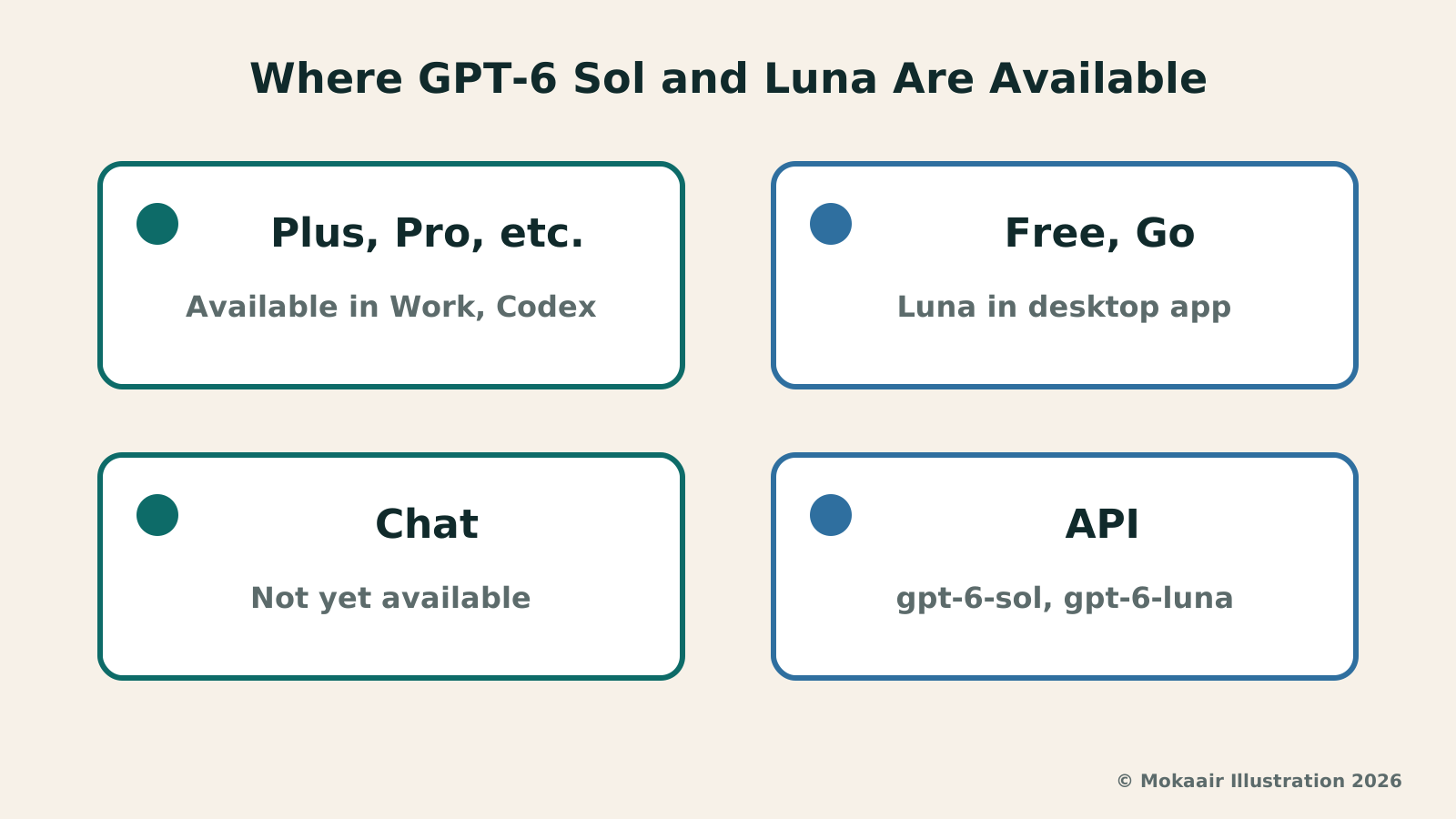
Starting the day of the announcement, Plus, Pro, Business, Enterprise, and Edu plans can use GPT-6 Sol and GPT-6 Luna in ChatGPT Work and Codex.
OpenAI's own wording is: "Free and Go users can access GPT-6 Luna in the desktop app." The original text does not specify an operating system, does not say whether it's in Work or Codex, and does not say whether the web or mobile versions can use it; both the announcement and the changelog mention only Luna, not Sol.
OpenAI also writes: "These models are not yet available in Chat." In other words, neither new model is available in Chat yet; OpenAI plans to roll it out in ChatGPT gradually that day, so try again later if you don't see it. Availability also depends on workspace settings, and Enterprise plans need an administrator to enable it first.
On regions and countries, OpenAI hasn't said: none of the four official sources discussing Sol and Luna's availability mention Taiwan, and none list any country or region restrictions either. Whether a Taiwan account can see them can only be confirmed by checking the model menu in the ChatGPT app or Codex directly.
What is the "50% cheaper" compared with: how to read the API pricing
OpenAI's announcement states it is "reducing API prices for Sol and Luna by 50% compared with their GPT-5.6 promotional pricing" — meaning the baseline for this price cut is each of Sol's and Luna's own GPT-5.6 promotional pricing, not the original list price.
The announcement's pricing table marks the price-reduction column "50% cheaper" for both the Sol and Luna rows (see the table below for the exact figures); for Luna's output price, the table prints a drop from $1.20 to $0.50.
The announcement states cached input-token reads get a 90% discount; the pricing page separately lists a cache-write price that is higher than the regular input price — for example, Sol's cache-write price is $2.50 per million tokens, above its regular input price of $2.00, and long context carries higher prices still.
The pricing page states that GPT-5.6 Sol's promotional pricing is available at least through November 21, 2026 — meaning the promotional price Sol is compared against is still in effect today, not an old price; pricing for two generations, GPT-5.6 Sol and GPT-6 Sol, now coexists. The pricing page does not state how long GPT-5.6 Luna's promotional pricing lasts.
| Item | GPT-6 Sol | GPT-6 Luna |
|---|---|---|
| Input | $2.00 | $0.10 |
| Cached input | $0.20 | $0.01 |
| Cache writes | $2.50 | $0.125 |
| Output | $10.00 | $0.50 |
| GPT-5.6 promotional price (input/output) | $4/$20 | $0.20/$1.20 |
OpenAI's own benchmark numbers, compared against Claude
OpenAI says that on its own chosen AutomationBench (a test of business workflows across apps), GPT-6 Sol (xhigh) scores 33.2%, beating Claude Opus 5 (max) at 26.9%, at 11.1 times Sol's cost per task. GPT-6 Luna (high) improves on its own predecessor by 5.4 percentage points, at 58% lower cost per task. The rival models' scores were taken from publicly available reports, and OpenAI itself notes that the table's figure for Claude Fable 5.1 understates its cost, since it omits the cost of Opus 5 fallbacks, which occurred on about 40% of tasks.
OpenAI says that on Agents' Last Exam, Sol (max) scores 56.4%, above Claude Opus 5's highest score on this evaluation, at 60% lower cost; on DeepSWE v1.1, Sol (max) scores 68.8%, within 1.1 percentage points of Fable 5's highest score of 69.9% (xhigh), at roughly 80% lower cost.
OpenAI states these evaluations ran in its own research environment or via its API, and may differ slightly from production ChatGPT; when Claude Fable 5.1 has no score, it reports Fable 5's score instead. For computer use, OpenAI still calls Astra its best model, saying Sol and Luna offer better cost efficiency than their predecessors, not a replacement for Astra.
Caveats on factual accuracy and the safety evaluation
OpenAI's internal factuality evaluation uses real conversations where users had flagged mistakes by its models; on this evaluation, GPT-6 Sol makes about half as many errors as its predecessor, approaching Astra-level reliability at a much lower cost. OpenAI itself states that these error-inducing conversations are not representative of typical usage, where factual errors are rarer.
OpenAI says GPT-6 Luna also improves substantially on factuality: at higher reasoning effort, Luna matches GPT-5.6 Sol at roughly a hundredth of the cost.
Safety information for Sol and Luna is written in an appendix (Section 11) of the GPT-6 Astra System Card, added on September 22, 2026 — not a separate, standalone system card. Under its Preparedness Framework, OpenAI treats both models as High capability in the Cybersecurity and Biological and Chemical domains — its own internal rating, not an outside assessment; neither model reaches the High threshold for AI Self-Improvement, the same as GPT-5.6 Sol/Luna, and OpenAI carries over the same set of safeguards.
The system card appendix also notes that both models hold steady or improve on length-adjusted scores for HealthBench Professional and Consensus, but regress on HealthBench and HealthBench Hard, with noticeably shorter answers: on HealthBench, mean answer length drops by about 45% for Sol and 35% for Luna, with similar reductions on HealthBench Hard.
Want to know if you can use it? Here's how to check yourself
The most direct way to check is to open the ChatGPT app or Codex and see whether GPT-6 Sol and GPT-6 Luna appear in the model menu; OpenAI plans to roll it out on the ChatGPT side gradually that day, so try again later if you don't see it yet.
Developers can call gpt-6-sol and gpt-6-luna directly through the API; in Codex CLI, switch with /model, or start a task with codex --model gpt-6-sol or codex --model gpt-6-luna. For actual billing, use the API pricing page as it reads on the day you make the call.
If your account is on an Enterprise plan, ask your administrator to enable the new models first. None of the four official sources state that GPT-5.6 Sol and Luna are being taken down.
OpenAI's announcement does not mention a rollout timeline for Taiwan or other regions, and does not say whether ChatGPT subscription prices are changing either — API price cuts and subscription fees are two different things; to find out when your own plan gets access, check the actual screen in your own account.
Frequently asked questions
Can the free tier use GPT-6 Sol or Luna?
Free and Go users can use GPT-6 Luna in the desktop app; both the announcement and the changelog mention only Luna, not Sol, and neither says whether it's Windows or macOS, whether it's Work or Codex within the app, or whether the web or mobile versions can use it.
Can I see these two new models in regular chat (Chat)?
Not yet. Both OpenAI's announcement and the changelog in the ChatGPT/Codex documentation state that these two models are not yet available in Chat, and neither gives a timeline for when they will be.
What is the "50% cheaper" compared with?
It's compared with GPT-6 Sol's and GPT-6 Luna's own GPT-5.6 promotional pricing, not the original list price; OpenAI's pricing page states that GPT-5.6 Sol's promotional pricing is available at least through November 21, 2026, meaning pricing for two generations, GPT-5.6 Sol and GPT-6 Sol, now coexists.
Is GPT-6 Sol really stronger than Claude?
Every comparison with Claude in the announcement is an evaluation OpenAI itself chose, with the rival models' scores taken from publicly available reports; when Claude Fable 5.1 lacks a score, Claude Fable 5's score is substituted, and OpenAI itself states that the table's figure for Fable 5.1 understates its cost. These are numbers the vendor published unilaterally, not independent tests this site has run.
Can it be used in Taiwan right now?
OpenAI hasn't said. The announcement, the changelog, and the pricing page don't mention Taiwan or any other country's regional restrictions; the most accurate way to check whether your own account can use it is to open your own ChatGPT app or Codex and look at the model menu for these two new models.
Can GPT-5.6 Sol and Luna still be used?
OpenAI's API pricing page states that GPT-5.6 Sol's promotional pricing is available at least through November 21, 2026, and none of the four official sources say GPT-5.6 Sol and Luna are being taken down or discontinued.
2026 AI News Roundup: Highlights and Daily Life Applications from January to September2026 AI News Roundup: Highlights and Daily Life Applications from January to SeptemberOrganizing key AI news stories month by month from January to September 2026, linking to full analyses in five languages. Covering models, work tools, creation, costs, and transparency, explaining backgrounds, uses, and limits.Read the full article
GPT-6 Astra Announced: From Answering Questions to Completing Computer TasksGPT-6 Astra Announced: From Answering Questions to Completing Computer TasksOpenAI announced GPT-6 Astra on September 3, 2026, emphasizing computer use, multi-step workflows, and template-based document output. Focusing on general reporting, data organization, and admin tasks, this article explains the gap between model ability and tool permissions, how to draft verifiable tasks, set required confirmation checkpoints, and recognize phased rollouts without assuming launch demos are instantly available to every account.Read the full article
Lifestyle
Claude Opus 5.5 Launches: List Price Cut 20%, Paid Plans’ Five-Hour Limit Raised, 40% Is Anthropic’s Cost Estimate
On September 22, 2026, Anthropic introduced Claude Opus 5.5, the first model in the new Claude 5.5 family; the announcement lists no region restrictions. This article separates three easily confused numbers — the 40% cost estimate and the 20% and 60% official price cuts — and lays out which paid plans get the five-hour limit increase and how model switching works (checked September 2026).
Lifestyle
ChatGPT Ads Begin Rolling Out in Taiwan: Which Plans Will See Them, How to Control Them, and How Businesses Can Buy
OpenAI announced on September 23, 2026 that ChatGPT Ads have begun rolling out in Taiwan: users on the Free and Go plans may gradually start seeing ads, while ad-free plans such as Plus and Pro are unaffected. Businesses in Taiwan can also place ads on ChatGPT through the Ads Solutions team, agency partners, technology partners, or self-service Ads Manager if eligible (verified September 2026).
Lifestyle
Google Vids Opens Free Gemini Omni 1.1 Video Generation: Who Can Use It, How to Read the Quota, and What to Know First
In the early hours of September 24, 2026, Taipei time (September 23, 2026, US time), Google let any Google account generate video for free in desktop Google Vids; its two official help pages disagree on the monthly quota, and neither the announcement nor the help pages say whether there is an age limit or whether Chinese-language prompts work (verified September 2026).
Lifestyle
NVIDIA launches DGX Spark 64GB: on sale October 23 from $4,999, two units can be linked into 128GB
On October 2, 2026, NVIDIA announced a more affordable 64GB memory version of its DGX Spark personal AI computer, available from October 23 through six makers including Acer and ASUS. It is aimed mainly at developers and researchers who want to run AI models on their own machines. Below we summarize the specs NVIDIA published, its claims about linking two units, and what it means for general readers.
Articles that cite this one
Latest travel guides

GuideTokyo
Where to Stay in Tokyo: Comparing Shinjuku, Ueno, Tokyo Station, Shibuya, Asakusa, Ikebukuro, and Ginza, Plus Airport Access, Accommodation Tax, and Luggage Delivery
Where should you stay in Tokyo? Compare Shinjuku, Ueno, Tokyo Station, Shibuya, Asakusa, Ikebukuro, and Ginza by the same criteria: access from Narita and Haneda, transit routes, nearby attractions, neighborhood character, and who each area suits. Includes a comparison table, a Yamanote Line diagram, Tokyo’s accommodation tax as verified in 2026/9 (changing to 3% in 2027/4), and Airport TA-Q-BIN luggage shipping rules.
- Budget
- Hotels

GuideTokyo
How to Choose Tokyo Transit Passes: Are Suica, Welcome Suica, the Tokyo Subway Ticket, and the JR Pass Worth It?
On a first Tokyo trip, start with an IC card and pay per ride (Welcome Suica has no deposit and is valid for 28 days). If you take four or more subway rides in a day, add a 72-hour Tokyo Subway Ticket for 2,000 yen; a JR Pass is never worthwhile if you stay in Tokyo and do not go to Kansai. See what TOURIST PASMO, Suica on iPhone, and the Tokyo Metro day pass do and do not cover, with a decision chart. Prices verified in September 2026.
- Transport
- Budget

GuideTokyo
Tokyo Disneyland and DisneySea Guide: Ticket Prices, Fantasy Springs, Disney Premier Access (DPA), Standby Pass, and Which Park to Choose for Your First Visit
Tokyo Disney one-day Passport prices vary: most weekdays in 9/2026 cost ¥9,900 and weekends ¥10,900. At 14:00 daily, tickets go on sale for the same date two months later. Free Priority Pass is no longer on the official service list; only paid Disney Premier Access (¥1,000–3,500 per person per use) shortens waits. Covers hours, the 25th anniversary, Standby Pass, Entry Request, Fantasy Springs access and first-visit park choice; checked on the official site in 9/2026.
- Itineraries
- Family
Sources
- OpenAI: Introducing GPT-6 Sol and Luna · Checked:
- OpenAI (ChatGPT/Codex documentation): Changelog, September 22, 2026 entry, "GPT-6 Sol and Luna in Codex and ChatGPT Work" · Checked:
- OpenAI API documentation: Pricing · Checked:
- OpenAI Deployment Safety Hub: GPT-6 Astra System Card (Section 11 appendix, "GPT-6 Sol, GPT-6 Luna," added September 22, 2026) · Checked: