Lifestyle
GPT-6.1 Sol Launches: New Sol Version in the API, Codex and ChatGPT Work, Not in Chat
OpenAI launched GPT-6.1 Sol on September 29, 2026, with the API name gpt-6.1-sol. The launch rollout covers Codex and ChatGPT Work on Plus, Pro, Business, Enterprise and Edu (Enterprise and Edu need an administrator to enable it); Free and Go are not included at launch, and it is not in Chat (checked September 2026).
About 10 min read
OpenAI launched GPT-6.1 Sol on September 29, 2026, with the API name gpt-6.1-sol. OpenAI's help documentation calls GPT-6 Sol "the previous Sol model," so this is a new version of Sol, but these documents do not say when GPT-6 Sol will be retired; the opening of the system card addendum says "GPT-6.1 is the latest model family in the GPT-6 series." On the ChatGPT side, the launch rollout includes Plus, Pro, Business, Enterprise and Edu in Codex and ChatGPT Work (Enterprise and Edu need an administrator to enable it). It is not in Chat, and Free and Go are not included at launch. Whether accounts in Taiwan can use it is not stated in these documents.
This article draws on OpenAI's API model page, pricing page, the Models page of the ChatGPT and Codex help documentation, and the system card addendum, all checked on September 30, 2026. Evaluations are cited only from the system card addendum. The claims about capability and safety are all published by OpenAI itself; we have not tested the model ourselves, and this is not a recommendation to buy or to switch models.
What GPT-6.1 Sol is, and how it relates to GPT-6 Sol
OpenAI's positioning on the API model page is that GPT-6.1 Sol delivers "near-Astra performance at a lower cost" for complex coding, computer use and professional work. This is OpenAI's own description; it gives no percentage or score gap, and the model page also suggests that developers compare it with Astra on their own tasks to weigh the tradeoff between quality and cost.
The help documentation asks readers to compare GPT-6.1 Sol and GPT-6 Sol themselves to see how their API specifications differ. GPT-6 Sol is still there: the help documentation lists it alongside GPT-6.1 Sol as available in Work and Codex, and the pricing page still lists it as of the check date.
Specifications listed on the API model page (as of the check date): a 1,050,000-token context window, 128,000 max output tokens and an April 30, 2026 knowledge cutoff; input is text and images, and output is text.
Reading the API list prices: next to GPT-6 Sol and GPT-6 Astra
List prices on the API pricing page for Standard, short context (per 1M tokens, US dollars): GPT-6.1 Sol is $2.00 for input, $0.10 for cached input, $2.50 for cache writes and $10.00 for output; GPT-6 Astra is $10.00, $1.00, $12.50 and $50.00. Converting from the list prices, the editors find that GPT-6.1 Sol's input and output list prices are each one-fifth of Astra's.
Compared with GPT-6 Sol: in the All models list on the same pricing page, GPT-6 Sol's short-context list prices are $2.00 for input, $0.20 for cached input, $2.50 for cache writes and $10.00 for output, so only cached input differs ($0.10 versus $0.20).
The GPT-6.1 Sol model page spells out the pricing rules: cached input is priced at 5% of the uncached input rate, and cache writes are billed at 1.25x the uncached input rate, which is why the $2.50 for cache writes is higher than regular input. For prompts with more than 272K input tokens, the whole request is priced at 2x the input and cache rates and 1.5x the output rate. Fast mode prices are 2x Standard, Batch and Flex prices are 50% lower than Standard, and regional processing adds a 10% premium where available.
These are API list prices, not ChatGPT subscription prices; these pages do not state monthly fees for any plan or usage limits for GPT-6.1 Sol.
| Item (per 1M tokens) | GPT-6.1 Sol | GPT-6 Sol | GPT-6 Astra |
|---|---|---|---|
| Input | $2.00 | $2.00 | $10.00 |
| Cached input | $0.10 | $0.20 | $1.00 |
| Cache writes | $2.50 | $2.50 | $12.50 |
| Output | $10.00 | $10.00 | $50.00 |
Who can use GPT-6.1 Sol, and where
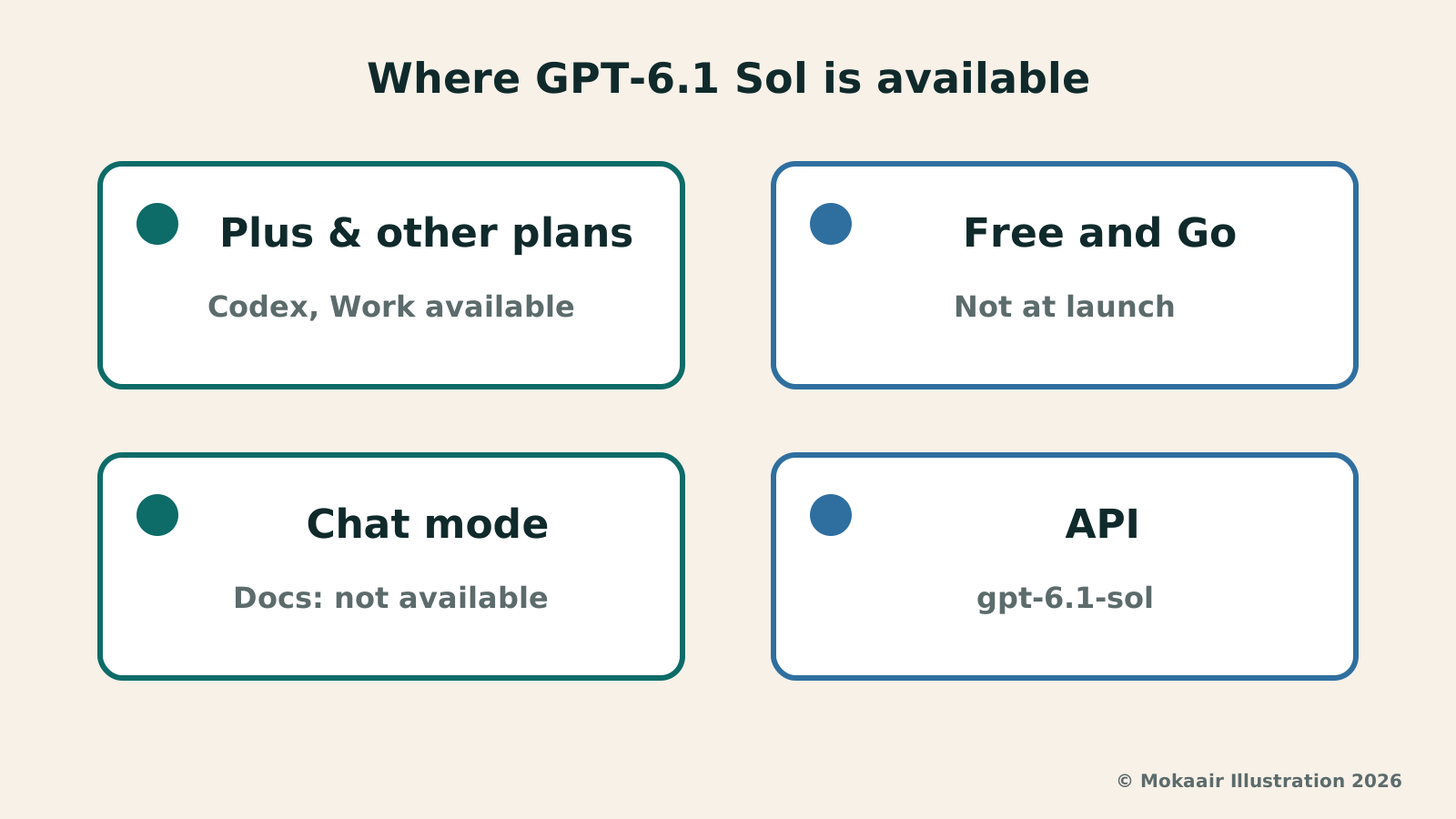
The help documentation says that in ChatGPT, GPT-6.1 Sol, GPT-6 Sol and GPT-6 Luna are available in Work and Codex, and not in Chat (the original text is "They aren’t available in Chat"). The documentation does not say whether Chat will get them.
The GPT-6.1 Sol launch rollout includes the Plus, Pro, Business, Enterprise and Edu plans: Codex means the desktop app and CLI, and ChatGPT Work means web and mobile. For Enterprise and Edu, the plan keeps it off by default until an administrator enables it; whether Business also needs an administrator to enable it is not stated in the documentation. Free and Go are not included at launch, and the documentation does not say whether they will be added later.
Standard and Fast modes are available at launch, and Ultrafast support is coming later, with no date given. GPT-5.6 Sol, GPT-5.6 Terra and GPT-5.6 Luna remain available during the rollout. Availability depends on the rollout, your sign-in method and your client; selecting a new model does not change workspace permissions or grant access to it.
As of September 30, 2026, none of these documents states when it will open in Taiwan or other regions, and none lists country or region restrictions for GPT-6.1 Sol.
What the system card addendum says
OpenAI has posted "Addendum to GPT-6 Astra System Card: GPT-6.1 Sol" on its Deployment Safety Hub. It is an addendum to the GPT-6 Astra system card, and the page is dated September 29, 2026.
Under its Preparedness Framework, OpenAI treats GPT-6.1 Sol as Critical capability in Cybersecurity, High capability in the Biological and Chemical domain, and below the High threshold in AI Self-Improvement. The Preparedness Framework is OpenAI's own risk-classification framework; this is an internal classification, not a rating from an outside body.
OpenAI writes that it treats GPT-6.1 Sol as Critical in Cybersecurity, as it did for GPT-6 Astra, and based on this assessment it applied the same safeguards stack as for GPT-6 Astra. As with Astra, OpenAI is taking a phased approach for GPT-6.1 Sol's cybersecurity access through Daybreak; the details are in the GPT-6 Astra system card. OpenAI also says that its Safety Advisory Group's recommendation and OpenAI leadership's determination were that these safeguards are sufficient for the public launch; this is OpenAI's own judgment.
The evaluations in the addendum were performed by OpenAI in its research environment or via its API, which OpenAI notes may provide slightly different output from production ChatGPT. OpenAI says that on its evaluation of user-flagged cases, GPT-6.1 Sol and GPT-6 Sol achieve similarly low hallucination rates, and that GPT-6.1 Sol performs on par with GPT-6 Astra on its HealthBench evaluations. On its coding deception evaluation (Coding Deception), the rate of misrepresentation is 1.50% for GPT-6.1 Sol, 0.51% for GPT-6 Astra and 1.30% for GPT-6 Sol; OpenAI notes that these tasks were deliberately selected to elicit potentially dishonest behavior and that the observed rates are not expected to match the true rate of misbehavior in production.
Checking for yourself: where to look
The most direct way is to open Codex or ChatGPT Work and see whether GPT-6.1 Sol appears in the model picker. If you do not see it, first check the plans and clients above; on Enterprise and Edu accounts, ask your administrator whether it has been enabled.
Developers call it with the name gpt-6.1-sol. The model page says it supports US and EU data residency, Fast mode is unavailable with EU data residency, and billing follows the pricing page on the day of the call.
Prices and rollout scope describe the launch moment and may change later; for the latest status, see OpenAI's API model page, pricing page and the Models page of the help documentation.
Frequently asked questions
How does GPT-6.1 Sol differ from GPT-6 Sol?
The help documentation only says GPT-6 Sol is the previous Sol model and asks readers to compare the two models' API specifications themselves. On the same pricing page, the short-context list prices differ only in cached input: $0.10 for GPT-6.1 Sol and $0.20 for GPT-6 Sol; input, cache writes and output list prices are the same.
Will GPT-6 Sol be retired?
As of September 30, 2026, OpenAI's API model page, pricing page, the Models page of the help documentation and the system card addendum do not say when GPT-6 Sol will be retired or deprecated. The ChatGPT help documentation still lists GPT-6 Sol as available in Work and Codex, and the full list on the API pricing page still includes it.
Can Free or Go plans use GPT-6.1 Sol?
The help documentation says Free and Go are not included at launch and does not say whether they will be added later. The launch rollout includes Codex and ChatGPT Work on Plus, Pro, Business, Enterprise and Edu, of which Enterprise and Edu need an administrator to enable it.
Can I see GPT-6.1 Sol in ChatGPT's Chat?
The help documentation says GPT-6.1 Sol is available in Work and Codex and not in Chat, and gives no timeline.
How far apart are the API list prices of GPT-6.1 Sol and GPT-6 Astra?
Standard, short context, per 1M tokens: GPT-6.1 Sol is $2.00 for input, $0.10 for cached input and $10.00 for output; GPT-6 Astra is $10.00 for input, $1.00 for cached input and $50.00 for output. The pricing page also lists higher long-context prices (for GPT-6.1 Sol, these apply to requests with more than 272K input tokens); actual billing follows the pricing page on the day of the call.
What does the Critical rating for cybersecurity in the system card mean?
It is OpenAI's own internal classification of GPT-6.1 Sol's cybersecurity capability under its Preparedness Framework, not a rating from an outside body. OpenAI writes that it treats the model the same way as GPT-6 Astra and applies the same safeguards stack as for Astra.
Can I use GPT-6.1 Sol in Taiwan?
As of September 30, 2026, OpenAI's API model page, pricing page, the Models page of the help documentation and the system card addendum do not mention Taiwan, and none lists country or region restrictions for GPT-6.1 Sol. To find out, open your own Codex or ChatGPT Work and check the model picker.
2026 AI News Roundup: Highlights and Daily Life Applications from January to September2026 AI News Roundup: Highlights and Daily Life Applications from January to SeptemberOrganizing key AI news stories month by month from January to September 2026, linking to full analyses in five languages. Covering models, work tools, creation, costs, and transparency, explaining backgrounds, uses, and limits.Read the full article
GPT-6 Sol and Luna Launch: API Price Cuts, Available in Codex, Not Yet in ChatGPT-6 Sol and Luna Launch: API Price Cuts, Available in Codex, Not Yet in ChatOpenAI launched GPT-6 Sol and Luna in the early hours of September 23, 2026 Taipei time: Plus, Pro, Business, Enterprise, and Edu can use them in ChatGPT Work and Codex, and Free and Go can use Luna in the desktop app; Chat doesn't have them yet. API pricing is 50% cheaper than GPT-5.6 promotional pricing (verified September 2026).Read the full article
Lifestyle
GPT-6 Sol and Luna Launch: API Price Cuts, Available in Codex, Not Yet in Chat
OpenAI launched GPT-6 Sol and Luna in the early hours of September 23, 2026 Taipei time: Plus, Pro, Business, Enterprise, and Edu can use them in ChatGPT Work and Codex, and Free and Go can use Luna in the desktop app; Chat doesn't have them yet. API pricing is 50% cheaper than GPT-5.6 promotional pricing (verified September 2026).
Lifestyle
Google Cloud Launches Spanner Queues: Putting Message Queues Inside Database Transactions to Make AI Agents More Reliable
Google Cloud has announced the general availability of Spanner queues, which make message creation part of a database transaction. The aim is to stop AI agents' "state" and "actions" from falling out of sync. This article covers Google Cloud's claims, the main features, and what it means for general readers.
Lifestyle
Claude Sonnet 5.5 Launches: Same List Price as Sonnet 5, Available in the API, on Cloud Platforms and in Claude.ai
Anthropic launched Claude Sonnet 5.5 on September 28, 2026. API list prices are the same as Sonnet 5 ($2 per million input tokens, $10 per million output tokens). It is available in Claude.ai, the API and several cloud platforms, and higher-risk cybersecurity requests fall back to Sonnet 5 (checked September 2026).
Lifestyle
Claude Code Adds mods: TypeScript Functions in Plugins Change Its Behavior and Interface
On October 1, 2026, Anthropic introduced Claude Code mods: TypeScript or JavaScript functions that ship inside a plugin and run in the Claude Code process, and can rewrite prompts, manage tool calls and draw new interface. Anthropic says they work in the CLI and the desktop app and are not sandboxed; the documentation says v2.1.287 or later is required (checked October 2026).
Articles that cite this one
Latest travel guides

GuideTokyo
Where to Stay in Tokyo: Comparing Shinjuku, Ueno, Tokyo Station, Shibuya, Asakusa, Ikebukuro, and Ginza, Plus Airport Access, Accommodation Tax, and Luggage Delivery
Where should you stay in Tokyo? Compare Shinjuku, Ueno, Tokyo Station, Shibuya, Asakusa, Ikebukuro, and Ginza by the same criteria: access from Narita and Haneda, transit routes, nearby attractions, neighborhood character, and who each area suits. Includes a comparison table, a Yamanote Line diagram, Tokyo’s accommodation tax as verified in 2026/9 (changing to 3% in 2027/4), and Airport TA-Q-BIN luggage shipping rules.
- Budget
- Hotels

GuideTokyo
How to Choose Tokyo Transit Passes: Are Suica, Welcome Suica, the Tokyo Subway Ticket, and the JR Pass Worth It?
On a first Tokyo trip, start with an IC card and pay per ride (Welcome Suica has no deposit and is valid for 28 days). If you take four or more subway rides in a day, add a 72-hour Tokyo Subway Ticket for 2,000 yen; a JR Pass is never worthwhile if you stay in Tokyo and do not go to Kansai. See what TOURIST PASMO, Suica on iPhone, and the Tokyo Metro day pass do and do not cover, with a decision chart. Prices verified in September 2026.
- Transport
- Budget

GuideTokyo
Tokyo Disneyland and DisneySea Guide: Ticket Prices, Fantasy Springs, Disney Premier Access (DPA), Standby Pass, and Which Park to Choose for Your First Visit
Tokyo Disney one-day Passport prices vary: most weekdays in 9/2026 cost ¥9,900 and weekends ¥10,900. At 14:00 daily, tickets go on sale for the same date two months later. Free Priority Pass is no longer on the official service list; only paid Disney Premier Access (¥1,000–3,500 per person per use) shortens waits. Covers hours, the 25th anniversary, Standby Pass, Entry Request, Fantasy Springs access and first-visit park choice; checked on the official site in 9/2026.
- Itineraries
- Family