Lifestyle
Astra for Law Launches: OpenAI's Legal Tool Adds an Index, Not a New Model
On September 17, 2026, OpenAI launched Astra for Law. OpenAI's own framing is that it configures GPT‑6 Astra into an AI foundation for law, adding a U.S. legal index, Trusted Access, and data terms, and it will be initially offered to selected law firms. Checked September 18, 2026, this article covers what OpenAI's benchmarks mean and what region and pricing details are still missing; we have not used it, and nothing here is legal advice.
About 13 min read
On September 17, 2026, OpenAI published the announcement “Introducing Astra for Law.” OpenAI's own framing is that it configured “our most powerful model” into a new AI foundation for law: combining GPT‑6 Astra with settings, tools, and context built for professional legal work. The same day, OpenAI also published a customer story about the international law firm Cooley, which built GO Public using a different product, ChatGPT Work.
This article was checked on September 18, 2026, against OpenAI's official announcement page, the Cooley customer story page, and the legal category of OpenAI's plugin directory. We have not used Astra for Law ourselves; the feature descriptions, benchmark figures, and customer statements below are all OpenAI's own claims or those of its customers. This article is not legal advice, and we do not suggest it as a substitute for a lawyer's professional judgment.
What Was Announced on September 17, 2026: Why “Configured” Is Not “New Model”
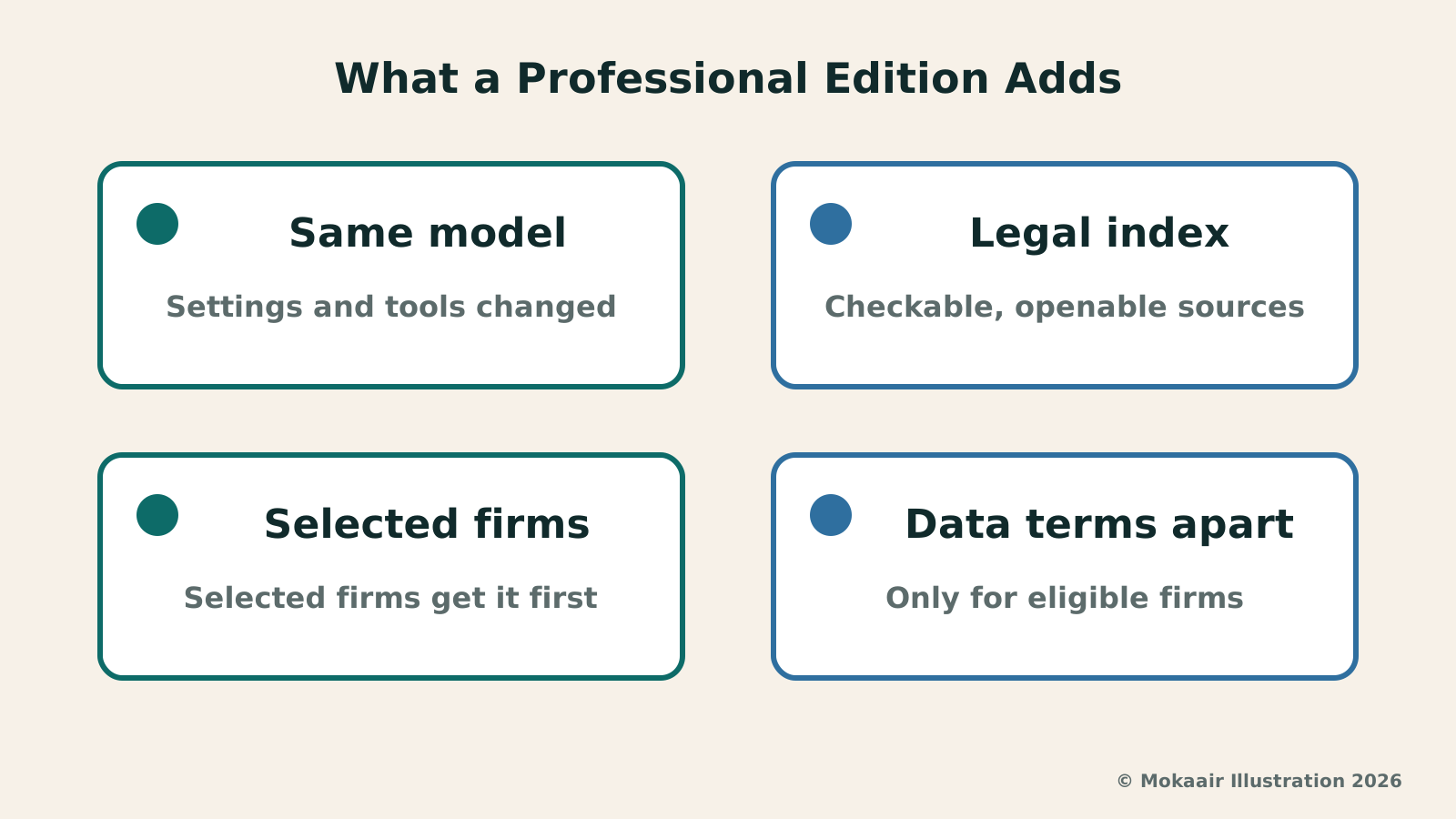
The official announcement opens by positioning Astra for Law as “our most powerful model, configured into a new AI foundation for law”; the text does not mention training a separate new model, and what changed sits outside the model itself. Even so, it will appear in the model picker as “GPT‑6 Astra Law,” and its API identifier is gpt-6-astra-law.
These additions — a legal search index, a set of tools, and terms governing eligibility and data handling — are explained section by section below. We covered OpenAI's version of ChatGPT for financial institutions a week earlier (event date September 10, 2026); this time it's law firms, with a different index, benchmark, and eligibility conditions, and this article does not repeat what that one already covered.
GPT‑6 Astra is the model the announcement describes as its “latest and most powerful”; we've already covered its capabilities in a separate article (event date September 3, 2026) and won't repeat that here. This article covers only what's added once it's configured into a legal foundation.
What Was Actually Added: a U.S. Legal Index, and Citations You Can Check
The official announcement says Astra for Law can search U.S. case law, statutes, regulations, court rules, and administrative decisions, with an index described as “more than 230 million URLs” and “sources added daily.” Two things need to be kept separate here: the index's scope is explicitly the United States — OpenAI's own text prefixes the entire list with “U.S.” — but which country or region selected law firms may come from is not stated, and the two cannot be inferred from each other.
On case law, OpenAI says it worked with the nonprofit Free Law Project, the organization behind CourtListener, whose case-law collection “covers more than 99.9% of published U.S. precedential case law.” OpenAI also states that this index complements, rather than replaces, the licensed content and specialist products firms already rely on, citing Thomson Reuters as an example; the announcement adds, “Building on OpenAI should mean getting more from the ecosystem, not replacing it.”
Beyond retrieval, the selling point OpenAI emphasizes most is that sources can be checked and opened: OpenAI's own framing is a stronger research foundation, with “reliable authorities the lawyer can examine for herself.” This is the point this article thinks matters most for general readers — not that the model got smarter, but that it now comes with a set of sources you can check yourself.
| Item | What it is | Who gets it | What OpenAI hasn't stated |
|---|---|---|---|
| Model | The same GPT‑6 Astra; the announcement does not mention training a separate new model | Firms given access to Astra for Law | Whether a standalone legal model is coming |
| Legal index | U.S. case law, statutes, court rules, and administrative decisions; more than 230 million URLs, added daily | Firms using Astra for Law | Whether it covers jurisdictions outside the U.S. |
| Trusted Access | Initially offered in ChatGPT and Codex; coming soon to the API | Selected law firms | Which regions may apply, firm size, and eligibility criteria |
| Data terms | Zero Data Retention on the API; ChatGPT Enterprise usage excluded from human review by default | Eligible firms | Whether the terms extend beyond eligible firms |
| Plugins and community skills | 26 partner plugins launched the same day; 9 community plugins add 47 custom skills | Firms using the plugins | The full plugin list and individual pricing |
| ChatGPT for Word | Proofreading, suggested edits, and flagging formatting issues; generally available the same day | OpenAI says generally available, without further detail | Which plans, regions, and languages it covers |
How to Read OpenAI's Benchmark: 200 Questions, a Private Validation Set, and Matched Reasoning Effort
Every benchmark OpenAI published is a test OpenAI ran itself; we have not independently verified any of it. With both systems at the highest reasoning effort, OpenAI tested Astra for Law's complete setup on 200 U.S. legal research questions drawn from Vals AI's “Legal Research Bench” private validation set. OpenAI says Astra for Law passed the evaluation's overall correctness check on 54.0% of questions, versus 38.7% for GPT‑6 Astra using web search alone, which OpenAI calls a “40% relative improvement.” “Private” means the questions themselves are not public, so outsiders cannot rerun these 200 questions and can only cite the results OpenAI published.
On retrieval, OpenAI separately states that on an audited set of target passages, when comparing the two systems at the same reasoning effort, Astra for Law retrieved “up to 54% more relevant passages from the correct court opinions.” That “up to” is a hedge in OpenAI's own text, meaning not every question sees a 54% gain.
Taken together, what OpenAI is emphasizing with these figures is an improvement in indexing and retrieval, not simply a smarter model; all four percentages hold only under OpenAI's own test conditions, and a different set of questions could produce different results. The two outside quotes in the announcement that directly comment on Astra for Law use phrases like “preview early versions,” “this early stage,” and “early testing” — impressions from an early stage, not formal results.
Who Can Use It and How Data Is Handled: Selected Firms and Two Data Terms
The official announcement draws eligibility narrowly: Astra for Law will be initially offered to selected law firms, through Trusted Access in ChatGPT and Codex, with the API coming soon; it's meant for lawyers at eligible firms and people working under their supervision, for professional legal work. But the announcement does not state the eligibility criteria, firm size, or number of spots, and “coming soon” comes with no timeline. The announcement closes with a single line: to explore early access or build it into your own product, contact OpenAI — beyond that, there's no public application process.
Data terms are handled separately: OpenAI lists two provisions, both scoped to eligible firms — Zero Data Retention on the API, and ChatGPT Enterprise usage excluded from human review by default. OpenAI also mentions it is working with Latham & Watkins, which it describes as a leader in AI governance, to design for information permissions, ethical walls, client instructions, and firm oversight; a separate firm, Wachtell, Lipton, Rosen & Katz, is described as exploring together how AI can support work that requires professional judgment. The announcement frames both as ongoing collaborations, not yet a published standard.
On plugins, OpenAI separately maintains a plugin directory; as read on September 18, 2026, its filter categories include Legal alongside Small Business, Productivity, Engineering & IT, Data & Research, Finance, and others. The announcement says 26 partner-built plugins launched the same day, and a further 9 community plugins written by lawyers and legal engineers add 47 custom skills.
The same announcement separately describes custom applications built with three firms, using the phrase “adapting ChatGPT Enterprise” rather than Astra for Law; Cooley is one of them, with GO Public. Yet Cooley's customer story, published the same day, states plainly that GO Public is built on ChatGPT Work, and notes that in 2025 Cooley advised on 180 deals globally, totaling more than $51.5 billion — a figure about the firm's overall business, which OpenAI does not connect to any AI outcome, and this article does not read the two together either.
What OpenAI Hasn't Made Clear, and the One Thing General Readers Can Use
Across three official pages checked through September 18, 2026, several things go unstated: no price is published; no regional list of eligible firms is given, and whether Taiwanese firms can apply is not addressed; no timeline is given for API availability; and the announcement's body never mentions personal ChatGPT accounts, so it's unclear whether it will ever open to individual users.
The one thing in this announcement more relevant to general readers is that ChatGPT for Word became generally available the same day: it can help proofread, suggest edits, and flag formatting issues, making it easier for lawyers to work inside Word, the tool they already use. But OpenAI states only that it's generally available, without saying which plans, regions, or languages are covered, so this article can only relay the scope OpenAI actually wrote.
Here is an example designed by the editors, not a hands-on test: if a reader receives an AI-generated explanation of a contract clause that cites a statute that doesn't actually exist, the fix this announcement demonstrates isn't a smarter model — it's a retrieval system with labeled sources you can click open and check. The same approach applies to any AI answer you run into day to day: ask first whether you can open the source it cites, then decide whether to trust it.
Frequently asked questions
Is Astra for Law a brand-new AI model?
OpenAI does not say so. In the announcement, OpenAI frames it as “our most powerful model, configured into a new AI foundation for law”: the approach described is taking the existing GPT‑6 Astra and adding settings, tools, and a legal index built for legal work, and the text does not mention training a separate new model. Even so, it will appear in the model picker as “GPT‑6 Astra Law,” with the API identifier gpt-6-astra-law.
Can this legal index look up Taiwanese or other countries' law?
The official announcement states the index's scope as the United States: the original text prefixes the whole list with “U.S.,” covering case law, statutes, court rules, and administrative decisions. These pages don't mention any jurisdiction outside the U.S., and this article found no OpenAI statement about versions for other countries; readers should not assume it can look up Taiwanese or other regional law.
Can Taiwanese law firms apply to use Astra for Law?
Neither the official announcement nor the Trusted Access description lists which countries or regions may apply — they only say selected, eligible firms, and this article found nothing stating whether Taiwan is included as of September 18, 2026. Which jurisdiction the index searches and who can apply are two different things: the index being U.S.-focused doesn't mean only U.S. firms may apply, and it doesn't mean Taiwanese firms may apply either. Anyone who needs to know should contact OpenAI directly.
OpenAI published a benchmark result of 54.0% versus 38.7% — does that mean this tool's answers are necessarily more accurate?
This is a test OpenAI ran and published itself, and we have not independently verified it. The conditions were both systems at the highest reasoning effort, with questions drawn from 200 U.S. legal research questions in Vals AI's private validation set; “private” means outsiders cannot see the questions themselves and so cannot rerun the numbers. It's reasonable to treat this result as OpenAI's own claim for reference, not as an objective accuracy figure that applies to every situation.
Is Cooley, the firm mentioned in the customer story, already using Astra for Law?
The announcement lists Cooley among the firms it helped build custom applications for, using the phrase “adapting ChatGPT Enterprise.” OpenAI's Cooley customer story, published the same day, states plainly that Cooley's GO Public is built on ChatGPT Work — a different product, not Astra for Law. Reading both pages together avoids the mix-up.
What can a general reader without a law-firm account get out of this announcement?
OpenAI also announced the same day that ChatGPT for Word is now generally available, for proofreading documents, suggesting edits, and flagging formatting issues; but the announcement only says it's generally available, without stating which plans, regions, or languages it covers, and this article found no further detail on other pages as of September 18, 2026. Everything else — the legal index search, Trusted Access — is restricted to selected, eligible firms and isn't available to individual accounts.
2026 AI News Roundup: Highlights and Daily Life Applications from January to September2026 AI News Roundup: Highlights and Daily Life Applications from January to SeptemberOrganizing key AI news stories month by month from January to September 2026, linking to full analyses in five languages. Covering models, work tools, creation, costs, and transparency, explaining backgrounds, uses, and limits.Read the full article
ChatGPT for Financial Services Launches: An AI Tool for Financial Institutions, Not Your Personal AccountChatGPT for Financial Services Launches: An AI Tool for Financial Institutions, Not Your Personal AccountOn September 10, 2026, OpenAI launched ChatGPT for Financial Services. OpenAI says it starts with investment banking and equity research: a customized ChatGPT Work edition with built-in financial data and GPT-6 Astra's reasoning, open to eligible institutions that contact sales. Checked September 18, 2026, this article covers what OpenAI's benchmark charts show and what price, region, and timeline details are missing; we have not used it, and nothing here is investment advice.Read the full article
Lifestyle
ChatGPT for Financial Services Launches: An AI Tool for Financial Institutions, Not Your Personal Account
On September 10, 2026, OpenAI launched ChatGPT for Financial Services. OpenAI says it starts with investment banking and equity research: a customized ChatGPT Work edition with built-in financial data and GPT-6 Astra's reasoning, open to eligible institutions that contact sales. Checked September 18, 2026, this article covers what OpenAI's benchmark charts show and what price, region, and timeline details are missing; we have not used it, and nothing here is investment advice.
Lifestyle
OpenAI Publishes a Misalignment Reporting Framework: All 6 Reports Come From Training
OpenAI's own page prints a publication date of September 16, 2026, U.S. time, which is already September 17 in Taipei time; the same day it also released 6 case reports. Checked against the framework announcement, the alignment.openai.com overview page, and two of the case reports, this article explains what stage and which models the 6 reports are marked with, what steps a disclosure goes through, and what each of the two published rates actually measures.
Lifestyle
NVIDIA launches DGX Spark 64GB: on sale October 23 from $4,999, two units can be linked into 128GB
On October 2, 2026, NVIDIA announced a more affordable 64GB memory version of its DGX Spark personal AI computer, available from October 23 through six makers including Acer and ASUS. It is aimed mainly at developers and researchers who want to run AI models on their own machines. Below we summarize the specs NVIDIA published, its claims about linking two units, and what it means for general readers.
Lifestyle
Google Cloud Launches Spanner Queues: Putting Message Queues Inside Database Transactions to Make AI Agents More Reliable
Google Cloud has announced the general availability of Spanner queues, which make message creation part of a database transaction. The aim is to stop AI agents' "state" and "actions" from falling out of sync. This article covers Google Cloud's claims, the main features, and what it means for general readers.
Articles that cite this one
Latest travel guides

GuideTokyo
Where to Stay in Tokyo: Comparing Shinjuku, Ueno, Tokyo Station, Shibuya, Asakusa, Ikebukuro, and Ginza, Plus Airport Access, Accommodation Tax, and Luggage Delivery
Where should you stay in Tokyo? Compare Shinjuku, Ueno, Tokyo Station, Shibuya, Asakusa, Ikebukuro, and Ginza by the same criteria: access from Narita and Haneda, transit routes, nearby attractions, neighborhood character, and who each area suits. Includes a comparison table, a Yamanote Line diagram, Tokyo’s accommodation tax as verified in 2026/9 (changing to 3% in 2027/4), and Airport TA-Q-BIN luggage shipping rules.
- Budget
- Hotels

GuideTokyo
How to Choose Tokyo Transit Passes: Are Suica, Welcome Suica, the Tokyo Subway Ticket, and the JR Pass Worth It?
On a first Tokyo trip, start with an IC card and pay per ride (Welcome Suica has no deposit and is valid for 28 days). If you take four or more subway rides in a day, add a 72-hour Tokyo Subway Ticket for 2,000 yen; a JR Pass is never worthwhile if you stay in Tokyo and do not go to Kansai. See what TOURIST PASMO, Suica on iPhone, and the Tokyo Metro day pass do and do not cover, with a decision chart. Prices verified in September 2026.
- Transport
- Budget

GuideTokyo
Tokyo Disneyland and DisneySea Guide: Ticket Prices, Fantasy Springs, Disney Premier Access (DPA), Standby Pass, and Which Park to Choose for Your First Visit
Tokyo Disney one-day Passport prices vary: most weekdays in 9/2026 cost ¥9,900 and weekends ¥10,900. At 14:00 daily, tickets go on sale for the same date two months later. Free Priority Pass is no longer on the official service list; only paid Disney Premier Access (¥1,000–3,500 per person per use) shortens waits. Covers hours, the 25th anniversary, Standby Pass, Entry Request, Fantasy Springs access and first-visit park choice; checked on the official site in 9/2026.
- Itineraries
- Family
Sources
- Introducing Astra for Law · Checked:
- How Cooley is accelerating IPO work with ChatGPT · Checked:
- Plugins | Secure integrations for enterprise workflows · Checked: