Lifestyle
ChatGPT for Financial Services Launches: An AI Tool for Financial Institutions, Not Your Personal Account
On September 10, 2026, OpenAI launched ChatGPT for Financial Services. OpenAI says it starts with investment banking and equity research: a customized ChatGPT Work edition with built-in financial data and GPT-6 Astra's reasoning, open to eligible institutions that contact sales. Checked September 18, 2026, this article covers what OpenAI's benchmark charts show and what price, region, and timeline details are missing; we have not used it, and nothing here is investment advice.
About 12 min read
On September 10, 2026, OpenAI published the announcement "Introducing ChatGPT for Financial Services," launching a customized ChatGPT Work edition built specifically for financial institutions. OpenAI says the service combines built-in financial data with GPT-6 Astra's reasoning to help teams handle work such as research, financial models, and customized client materials; the product's direction was shaped through a design partnership with Morgan Stanley and Evercore.
This article was checked on September 18, 2026, reading directly from OpenAI's official announcement page and the pricing page of OpenAI's official ChatGPT documentation; web pages can change at any time, and this article reflects the version read on the day it was checked. We have not used this product ourselves, and we are not offering investment, procurement, or adoption advice; the benchmark figures and feature descriptions below are all OpenAI's own published claims.
OpenAI Launches a ChatGPT Built for Financial Institutions
The positioning line in the official announcement is "Frontier intelligence, built for financial services." OpenAI explains that the product brings together the financial data teams need; OpenAI says the product starts with investment banking and equity research, with the partnership feeding into further training and product improvements and expansion into other categories of financial services.
OpenAI says Morgan Stanley and Evercore are this product's design partners, and that the collaboration helped OpenAI pinpoint the biggest challenges it can solve for financial institutions; for these two partners' teams, the biggest pain points were whether they could reliably access data and whether they could produce high-quality output. The announcement quotes statements from both companies (attributed to the companies, not to named individuals), describing a process of testing ideas together and shaping the product step by step; the announcement does not say either institution has formally adopted or purchased the service.
This is an enterprise service that requires a separate sales conversation: the body of the announcement does not mention individual consumers, and does not say whether existing ChatGPT Plus, Pro, or Business users can get these features by upgrading. The rest of this article covers what OpenAI has stated clearly and what it has not.
How the Built-In Data and Existing Subscriptions Connect
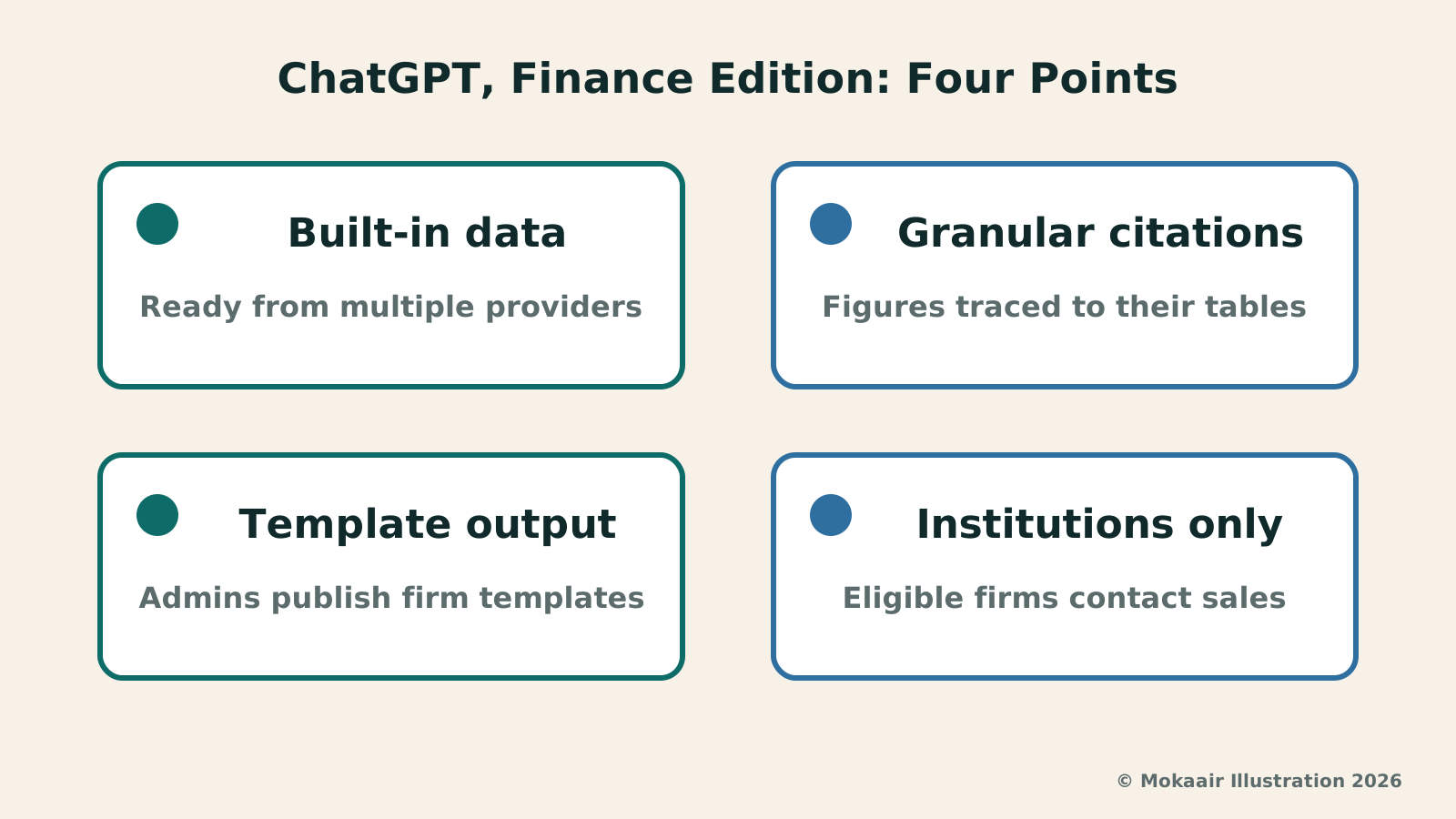
OpenAI sums up the data section as three things: adding premium financial data, simplifying connections to existing data providers, and improving MCP performance. The first is built-in data: OpenAI says the product has built-in data from providers such as Daloopa, PitchBook, LSEG News, and Crunchbase, covering earnings call transcripts, financial statements, company fundamentals, and private-company information; this data is indexed by OpenAI itself and hosted on its own infrastructure, so teams can use it directly without signing separate contracts or setting up connectors. OpenAI also claims this improves accuracy and enables features like granular citations, letting users trace figures and claims back to their original tables and passages to check them.
The second is existing subscriptions: OpenAI says it knows many customers already have data subscriptions, so it is "working with" S&P Capital IQ, LSEG, MSCI, Dow Jones Factiva, and Moody's on shared sign-in and entitlement integrations; data providers "will be able" to recognize users through their ChatGPT sign-in and automatically grant access to data they are already entitled to. The announcement gives no timeline and does not say this is already live.
The third is the broader connector ecosystem: OpenAI says it can be challenging to use data providers' MCP connectors effectively, so it has optimized some of the most-used MCPs in financial services for immediate use in the product, so teams can spend less time troubleshooting connections and more time on analysis. The announcement puts the connector ecosystem at "over 50+" connectors (OpenAI's own wording repeats itself that way) and names Datasite, Box, Preqin, FactSet, and Intapp as examples, not a complete list.
| Connection type | Data source (OpenAI's wording) | Current status |
|---|---|---|
| Built-in data | Daloopa, PitchBook, LSEG News, Crunchbase, and others | OpenAI says it's ready to use directly, no contract or connector setup needed |
| Existing subscriptions (in progress) | S&P Capital IQ, LSEG, MSCI, Dow Jones Factiva, Moody's | OpenAI says it is working on shared sign-in; no timeline given |
| Broader connector ecosystem | Datasite, Box, Preqin, FactSet, Intapp, and others | OpenAI says "over 50+"; some commonly used connectors already optimized |
GPT-6 Astra's Three Benchmarks, and How to Read Them
OpenAI says GPT-6 Astra is state of the art across three of the core capabilities financial-services work requires: information retrieval, financial reasoning, and artifact generation. OpenAI's own description is that the model can navigate the numbers, tables, and footnotes in financial documents, can run financial analysis on input data and draw conclusions, and can synthesize the results into concrete output such as documents, spreadsheets, and slides.
OpenAI published three benchmark charts, and GPT-6 Astra is the top-scoring model on all three; each chart tested three models, and each caption names only two of them. The first, OfficeQA Pro, tests whether a model can find and analyze information across U.S. Treasury Bulletins, including complex financial tables, charts, and footnotes; the caption reads GPT-6 Astra at 69.9% and GPT-5.6 Sol at 60.2%, while the third model the caption does not mention, Claude Fable 5.1, scored 62.4%. Unlike the other two charts, this one does not note who ran the evaluation. The second, BoxBench, tests whether a model can turn documents from complex business workflows into complete deliverables; the caption reads 77% versus 74%, noting "this is an Eval provided by an External partner."
The third chart is a professional slide-creation comparison; both the chart and its caption note this is an internal evaluation, with slides from each model compared by human reviewers. The rival is labeled "Opus 5" on the chart, and GPT-6 Astra's win rate is 55.6%. This caption disagrees with the chart's own underlying data on another comparison figure, so this article only uses the number the caption and the chart agree on. None of the three charts states its evaluation method, number of questions, or number of raters, so it is best to read them as the vendor's own comparison, not an independent ranking.
Template Output and Security Governance
Once the analysis is done, it needs to become something people can read. OpenAI says administrators can publish a firm's own Excel, Word, and PowerPoint templates through a dedicated admin page; once a firm's templates and style guide are configured, teams can turn analysis into valuation models, research notes, and pitchbooks in the firm's own format and style.
Security and governance build on ChatGPT Enterprise's existing capabilities: SAML single sign-on, SCIM-based account provisioning, and role-based access controls. OpenAI says a firm's business data is not used to train its models by default, that data is encrypted at rest and in transit, and that admins can configure workspace data retention.
Compliance teams can use the OpenAI Compliance Platform to export supported workspace logs into their existing audit and investigation workflows; firms can also manage who can use which skills and apps by role and can create multiple workspaces to enforce information barriers. OpenAI frames this section around protecting material non-public information and client confidentiality, which it says matters enormously to financial institutions.
Who Can Use It, and What's Still Unclear
OpenAI says ChatGPT for Financial Services is just one way it serves customers, and that the needs of the finance industry require a range of solutions; institutions and developers can also use OpenAI's API directly to build their own specialized applications. The "Availability" section is only two sentences: the service is available to "eligible financial institutions," and interested parties should contact OpenAI sales or their account team; the announcement includes no price, region, or rollout timeline at all.
The announcement does not state this service's cost, minimum adoption size, or contract length, nor which countries or regions can apply; as of the September 18, 2026 check, the pricing page of OpenAI's official ChatGPT documentation also has no price for this service. Whether Taiwan's financial institutions can apply, and how much it would cost, is a question neither OpenAI's announcement nor anything else this article found can answer; readers who need to know should contact OpenAI sales directly.
This announcement covers data, templates, and governance; it does not repeat GPT-6 Astra's full capabilities or explain how ChatGPT Work assigns tasks. We have already covered both of those separately, along with the billing and data location of OpenAI's Agents API.
Frequently asked questions
What is ChatGPT for Financial Services?
It's a product OpenAI launched on September 10, 2026. OpenAI describes it as a customized ChatGPT Work edition built for financial institutions, with built-in financial data and GPT-6 Astra's reasoning, to help teams handle work such as research, financial models, and customized client materials. The announcement says it is available to eligible financial institutions that contact sales, and does not describe it as a new feature of an existing ChatGPT plan.
Will my regular ChatGPT account (Free, Plus, Pro, or Business) automatically get these features?
The announcement does not say so. It only states that the service is available to "eligible financial institutions" that separately contact sales or their account team, and it does not mention personal accounts or existing ChatGPT Business workspaces gaining new features as a result. As of the September 18, 2026 check of the official announcement page and the pricing page of OpenAI's official ChatGPT documentation, we found no mention of this applying to any personal plan.
Have Morgan Stanley, Evercore, or the data providers named in the announcement formally adopted this product?
OpenAI refers to Morgan Stanley and Evercore only as "design partners" who helped shape the product's direction, and quotes statements from both companies; the announcement does not say either institution has adopted, purchased, or fully deployed the product. Data providers such as Daloopa, PitchBook, LSEG News, and Crunchbase supply the built-in data as a vendor relationship, which does not mean they are users of this product.
Does this product recommend stocks, judge valuations, or offer investment advice?
The official pages this article checked describe workflows such as organizing data, building financial models, and producing presentations; as of the September 18, 2026 check, we found no stock tickers, return figures, or buy/sell timing advice. What this article describes is only the product's features and current status, not investment advice, and readers should not treat this article or the official pages as a basis for investment decisions.
Do the benchmark figures OpenAI published mean this model is more accurate?
These figures were all published by OpenAI on its own announcement page; they are not results this site tested itself. OpenAI notes that BoxBench is an Eval provided by an external partner, and that the professional slide-creation comparison is an internal evaluation; the OfficeQA Pro chart does not note who ran it. None of the three charts states its evaluation method, number of questions, or number of raters, so it's best treated as the vendor's own claim for reference, not as an objective ranking.
Can banks or financial institutions in Taiwan apply to use this? How much does it cost?
The announcement does not mention Taiwan, Asia, or the availability status of any region, and does not publish a price, minimum adoption size, or contract length; it only says eligible financial institutions can contact sales. As of the September 18, 2026 check of the two official pages, we found no information on region or cost; this site cannot determine on a reader's behalf whether any particular institution is eligible.
2026 AI News Roundup: Highlights and Daily Life Applications from January to September2026 AI News Roundup: Highlights and Daily Life Applications from January to SeptemberOrganizing key AI news stories month by month from January to September 2026, linking to full analyses in five languages. Covering models, work tools, creation, costs, and transparency, explaining backgrounds, uses, and limits.Read the full article
ChatGPT Ads Open Up to Self-Serve Buying: The Tools, Billing, and Targeting from OpenAI's May AnnouncementChatGPT Ads Open Up to Self-Serve Buying: The Tools, Billing, and Targeting from OpenAI's May AnnouncementOn May 5, 2026, OpenAI announced it was expanding how ChatGPT ads can be bought, adding a beta self-serve ad management tool, CPC bidding, and more measurement tools. Based on the announcement and OpenAI's developer documentation, this article covers the ad account, campaign, ad group, and ad structure, how the three campaign objectives are billed, bidding strategies, and region, platform, and context hints targeting, and notes how the documentation differs from the May 5 announcement.Read the full article
Lifestyle
ChatGPT Ads Open Up to Self-Serve Buying: The Tools, Billing, and Targeting from OpenAI's May Announcement
On May 5, 2026, OpenAI announced it was expanding how ChatGPT ads can be bought, adding a beta self-serve ad management tool, CPC bidding, and more measurement tools. Based on the announcement and OpenAI's developer documentation, this article covers the ad account, campaign, ad group, and ad structure, how the three campaign objectives are billed, bidding strategies, and region, platform, and context hints targeting, and notes how the documentation differs from the May 5 announcement.
Lifestyle
GPT-6 Astra Announced: From Answering Questions to Completing Computer Tasks
OpenAI announced GPT-6 Astra on September 3, 2026, emphasizing computer use, multi-step workflows, and template-based document output. Focusing on general reporting, data organization, and admin tasks, this article explains the gap between model ability and tool permissions, how to draft verifiable tasks, set required confirmation checkpoints, and recognize phased rollouts without assuming launch demos are instantly available to every account.
Lifestyle
OpenAI Discloses Habitat Storage Architecture: The Scale and Limits Behind Over 1 Billion Weekly Users
On September 11, 2026, OpenAI published an engineering-blog post describing how its storage platform, Habitat, evolved from a Python client library into an independent service, and was rewritten in Rust in the second quarter of this year. This article sets out the request-volume, regional-coverage, and data-volume figures OpenAI states, plus the durability and regional details it omits; this site has not tested any of this and offers no advice on using or buying anything.
Lifestyle
NVIDIA launches DGX Spark 64GB: on sale October 23 from $4,999, two units can be linked into 128GB
On October 2, 2026, NVIDIA announced a more affordable 64GB memory version of its DGX Spark personal AI computer, available from October 23 through six makers including Acer and ASUS. It is aimed mainly at developers and researchers who want to run AI models on their own machines. Below we summarize the specs NVIDIA published, its claims about linking two units, and what it means for general readers.
Articles that cite this one
Latest travel guides

GuideTokyo
Where to Stay in Tokyo: Comparing Shinjuku, Ueno, Tokyo Station, Shibuya, Asakusa, Ikebukuro, and Ginza, Plus Airport Access, Accommodation Tax, and Luggage Delivery
Where should you stay in Tokyo? Compare Shinjuku, Ueno, Tokyo Station, Shibuya, Asakusa, Ikebukuro, and Ginza by the same criteria: access from Narita and Haneda, transit routes, nearby attractions, neighborhood character, and who each area suits. Includes a comparison table, a Yamanote Line diagram, Tokyo’s accommodation tax as verified in 2026/9 (changing to 3% in 2027/4), and Airport TA-Q-BIN luggage shipping rules.
- Budget
- Hotels

GuideTokyo
How to Choose Tokyo Transit Passes: Are Suica, Welcome Suica, the Tokyo Subway Ticket, and the JR Pass Worth It?
On a first Tokyo trip, start with an IC card and pay per ride (Welcome Suica has no deposit and is valid for 28 days). If you take four or more subway rides in a day, add a 72-hour Tokyo Subway Ticket for 2,000 yen; a JR Pass is never worthwhile if you stay in Tokyo and do not go to Kansai. See what TOURIST PASMO, Suica on iPhone, and the Tokyo Metro day pass do and do not cover, with a decision chart. Prices verified in September 2026.
- Transport
- Budget

GuideTokyo
Tokyo Disneyland and DisneySea Guide: Ticket Prices, Fantasy Springs, Disney Premier Access (DPA), Standby Pass, and Which Park to Choose for Your First Visit
Tokyo Disney one-day Passport prices vary: most weekdays in 9/2026 cost ¥9,900 and weekends ¥10,900. At 14:00 daily, tickets go on sale for the same date two months later. Free Priority Pass is no longer on the official service list; only paid Disney Premier Access (¥1,000–3,500 per person per use) shortens waits. Covers hours, the 25th anniversary, Standby Pass, Entry Request, Fantasy Springs access and first-visit park choice; checked on the official site in 9/2026.
- Itineraries
- Family
Sources
- Introducing ChatGPT for Financial Services · Checked:
- Pricing · Checked: