Lifestyle
OpenAI Discloses Habitat Storage Architecture: The Scale and Limits Behind Over 1 Billion Weekly Users
On September 11, 2026, OpenAI published an engineering-blog post describing how its storage platform, Habitat, evolved from a Python client library into an independent service, and was rewritten in Rust in the second quarter of this year. This article sets out the request-volume, regional-coverage, and data-volume figures OpenAI states, plus the durability and regional details it omits; this site has not tested any of this and offers no advice on using or buying anything.
About 12 min read
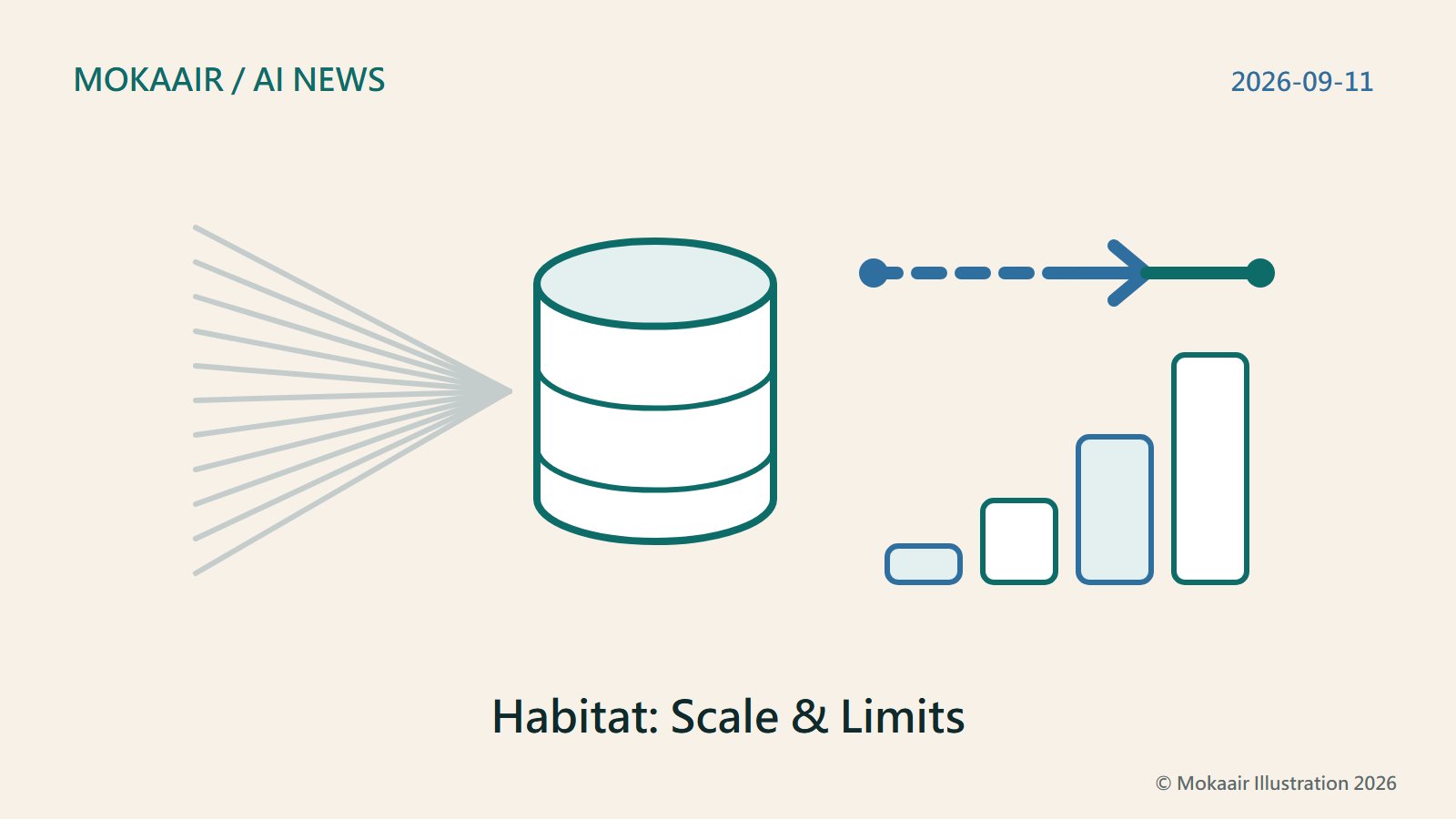
On September 11, 2026, OpenAI published a post titled “Rapidly scaling online storage to serve over 1 billion ChatGPT users” on its official engineering blog, describing how its internal storage platform, Habitat, evolved over the years from a Python client-side library into an independently operating service. The post is filed under the Engineering category and credited to three named technical staff, Jon Lee, Chaomin Yu, and Ben Ries; it closes with a link to an engineering job opening. It is a technical blog post, not an announcement of a new product or plan.
This article was checked on September 18, 2026 against the original OpenAI post, OpenAI's official news RSS feed, and the Engineering section of OpenAI's official sitemap. For several days beforehand, the post's page on openai.com would sometimes return only an access-restricted page; by the day of this check it could be read directly. Every figure below is OpenAI's own statement; this site has not run any tests of its own and offers no advice on purchasing or using anything. This article uses no invented everyday scenario.
What This Post Is: An Engineering Blog Post, Not a Product Announcement
OpenAI files this post under its Engineering category, describing Habitat as the online storage platform it built in-house so its products can retrieve the data they need quickly and reliably: a user logging in, checking their Codex settings, or opening a new ChatGPT conversation can all involve multiple data queries behind the scenes. OpenAI writes that when those queries are slow, the product feels slow; when they fail, the product simply stops working.
The stat block at the top of the post lists three numbers side by side: over 70 million requests per second, over 1 billion people a week, and over 500 PB of data. OpenAI explains that Habitat first launched at DevDay 2023 to support GPTs, starting as a simple Python client-side library connected to a single database, and has since grown into a complex distributed system.
The post closes with a link to an engineering job opening (the URL carries the name of Seattle); this is the first of two posts on the storage topic, and the second is expected to cover multi-tenancy reliability, a layered strategy for read performance, and how the partnership with Azure Cosmos DB is being scaled up. As checked against the official sitemap and news feed through September 18, 2026, no entry for the second part has appeared yet, and no date has been announced.
The Scale OpenAI Describes: A Few Numbers Worth Reading Together
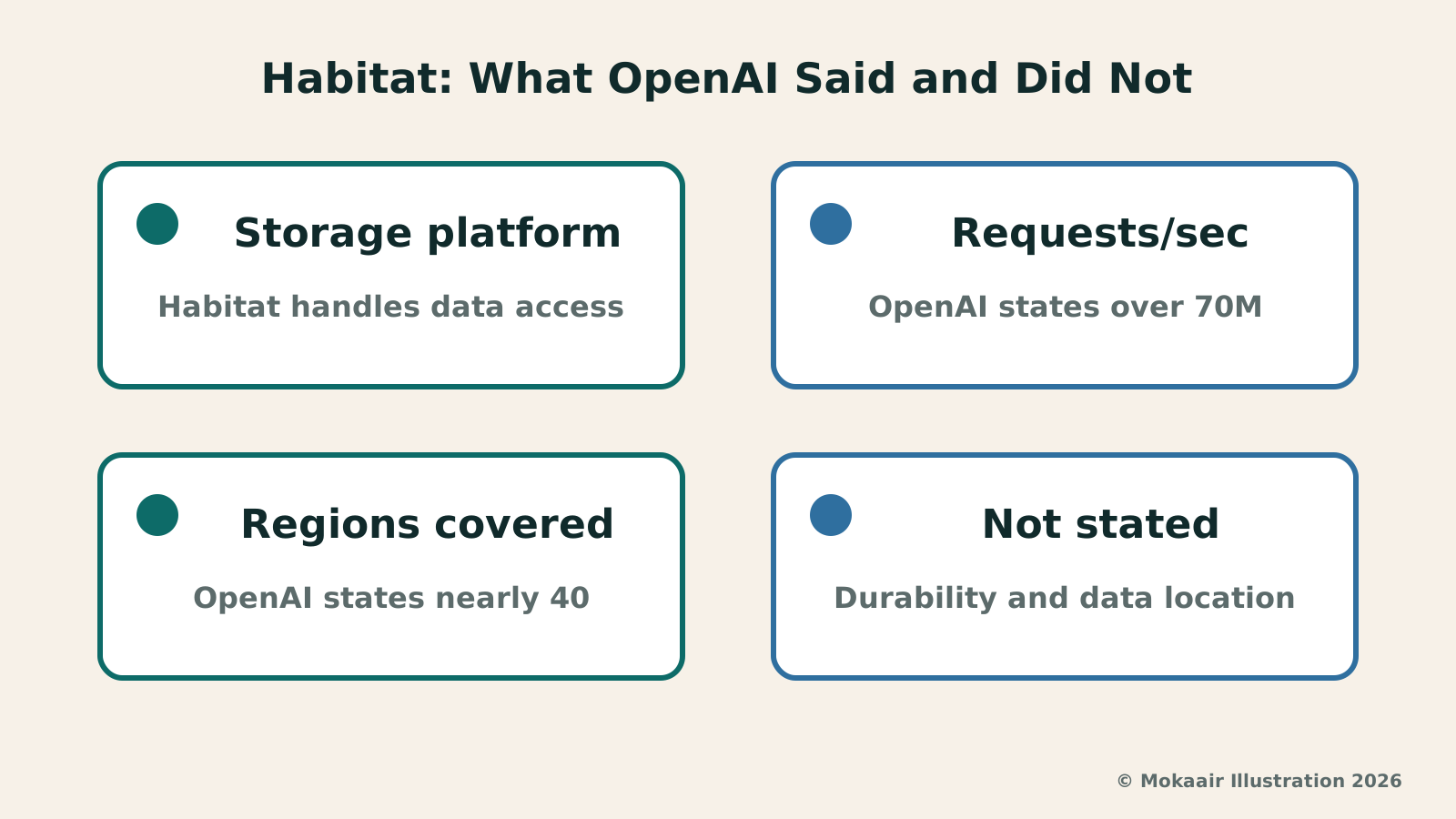
OpenAI writes in the body of the post that Habitat now handles over 70 million requests every second, supports products used by over 1 billion people a week, and spans nearly 40 regions; the post does not list the countries or cities behind those regions. The closest thing to regional detail appears on a diagram the post itself labels “simplified,” which shows three example database codes, us0, us1, and eu0 — labels on a diagram, not a published list of regions.
Worth noting: OpenAI's official RSS feed and the page's own metadata separately state “22M requests per second.” Rereading the full body text on the day of this check, this article found that figure only in the summary and metadata; it never appears again in the body, and the post never explains how it relates to the 70 million or 20 million figures.
OpenAI also states that its scale has grown more than 10x year-over-year for the last three years; the post's own line notes that systems engineers typically design for 10x the current scale, hoping it holds for a few years while they prepare for the next 10x.
| Figure | What it represents | Where it appears |
|---|---|---|
| Over 70 million/sec | Requests handled per second now | Body text and stat block |
| Over 20 million/sec | Python's peak requests before the rewrite | Body text |
| 22M/sec | Figure given in the official summary and metadata | Summary only, not the body |
| Over 500 PB | Data volume stored now | Body text and stat block |
| Nearly 40 | Number of geographic regions served | Body text, regions not named |
| More than 10x | Year-over-year growth, last three years | Body text |
Why Users Can Feel a Single Slow Query
OpenAI explains that when the average user's request triggers hundreds of database calls behind the scenes, what the user feels is the slowest one. The post calls managing this tail latency — a small number of unusually slow queries — the main challenge of running a Python service at this scale.
The post gives one example: Habitat uses Statsig, a feature-flag tool, which by default polls for updated configuration once a minute with no jitter, and that configuration includes every production rule across every service. Layered on top of the architectural decision that a pod runs up to 8 Python processes, the result was that every minute, each pod would have some moment where all of its worker processes simultaneously stalled their in-flight requests to instead parse that giant configuration file. OpenAI says that once CPU profiling helped them find the root cause, the fix was simple: deploy narrower-scoped configuration, lengthen the polling interval, and add jitter to background work like this.
The other example involves connection pooling: OpenAI says Python's aiohttp library defaults to preferring the most recently released connection for reuse, which is normally a reasonable default. But during a burst of requests, slower, already-overloaded servers returned connections to the pool later and were therefore selected more often by subsequent requests, gradually concentrating more traffic on the pods already struggling. OpenAI calls this a kind of “metastable failure”: even after the client causing the overload stops, a subset of processes keeps degrading and only recovers after a restart. Switching to preferring the earliest-released connection not only broke the feedback loop but also reduced variance in request volume under steady state; this kind of connection management is now mostly handled by Istio and Envoy.
What OpenAI Does Not Explain in This Post
This article compared the original English wording term by term: the post does not contain the words durability, backup, or replica, and does not state how many copies of a piece of data are kept. OpenAI describes, just once, wanting to move its most critical datasets into an Azure Cosmos DB account distributed across regions, to narrow the blast radius of a single-region failure — and says nothing further about retention or redundancy mechanisms. The post also gives no availability figures or service-level agreement, describing only a few incidents its own systems have had — for example, one team rolling its own service back to an older version with a problematic client for unrelated reasons, which set off the very outage so much effort had gone into avoiding — without stating a date, duration, or the actual impact on users.
On regions, the post states only that it covers nearly 40 regions, without naming any country or city as a data location, and without mentioning Taiwan or Asia. The closest things to regional information are the three database codes on the diagram and the city name in the URL of the job link. The post likewise does not spell out what data Habitat actually stores — logging in, checking Codex settings, and opening a new conversation may all require querying data, but the post never states outright whether conversation content itself is stored in Habitat, saying only that this is where user data is protected, a key point guarding against unauthorized access by external, internal, and agent actors.
The numbers for the Rust rewrite are the same kind of claim: OpenAI says its own data shows the new version is 6x more CPU-efficient and 15x more memory-efficient, with both average and tail latency significantly reduced; it now handles 95% of production requests, and OpenAI plans to fully retire the Python version within the next few weeks. OpenAI also says it plans to publish another post sharing more learnings, and that follow-up likewise has no announced date. The post includes no testing methodology, test scenarios, or third-party verification, so for now these numbers can only be treated as internal measurements OpenAI has published itself.
How Readers Might Weigh This Post
This post announces no new product, plan, region, or setting, so ChatGPT or Codex users do not need to change anything because of it. OpenAI itself never claims in the post that users will feel anything faster or cheaper; for now, the benefits of the rewrite remain solely OpenAI's own internal account.
This post is best treated as a reminder: every service has its own storage and availability design behind it, and the scale figures an operator publishes about itself — whether request volume, user counts, or growth multiples — can only be taken as the vendor's own statement until there is third-party verification. Readers may want to notice whether a post like this addresses durability, service-level agreements, or incident details, which usually says more about a service's stability than any single eye-catching number.
Readers who want to check for updates can consult two free official channels themselves: OpenAI's news RSS feed and the Engineering section of the sitemap — this article used exactly those two channels to confirm that the second part has not appeared yet. Note that the time stamped on the sitemap does not match the publication date printed on the page itself, so it should not be treated as the post's publication or update date; that is an observation made on the day of this check.
Frequently asked questions
Does this post change how I use ChatGPT or Codex?
No. This post announces no new product, plan, feature, or setting, and OpenAI never says users will feel any change. Its main purpose is to describe the technical evolution of the internal storage platform Habitat, closing with a link to an engineering job opening.
What exactly does “over 1 billion” users mean?
OpenAI itself uses several different phrasings. The scale statement in the body text says it is “supporting products used by over 1 billion people a week” — a weekly usage figure, not a count of registered accounts. But the official headline and the closing teaser both say “over 1 billion ChatGPT users,” the page's own metadata says “1 billion ChatGPT users,” and the alt text on the official social share image says “nearly 1 billion.” OpenAI does not explain how these figures relate to one another, or which products are counted, so this article follows only the body text's own wording.
Is my data stored in Taiwan, or somewhere close to Taiwan?
The post does not say. OpenAI states only that Habitat's service spans nearly 40 regions, without naming any country or city as a data location, and without mentioning Taiwan or Asia. The closest things to regional information are the example codes on the diagram that stand in for database nodes, and the city name in the URL of the job link — neither of which is a published list of regions.
Did OpenAI really rewrite the system from Python to Rust using AI itself?
That is what OpenAI says: the post states that in the second quarter of 2026, just two engineers, working with Codex and GPT-5.5, rewrote the entire service in Rust, and that the new version now handles 95% of production requests. But the post includes no testing methodology, code-share figures, or third-party verification of the rewrite process, so for now this can only be treated as a result OpenAI has published itself.
When will the second part of the series come out?
As checked against the official sitemap and news feed through September 18, 2026, no entry for the second part has appeared yet, and OpenAI has not announced a date separately. Readers can check OpenAI's news feed and the Engineering sitemap themselves — both are free and require no account — though this article found, on the day of this check, that the time stamped on the sitemap does not match the publication date printed on the page, so it should not be treated as the post's publication or update date.
2026 AI News Roundup: Highlights and Daily Life Applications from January to September2026 AI News Roundup: Highlights and Daily Life Applications from January to SeptemberOrganizing key AI news stories month by month from January to September 2026, linking to full analyses in five languages. Covering models, work tools, creation, costs, and transparency, explaining backgrounds, uses, and limits.Read the full article
OpenAI and Broadcom Unveil the Jalapeño Chip: The Official Stage, Division of Labor, and What's Not Yet AnnouncedOpenAI and Broadcom Unveil the Jalapeño Chip: The Official Stage, Division of Labor, and What's Not Yet AnnouncedOn June 24, 2026, OpenAI and Broadcom jointly unveiled the custom inference chip Jalapeño, calling it OpenAI's first Intelligence Processor. Based on both companies' official articles, this piece explains that the chip is still at the engineering-sample and lab-testing stage, with tape-out completed in nine months, that deployment timing and performance figures remain vendor statements, and why this should be treated separately from the 10-gigawatt deal announced in 2025.Read the full article
Lifestyle
OpenAI and Broadcom Unveil the Jalapeño Chip: The Official Stage, Division of Labor, and What's Not Yet Announced
On June 24, 2026, OpenAI and Broadcom jointly unveiled the custom inference chip Jalapeño, calling it OpenAI's first Intelligence Processor. Based on both companies' official articles, this piece explains that the chip is still at the engineering-sample and lab-testing stage, with tape-out completed in nine months, that deployment timing and performance figures remain vendor statements, and why this should be treated separately from the 10-gigawatt deal announced in 2025.
Lifestyle
GPT-Live 1 Comes to the API: Can It Take Customer Service Calls, Whose Voice Is It, Will It Record?
On September 10, 2026, OpenAI’s API changelog noted that voice model GPT-Live 1 is now generally available in the API, so developers can wire it into phone support, apps, or their own products. Drawing on OpenAI’s developer documentation, this article covers the model’s API specs, how calls connect, the documentation’s note that outbound calls are not supported, its 12 named voices and unlisted spoken languages, and how recording and per-minute billing work; this site has not tested it.
Lifestyle
ChatGPT for Financial Services Launches: An AI Tool for Financial Institutions, Not Your Personal Account
On September 10, 2026, OpenAI launched ChatGPT for Financial Services. OpenAI says it starts with investment banking and equity research: a customized ChatGPT Work edition with built-in financial data and GPT-6 Astra's reasoning, open to eligible institutions that contact sales. Checked September 18, 2026, this article covers what OpenAI's benchmark charts show and what price, region, and timeline details are missing; we have not used it, and nothing here is investment advice.
Lifestyle
NVIDIA launches DGX Spark 64GB: on sale October 23 from $4,999, two units can be linked into 128GB
On October 2, 2026, NVIDIA announced a more affordable 64GB memory version of its DGX Spark personal AI computer, available from October 23 through six makers including Acer and ASUS. It is aimed mainly at developers and researchers who want to run AI models on their own machines. Below we summarize the specs NVIDIA published, its claims about linking two units, and what it means for general readers.
Articles that cite this one
Latest travel guides

GuideTokyo
Where to Stay in Tokyo: Comparing Shinjuku, Ueno, Tokyo Station, Shibuya, Asakusa, Ikebukuro, and Ginza, Plus Airport Access, Accommodation Tax, and Luggage Delivery
Where should you stay in Tokyo? Compare Shinjuku, Ueno, Tokyo Station, Shibuya, Asakusa, Ikebukuro, and Ginza by the same criteria: access from Narita and Haneda, transit routes, nearby attractions, neighborhood character, and who each area suits. Includes a comparison table, a Yamanote Line diagram, Tokyo’s accommodation tax as verified in 2026/9 (changing to 3% in 2027/4), and Airport TA-Q-BIN luggage shipping rules.
- Budget
- Hotels

GuideTokyo
How to Choose Tokyo Transit Passes: Are Suica, Welcome Suica, the Tokyo Subway Ticket, and the JR Pass Worth It?
On a first Tokyo trip, start with an IC card and pay per ride (Welcome Suica has no deposit and is valid for 28 days). If you take four or more subway rides in a day, add a 72-hour Tokyo Subway Ticket for 2,000 yen; a JR Pass is never worthwhile if you stay in Tokyo and do not go to Kansai. See what TOURIST PASMO, Suica on iPhone, and the Tokyo Metro day pass do and do not cover, with a decision chart. Prices verified in September 2026.
- Transport
- Budget

GuideTokyo
Tokyo Disneyland and DisneySea Guide: Ticket Prices, Fantasy Springs, Disney Premier Access (DPA), Standby Pass, and Which Park to Choose for Your First Visit
Tokyo Disney one-day Passport prices vary: most weekdays in 9/2026 cost ¥9,900 and weekends ¥10,900. At 14:00 daily, tickets go on sale for the same date two months later. Free Priority Pass is no longer on the official service list; only paid Disney Premier Access (¥1,000–3,500 per person per use) shortens waits. Covers hours, the 25th anniversary, Standby Pass, Entry Request, Fantasy Springs access and first-visit park choice; checked on the official site in 9/2026.
- Itineraries
- Family