Lifestyle
OpenAI and Broadcom Unveil the Jalapeño Chip: The Official Stage, Division of Labor, and What's Not Yet Announced
On June 24, 2026, OpenAI and Broadcom jointly unveiled the custom inference chip Jalapeño, calling it OpenAI's first Intelligence Processor. Based on both companies' official articles, this piece explains that the chip is still at the engineering-sample and lab-testing stage, with tape-out completed in nine months, that deployment timing and performance figures remain vendor statements, and why this should be treated separately from the 10-gigawatt deal announced in 2025.
About 12 min read
On June 24, 2026, OpenAI and chip maker Broadcom jointly unveiled a custom chip called Jalapeño. Both companies' official articles call it OpenAI's first “Intelligence Processor,” built for model “inference” (the computation that runs after a user submits a prompt and before the model produces a reply). The two companies' headlines are not quite the same: Broadcom's reads “LLM-Optimized Intelligence Processor,” while OpenAI's own reads “LLM-optimized inference chip.” The word “GPU” does not appear in the body of either article.
This article was checked on September 18, 2026, against the full text of the press release on Broadcom's investor relations site, the full text of OpenAI's own article published the same day, and the full text of Broadcom's earlier collaboration press release from October 13, 2025. This site has not tested any of this itself and does not offer purchase or investment advice. Everything below is a statement from one of these three official articles, and most of it still has no verifiable figures behind it.
The June 24 joint announcement: a chip that isn't called a GPU
What the two companies published is, in fact, largely the same text. Both open by calling it “an accelerator architected around OpenAI's vision for the future of LLM inference,” and both say Jalapeño “is designed with flexibility to work with all LLMs,” guided by OpenAI's insights into the inference needs of current and future AI models across the industry. Neither article says Jalapeño will be sold, rented, or offered to any company besides OpenAI, and neither names any third-party customer.
The official articles describe a handover scene: Jalapeño was delivered to OpenAI CEO Sam Altman and President Greg Brockman by Broadcom President and CEO Hock Tan and another Broadcom executive, Charlie Kawwas. Brockman's words come in two parts: “The world is moving to a compute-powered economy,” and “Jalapeño is part of our long-term full-stack infrastructure strategy to make compute more abundant, resulting in AI which is faster, more reliable, more affordable for people and businesses…”
Who did which part: OpenAI's design, Broadcom's silicon and networking
The division of labor as officially described: OpenAI designed the chip architecture from scratch based on its own understanding of large-language-model computing, and Broadcom and Celestica then helped “industrialize” the platform together. The closing lines of both articles then split the two apart: Broadcom contributed silicon implementation, networking, and connectivity technologies (naming only one product, the Tomahawk networking silicon), while Celestica contributed board, rack, and system expertise. This is the companies' own description of their roles, which this site cannot independently verify.
One thing worth noting: across all three official articles cited in this piece, Celestica's role is described only from Broadcom's and OpenAI's side. None of the three articles quotes Celestica directly, and this article does not cite any statement from Celestica itself as corroboration.
Both official articles also state that the design process used OpenAI's own models to speed up parts of the design and optimization work, saying that “the same models served to users” are helping improve the infrastructure that will run future models. This is the two companies' own account, which outsiders have no way to verify.
| Participant | Official Role Description | Original Announcement Wording |
|---|---|---|
| OpenAI | Designed the chip architecture from scratch, guided by model and serving-system needs | designed the chip from scratch |
| Broadcom | Silicon implementation, networking and connectivity technologies (including Tomahawk networking silicon) | silicon implementation, networking, and connectivity technologies |
| Celestica | Board, rack and system expertise (described only by Broadcom and OpenAI) | board, rack and system expertise |
What stage things are at now: tape-out done in nine months, still running models in the lab
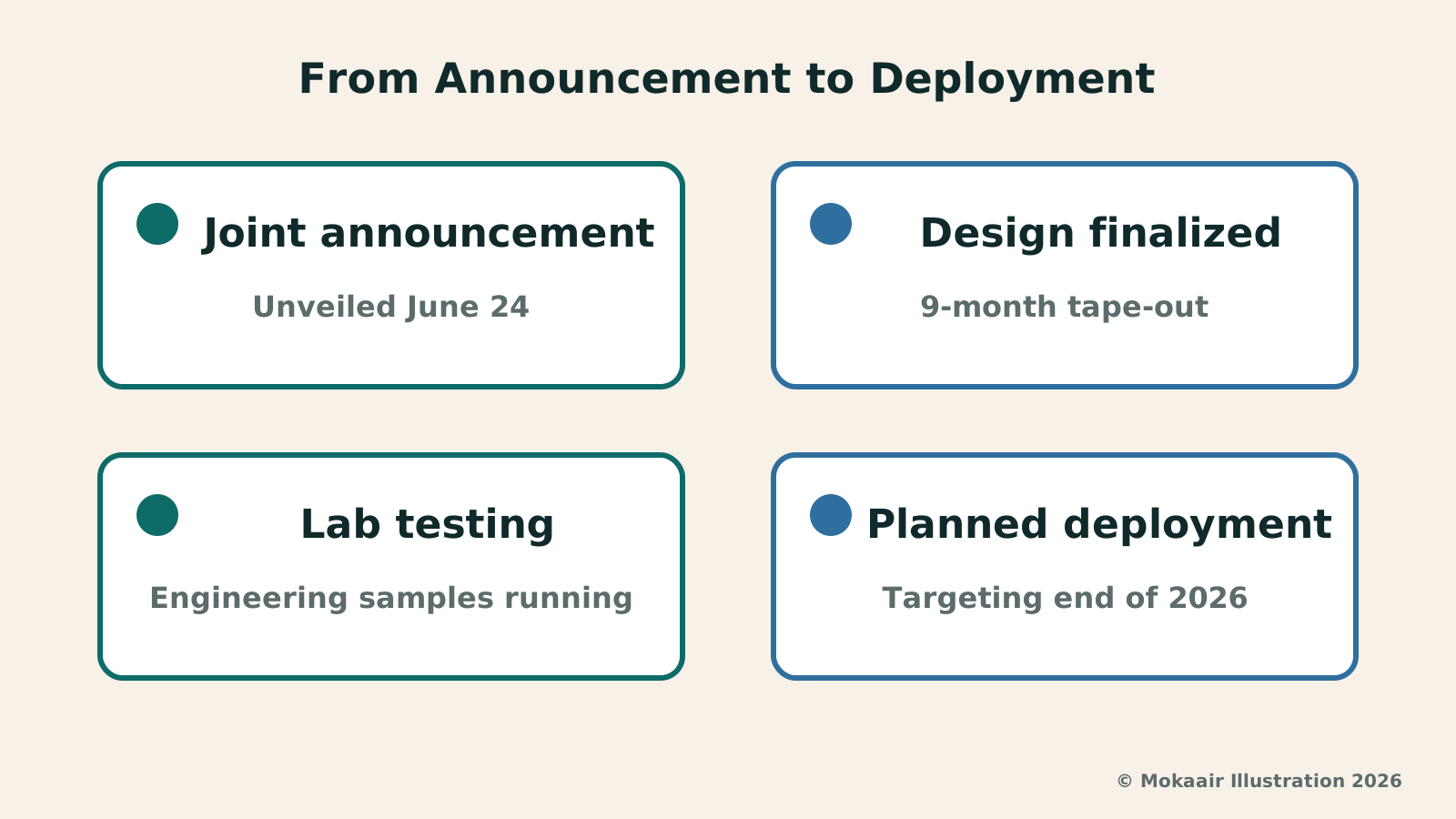
Both official articles contain a pair of statements that look similar but are not the same: the bullet points say the chip went from design to “production” in just nine months, while the body text says it went “from initial design to manufacturing tape-out in just nine months.” Tape-out is the stage where a chip's design is finalized and handed off for manufacturing; it is not the same as already being in mass production and shipping. Both articles' own subheading also reads “Nine-month tape-out.” Going by the body text and the subheading, what the two companies are saying is that tape-out was completed within nine months, not that mass production was completed within nine months; this figure, too, is the companies' own statement.
The companies say that, for now, engineering samples are running machine-learning workloads, including GPT-5.3-Codex-Spark, in the lab at production-target frequency and power. Both articles stop there — neither says how these samples relate to a shipping product, and neither gives a shipping or launch date. Performance is described only in directional terms so far: OpenAI says it is “still measuring final performance,” and early testing shows performance per watt “substantially better than current state-of-the-art,” but neither article defines what “current state-of-the-art” means or names any vendor; the companies say a detailed technical report will be presented “in the coming months.”
For the same claim about the “fastest ASIC development cycle,” the two companies hedge it differently: Broadcom's own wording is “what may be the fastest ASIC development cycle ever achieved in high-performance advanced semiconductors,” while OpenAI's own article uses “what we believe to be” for the identical sentence. Both versions are hedged, and this article presents them side by side exactly as written rather than merging them.
Deployment timing and an earlier collaboration: two announcements, not to be mixed up
Both official articles describe the deployment scale only as “gigawatt scale,” with no gigawatt figure, chip count, or data-center location given; the official line is that this multi-generation platform is “designed for initial deployment by the end of 2026, and expanding in the years ahead.” Hock Tan names Microsoft as one data-center partner, in his own words: “we are enabling the deployment of gigawatt scale data centers with Microsoft and other partners beginning in 2026.” Microsoft is the only data-center partner named by name in either official article; everyone else is referred to only as “other partners.”
This deployment timeline carries a caveat that is easy to miss: at the end of its press release, Broadcom includes a “forward-looking statements” notice required under U.S. securities law, which explicitly lists “the deployment of gigawatt scale data centers” as one of the forward-looking statements and states that “undue reliance should not be placed on such statements.” In other words, Broadcom itself is acknowledging that this timeline is a plan that has not happened yet and could change.
Also to be kept separate is an earlier announcement from October 13, 2025: the two companies then announced a collaboration to deploy 10 gigawatts of custom AI accelerators, stating that Broadcom's deployment of racks was “targeted to start in the second half of 2026, to complete by end of 2029,” and that the two sides had signed a term sheet to deploy the racks; that announcement also stated that OpenAI had, at that time, “grown to over 800 million weekly active users.” The June 2026 article does not repeat the “10 gigawatts” figure and does not state that Jalapeño is that accelerator — these are two separate announcements, and they should not be treated as the same thing.
How to read this announcement: what is fact and what is the companies' own words
This announcement mixes three different kinds of content: externally observable facts, such as both companies publishing official articles on June 24 and exactly where the wording of the two differs; statements that are visible only inside the companies and cannot be verified from outside, such as tape-out being completed in nine months, engineering samples running in the lab, “performance per watt substantially better than current state-of-the-art,” and “over 800 million weekly active users”; and plans for the future, such as the deployment timeline, which even Broadcom itself warns not to over-rely on.
Both official articles contain one sentence that is often over-read: “If AI can help engineers design better chips faster, it can lower the cost of compute across the industry and help democratize access to advanced AI.” This sentence opens with “if,” is about the industry as a whole, carries no number or percentage, and does not say how much cheaper Jalapeño itself is. As checked through September 18, 2026, neither article contains any cost-savings percentage of any kind.
As checked through September 18, 2026, neither official article states the chip's manufacturing process, which foundry makes it, the memory type and capacity, or its power draw in watts, and neither makes any direct comparison with an NVIDIA chip or any other vendor's chip. OpenAI's article does have one undated, conditional sentence saying that improvements in cost, speed, and reliability “can show up as” a faster ChatGPT reply, an API product that is cheaper to build, and more; beyond that, no sentence states on what date users would notice any difference.
Frequently asked questions
Can I buy or rent the Jalapeño chip right now?
Neither official article mentions the chip being sold, rented, or offered to any company besides OpenAI, and neither names a third-party customer or announces any way to order one. According to the companies, its current status is that engineering samples are running machine-learning workloads in the lab; neither of the June 24 official articles states any shipping or launch date.
Is Jalapeño faster than NVIDIA's chips? How much cheaper is it?
The official articles don't answer this question. OpenAI and Broadcom say only that Jalapeño's performance per watt is “substantially better than current state-of-the-art,” but they don't define which chip “current state-of-the-art” refers to, and they don't name NVIDIA or any other vendor, let alone publish any test figures or price comparison. The companies say a detailed technical performance report will be published in the coming months.
Does this mean OpenAI will only use its own chips from now on, and drop other vendors' chips?
Neither official article says that. The announcement is about OpenAI having designed a custom chip for inference on its own models; it does not say OpenAI will stop using other suppliers' chips or compute platforms — the official articles simply don't address that question at all.
Is Jalapeño the same thing as the “10-gigawatt” collaboration from 2025?
No, it's not the same announcement. The October 13, 2025 announcement covers a multi-year collaboration to deploy 10 gigawatts of custom AI accelerators, with Broadcom's deployment of racks “targeted to start in the second half of 2026, to complete by end of 2029.” The June 24, 2026 announcement unveils the Jalapeño chip itself, but it does not repeat that 10-gigawatt figure and does not explicitly say Jalapeño is the accelerator to be deployed under that collaboration. The two should be treated as separate and should not be assumed to be the same thing.
Will this make the ChatGPT I use faster or cheaper?
OpenAI's article has one conditional sentence saying that every improvement in cost, speed, and reliability “can show up as” a faster ChatGPT reply, a Codex task that needs less waiting, an API product that is cheaper to build, and more — but that sentence carries no date, no percentage, and no guarantee, and it doesn't say the improvement comes from Jalapeño specifically. According to the companies, Jalapeño is currently still at the lab-testing stage, and there is still a planned timeline between that and deployment into an actual service.
What is an “Intelligence Processor,” and how is it different from a GPU?
This is the official name Broadcom and OpenAI chose for Jalapeño; as checked through September 18, 2026, the word “GPU” does not appear in the body of either official article. Officially, the chip is described as designed for modern large-language-model inference rather than as a general-purpose accelerator adapted from other, older AI workloads — but the official articles don't publish the manufacturing process, transistor count, or other technical specifications, so this article cannot compare its specific hardware design against a GPU's any further.
2026 AI News Roundup: Highlights and Daily Life Applications from January to September2026 AI News Roundup: Highlights and Daily Life Applications from January to SeptemberOrganizing key AI news stories month by month from January to September 2026, linking to full analyses in five languages. Covering models, work tools, creation, costs, and transparency, explaining backgrounds, uses, and limits.Read the full article
OpenAI Discloses Habitat Storage Architecture: The Scale and Limits Behind Over 1 Billion Weekly UsersOpenAI Discloses Habitat Storage Architecture: The Scale and Limits Behind Over 1 Billion Weekly UsersOn September 11, 2026, OpenAI published an engineering-blog post describing how its storage platform, Habitat, evolved from a Python client library into an independent service, and was rewritten in Rust in the second quarter of this year. This article sets out the request-volume, regional-coverage, and data-volume figures OpenAI states, plus the durability and regional details it omits; this site has not tested any of this and offers no advice on using or buying anything.Read the full article
Lifestyle
OpenAI Discloses Habitat Storage Architecture: The Scale and Limits Behind Over 1 Billion Weekly Users
On September 11, 2026, OpenAI published an engineering-blog post describing how its storage platform, Habitat, evolved from a Python client library into an independent service, and was rewritten in Rust in the second quarter of this year. This article sets out the request-volume, regional-coverage, and data-volume figures OpenAI states, plus the durability and regional details it omits; this site has not tested any of this and offers no advice on using or buying anything.
Lifestyle
OpenAI Raises $122 Billion: What the Announcement Promises, and What It Doesn't
On March 31, 2026, OpenAI announced that it had closed a funding round of $122 billion in committed capital at a post-money valuation of $852 billion. Drawing on official announcements from OpenAI, SoftBank and Amazon, this article sets out who put up the money, how the committed capital is being paid in over time, and what the announcement does not promise — for example, whether ChatGPT will get faster or cheaper because of it. It offers no investment judgment. Checked on September 18, 2026.
Lifestyle
OpenAI Confidentially Submits a Draft S-1: What the One-Line Announcement Doesn't Say
On June 8, 2026, OpenAI confirmed it had confidentially submitted a draft S-1 to the SEC, with no decision yet on timing. Based on OpenAI's announcement, the Securities Act of 1933's confidential-submission rules, and a May 2026 SEC proposed rule, this article explains what the announcement does and does not represent, and confirms by full-text search that, as of the check date, no public registration statement under OpenAI's filer name could be found.
Lifestyle
NVIDIA launches DGX Spark 64GB: on sale October 23 from $4,999, two units can be linked into 128GB
On October 2, 2026, NVIDIA announced a more affordable 64GB memory version of its DGX Spark personal AI computer, available from October 23 through six makers including Acer and ASUS. It is aimed mainly at developers and researchers who want to run AI models on their own machines. Below we summarize the specs NVIDIA published, its claims about linking two units, and what it means for general readers.
Articles that cite this one
Latest travel guides

GuideTokyo
Where to Stay in Tokyo: Comparing Shinjuku, Ueno, Tokyo Station, Shibuya, Asakusa, Ikebukuro, and Ginza, Plus Airport Access, Accommodation Tax, and Luggage Delivery
Where should you stay in Tokyo? Compare Shinjuku, Ueno, Tokyo Station, Shibuya, Asakusa, Ikebukuro, and Ginza by the same criteria: access from Narita and Haneda, transit routes, nearby attractions, neighborhood character, and who each area suits. Includes a comparison table, a Yamanote Line diagram, Tokyo’s accommodation tax as verified in 2026/9 (changing to 3% in 2027/4), and Airport TA-Q-BIN luggage shipping rules.
- Budget
- Hotels

GuideTokyo
How to Choose Tokyo Transit Passes: Are Suica, Welcome Suica, the Tokyo Subway Ticket, and the JR Pass Worth It?
On a first Tokyo trip, start with an IC card and pay per ride (Welcome Suica has no deposit and is valid for 28 days). If you take four or more subway rides in a day, add a 72-hour Tokyo Subway Ticket for 2,000 yen; a JR Pass is never worthwhile if you stay in Tokyo and do not go to Kansai. See what TOURIST PASMO, Suica on iPhone, and the Tokyo Metro day pass do and do not cover, with a decision chart. Prices verified in September 2026.
- Transport
- Budget

GuideTokyo
Tokyo Disneyland and DisneySea Guide: Ticket Prices, Fantasy Springs, Disney Premier Access (DPA), Standby Pass, and Which Park to Choose for Your First Visit
Tokyo Disney one-day Passport prices vary: most weekdays in 9/2026 cost ¥9,900 and weekends ¥10,900. At 14:00 daily, tickets go on sale for the same date two months later. Free Priority Pass is no longer on the official service list; only paid Disney Premier Access (¥1,000–3,500 per person per use) shortens waits. Covers hours, the 25th anniversary, Standby Pass, Entry Request, Fantasy Springs access and first-visit park choice; checked on the official site in 9/2026.
- Itineraries
- Family