Lifestyle
GPT-5.5 Moves Toward Multi-Step Work: Turning Vague Needs into Verifiable Deliverables
Reviewing the context of OpenAI's GPT-5.5 release in 2026, exploring how teams break down vague long-horizon tasks into verifiable deliverables while establishing clear human checkpoints and quality metrics.
Updated: About 7 min read
Event date: 2026-04-23; Verification date for this article: 2026-09-14. On April 23, GPT-5.5 was released, emphasizing long-horizon tasks across coding, online research, data analysis, documents, spreadsheets, and software operations.
The announcement claimed improved capabilities with per-token latency comparable to GPT-5.4, and fewer tokens used for Codex tasks; this does not guarantee identical time spent or costs for every user. The initial ChatGPT/Codex rollout was phased, and an April 24 update confirmed API availability for GPT-5.5 and Pro. The page has linked forward to the subsequent GPT-6; this article focuses on the shifts announced in April, and current plans cannot be inferred from older articles. The following life and work scenarios are examples designed by the editors for readers to verify on their own, not hands-on product benchmarks conducted by this site.
Demarcating Clear Boundaries Between Vague Expectations and Autonomous Decisions
In real-world office scenarios, requests from business units are often quite rough. Taking a non-profit association organizing an annual forum as an example, administrative staff might receive only a single directive stating the need to assemble a completely new sponsorship package, encompassing a project overview, a sponsorship benefits table, and draft outreach emails for potential corporate sponsors. Faced with such open-ended tasks, long-horizon models can certainly generate the entire suite of materials in one go, but operators must clearly realize that the context filled in by algorithms is fundamentally just conjecture. A model's ability to digest vague semantics does not grant it the authority to decide external commitments on behalf of an organization.
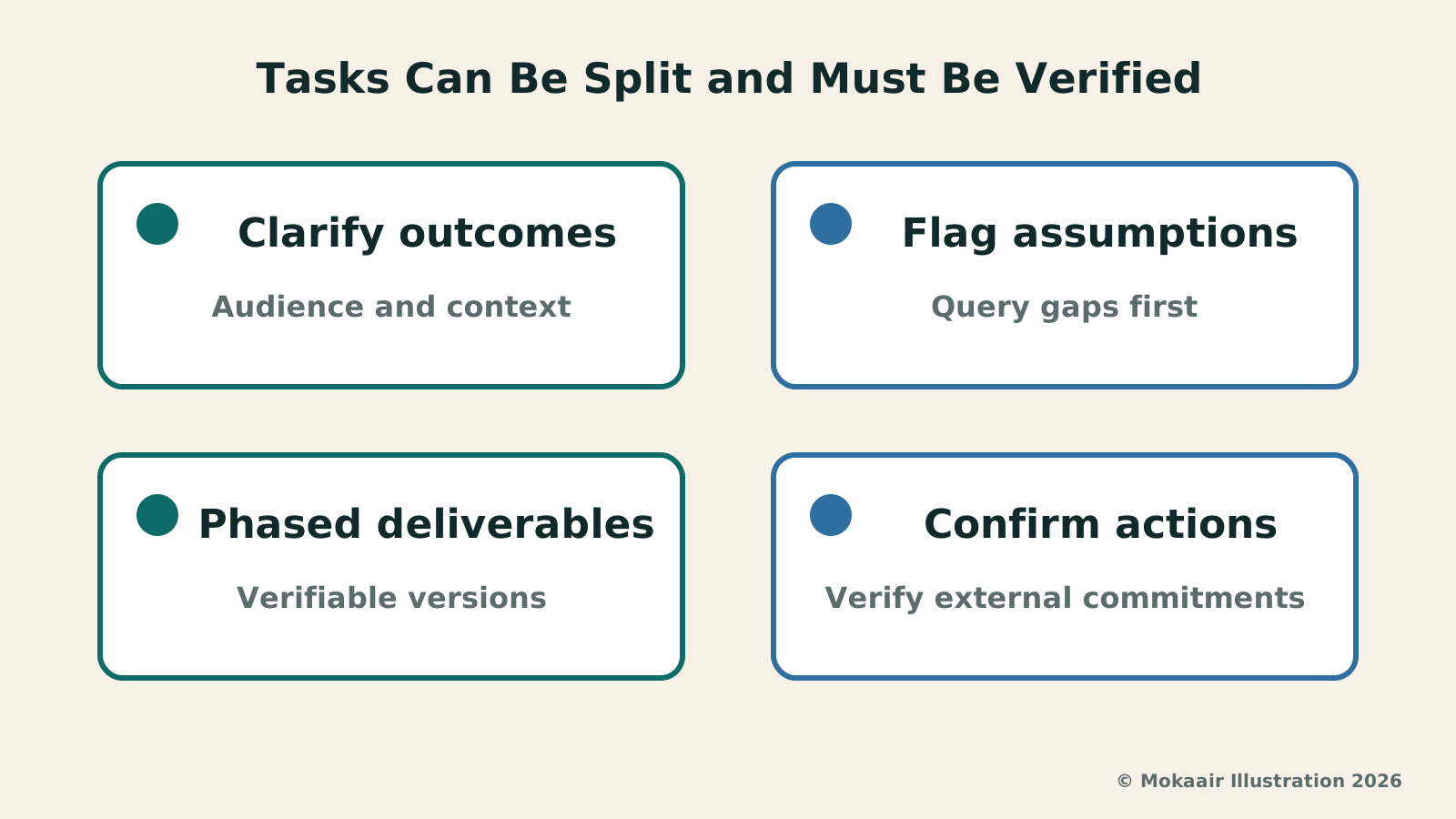
If facts and unconfirmed assumptions are not flagged at the initial stage, the system might arbitrarily insert unrealistic sponsorship benefit details, such as promising prime booth locations or speaker slots. Once such unauthorized decisions flow into downstream workflows, they substantially increase the burden of cross-departmental proofreading. A sensible approach is to require the model right at the task's start to isolate and list undefined variables, locking down non-negotiable business principles, so that automation focuses on formatting transformation and information organization rather than blindly making commercial concessions on behalf of decision-makers.
Establishing Necessary Checkpoints for Budget Commitments and External Communications
The core vulnerability of multi-step collaboration lies in errors easily snowballing as steps progress. The benefits table in a sponsorship package often involves tangible resource costs, such as VIP banquet seats, forum brochure ad print pages, and exclusive backdrop exposure. If an automated workflow is allowed to run directly from an outline to sending emails, any minor numerical typo could turn into a legally binding external quoting risk. Therefore, building unskippable human checkpoints into workflow design is an essential line of defense for safeguarding professional credibility.
In practice, the association should clearly divide material generation into three review checkpoints: stage one reviews only the project overview structure and alignment with target audiences; stage two strictly verifies budget caps and promised items in the sponsorship benefits spreadsheet; stage three proceeds to polish the email drafts. Only after internal organizers sign off on each item in stage two should the system be allowed to load the confirmed data to generate outbound texts. Physically isolating external commitments from automated generation mechanisms prevents the hazard of the model granting excessive corporate perks on its own due to hallucinations or misunderstandings.
| Collaboration Stage | Potential Escalation Risk | Mandatory Acceptance Criteria |
|---|---|---|
| Requirement definition and outline decomposition | Algorithm arbitrarily invents sponsorship tiers and unexpected perks | Flag assumptions item by item and confirm with project lead |
| Benefit structure and spreadsheet calculation | Resource cost overruns or benefit promises exceeding budget limits | Cross-check financial guidelines and calculate physical resource capacity |
| Polishing and drafting corporate outreach emails | Over-promising tone or semantic ambiguity in key terms | Verify consistency of commercial terms and obtain sales lead approval |
| External dispatch and document archiving | Sent to incorrect recipients or published without authorization | Restricted to dedicated personnel manually triggering dispatch and archiving |
Replacing Vague Efficiency Metrics with Total Revision Cost Thinking
When evaluating the benefits of adopting long-horizon task collaboration, traditionally merely calculating how many minutes were saved generating a first draft often conceals serious hidden costs. If simply pursuing first-draft speed results in missing information or logical contradictions, the time spent on subsequent manual debugging and repeated cross-departmental confirmations usually far exceeds the cost of writing from scratch. Truly scientific performance measurement should focus on the total expenditure for qualified delivery, including compute API call costs, the frequency of revisions by internal colleagues, and whether the final deliverable omits critical compliance requirements.
When a sponsorship proposal must be overturned and redone three times before being finalized, the overall collaboration is a failure and expensive regardless of how fast the model generates it. By compiling statistics on specific reasons for each revision—such as numerical calculation errors, non-compliant tone, or omission of exit clauses—teams can work backward to refine acceptance specifications for initial inputs. Anchoring on the stability of tangible deliverables encourages staff to move past the illusion of one-click completion and instead prioritize precise input of upfront constraints, fundamentally reducing hidden working hours wasted on downstream debugging.
Establishing Phased Inspection and Version Tracking Delivery Standards
To ensure multi-step tasks do not spin out of control or veer off course, decomposing large projects into smaller modules with independent acceptance criteria is a highly effective engineering method. When producing a sponsorship package, rather than attempting to request the final product all at once, instruct the system to produce a structural outline first, expand into spreadsheet calculations after passing inspection, and draft emails only at the final stage. Every sub-stage must include clear version tags documenting the underlying data sources referenced by the current output, allowing every collaborator to clearly track the evolutionary context.
This phased delivery model allows reviewers to conduct inspections in very little time. For instance, when auditing a spreadsheet module, the audit focus only needs to be on whether field definitions are consistent and whether sum totals are logically correct, without being distracted by email rhetoric. Once a deviation is found in a specific data tier, only that specific module needs to be sent back for restructuring, avoiding scrapping the entire document to start over. Through version tracking mechanisms, teams can also compare differences before and after modifications at any time, ensuring the model does not drop previously confirmed critical agreements during subsequent revision processes.
Permission Separation and Audit Defenses for Irreversible External Actions
Sending out a sponsorship package affects external recipients, and mistaken commitments or attachments may not be easily recalled. In this scenario, the model's work can be restricted to draft preparation first, with outbound dispatch authorized only after verification by the person in charge. This is the workflow arrangement adopted in this case study, and it does not mean that all products can never send emails automatically; in actual operations, confirmation methods should be determined based on authorizations, tool limitations, and consequences.
Beyond email dispatch, any step involving writes to external databases or contract template updates similarly requires establishing detailed audit logs. Before clicking confirm, reviewers should verify that email subjects, recipient lists, and body attachments completely match the original budget guidelines. By enforcing human gatekeeping for irreversible actions, organizations can fully leverage the model's powerful content synthesis capabilities while erecting a robust risk firewall to ensure all external business interactions align with established organizational authorizations and legal compliance requirements.
2026 AI News Roundup: Highlights and Daily Life Applications from January to September2026 AI News Roundup: Highlights and Daily Life Applications from January to SeptemberOrganizing key AI news stories month by month from January to September 2026, linking to full analyses in five languages. Covering models, work tools, creation, costs, and transparency, explaining backgrounds, uses, and limits.Read the full article
Gemini Omni Debuts at I/O: Conversational Video Edits Still Demand CareGemini Omni Debuts at I/O: Conversational Video Edits Still Demand CareReviewing Gemini Omni's conversational video editing unveiled at Google I/O. Using self-shot pottery clips as a case study, we examine shot continuity, multi-turn prompt drift, and asset licensing.Read the full article
Lifestyle
NVIDIA launches DGX Spark 64GB: on sale October 23 from $4,999, two units can be linked into 128GB
On October 2, 2026, NVIDIA announced a more affordable 64GB memory version of its DGX Spark personal AI computer, available from October 23 through six makers including Acer and ASUS. It is aimed mainly at developers and researchers who want to run AI models on their own machines. Below we summarize the specs NVIDIA published, its claims about linking two units, and what it means for general readers.
Lifestyle
Google Cloud Launches Spanner Queues: Putting Message Queues Inside Database Transactions to Make AI Agents More Reliable
Google Cloud has announced the general availability of Spanner queues, which make message creation part of a database transaction. The aim is to stop AI agents' "state" and "actions" from falling out of sync. This article covers Google Cloud's claims, the main features, and what it means for general readers.
Lifestyle
GPT-6.1 Sol Launches: New Sol Version in the API, Codex and ChatGPT Work, Not in Chat
OpenAI launched GPT-6.1 Sol on September 29, 2026, with the API name gpt-6.1-sol. The launch rollout covers Codex and ChatGPT Work on Plus, Pro, Business, Enterprise and Edu (Enterprise and Edu need an administrator to enable it); Free and Go are not included at launch, and it is not in Chat (checked September 2026).
Lifestyle
Claude Sonnet 5.5 Launches: Same List Price as Sonnet 5, Available in the API, on Cloud Platforms and in Claude.ai
Anthropic launched Claude Sonnet 5.5 on September 28, 2026. API list prices are the same as Sonnet 5 ($2 per million input tokens, $10 per million output tokens). It is available in Claude.ai, the API and several cloud platforms, and higher-risk cybersecurity requests fall back to Sonnet 5 (checked September 2026).
Articles that cite this one
Latest travel guides

GuideTokyo
Where to Stay in Tokyo: Comparing Shinjuku, Ueno, Tokyo Station, Shibuya, Asakusa, Ikebukuro, and Ginza, Plus Airport Access, Accommodation Tax, and Luggage Delivery
Where should you stay in Tokyo? Compare Shinjuku, Ueno, Tokyo Station, Shibuya, Asakusa, Ikebukuro, and Ginza by the same criteria: access from Narita and Haneda, transit routes, nearby attractions, neighborhood character, and who each area suits. Includes a comparison table, a Yamanote Line diagram, Tokyo’s accommodation tax as verified in 2026/9 (changing to 3% in 2027/4), and Airport TA-Q-BIN luggage shipping rules.
- Budget
- Hotels

GuideTokyo
How to Choose Tokyo Transit Passes: Are Suica, Welcome Suica, the Tokyo Subway Ticket, and the JR Pass Worth It?
On a first Tokyo trip, start with an IC card and pay per ride (Welcome Suica has no deposit and is valid for 28 days). If you take four or more subway rides in a day, add a 72-hour Tokyo Subway Ticket for 2,000 yen; a JR Pass is never worthwhile if you stay in Tokyo and do not go to Kansai. See what TOURIST PASMO, Suica on iPhone, and the Tokyo Metro day pass do and do not cover, with a decision chart. Prices verified in September 2026.
- Transport
- Budget

GuideTokyo
Tokyo Disneyland and DisneySea Guide: Ticket Prices, Fantasy Springs, Disney Premier Access (DPA), Standby Pass, and Which Park to Choose for Your First Visit
Tokyo Disney one-day Passport prices vary: most weekdays in 9/2026 cost ¥9,900 and weekends ¥10,900. At 14:00 daily, tickets go on sale for the same date two months later. Free Priority Pass is no longer on the official service list; only paid Disney Premier Access (¥1,000–3,500 per person per use) shortens waits. Covers hours, the 25th anniversary, Standby Pass, Entry Request, Fantasy Springs access and first-visit park choice; checked on the official site in 9/2026.
- Itineraries
- Family
Sources
- OpenAI: GPT-5.5 Announcement · Checked: