Lifestyle
Claude Opus 4.6 and Long Context: Reading Vast Data In, Retrieving It Accurately Out
Analyzing application boundaries of long-context models for massive document sorting. Using a condo management committee's multi-year quotes as an example, we examine token metrics, grouped querying, and manual spot-check workflows.
Updated: About 7 min read
Event date: 2026-02-05; Verification date for this article: 2026-09-14. On February 5, Opus 4.6 was released, emphasizing coding, research, and document workflows; Opus offered a 1M token context beta for the first time.
The announcement also introduced adaptive thinking, effort, and API context compaction. Initial availability includes Claude, the API, and major cloud platforms; the 1M beta is not a shared ceiling across all chat accounts. Benchmark scores are Anthropic evaluations, and long-context capacity cannot be equated with an absence of omissions or comprehension errors. The daily life and work scenarios below are editorially designed examples for readers to verify on their own, not this site's hands-on product tests.
Clarifying Token Metric Realities and Compression Risks
Tokens are the text fragment units models use when processing content, and they do not correspond in a fixed one-to-one ratio with a Chinese character or an English word. Different languages, symbols, and document formats generate varying consumption levels, so one cannot simply treat one million tokens as one million Chinese characters. When evaluating a batch of documents, you can first confirm the approximate usage via the measurement method provided by your chosen tool, and then leave buffer space for queries and responses rather than merely looking at page counts.
Furthermore, while the official context compaction technique helps streamline excessively long information, summarization and compression inherently run a strong risk of losing detail. During this process, key specifics such as custom component specifications, construction safety notes, or additional payment clauses are very likely filtered out during semantic distillation. If users fail to establish a structured input strategy in advance and simply feed years of unorganized contracts directly into the model, supporting evidence for disputes can easily be lost in compression, leading to distorted conclusions.
Establishing a Structured Document Registry and Timeline
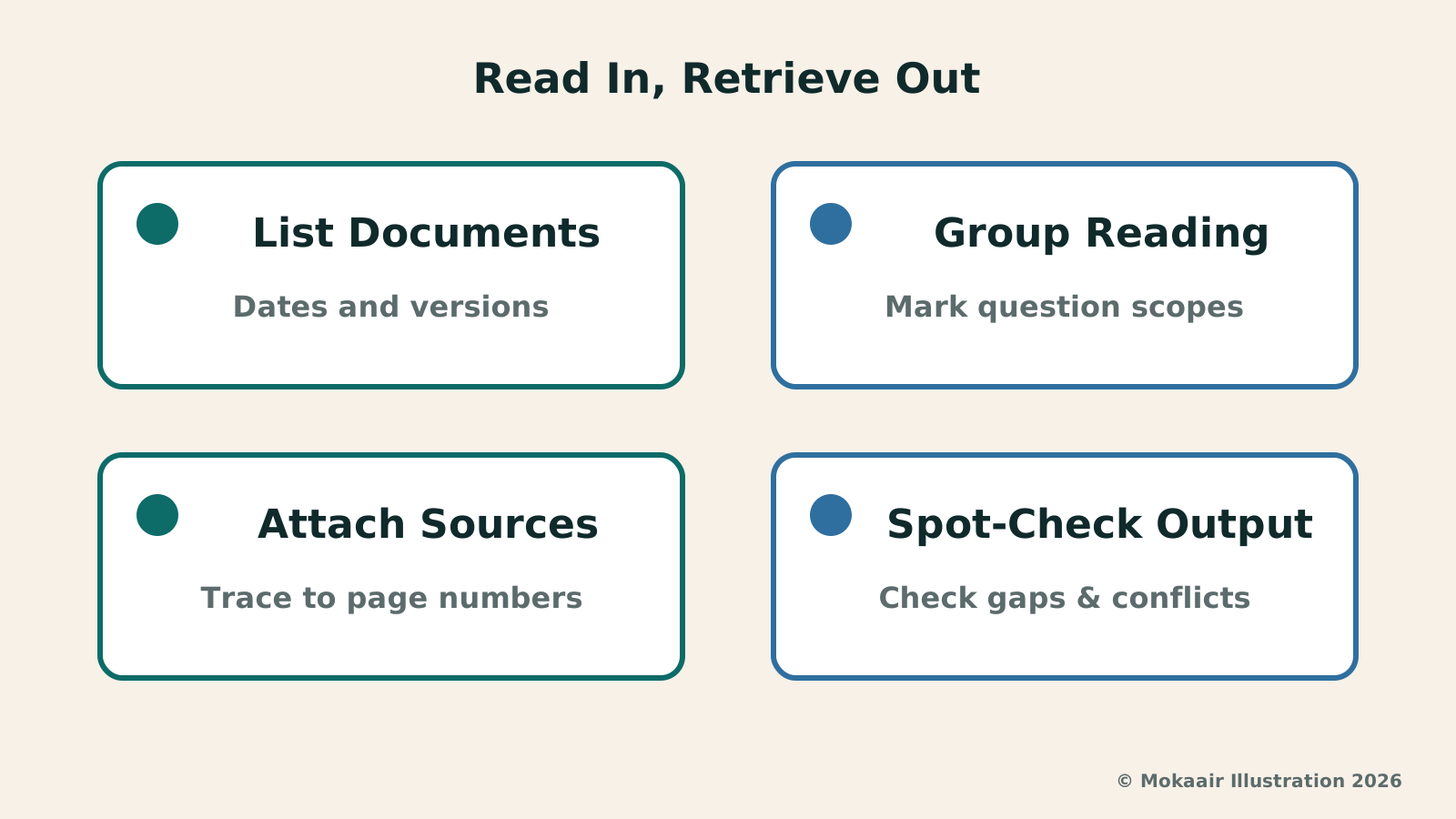
Take a condo management committee preparing to replace elevator steel cables as an example: the committee often holds accumulated quotes and maintenance logs from different vendors across multiple years. If all these unorganized scanned files are uploaded directly into the system, the model can easily become confused between timelines and vendor lists. A more grounded practice is to prepare a clear document inventory before feeding materials into the model, concretely listing each document's filing date, version number, original page range, and repair items to establish unified retrieval coordinates.
The core purpose of this preliminary workflow is to give sprawling materials clear chronological order and responsibility tags. When committee members input the organized inventory alongside the quotation content, they can first request that the model perform small-scale summaries based on specific date intervals, rather than drawing inferences across many years at once. Explicitly marking start and end page numbers and field names for every file effectively lowers the chances of model mix-ups while providing an accurate, dependable baseline for subsequent manual checks.
| Processing Stage | Practical Operational Focus | Potential Risks and Safeguards |
|---|---|---|
| Upfront Preparation | Build a document list with dates, version numbers, and page numbers to set retrieval coordinates. | Raw uploads confuse timelines; complete labeling before running analysis. |
| Content Input | Group quotes by engineering category for batch queries, explicitly marking document ID ranges. | Excessive single inputs may trigger context compaction and lose detail; limit comparison scopes. |
| Result Output | Require the model to cite original file sources and page numbers when listing amounts and schedules. | Smooth but baseless inferences arise; place claims lacking page citations on a pending review list. |
| Manual Verification | Spot-check high-value items and disputed years; instruct model to flag cross-document conflicts. | Over-relying on automated summaries misses disclaimers; enforce manual spot-checks as final guard. |
Narrowing Comparison Scopes by Engineering Category
When facing an extensive, multi-year quote history, breaking long texts into grouped reading workflows is often far more robust than a single massive input. Users can partition reading batches by project category or annual phase—for instance, separating machine room control board replacements from routine steel cable maintenance as independent tasks. When querying, explicitly define question scopes, instructing the system to extract terms and compare items strictly based on specified document numbers to prevent the model from cobbling together vague, out-of-period info from its memory.
Once scopes are narrowed, comparison focal points become easier to articulate clearly—such as whether labor is billed separately or whether scrap disposal is included in the total price. This is a design approach for organizational tasks; it cannot be presumed to automatically trigger specific thinking depth settings. If your tool offers effort- or thinking-related options, you can hold them constant across the same dataset for comparison; when such options are absent, you can still improve verification through explicit queries and source tagging.
Insisting on Source Paragraphs and Page Numbers
Expanded long-context processing capabilities can easily instill excessive trust in users, leading them to assume summary tables produced by the model are entirely correct. In practical workflows, you must mandate that whenever the model presents any conclusion, monetary amount, or construction schedule, it simultaneously attaches the original paragraph source, including file name, year, and specific page number. If the model cannot pinpoint exactly which field of which document a payment originates from, that conclusion must be flagged as questionable and cannot directly serve as a basis for decision-making.
Requiring the model to trace back to paragraph page numbers is a vital defense line against distorted long-document comprehension. When committee members see a summary table noting that a quote for vibration dampening pads appears on page four of a specific contract, they can immediately flip open the paper binder to verify the original, checking whether that quote carried other construction prerequisites or exclusion clauses. As long as asking for concrete citations becomes a routine prompting habit, you can cut off ungrounded assertions and ensure all decision discussions rest on objective, verifiable evidence.
Implementing Spot-Checks and Identifying Discrepancies
After completing an initial synthesis, establishing a random sampling review mechanism is an indispensable safeguard for maintaining outcome quality. Committee members can pick the three highest-value projects along with two years exhibiting greater scheduling disputes to personally check whether the model's statements match scanned originals. Spot-checks should focus on tax calculation methods, warranty term limits, and penalty clauses for breach of contract—clauses easily smoothed over by semantic compression—to objectively evaluate the model output's true reliability.
Furthermore, multi-year files often contain conflicting information; for example, meeting minutes from one year may state the vendor promised a free warranty, whereas the following year's billing invoice charges for parts. In prompt design, you can specifically instruct the model to highlight contradictions and discrepancies across different documents, rather than forcing it to deliver a smoothed, conflict-free single conclusion. Directing the model to focus on identifying record disparities across versions, rather than arbitrating disputes in place of humans, puts the value of long-context analysis tools right where it matters.
Long-context technology expands the sheer breadth of multi-document processing, but when it comes to critical decisions involving expenditures and accountability, rigorous human verification processes remain irreplaceable. By employing the threefold safeguard of front-end document registries, mid-stage grouped reading, and back-end spot-checking, teams can enjoy the benefits of efficient model organization while effectively avoiding potential omissions and misinterpretations—ensuring every data comparison withstands real inspection and scrutiny.
2026 AI News Roundup: Highlights and Daily Life Applications from January to September2026 AI News Roundup: Highlights and Daily Life Applications from January to SeptemberOrganizing key AI news stories month by month from January to September 2026, linking to full analyses in five languages. Covering models, work tools, creation, costs, and transparency, explaining backgrounds, uses, and limits.Read the full article
GPT-5.3-Codex Launched: How AI Coding Moves Toward Deliverable WorkGPT-5.3-Codex Launched: How AI Coding Moves Toward Deliverable WorkExploring how OpenAI's early 2026 release of GPT-5.3-Codex affects software delivery workflows for non-technical readers and small teams, offering clear requirement breakdown and acceptance methods.Read the full article
Lifestyle
NVIDIA launches DGX Spark 64GB: on sale October 23 from $4,999, two units can be linked into 128GB
On October 2, 2026, NVIDIA announced a more affordable 64GB memory version of its DGX Spark personal AI computer, available from October 23 through six makers including Acer and ASUS. It is aimed mainly at developers and researchers who want to run AI models on their own machines. Below we summarize the specs NVIDIA published, its claims about linking two units, and what it means for general readers.
Lifestyle
Google Cloud Launches Spanner Queues: Putting Message Queues Inside Database Transactions to Make AI Agents More Reliable
Google Cloud has announced the general availability of Spanner queues, which make message creation part of a database transaction. The aim is to stop AI agents' "state" and "actions" from falling out of sync. This article covers Google Cloud's claims, the main features, and what it means for general readers.
Lifestyle
GPT-6.1 Sol Launches: New Sol Version in the API, Codex and ChatGPT Work, Not in Chat
OpenAI launched GPT-6.1 Sol on September 29, 2026, with the API name gpt-6.1-sol. The launch rollout covers Codex and ChatGPT Work on Plus, Pro, Business, Enterprise and Edu (Enterprise and Edu need an administrator to enable it); Free and Go are not included at launch, and it is not in Chat (checked September 2026).
Lifestyle
Claude Sonnet 5.5 Launches: Same List Price as Sonnet 5, Available in the API, on Cloud Platforms and in Claude.ai
Anthropic launched Claude Sonnet 5.5 on September 28, 2026. API list prices are the same as Sonnet 5 ($2 per million input tokens, $10 per million output tokens). It is available in Claude.ai, the API and several cloud platforms, and higher-risk cybersecurity requests fall back to Sonnet 5 (checked September 2026).
Articles that cite this one
Latest travel guides

GuideTokyo
Where to Stay in Tokyo: Comparing Shinjuku, Ueno, Tokyo Station, Shibuya, Asakusa, Ikebukuro, and Ginza, Plus Airport Access, Accommodation Tax, and Luggage Delivery
Where should you stay in Tokyo? Compare Shinjuku, Ueno, Tokyo Station, Shibuya, Asakusa, Ikebukuro, and Ginza by the same criteria: access from Narita and Haneda, transit routes, nearby attractions, neighborhood character, and who each area suits. Includes a comparison table, a Yamanote Line diagram, Tokyo’s accommodation tax as verified in 2026/9 (changing to 3% in 2027/4), and Airport TA-Q-BIN luggage shipping rules.
- Budget
- Hotels

GuideTokyo
How to Choose Tokyo Transit Passes: Are Suica, Welcome Suica, the Tokyo Subway Ticket, and the JR Pass Worth It?
On a first Tokyo trip, start with an IC card and pay per ride (Welcome Suica has no deposit and is valid for 28 days). If you take four or more subway rides in a day, add a 72-hour Tokyo Subway Ticket for 2,000 yen; a JR Pass is never worthwhile if you stay in Tokyo and do not go to Kansai. See what TOURIST PASMO, Suica on iPhone, and the Tokyo Metro day pass do and do not cover, with a decision chart. Prices verified in September 2026.
- Transport
- Budget

GuideTokyo
Tokyo Disneyland and DisneySea Guide: Ticket Prices, Fantasy Springs, Disney Premier Access (DPA), Standby Pass, and Which Park to Choose for Your First Visit
Tokyo Disney one-day Passport prices vary: most weekdays in 9/2026 cost ¥9,900 and weekends ¥10,900. At 14:00 daily, tickets go on sale for the same date two months later. Free Priority Pass is no longer on the official service list; only paid Disney Premier Access (¥1,000–3,500 per person per use) shortens waits. Covers hours, the 25th anniversary, Standby Pass, Entry Request, Fantasy Springs access and first-visit park choice; checked on the official site in 9/2026.
- Itineraries
- Family
Sources
- Anthropic: Claude Opus 4.6 · Checked:
- Anthropic: Model Status and Deprecation Timelines · Checked: