Lifestyle
Claude Sonnet 5: Balancing Capability and Cost in Daily Work
Using weekly customer service FAQ compilation as a scenario, this article explores Claude Sonnet 5's reasoning effort, retry rates, and trade-offs for qualified delivery costs.
Updated: About 7 min read
Event date: 2026-06-30; article verification date: 2026-09-14. On June 30, Sonnet 5 was released, emphasizing planning, tool use, coding, and knowledge work; it was launched across all plans and set as the default for Free and Pro.
The official claim states it approaches some of Opus 4.8's performance at a lower cost, which represents the vendor's benchmark claims. An announcement updated on August 10 made the introductory pricing of $2 per million input tokens and $10 per million output tokens permanent; the previously planned $3/$15 rate for September 1 no longer applies. API unit pricing differs from chat subscription fees, and effort, task length, and retries also affect actual usage. The life and work scenarios below are editorially designed examples for readers to verify on their own and do not constitute actual product testing by this site.
Tiered Thinking for Customer Service FAQ Compilation
To analyze model performance in an environment without personal data leak concerns, we can establish a hypothetical workflow of organizing weekly customer service FAQs. Such tasks typically span three tiers: first, basic topical classification of a large volume of user reports; second, cross-checking different responses for policy contradictions; and third, drafting empathetic, logical initial drafts for thorny issues. Each tier demands distinctly different reasoning capabilities from language models; applying high-intensity computing across all of them easily leads to wasted resources.
Basic topic classification is information organization with clear rules. The model only needs to understand standard semantics to quickly map text to known categories, requiring virtually no extra thinking steps. However, when multiple customer service agents respond to similar issues, conflicting statements often arise due to time lags in policy updates; at this point, the model must break down textual context paragraph by paragraph and cross-reference them. Finally, drafting responses for complex edge cases involves multi-step causal deduction and weighing policy boundaries.
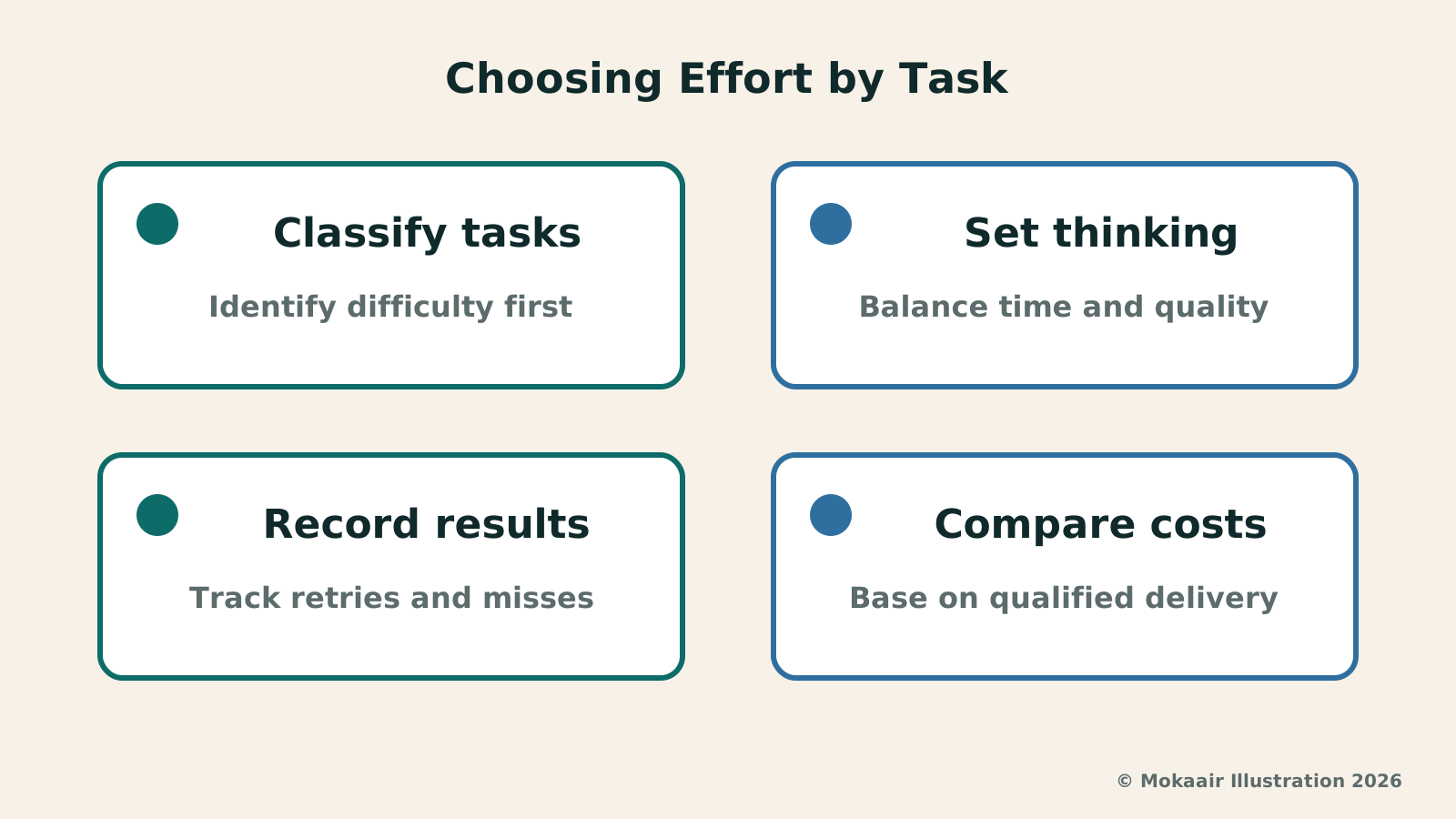
In this editorial scenario, items of differing complexity require varying context lengths and output token volumes. Mixing basic classification and complex policy drafting within the same pipeline often prevents engineering teams from accurately assessing cost-efficiency. Therefore, during the initial adoption phase, the primary task is to decompose internal workflow types, identifying which tasks require multi-step reasoning by the model and which need only a single quick response, thereby establishing clear routing standards.
The Correlation Between Reasoning Effort and Retry Frequency
The depth of reasoning a model applies when handling knowledge work is often directly related to the configured thinking time. Taking the cross-checking of customer service policy contradictions as an example, if the model is only given the shortest thinking path, it might overlook subtle caveat clauses, producing a report that reads smoothly but fundamentally misses issues, forcing operators to reprompt multiple times. Each retry not only consumes manual review time but also directly increases accumulated input and output token usage.
For drafts with numerous conditions, one can compare whether different thinking settings reduce omissions, but do not presuppose that longer thinking will inevitably boost qualification rates. Record the first output, the number of retries, and manual correction time together before deciding whether spending extra computing time is worthwhile. If the parts requiring rewriting remain unchanged, the issue may stem from missing data or unclear requirements rather than simply insufficient computing power.
Conversely, demanding excessive reasoning effort on straightforward classification tasks with clear rules can lead the model to over-interpret user feedback tone, which degrades classification consistency and processing speed instead. The core of adjusting model reasoning intensity lies in finding an optimal balance based on the nature of the work—avoiding over-investing compute in simple tasks while granting sufficient computational leeway at checkpoints requiring meticulous deliberation.
| Task Scenario or Cost Item | Compute and Invocation Characteristics | Cost and Verification Considerations |
|---|---|---|
| Basic topic classification | Short single output, no deep reasoning needed | Account for both input and output usage, then test classification errors and retries |
| Policy contradiction cross-checking | Requires comparing context of multiple replies, moderate reasoning needed | Account for input, output, and manual spot-check time for missed issues |
| Drafting thorny responses | Long-form text generation requiring causal deduction, consumes more tokens | Compare pass rate and revision counts; do not assume deep thinking saves money |
| Overall delivery architecture | Can adopt fixed subscriptions or pay-as-you-go invocation | Requires holistic evaluation of model costs, engineering maintenance, and final manual acceptance |
Reviewing Qualified Delivery Rates and Hidden Costs
When evaluating any automated workflow, one cannot rely solely on raw output volume; the qualified result rate is the key metric for measuring economic efficiency. In a hypothetical customer service compilation workflow, if an analysis report contains undetected policy contradictions or suffers a high classification error rate, internal staff must intervene to proofread and correct each instance. The cost converted from this invested manual labor time is often far higher than the raw compute cost of calling the model.
Because model outputs are not 100% deterministic, clear qualification standards and sampling procedures must be established when designing acceptance mechanisms. For example, for weekly generated FAQ drafts, checkpoints such as structural completeness, policy compliance, and emotional appropriateness can be set. Only when outputs meet these acceptance thresholds does that model invocation genuinely deliver value; if outputs require a total rewrite, the preceding compute resources constitute pure waste.
Weighing the Benefits of UI Subscriptions vs. API Invocations
For small teams organizing only a small amount of data weekly, starting with their existing chat interfaces may be easier to evaluate than building a separate API workflow. Free and paid subscriptions are different plans, and they may have different limits or add-on mechanisms; one cannot assume all chat usage is unlimited within a fixed monthly fee. This article documents the initial release and pricing update of Sonnet 5; actual available models, limits, and pricing must still be checked on one's current account.
Conversely, while adopting an API interface enables integration with internal knowledge bases and ticketing systems—along with benefiting from the permanently reduced rates of $2 per million input tokens and $10 per million output tokens—actual expenses are directly influenced by task length, system prompt length, and call frequency. When business volume spikes or retry loops occur, billing amounts can climb rapidly, requiring administrators to implement strict usage monitoring and budget caps at the architectural level.
Additionally, technical maintenance capacity across different teams is an important consideration. Adopting a programmatic interface means engineering resources must be invested to maintain prompt templates, error-catching mechanisms, and pre/post-processing scripts. If an organization lacks corresponding engineering manpower, forcing an automated integration may lead to maintenance burdens exceeding the value of saved time; in such cases, flexibly using ready-made interfaces or phasing adoption is a sounder approach.
Phased Acceptance and Monitoring Mechanisms for Implementation
To translate technological investment into tangible productivity, organizations should establish small-scale pilot processes during early adoption rather than immediately replacing existing manual workflows across the board. Taking weekly customer service question compilation as an example, a team can first select non-confidential FAQs from a single product line as a pilot to test output quality for simple classification and contradiction cross-checking separately. By recording model omission rates and retry counts week by week, prompt structures and thinking depth parameters can be gradually fine-tuned.
The ultimate goal is to build a collaborative workflow combining model computing with human oversight. The model handles tedious preliminary screening, semantic cross-referencing, and initial drafting, while senior customer service and operations personnel focus on final standard reviews and anomaly handling. Through transparent delivery standards and cost tracking, teams can find an enduring balance between model capabilities and operational expenses, ensuring each technological update delivers genuine efficiency gains.
2026 AI News Roundup: Highlights and Daily Life Applications from January to September2026 AI News Roundup: Highlights and Daily Life Applications from January to SeptemberOrganizing key AI news stories month by month from January to September 2026, linking to full analyses in five languages. Covering models, work tools, creation, costs, and transparency, explaining backgrounds, uses, and limits.Read the full article
ChatGPT Work Officially Debuts: How to Clearly Delegate Cross-File TasksChatGPT Work Officially Debuts: How to Clearly Delegate Cross-File TasksAn analysis of cross-file delegation methods following the mid-2026 launch of ChatGPT Work. Using a reading community's events and budget organization as an example, this piece explores multi-tool consistency, tracking intervention points, and acceptance principles.Read the full article
Lifestyle
NVIDIA launches DGX Spark 64GB: on sale October 23 from $4,999, two units can be linked into 128GB
On October 2, 2026, NVIDIA announced a more affordable 64GB memory version of its DGX Spark personal AI computer, available from October 23 through six makers including Acer and ASUS. It is aimed mainly at developers and researchers who want to run AI models on their own machines. Below we summarize the specs NVIDIA published, its claims about linking two units, and what it means for general readers.
Lifestyle
Google Cloud Launches Spanner Queues: Putting Message Queues Inside Database Transactions to Make AI Agents More Reliable
Google Cloud has announced the general availability of Spanner queues, which make message creation part of a database transaction. The aim is to stop AI agents' "state" and "actions" from falling out of sync. This article covers Google Cloud's claims, the main features, and what it means for general readers.
Lifestyle
GPT-6.1 Sol Launches: New Sol Version in the API, Codex and ChatGPT Work, Not in Chat
OpenAI launched GPT-6.1 Sol on September 29, 2026, with the API name gpt-6.1-sol. The launch rollout covers Codex and ChatGPT Work on Plus, Pro, Business, Enterprise and Edu (Enterprise and Edu need an administrator to enable it); Free and Go are not included at launch, and it is not in Chat (checked September 2026).
Lifestyle
Claude Sonnet 5.5 Launches: Same List Price as Sonnet 5, Available in the API, on Cloud Platforms and in Claude.ai
Anthropic launched Claude Sonnet 5.5 on September 28, 2026. API list prices are the same as Sonnet 5 ($2 per million input tokens, $10 per million output tokens). It is available in Claude.ai, the API and several cloud platforms, and higher-risk cybersecurity requests fall back to Sonnet 5 (checked September 2026).
Articles that cite this one
Latest travel guides

GuideTokyo
Where to Stay in Tokyo: Comparing Shinjuku, Ueno, Tokyo Station, Shibuya, Asakusa, Ikebukuro, and Ginza, Plus Airport Access, Accommodation Tax, and Luggage Delivery
Where should you stay in Tokyo? Compare Shinjuku, Ueno, Tokyo Station, Shibuya, Asakusa, Ikebukuro, and Ginza by the same criteria: access from Narita and Haneda, transit routes, nearby attractions, neighborhood character, and who each area suits. Includes a comparison table, a Yamanote Line diagram, Tokyo’s accommodation tax as verified in 2026/9 (changing to 3% in 2027/4), and Airport TA-Q-BIN luggage shipping rules.
- Budget
- Hotels

GuideTokyo
How to Choose Tokyo Transit Passes: Are Suica, Welcome Suica, the Tokyo Subway Ticket, and the JR Pass Worth It?
On a first Tokyo trip, start with an IC card and pay per ride (Welcome Suica has no deposit and is valid for 28 days). If you take four or more subway rides in a day, add a 72-hour Tokyo Subway Ticket for 2,000 yen; a JR Pass is never worthwhile if you stay in Tokyo and do not go to Kansai. See what TOURIST PASMO, Suica on iPhone, and the Tokyo Metro day pass do and do not cover, with a decision chart. Prices verified in September 2026.
- Transport
- Budget

GuideTokyo
Tokyo Disneyland and DisneySea Guide: Ticket Prices, Fantasy Springs, Disney Premier Access (DPA), Standby Pass, and Which Park to Choose for Your First Visit
Tokyo Disney one-day Passport prices vary: most weekdays in 9/2026 cost ¥9,900 and weekends ¥10,900. At 14:00 daily, tickets go on sale for the same date two months later. Free Priority Pass is no longer on the official service list; only paid Disney Premier Access (¥1,000–3,500 per person per use) shortens waits. Covers hours, the 25th anniversary, Standby Pass, Entry Request, Fantasy Springs access and first-visit park choice; checked on the official site in 9/2026.
- Itineraries
- Family
Sources
- Anthropic: Claude Sonnet 5 · Checked:
- Anthropic: Model Status and Deprecation Schedule · Checked: