Lifestyle
Claude Sonnet 5.5 Launches: Same List Price as Sonnet 5, Available in the API, on Cloud Platforms and in Claude.ai
Anthropic launched Claude Sonnet 5.5 on September 28, 2026. API list prices are the same as Sonnet 5 ($2 per million input tokens, $10 per million output tokens). It is available in Claude.ai, the API and several cloud platforms, and higher-risk cybersecurity requests fall back to Sonnet 5 (checked September 2026).
About 10 min read
Anthropic launched Claude Sonnet 5.5 on September 28, 2026, calling it the second model in the Claude 5.5 family; Opus 5.5 is the other. API list prices are the same as Sonnet 5: $2 per million input tokens and $10 per million output tokens. The announcement says the cost per task is "up to 30% less" than the previous generation. That is a result Anthropic measured in its own testing, not a list-price cut.
The information in this article was checked on September 30, 2026, against Anthropic's announcement, model page, product page and System Card. The Sonnet product page says anyone can use it on Claude.ai; developers use claude-sonnet-5-5. These pages do not mention Taiwan and do not list which regions are open or restricted. The evaluations and the safety classification are published by Anthropic itself; this site has not tested them, and we do not recommend switching models or subscribing.
What Sonnet 5.5 Is and How It Relates to Sonnet 5
Anthropic says Sonnet 5.5 is a faster, lower-cost complement to Opus 5.5. Opus 5.5 is built for complex work that requires careful judgment, while Sonnet 5.5 is strongest at well-scoped everyday tasks, fixing bugs, and creating polished documents, slides and spreadsheets. The announcement calls it a "clear upgrade" over Sonnet 5 that generates outputs 30% or more faster. All of this is Anthropic's own description.
On older versions, as of the checked date the announcement, model page and product page do not say when Sonnet 5 will be retired; the model page gives only Sonnet 5.5's own retirement date as "not sooner than September 28, 2027", which is Anthropic's commitment for Sonnet 5.5. The announcement also says higher-risk cybersecurity tasks fall back to Sonnet 5 (see the last section).
For developers, the model page lists five breaking changes that affect code already running on Sonnet 5; the announcement calls out one of them: if you run with thinking off, you need to switch to the new between_tools setting before moving to Sonnet 5.5.
Reading the Price: List Prices Are Unchanged, and Anthropic Says the Per-Task Usage Is What Changed
The table below shows the Sonnet 5.5 list prices from the announcement's pricing table and the model page (per million tokens, in US dollars). The announcement states that input, output and cache reads are the same as Sonnet 5, and says it typically needs far fewer tokens to do the same work.
"Up to 30% cheaper" needs a careful reading. The announcement says that in Anthropic's testing, the cost per task is up to 30% less than the previous generation; the product page says that for typical workloads billed by token, the estimated cost to run is up to 30% less than Sonnet 5. Both say "up to", both come from Anthropic's own testing or estimates, and the list price has not been lowered. Your actual cost depends on how many tokens your own tasks use.
The product page adds: prompt caching can save up to 90% and batch processing 50%; for workloads that need to run in the US, US-only inference is available at 1.1x pricing for input and output tokens.
| Item (per million tokens) | Sonnet 5.5 list price | Where it is listed |
|---|---|---|
| Input | $2 | Announcement, model page |
| Output | $10 | Announcement, model page |
| Cache reads | $0.20 | Announcement, model page |
| 5-minute cache writes | $2.50 | Model page (the announcement's pricing table says "Cache writes") |
| 1-hour cache writes | $4 | Model page |
| Batch API | 50% discount on input and output | Model page |
Where You Can Use Sonnet 5.5
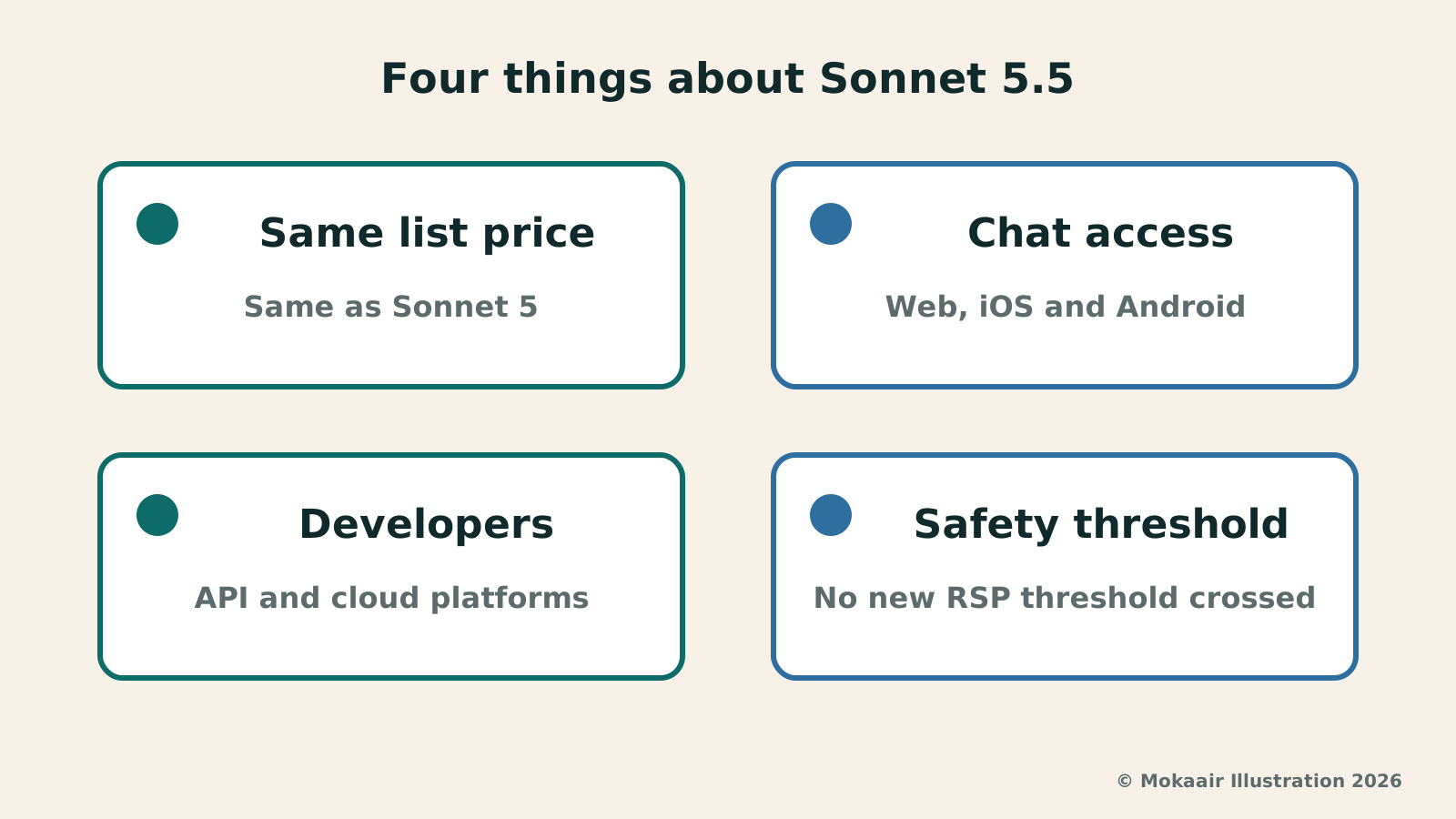
On the chat side, the Sonnet product page says anyone can chat with Claude using Sonnet 5.5 on Claude.ai, on the web, iOS and Android. That sentence does not list the individual plans, and it does not state usage limits or whether it is the default model; none of these pages address this as of the checked date, so it cannot be read as meaning that some plan cannot use it.
On the developer side, the announcement says Sonnet 5.5 is now available on "all platforms", with examples including Amazon Web Services, Google Cloud and Microsoft Azure; the model page lists the platforms Claude API, Amazon Bedrock, Google Cloud, Microsoft Foundry and Claude Platform on AWS. The model ID is claude-sonnet-5-5 everywhere except Amazon Bedrock, where it is anthropic.claude-sonnet-5-5.
The model page lists a context window of 1M tokens, a maximum output of 128K tokens and a reliable knowledge cutoff of June 2026; these pages have no Sonnet 5 specifications to compare against. The announcement also says the default effort is Medium in Claude Code and Claude apps, and High on the Claude Platform.
How to Read the Evaluations Anthropic Published
Below are scores Anthropic published in the announcement's evaluation table; they do not represent a reader's own tasks. Terminal-Bench 4.0 (agentic coding): Sonnet 5.5 70.6%, Sonnet 5 10.3%, Opus 5.5 66.4% (footnote: for Opus 5.5, the highest score at Xhigh effort). CursorBench 4.0: 55.5%, 34.1%, 57.8%. OSWorld 2.1, for computer use: 80.1%, 57.0%, 81.8%.
FrontierCode 1.1 (Main) has to be read together with effort: Sonnet 5.5 scores 46.2% at Max effort and 52.1% at Xhigh effort, Sonnet 5 scores 42.4% and Opus 5.5 scores 54.4%; a footnote says Max is lower because it more often ran Claude Code's code-review skill, which in two cases examined by Cognition led to timeouts or edits outside the task scope. GDPval-AA v2.1 is scored in points, not percentages: Sonnet 5.5 1844, Sonnet 5 1449, Opus 5.5 1846; a footnote says Artificial Analysis ran it on a pre-launch deployment, and Anthropic found a bug in that deployment that could degrade responses for requests using structured outputs, which has since been fixed.
Anthropic itself adds a caveat: benchmark scores capture only one facet of a model's capabilities, and in Anthropic's own testing and that of external testers, Opus 5.5 remains clearly stronger at complex, open-ended work requiring sustained judgment.
The System Card and Safeguards
The System Card says that, under Anthropic's own Responsible Scaling Policy (RSP, a responsible-scaling policy framework Anthropic defined itself, not an external rating), its evaluations found Sonnet 5.5 broadly less capable than Opus 5.5, and it does not cross any new RSP thresholds. The determination that Opus 5.5 does not cross the CB-2 or Autonomy-2 thresholds also applies. Anthropic treats Sonnet 5.5 as meeting its CB-1 and Autonomy-1 thresholds and applies the corresponding mitigations from its RSP.
The other conclusions in the System Card summary are likewise Anthropic's assessment: misalignment risk is low; it is Anthropic's most robust Sonnet-class model yet against prompt injection (particularly in coding environments and browser use), but in computer use environments its refusal rate on harmful tasks is comparable to Opus 5.5 and a regression relative to some earlier models.
The announcement says Sonnet 5.5's cybersecurity capabilities are a large step up from Sonnet 5, and that it is the first Sonnet model to launch with cyber safeguards and fallbacks. Finding and fixing bugs in routine software development is not affected, while higher-risk cybersecurity tasks will visibly fall back to Sonnet 5. The System Card warns that users should expect increased refusals, even on benign cybersecurity-related tasks; it also adds that this fallback applies to Anthropic's first-party products and to developers who opt in to such fallbacks on the API, and that traffic through other platforms and providers may see different behavior.
Frequently asked questions
Is Sonnet 5.5 more expensive than Sonnet 5?
The list prices are the same: $2 per million input tokens, $10 per million output tokens and $0.20 for cache reads. The "up to 30% cheaper" Anthropic mentions is the cost per task in its testing, or its estimate for typical workloads; it is not a list-price cut, and your actual usage depends on your own tasks.
Can the free plan use Sonnet 5.5?
Anthropic's Sonnet product page says anyone can chat with Claude using Sonnet 5.5 on Claude.ai, on the web, iOS and Android. That sentence does not list the individual plans or state usage limits; none of these pages address this as of the checked date. To confirm for your own account, sign in and see which models you can choose.
Will Sonnet 5 be retired?
As of September 30, 2026, Anthropic's announcement, model page and Sonnet product page do not say when Sonnet 5 will be retired. The model page gives only Sonnet 5.5's own retirement date, not sooner than September 28, 2027.
Why are some cybersecurity-related requests answered by Sonnet 5?
The announcement says Sonnet 5.5 is the first Sonnet model to launch with cyber safeguards and fallbacks, and that higher-risk cybersecurity tasks will visibly fall back to Sonnet 5; finding and fixing bugs in routine software development is not affected. The System Card notes that this fallback applies to Anthropic's first-party products and to developers who opt in to such fallbacks on the API, and that traffic through other platforms and providers may see different behavior.
What does "does not cross any new RSP thresholds" mean?
The RSP is a responsible-scaling policy framework Anthropic defined itself. The System Card says Anthropic's evaluations found Sonnet 5.5 broadly less capable than Opus 5.5 and not crossing any new thresholds, and Anthropic treats it as meeting CB-1 and Autonomy-1 while not crossing CB-2 and Autonomy-2. This is Anthropic's own determination, not a rating by an outside body.
Has Claude Haiku 5.5 launched?
The announcement says Claude Haiku 5.5 will join the Claude 5.5 family "in the coming weeks", without giving a date. As of the checked date, the announcement, model page, product page and System Card contain no launch information for it.
2026 AI News Roundup: Highlights and Daily Life Applications from January to September2026 AI News Roundup: Highlights and Daily Life Applications from January to SeptemberOrganizing key AI news stories month by month from January to September 2026, linking to full analyses in five languages. Covering models, work tools, creation, costs, and transparency, explaining backgrounds, uses, and limits.Read the full article
Claude Sonnet 5: Balancing Capability and Cost in Daily WorkClaude Sonnet 5: Balancing Capability and Cost in Daily WorkUsing weekly customer service FAQ compilation as a scenario, this article explores Claude Sonnet 5's reasoning effort, retry rates, and trade-offs for qualified delivery costs.Read the full article
Lifestyle
Claude Sonnet 5: Balancing Capability and Cost in Daily Work
Using weekly customer service FAQ compilation as a scenario, this article explores Claude Sonnet 5's reasoning effort, retry rates, and trade-offs for qualified delivery costs.
Lifestyle
Claude Opus 5.5 Launches: List Price Cut 20%, Paid Plans’ Five-Hour Limit Raised, 40% Is Anthropic’s Cost Estimate
On September 22, 2026, Anthropic introduced Claude Opus 5.5, the first model in the new Claude 5.5 family; the announcement lists no region restrictions. This article separates three easily confused numbers — the 40% cost estimate and the 20% and 60% official price cuts — and lays out which paid plans get the five-hour limit increase and how model switching works (checked September 2026).
Lifestyle
NVIDIA launches DGX Spark 64GB: on sale October 23 from $4,999, two units can be linked into 128GB
On October 2, 2026, NVIDIA announced a more affordable 64GB memory version of its DGX Spark personal AI computer, available from October 23 through six makers including Acer and ASUS. It is aimed mainly at developers and researchers who want to run AI models on their own machines. Below we summarize the specs NVIDIA published, its claims about linking two units, and what it means for general readers.
Lifestyle
Google Cloud Launches Spanner Queues: Putting Message Queues Inside Database Transactions to Make AI Agents More Reliable
Google Cloud has announced the general availability of Spanner queues, which make message creation part of a database transaction. The aim is to stop AI agents' "state" and "actions" from falling out of sync. This article covers Google Cloud's claims, the main features, and what it means for general readers.
Articles that cite this one
Latest travel guides

GuideTokyo
Where to Stay in Tokyo: Comparing Shinjuku, Ueno, Tokyo Station, Shibuya, Asakusa, Ikebukuro, and Ginza, Plus Airport Access, Accommodation Tax, and Luggage Delivery
Where should you stay in Tokyo? Compare Shinjuku, Ueno, Tokyo Station, Shibuya, Asakusa, Ikebukuro, and Ginza by the same criteria: access from Narita and Haneda, transit routes, nearby attractions, neighborhood character, and who each area suits. Includes a comparison table, a Yamanote Line diagram, Tokyo’s accommodation tax as verified in 2026/9 (changing to 3% in 2027/4), and Airport TA-Q-BIN luggage shipping rules.
- Budget
- Hotels

GuideTokyo
How to Choose Tokyo Transit Passes: Are Suica, Welcome Suica, the Tokyo Subway Ticket, and the JR Pass Worth It?
On a first Tokyo trip, start with an IC card and pay per ride (Welcome Suica has no deposit and is valid for 28 days). If you take four or more subway rides in a day, add a 72-hour Tokyo Subway Ticket for 2,000 yen; a JR Pass is never worthwhile if you stay in Tokyo and do not go to Kansai. See what TOURIST PASMO, Suica on iPhone, and the Tokyo Metro day pass do and do not cover, with a decision chart. Prices verified in September 2026.
- Transport
- Budget

GuideTokyo
Tokyo Disneyland and DisneySea Guide: Ticket Prices, Fantasy Springs, Disney Premier Access (DPA), Standby Pass, and Which Park to Choose for Your First Visit
Tokyo Disney one-day Passport prices vary: most weekdays in 9/2026 cost ¥9,900 and weekends ¥10,900. At 14:00 daily, tickets go on sale for the same date two months later. Free Priority Pass is no longer on the official service list; only paid Disney Premier Access (¥1,000–3,500 per person per use) shortens waits. Covers hours, the 25th anniversary, Standby Pass, Entry Request, Fantasy Springs access and first-visit park choice; checked on the official site in 9/2026.
- Itineraries
- Family
Sources
- Anthropic: Introducing Claude Sonnet 5.5 · Checked:
- Claude Platform Docs: Claude Sonnet 5.5 (model page) · Checked:
- Anthropic: System Card: Claude Sonnet 5.5 · Checked:
- Anthropic: Claude Sonnet (product page) · Checked: