Lifestyle
GPT-5.6 Sol Starts from Limited Preview: Why Announcement Differs from General Availability
Reviewing the June 26, 2026 milestone of the official GPT-5.6 Sol limited preview, examining the verification stages and enterprise adoption strategies between launch and general availability.
Updated: About 7 min read
Event date: 2026-06-26; Verification date of this article: 2026-09-14. On June 26, the GPT-5.6 series was previewed: Sol as the flagship, Terra leaning toward balanced workloads, and Luna leaning toward fast, low-cost tasks.
OpenAI stated that after discussions with the U.S. government, initial previews were granted only to a small group of trusted partners; broader access was part of subsequent plans. The provider emphasized high-risk capability safeguards, evaluations, and iterative red teaming, which do not constitute a zero-risk guarantee. Another GPT-5.6 release announcement followed in July, and the current status must be tracked through subsequent announcements; the June restrictions should not be characterized as permanent lockouts. The daily and workplace scenarios below are editor-designed examples for readers to verify independently, not product benchmarks conducted by this site.
Distinguishing Launch Demos from Commercial Access Tiers
Whenever a major model is unveiled, the market frequently mistakes public technical demonstrations for immediate availability across all users. In reality, performance claims at launch events represent only feasibility verifications in laboratory or specifically constrained environments, which are entirely different from an enterprise securing a contract, having an account provisioned, or gaining interface access. If decision-makers confuse demo outcomes with production commercial access, they often form unrealistic timeline expectations before the technology is broadly released.
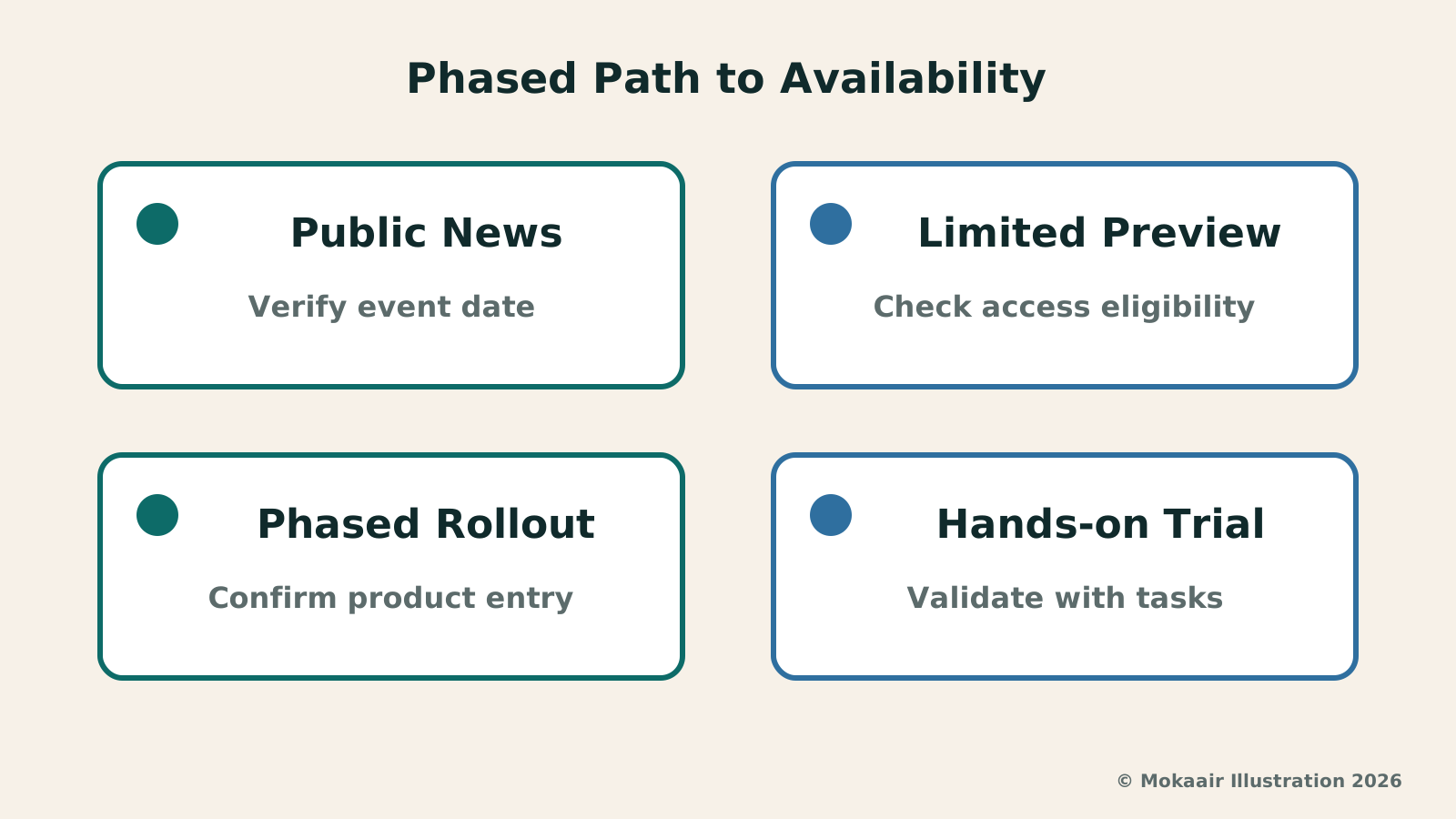
In the early phase of architecture evaluation, teams should clearly delineate public announcements, partner-limited testing, public beta testing, and general availability into four separate stages. When an official announcement indicates access is initially restricted to a few designated trusted parties, typical organizations should maintain an observational stance and track specifications, avoiding direct reliance on launch-day benchmark figures to design imminent production pipelines. Establishing a tiered understanding ensures a sound foundation for planning subsequent digital transformation roadmaps.
Furthermore, red teaming—where independent testers simulate adversary behaviors to uncover model vulnerabilities—and safety safeguards are fundamentally designed to reduce the probability of catastrophic vulnerabilities, rather than guaranteeing error-free execution across all commercial contexts. When evaluating emerging technologies, enterprises must construct their own internal acceptance frameworks and never treat vendor safety claims as zero-risk guarantees for operational workflows.
Model Specialization within a Series and Task Scenario Mapping
The positioning of Sol, Terra, and Luna can serve as a starting point for selecting pilot tasks. While the vendor designated Sol as the flagship, this does not mean every workflow requires it. The actual elapsed time, cost, and qualification pass rates across different models can only be comparatively tested using one's own data once access is granted. For average small teams, listing which tasks are straightforward and which require cross-referencing multiple sources makes evaluation significantly easier than defaulting unconditionally to the top-tier model.
By contrast, if daily enterprise operations are saturated with high-volume real-time summarization, initial customer service routing, or structured data extraction, choosing balanced or fast, low-cost tiers proves far more operationally cost-effective. Establishing a clear routing mechanism within internal architecture—directing simple queries through lightweight pathways while reserving flagship tiers solely for edge cases or complex challenges—represents a rational selection strategy balancing latency response and cost control.
This division-of-labor logic applies equally to acceptance test planning. Enterprises need not hold up every initiative waiting for flagship access credentials; instead, they can build test sets through structurally equivalent existing pipelines, predefining output formats, accuracy metrics, and latency tolerances. When higher-tier models subsequently open for access, they can be plugged into established testing pipelines to complete comparative evaluations, potentially shortening the transition time required for evaluation.
| Evaluation Stage | Key Evidence & Audit Items | Project Schedule & Decision Principles |
|---|---|---|
| Public Announcement Phase | Official press releases, vendor benchmarks, and public functional specs | Track on technology radar only; make no product launch commitments |
| Limited Preview Phase | Trusted partner vetting, initial access interfaces, and safeguard mechanisms | Build domain-specific test sets and perform small-scale simulations |
| General Launch Phase | Official releases, commercial contract terms, general availability, Taiwan access | Run automated benchmark evaluations; calculate adoption ROI and costs |
| Architecture Scaling Phase | Flagship vs. lightweight routing metrics, operational stability, latency profiles | Deploy complexity-based routing policies; integrate into daily operations |
Avoiding Over-Commitment and Establishing an Unreleased Feature Watchlist
One of the most pervasive risks in project management is rashly committing delivery schedules to external clients or business units before a model achieves general availability or commercial contracts are finalized. The formidable capabilities highlighted in marketing promotions remain external variables that cannot be scheduled into formal development cycles without production-grade interface support. Tying them prematurely to key performance indicators frequently triggers severe project delays.
A mature engineering team should maintain an objective unreleased feature watchlist to systematically track the evolution of various indicators. This tracking matrix should encompass official release dates, eligible contract tiers, Taiwan access availability, and documented functional limitations. By regularly reviewing this tracking log, teams maintain a clear grasp of actual deployment timelines, safeguarding internal planning agility and credibility.
During this interim period, external proposals should center on currently stable, accessible technical solutions, treating newly announced models as potential optimization paths rather than foundational dependencies. When clients request bleeding-edge technology, objectively explaining the difference between limited previews and production releases demonstrates rigorous engineering governance and shields the organization from breach-of-contract liabilities caused by upstream vendor delays.
Compliance and Security Governance Audits from Preview to General Availability
When a model provider announces that an offering requires regulatory consultation and staged gating, it reflects a cautious stance toward the security, bias, and systemic risks associated with advanced AI. In considering adoption, enterprises must correspondingly elevate internal data governance standards, analyzing whether safety constraints applied across various release stages will disrupt the execution of specific business logic.
In multinational operations or heavily regulated sectors, model moderation filters may generate overly defensive refusals when processing industry-specific terminology or compliance queries. When conducting early proof-of-concept tests, organizations should assess these boundary effects generated by safety filters to ensure protective measures maintain compliance without unintentionally severing automated workflows in core operations.
Simultaneously, contractual liability clauses, data retention policies, and service level agreements often diverge between preview periods and general releases. Legal and infosec teams must collaborate closely to examine vendor terms of service across release stages, ensuring that sensitive enterprise data piped into the model conforms to existing privacy regulations and that early testing does not compromise internal security perimeters.
Engineering Pathways for Enterprise-Specific Acceptance Test Suites
To objectively evaluate the real-world performance of new models, teams cannot rely solely on vendor-published benchmark scores, as standardized tests rarely capture the nuanced context of a company's specific business domain. The most pragmatic course while awaiting production access is to aggregate historical edge cases and typical operational challenges into a dedicated benchmark suite, serving as the frontline evaluation baseline for upcoming pilots.
This acceptance checklist should include concrete scenario evaluations: comprehension accuracy over lengthy Traditional Chinese technical documents, conversion fidelity for domain-specific terminology, and logical consistency across multi-step reasoning workflows. Armed with standardized scoring metrics, engineering teams can run automated comparisons immediately upon gaining system access, objectively quantifying the tangible gains and potential cost shifts introduced by the upgrade.
Ultimately, the adoption of emerging technologies must be anchored in rigorous engineering experimentation rather than market excitement. Viewing model announcements as technical milestones and substituting blind enthusiasm with disciplined acceptance frameworks allows enterprises to navigate rapid architectural evolutions—capturing performance dividends while firmly preserving system stability, cost-efficiency, and security compliance.
2026 AI News Roundup: Highlights and Daily Life Applications from January to September2026 AI News Roundup: Highlights and Daily Life Applications from January to SeptemberOrganizing key AI news stories month by month from January to September 2026, linking to full analyses in five languages. Covering models, work tools, creation, costs, and transparency, explaining backgrounds, uses, and limits.Read the full article
Claude Sonnet 5: Balancing Capability and Cost in Daily WorkClaude Sonnet 5: Balancing Capability and Cost in Daily WorkUsing weekly customer service FAQ compilation as a scenario, this article explores Claude Sonnet 5's reasoning effort, retry rates, and trade-offs for qualified delivery costs.Read the full article
Lifestyle
NVIDIA launches DGX Spark 64GB: on sale October 23 from $4,999, two units can be linked into 128GB
On October 2, 2026, NVIDIA announced a more affordable 64GB memory version of its DGX Spark personal AI computer, available from October 23 through six makers including Acer and ASUS. It is aimed mainly at developers and researchers who want to run AI models on their own machines. Below we summarize the specs NVIDIA published, its claims about linking two units, and what it means for general readers.
Lifestyle
Google Cloud Launches Spanner Queues: Putting Message Queues Inside Database Transactions to Make AI Agents More Reliable
Google Cloud has announced the general availability of Spanner queues, which make message creation part of a database transaction. The aim is to stop AI agents' "state" and "actions" from falling out of sync. This article covers Google Cloud's claims, the main features, and what it means for general readers.
Lifestyle
GPT-6.1 Sol Launches: New Sol Version in the API, Codex and ChatGPT Work, Not in Chat
OpenAI launched GPT-6.1 Sol on September 29, 2026, with the API name gpt-6.1-sol. The launch rollout covers Codex and ChatGPT Work on Plus, Pro, Business, Enterprise and Edu (Enterprise and Edu need an administrator to enable it); Free and Go are not included at launch, and it is not in Chat (checked September 2026).
Lifestyle
Claude Sonnet 5.5 Launches: Same List Price as Sonnet 5, Available in the API, on Cloud Platforms and in Claude.ai
Anthropic launched Claude Sonnet 5.5 on September 28, 2026. API list prices are the same as Sonnet 5 ($2 per million input tokens, $10 per million output tokens). It is available in Claude.ai, the API and several cloud platforms, and higher-risk cybersecurity requests fall back to Sonnet 5 (checked September 2026).
Articles that cite this one
Latest travel guides

GuideTokyo
Where to Stay in Tokyo: Comparing Shinjuku, Ueno, Tokyo Station, Shibuya, Asakusa, Ikebukuro, and Ginza, Plus Airport Access, Accommodation Tax, and Luggage Delivery
Where should you stay in Tokyo? Compare Shinjuku, Ueno, Tokyo Station, Shibuya, Asakusa, Ikebukuro, and Ginza by the same criteria: access from Narita and Haneda, transit routes, nearby attractions, neighborhood character, and who each area suits. Includes a comparison table, a Yamanote Line diagram, Tokyo’s accommodation tax as verified in 2026/9 (changing to 3% in 2027/4), and Airport TA-Q-BIN luggage shipping rules.
- Budget
- Hotels

GuideTokyo
How to Choose Tokyo Transit Passes: Are Suica, Welcome Suica, the Tokyo Subway Ticket, and the JR Pass Worth It?
On a first Tokyo trip, start with an IC card and pay per ride (Welcome Suica has no deposit and is valid for 28 days). If you take four or more subway rides in a day, add a 72-hour Tokyo Subway Ticket for 2,000 yen; a JR Pass is never worthwhile if you stay in Tokyo and do not go to Kansai. See what TOURIST PASMO, Suica on iPhone, and the Tokyo Metro day pass do and do not cover, with a decision chart. Prices verified in September 2026.
- Transport
- Budget

GuideTokyo
Tokyo Disneyland and DisneySea Guide: Ticket Prices, Fantasy Springs, Disney Premier Access (DPA), Standby Pass, and Which Park to Choose for Your First Visit
Tokyo Disney one-day Passport prices vary: most weekdays in 9/2026 cost ¥9,900 and weekends ¥10,900. At 14:00 daily, tickets go on sale for the same date two months later. Free Priority Pass is no longer on the official service list; only paid Disney Premier Access (¥1,000–3,500 per person per use) shortens waits. Covers hours, the 25th anniversary, Standby Pass, Entry Request, Fantasy Springs access and first-visit park choice; checked on the official site in 9/2026.
- Itineraries
- Family
Sources
- OpenAI: GPT-5.6 Sol Preview · Checked:
- OpenAI: GPT-5.6 Official Release · Checked: