Lifestyle
Claude Fable 5 Launch, Suspension, and Restoration: Availability Criteria
Analyzing the suspension and restoration of Claude Fable 5, exploring how small research teams use neutral formats to preserve results and prepare alternatives amid availability shifts.
Updated: About 7 min read
Event date: 2026-06-09; Verification date: 2026-09-14. Fable 5 was launched on June 9, officially described as a Mythos-class model with general-purpose safeguards; Mythos 5 remains restricted to specific audiences.
Anthropic stated that access to both was suspended on June 12 due to U.S. export controls; this article attributes the cause to the official explanation without independently interpreting the law. On June 30, it was announced that restrictions were lifted, with access restored on July 1; eligible audiences for Fable and Mythos remain distinct. Original trial quotas had expiration dates; upon restoration, promotional offers for certain Fable plans ran through July 7, after which credits are used; this should not be assumed to remain free in September. The following life and work scenarios are editor-designed examples for reader verification, not product tests conducted by this site.
Cloud Service Disruption Risks and Supply Chain Variables
When selecting underlying models, technical teams often focus heavily on computing performance or logical reasoning benchmarks, easily overlooking non-technical downtime risks brought about by external regulatory changes. When vendors adjust service permissions based on official policies, enterprises typically cannot intervene directly or expedite resolution. Such sudden service suspensions not only interrupt ongoing analytical work, but may also render internal systems deeply integrated with specific interfaces instantly unresponsive, throwing organizational operational rhythms into disarray.
In such incidents, the most vulnerable link is usually automated workflows that rely excessively on real-time online generation. If the software architecture lacks failover nodes, once access to a specific model halts, downstream modules depending on its output will grind to a complete halt. Therefore, in the early stages of architectural design, outages caused by external forces such as vendor policies or export controls must be incorporated into regular risk matrix evaluations; continuous connectivity from a single provider must never be treated as an immutable given.
Preserving Raw Outputs and Neutral Format Archiving
Taking the daily collaboration of small research teams as an example, the most robust practice is to require all members to immediately save important interim conclusions, reasoning summaries, and key evidence into standard Markdown or plain-text universal documents, either manually or automatically, at the end of each model session. Extracting structured data from closed online interfaces prevents weeks of work outputs and dialogue history from becoming locked out due to account permission changes or unexpected external service suspensions.
Beyond textual conclusions, establishing archiving standards must also include prompt designs and source reference links. A prompt refers to the input text instruction that guides the model in generating content. When researchers retain clear contextual records and factual sources, they can quickly realign context using the stored universal files even if they must switch working environments in the future, ensuring project progress is not forced back to square one due to availability shifts in a single commercial tool.
| Date | Official Announced Event | Corresponding Operational Considerations |
|---|---|---|
| 2026-06-09 | Anthropic launches Claude Fable 5; Mythos 5 is limited to specific audiences. | Evaluate new model specifications while confirming access eligibility and applicability boundaries across model tiers. |
| 2026-06-12 | Official statement cites U.S. export controls for suspending access channels to both models. | Activate local universal archiving and alternative tools to handle unexpected policy-induced connectivity disruptions. |
| 2026-06-30 to 2026-07-01 | Lifting of restrictions announced; access restored July 1; eligible audiences for both remain distinct. | Re-verify existing workflows and connection endpoints; inspect whether account permissions have returned to normal. |
| After 2026-07-07 | Certain promotional offers for Claude Fable 5 end; subsequent usage transitions to credits billing. | Review long-term cost structures; the trial period has ended, so do not anticipate ongoing free quotas in September. |
Practical Implementation of Export Mechanisms and Local Backups
Although many online tools provide export features, without regular backup drills, teams often discover messy export formats or missing data only when a crisis strikes. Project managers should establish periodic local archiving protocols—such as aggregating completed investigative findings weekly and storing data in internally managed storage rather than relying indefinitely on cloud platforms to maintain historical chats. Proactively taking ownership of source files forms the cornerstone of mitigating platform lock-in risks.
When executing export policies, teams should designate personnel to conduct spot checks on archive completeness. Inspection criteria include whether character encodings remain compatible, attachment references remain valid, and team members can view the files without connecting to external platforms. Through standardized storage mechanisms, working teams not only ensure the long-term retention of valuable information, but can also respond rapidly based on local records when facing platform permission changes, maintaining business continuity.
One could select a finished set of research notes and ask another colleague to take over using only the exported files to see if citations and unresolved issues can be located. If they still need to return to the original platform to understand attachments or context, the backup method requires reinforcement. Such small handover drills reflect whether data is genuinely portable far better than merely confirming that a download button works.
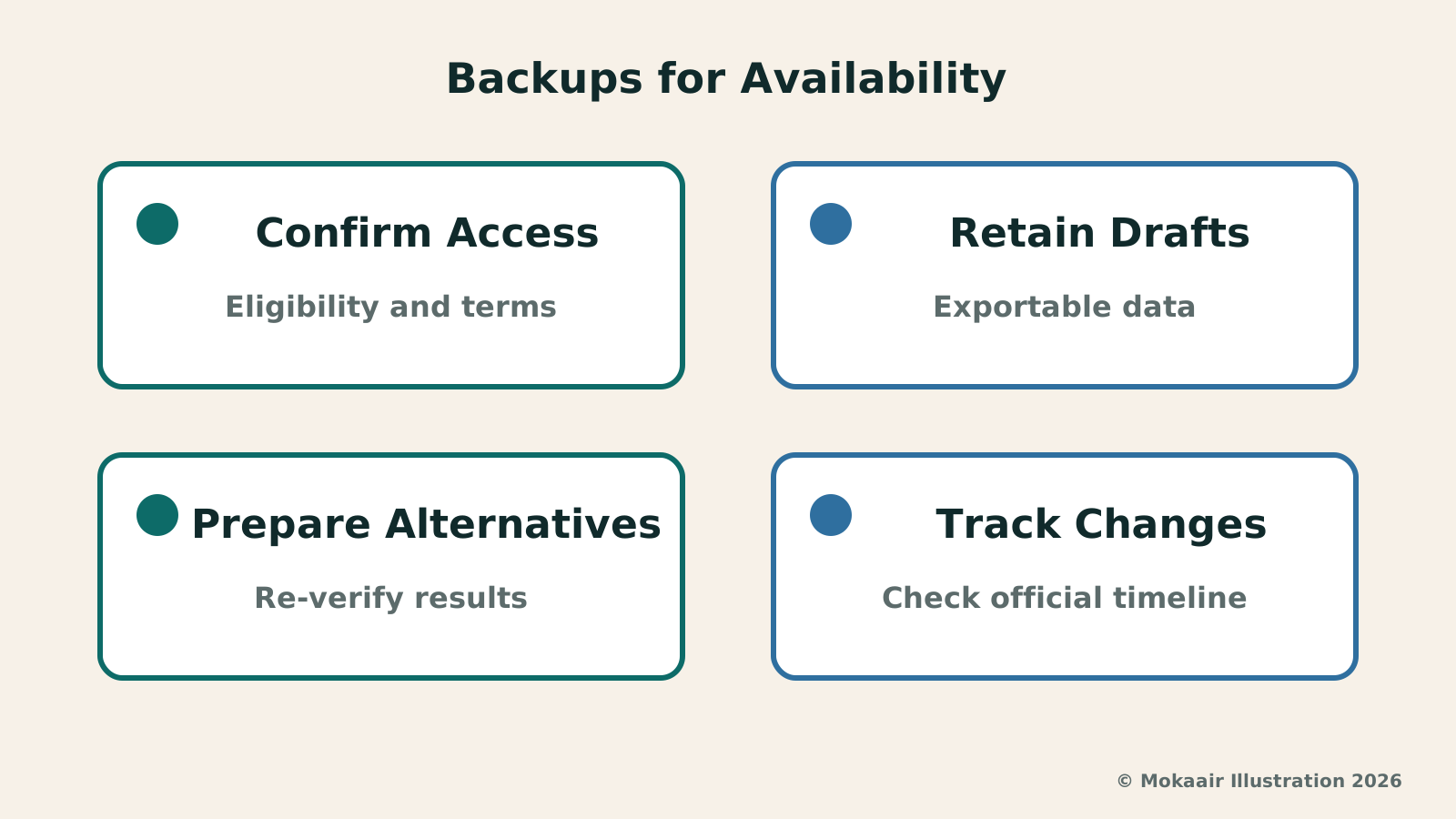
Read the full description
Confirm access: eligibility and terms; Retain drafts: exportable data; Prepare alternatives: re-verify results; Track changes: follow official timeline.
The Re-verification Costs of Switching to Alternative Tools
When a primary model becomes temporarily unreachable, switching to an alternative solution is not as simple as merely changing a system endpoint. Different language models exhibit nuanced variations in semantic comprehension depth, safety restriction guardrail tiers, and format adherence; the same prompt evaluated by different engines can yield structurally conflicting answers. If small research teams are to transition workflows on short notice, they must budget additional labor and time costs to conduct item-by-item re-verification of the alternative model's outputs.
This re-verification workflow includes verifying whether output content conforms to original specifications, checking key arguments for hallucinations, and ensuring code samples execute smoothly. To reduce frictional switching costs, teams should maintain a compact benchmark evaluation suite during normal operations, pre-testing several representative operational tasks across candidate tools to master the style and weaknesses of each model, thereby avoiding panic and loss of quality control during forced, last-minute system migrations.
Tracking Official Timelines and Cost Structure Evolutions
When observing service shifts, closely tracking official timelines is a crucial skill for ensuring proper resource allocation. In this historical event, from the release in early June and suspension days later to the lifting announced at month-end and restoration the next day, promotional schedules across plans adjusted in tandem. Many users easily confuse initial trial allocations with subsequent billing models, neglecting the requirement to pay via credits after promotional windows close, which leads to project operational overruns.
When planning long-term budgets, teams must clearly distinguish short-term promotions from standard pricing. Once a service shifts to a credit-deduction mechanism, every query and text generation directly affects the account balance, leaving behind the relaxed terms of the trial period. Regularly reviewing provider announcements and staying informed on updates to usage permissions and billing structures enables teams to effectively control total cost of ownership for AI tools while ensuring core research remains uninterrupted.
2026 AI News Roundup: Highlights and Daily Life Applications from January to September2026 AI News Roundup: Highlights and Daily Life Applications from January to SeptemberOrganizing key AI news stories month by month from January to September 2026, linking to full analyses in five languages. Covering models, work tools, creation, costs, and transparency, explaining backgrounds, uses, and limits.Read the full article
GPT-5.6 Sol Starts from Limited Preview: Why Announcement Differs from General AvailabilityGPT-5.6 Sol Starts from Limited Preview: Why Announcement Differs from General AvailabilityReviewing the June 26, 2026 milestone of the official GPT-5.6 Sol limited preview, examining the verification stages and enterprise adoption strategies between launch and general availability.Read the full article
Lifestyle
NVIDIA launches DGX Spark 64GB: on sale October 23 from $4,999, two units can be linked into 128GB
On October 2, 2026, NVIDIA announced a more affordable 64GB memory version of its DGX Spark personal AI computer, available from October 23 through six makers including Acer and ASUS. It is aimed mainly at developers and researchers who want to run AI models on their own machines. Below we summarize the specs NVIDIA published, its claims about linking two units, and what it means for general readers.
Lifestyle
Google Cloud Launches Spanner Queues: Putting Message Queues Inside Database Transactions to Make AI Agents More Reliable
Google Cloud has announced the general availability of Spanner queues, which make message creation part of a database transaction. The aim is to stop AI agents' "state" and "actions" from falling out of sync. This article covers Google Cloud's claims, the main features, and what it means for general readers.
Lifestyle
GPT-6.1 Sol Launches: New Sol Version in the API, Codex and ChatGPT Work, Not in Chat
OpenAI launched GPT-6.1 Sol on September 29, 2026, with the API name gpt-6.1-sol. The launch rollout covers Codex and ChatGPT Work on Plus, Pro, Business, Enterprise and Edu (Enterprise and Edu need an administrator to enable it); Free and Go are not included at launch, and it is not in Chat (checked September 2026).
Lifestyle
Claude Sonnet 5.5 Launches: Same List Price as Sonnet 5, Available in the API, on Cloud Platforms and in Claude.ai
Anthropic launched Claude Sonnet 5.5 on September 28, 2026. API list prices are the same as Sonnet 5 ($2 per million input tokens, $10 per million output tokens). It is available in Claude.ai, the API and several cloud platforms, and higher-risk cybersecurity requests fall back to Sonnet 5 (checked September 2026).
Articles that cite this one
Latest travel guides

GuideTokyo
Where to Stay in Tokyo: Comparing Shinjuku, Ueno, Tokyo Station, Shibuya, Asakusa, Ikebukuro, and Ginza, Plus Airport Access, Accommodation Tax, and Luggage Delivery
Where should you stay in Tokyo? Compare Shinjuku, Ueno, Tokyo Station, Shibuya, Asakusa, Ikebukuro, and Ginza by the same criteria: access from Narita and Haneda, transit routes, nearby attractions, neighborhood character, and who each area suits. Includes a comparison table, a Yamanote Line diagram, Tokyo’s accommodation tax as verified in 2026/9 (changing to 3% in 2027/4), and Airport TA-Q-BIN luggage shipping rules.
- Budget
- Hotels

GuideTokyo
How to Choose Tokyo Transit Passes: Are Suica, Welcome Suica, the Tokyo Subway Ticket, and the JR Pass Worth It?
On a first Tokyo trip, start with an IC card and pay per ride (Welcome Suica has no deposit and is valid for 28 days). If you take four or more subway rides in a day, add a 72-hour Tokyo Subway Ticket for 2,000 yen; a JR Pass is never worthwhile if you stay in Tokyo and do not go to Kansai. See what TOURIST PASMO, Suica on iPhone, and the Tokyo Metro day pass do and do not cover, with a decision chart. Prices verified in September 2026.
- Transport
- Budget

GuideTokyo
Tokyo Disneyland and DisneySea Guide: Ticket Prices, Fantasy Springs, Disney Premier Access (DPA), Standby Pass, and Which Park to Choose for Your First Visit
Tokyo Disney one-day Passport prices vary: most weekdays in 9/2026 cost ¥9,900 and weekends ¥10,900. At 14:00 daily, tickets go on sale for the same date two months later. Free Priority Pass is no longer on the official service list; only paid Disney Premier Access (¥1,000–3,500 per person per use) shortens waits. Covers hours, the 25th anniversary, Standby Pass, Entry Request, Fantasy Springs access and first-visit park choice; checked on the official site in 9/2026.
- Itineraries
- Family
Sources
- Anthropic: Claude Fable 5 and Mythos 5 · Checked:
- Anthropic: Redeploying Fable 5 · Checked: