Lifestyle
Gemini Spark and Daily Brief: AI Moves from Morning Summaries to Background Tasks
Analyzing Google's 2026 technical context of Gemini Spark and Daily Brief, exploring the four-tier architecture, error magnification risks, and authorization check mechanisms of background cloud agents in daily scenarios such as volunteer scheduling.
Updated: About 8 min read
Event date: 2026-05-19; Verification date for this article: 2026-09-14. On May 19, the Gemini Spark cloud agent and Daily Brief personal morning report were introduced, capable of utilizing applications connected by user choice.
Spark initially launched for trusted testers, with a US Ultra beta planned for the following week at the time; Daily Brief's initial wave covered US Plus/Pro/Ultra. Officially, Spark can work in the cloud while the device is turned off, and is designed to require confirmation before significant actions like spending money or sending emails. A July official monthly update subsequently described Spark expanding globally, but excluding the EEA, the UK, Switzerland, and Nigeria; the May preview should not be interpreted as a full rollout in Taiwan at launch. The following life and work scenarios are editorially designed examples for readers to verify on their own, not hands-on product tests by this site.
Tiered Automation Architecture and Control Boundaries
When understanding background agents, their actions can be divided by what they actually do into summaries, reminders, scheduling, and external actions. Summaries focus on reading and organizing; reminders may notify the user at a specified time or when certain conditions arise. Even if only reading data, an erroneous summary or notification can still affect subsequent judgment, making it necessary to verify dates, recipients, and sources. This classification is an approach for reading and workflow design, not four official product modes claimed by the developer.
Once advanced to the scheduling stage, the cloud system begins automatically executing a series of retrieval and synthesis logic on specific schedules or event triggers. This means the system possesses continuity, no longer waiting for real-time clicks to operate. If extended further to external actions, the system sends messages, allocates resources, or modifies shared files on behalf of the user. Because the latter two possess the ability to actively alter external states, their system boundaries and fault tolerance must be rigorously defined and restricted.
Understanding the boundaries of these four levels is the first step in building a robust human-machine collaborative workflow. If an organization grants the highest external execution permissions to a background agent from the outset, it essentially transfers the system's judgment risks directly to external stakeholders. A sound strategy is to confine most automation to the stage of generating drafts via scheduling, firmly reserving final outbound dispatch permissions for human review, thereby striking a stable balance between time-saving efficiency and operational safety.
Draft Isolation Safeguards for Volunteer Scheduling Collaboration
Taking the complex weekly volunteer scheduling of a non-profit organization as an example, volunteers often request last-minute shift swaps via forms or messaging groups; manual cross-checking is not only labor-intensive but also prone to overlooking subtle changes. When introducing a cloud agent concept, an ideal hypothetical workflow lets the system read only authorized registration records, automatically cross-reference staffing needs with availability for each time slot, and generate weekly shift change drafts and shortage rosters in the background, rather than publishing them directly.
This system-compiled shortage list can clearly mark which service slots still lack front-desk staff and which volunteers need coordinating substitutes due to schedule conflicts. Because this step remains strictly at the scheduled organization level, the agent lacks authority to dispatch formal announcements, allowing scheduling managers to calmly verify whether the system misread volunteer leave notes or mistook provisional sign-ups for confirmed attendance, preventing misunderstandings from compounding at the source.
Only after the scheduling manager completes the draft review and fills any gaps does the manager manually initiate outbound notifications to distribute the finalized roster to all members. This architecture—delegating data consolidation to the system while preserving final confirmation authority for humans—offers the opportunity to reduce tedious hours spent cross-referencing rosters one by one, while mitigating dispatch errors caused by model context misinterpretations, embodying the core ethos of technology assisting rather than replacing humans.
| Automation Tier | Primary Operating Mode | Key Risk Prevention Focus |
|---|---|---|
| Information Summarization | Only reads authorized data and condenses key points without altering the original state | Verify whether critical data contains semantic distortion or omissions |
| Conditional Reminders | Pushes notifications to an individual user based on time or specific events | Prevent excessive push frequency leading to alert fatigue and oversight |
| Periodic Scheduling | Executes background batch retrieval, cross-referencing, and draft list generation | Set exception break triggers to prevent repeated citation of erroneous data |
| External Actions | Sends emails, allocates resources, or modifies files on behalf of the user | Mandate manual confirmation of modification scopes and recipients before dispatch |
Data Bias Risks Magnified by Background Scheduling
The greatest difference between background agents and standard real-time conversational models lies in their scheduled nature of long-term background polling and autonomous linking. This advantage is also a double-edged sword: when source input data contains format mismatches, semantic ambiguities, or erroneous dates, a one-off real-time chat might only yield a single inaccurate reply, whereas a scheduled background task might repeatedly retrieve and cite that error at a fixed time every day, causing cascading derivative misjudgments.
For instance, if a volunteer writes 'next Wednesday' on a form but selects the wrong date code, and the scheduling system lacks rigorous cross-validation logic, the error will quietly persist in weekly reports and even be cited by downstream automated workflows as an established fact. As biases are repeatedly rolled and magnified by background schedules, the final summarized conclusions may become severely detached from reality, forcing staff to expend exponentially more time and effort tracing the root cause.
The key to preventing error magnification lies in setting clear exception interruption thresholds and cross-validation criteria for the scheduling system. Whenever source data conflicts or unconfirmed fields are encountered, the system should proactively flag the item as pending clarification and pause automated inference, rather than forcing a seemingly plausible outcome. Only by making uncertainty explicit can organizations ensure that outputs from automated workflows remain reliable and verifiable.
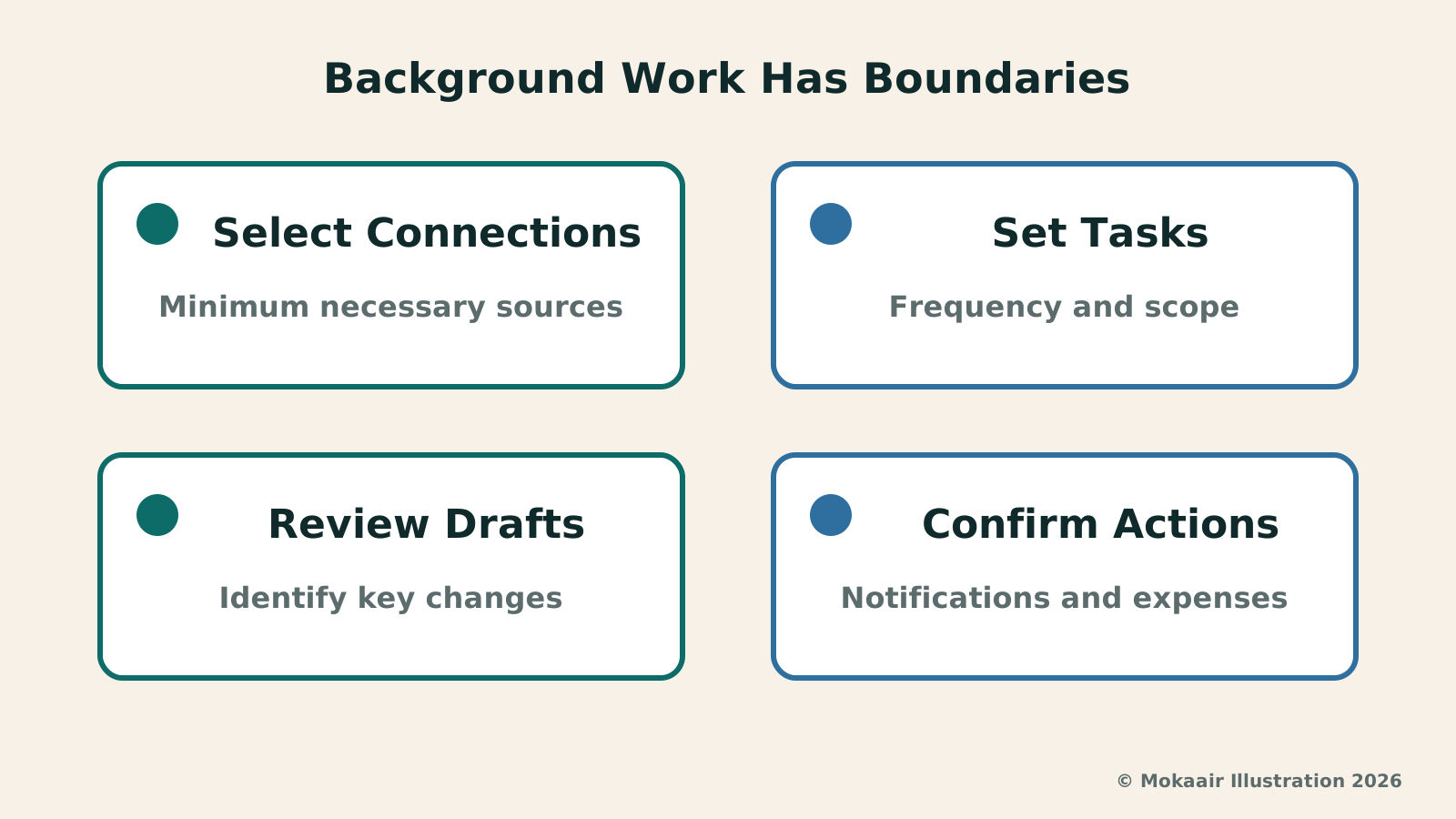
Authorization Verification for Dispatching Notifications and Modifying Resources
In designing agent technology, the official team particularly emphasized that sensitive actions like expenses and communications require explicit confirmation—a design principle carrying immense practical significance. Any instruction involving external transmission, resource allocation, or permission changes should never default to full automation. During the final mile where the system advances a draft to external communication, the interface must provide clear comparative summaries so managers can see key changes at a glance.
Specific acceptance checks should include three elements: whether the target of change is correct, whether the adjustments fall within authorized scope, and whether there are unanticipated collateral changes. Taking volunteer coordination as an example, if the system prepares to send shift confirmation emails to individual members, the review screen should display the intended recipient list and email content preview, allowing managers to approve only after verification, safeguarding the rigor of outbound communication and interpersonal trust.
Although this mandatory confirmation step may seem to add an extra click, it essentially establishes a boundary of responsibility between the organization and the automated system. Human confirmation serves not only as a safety valve preventing algorithmic errors but also as the anchor for legal and ethical accountability. When a system consistently returns control over critical actions to humans, users can genuinely feel at ease allowing background agents to handle massive amounts of tedious data preprocessing.
Agent Task Lifecycle and Periodic Maintenance Mechanisms
After enabling background automation, many users often overlook routine maintenance, leaving systems cluttered with outdated scraping rules and obsolete scheduled tasks. Operating an agent system is not a set-it-and-forget-it endeavor; an organization's operational framework, data field definitions, and authorized integrations evolve over time. Without periodic review mechanisms, canceled events or the permissions of departed personnel may continue to be polled by schedules, causing data leaks or confusion.
A sound governance approach assigns a clear validity period and maintenance owner to every automated task. Examples include conducting quarterly reviews of currently connected third-party apps, evaluating whether schedule trigger frequencies remain reasonable, and proactively deleting or disabling monitoring rules that are no longer needed. Only by enforcing least-privilege access and lifecycle management can background agent technology serve as a reliable, long-term productivity booster rather than an invisible operational liability.
2026 AI News Roundup: Highlights and Daily Life Applications from January to September2026 AI News Roundup: Highlights and Daily Life Applications from January to SeptemberOrganizing key AI news stories month by month from January to September 2026, linking to full analyses in five languages. Covering models, work tools, creation, costs, and transparency, explaining backgrounds, uses, and limits.Read the full article
Claude Fable 5 Launch, Suspension, and Restoration: Availability CriteriaClaude Fable 5 Launch, Suspension, and Restoration: Availability CriteriaAnalyzing the suspension and restoration of Claude Fable 5, exploring how small research teams use neutral formats to preserve results and prepare alternatives amid availability shifts.Read the full article
Lifestyle
NVIDIA launches DGX Spark 64GB: on sale October 23 from $4,999, two units can be linked into 128GB
On October 2, 2026, NVIDIA announced a more affordable 64GB memory version of its DGX Spark personal AI computer, available from October 23 through six makers including Acer and ASUS. It is aimed mainly at developers and researchers who want to run AI models on their own machines. Below we summarize the specs NVIDIA published, its claims about linking two units, and what it means for general readers.
Lifestyle
Google Cloud Launches Spanner Queues: Putting Message Queues Inside Database Transactions to Make AI Agents More Reliable
Google Cloud has announced the general availability of Spanner queues, which make message creation part of a database transaction. The aim is to stop AI agents' "state" and "actions" from falling out of sync. This article covers Google Cloud's claims, the main features, and what it means for general readers.
Lifestyle
GPT-6.1 Sol Launches: New Sol Version in the API, Codex and ChatGPT Work, Not in Chat
OpenAI launched GPT-6.1 Sol on September 29, 2026, with the API name gpt-6.1-sol. The launch rollout covers Codex and ChatGPT Work on Plus, Pro, Business, Enterprise and Edu (Enterprise and Edu need an administrator to enable it); Free and Go are not included at launch, and it is not in Chat (checked September 2026).
Lifestyle
Claude Sonnet 5.5 Launches: Same List Price as Sonnet 5, Available in the API, on Cloud Platforms and in Claude.ai
Anthropic launched Claude Sonnet 5.5 on September 28, 2026. API list prices are the same as Sonnet 5 ($2 per million input tokens, $10 per million output tokens). It is available in Claude.ai, the API and several cloud platforms, and higher-risk cybersecurity requests fall back to Sonnet 5 (checked September 2026).
Articles that cite this one
Latest travel guides

GuideTokyo
Where to Stay in Tokyo: Comparing Shinjuku, Ueno, Tokyo Station, Shibuya, Asakusa, Ikebukuro, and Ginza, Plus Airport Access, Accommodation Tax, and Luggage Delivery
Where should you stay in Tokyo? Compare Shinjuku, Ueno, Tokyo Station, Shibuya, Asakusa, Ikebukuro, and Ginza by the same criteria: access from Narita and Haneda, transit routes, nearby attractions, neighborhood character, and who each area suits. Includes a comparison table, a Yamanote Line diagram, Tokyo’s accommodation tax as verified in 2026/9 (changing to 3% in 2027/4), and Airport TA-Q-BIN luggage shipping rules.
- Budget
- Hotels

GuideTokyo
How to Choose Tokyo Transit Passes: Are Suica, Welcome Suica, the Tokyo Subway Ticket, and the JR Pass Worth It?
On a first Tokyo trip, start with an IC card and pay per ride (Welcome Suica has no deposit and is valid for 28 days). If you take four or more subway rides in a day, add a 72-hour Tokyo Subway Ticket for 2,000 yen; a JR Pass is never worthwhile if you stay in Tokyo and do not go to Kansai. See what TOURIST PASMO, Suica on iPhone, and the Tokyo Metro day pass do and do not cover, with a decision chart. Prices verified in September 2026.
- Transport
- Budget

GuideTokyo
Tokyo Disneyland and DisneySea Guide: Ticket Prices, Fantasy Springs, Disney Premier Access (DPA), Standby Pass, and Which Park to Choose for Your First Visit
Tokyo Disney one-day Passport prices vary: most weekdays in 9/2026 cost ¥9,900 and weekends ¥10,900. At 14:00 daily, tickets go on sale for the same date two months later. Free Priority Pass is no longer on the official service list; only paid Disney Premier Access (¥1,000–3,500 per person per use) shortens waits. Covers hours, the 25th anniversary, Standby Pass, Entry Request, Fantasy Springs access and first-visit park choice; checked on the official site in 9/2026.
- Itineraries
- Family
Sources
- Google: The next step for the Gemini app · Checked:
- Google: 100 announcements from I/O 2026 · Checked:
- Google: Gemini Drop July 2026 · Checked: