Lifestyle
Claude Fable 5.1 and Mythos 5.1: Capabilities, Access, and Limits
Anthropic released Claude Fable 5.1 and Mythos 5.1 on September 1, 2026, sharing the same underlying model but with different safety measures and access methods. This guide outlines key differences for general users, explaining how to interpret long tasks, vendor evaluations, and data terms, while offering practical methods to choose tools, verify deliverables, and confirm permissions across document research and team workflows.
Updated: About 7 min read
Anthropic released Claude Fable 5.1 and Claude Mythos 5.1 on September 1, 2026. The company stated that both share the same underlying model but adopt different safety measures: Fable 5.1 is broadly available to the public, while Mythos 5.1 is restricted to a trusted access program. For general users, the first priority is to check entry points and eligibility, rather than treating the two names as interchangeable options available to everyone.
Verified on September 14, 2026, this article interprets the release from the perspective of everyday work. It neither reproduces the vendor's showcased research results nor creates new model rankings. Below is a breakdown of the key distinctions from the announcement, followed by editorially designed document and team scenarios showing how to evaluate whether a higher-capability model genuinely improves your work.
Why the Same Underlying Model Has Different Access Methods
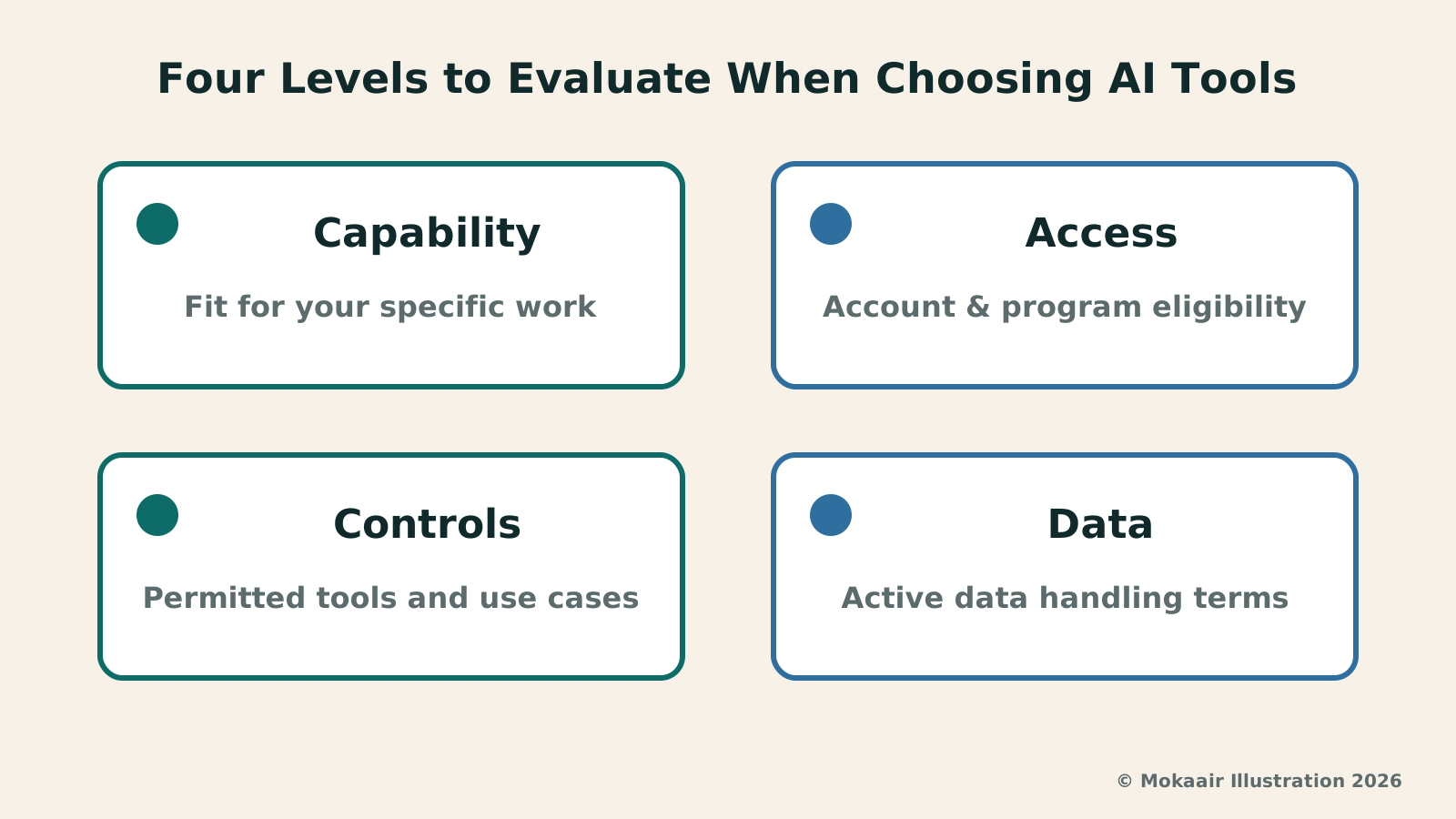
The release announcement positions Fable 5.1 for coding, knowledge work, and extended problem-solving, whereas access arrangements for Mythos 5.1 specifically involve cybersecurity and life sciences. This distinction demonstrates that capabilities, product entry points, and permitted use cases operate on different levels. Knowing what a model can do does not mean every account receives the same operational permissions.
When general readers encounter "trusted access," they should understand that it requires meeting specific program criteria, rather than assuming it can be accessed simply by subscribing to a more expensive tier. If your work does not involve those specialized domains, there is no need to treat a restricted model as an essential choice for daily use. Confirming whether publicly available tools meet your actual needs is far more effective than chasing names.
When teams handle procurement, model capabilities and service terms should also be listed separately. The former asks whether it can accomplish the work, while the latter asks who can use it, how data is processed, and what tooling and administrative features are available. Blending both into a single phrase like "this model is stronger" often causes the issues that truly impact adoption to be discovered only at the very end.
The Value of Long Tasks Lies in Continuously Sustaining Working Conditions
What official demonstrations of longer, more complex work performance offer general workers is an insight into whether a tool can remember delivery requirements from start to finish. Suppose you need to compile a report based on interview notes: beyond drafting a summary, you must also preserve differing perspectives, distinguish facts from speculation, and avoid dropping critical constraints when modifying formats.
Editors suggest breaking such tasks into verifiable deliverables. First request a data index, then organize findings, and finally draft the report, retaining references to original source locations at every stage. When issues arise in the results, you can return to the flawed step for corrections rather than asking the model to redo the entire document without knowing where it went off track.
You can also have the tool list incomplete portions upon delivery. Missing sources, unreadable attachments, or conflicting data should all be flagged in the handoff notes. Extended execution time does not mean the work was successful; in the end, one must still be able to find readable files and verify that they meet the initially defined requirements.
| Aspect to Compare | Clues from the News | What You Must Confirm |
|---|---|---|
| Underlying model | Both share model capabilities | Whether your tasks benefit |
| Access method | Fable broadly available, Mythos restricted | Account and program eligibility |
| Long tasks | Vendor showcases multi-step outputs | Actual delivery and source mapping |
| Data terms | Includes current terms and future plans | Current contract and active status |
How to Interpret Evaluations in the Release Announcement
Anthropic's release page lists multiple capability tests and explains that different reasoning settings affect cost and performance. When reading them, note what is being tested, what tools were used, and whether comparison conditions were consistent. A single high score cannot tell you whether your organization's documents, language, and workflows will yield the same results.
For general users, a more practical approach is to build a small acceptance test set. Select familiar tasks where you can easily judge correctness, maintain the same inputs and formatting requirements, and observe what the model delivers. Evaluate not only completion time, but also omissions, errors, the number of follow-up prompts needed, and the effort spent verifying results.
For example, with a research summary, you can require every key conclusion to cite the location of supporting materials and clearly flag data gaps. If a higher-capability tool reduces the time you spend verifying evidence paragraph by paragraph, that is a concrete, tangible benefit; if it merely writes more extensively while still requiring a full recheck, the improvement is far less direct than expected.
Data Processing Terms Depend on What Is Currently in Effect
This release also addressed data retention and enterprise security measures, including arrangements planned for phased rollout later. Planned features and terms already active for current accounts must be viewed separately. You cannot write future plans into today's operational guidelines, nor should you assume data is never stored simply because the word "privacy" appears.
If a team intends to submit internal documents, first check with the account administrator regarding the current plan, applicable terms, and the scope of data permitted for use. When comparisons are needed, frame questions as specific items: what data is sent to servers, who can access logs, how long data is retained, and what restrictions apply to sensitive content. This article assumes no answers for individual contracts.
For personal work, verifying workflows with anonymized samples usually makes it easier to determine whether a tool meets your needs. Do not bypass your existing data management rules simply because a model excels in research or coding benchmarks. Adoption should begin with understandable terms before deciding what content can be submitted.
When Choosing Tools, Clarify the Improvement You Expect
If your goal is to improve writing, compare whether it adheres to your tone, preserves essential facts, and shortens the revision process; if it is reading documents, check whether source mapping is complete; if it is team handoffs, see if deliverables can be picked up directly by colleagues. Articulating clear goals prevents model upgrades from turning into an endless comparison cycle.
Also pay attention to whether usage costs and wait times fit your workflow rhythm. Occasionally processing a complex document calls for different choices than running high volumes of routine tasks all day. These are differences in operational requirements that cannot be decided solely by the most powerful or newest name. If necessary, assign distinct tools to clearly defined segments of work and verify them using consistent acceptance criteria.
For general readers, the most practical takeaway from this Fable and Mythos release is to separate underlying capabilities, available access points, safety measures, and data terms. You do not need access to every model to begin improving your work; first turn your existing tasks into deliverable, auditable workflows, and then observe whether upgrading models genuinely lightens your load.
Claude Opus 5 Released: What Changes Matter Most for Everyday Work Users?Claude Opus 5 Released: What Changes Matter Most for Everyday Work Users?Anthropic released Claude Opus 5 on July 24, 2026, focusing on coding, knowledge work, and multi-step tasks. From the everyday office worker's perspective—document organization, proposal revisions, and task handoffs—this article covers the announced capability shifts, how to distinguish vendor benchmarks from real-world results, and how to set up data boundaries, acceptance criteria, and manual checkpoints before switching plans.Read the full article
GPT-6 Astra Announced: From Answering Questions to Completing Computer TasksGPT-6 Astra Announced: From Answering Questions to Completing Computer TasksOpenAI announced GPT-6 Astra on September 3, 2026, emphasizing computer use, multi-step workflows, and template-based document output. Focusing on general reporting, data organization, and admin tasks, this article explains the gap between model ability and tool permissions, how to draft verifiable tasks, set required confirmation checkpoints, and recognize phased rollouts without assuming launch demos are instantly available to every account.Read the full article
Lifestyle
NVIDIA launches DGX Spark 64GB: on sale October 23 from $4,999, two units can be linked into 128GB
On October 2, 2026, NVIDIA announced a more affordable 64GB memory version of its DGX Spark personal AI computer, available from October 23 through six makers including Acer and ASUS. It is aimed mainly at developers and researchers who want to run AI models on their own machines. Below we summarize the specs NVIDIA published, its claims about linking two units, and what it means for general readers.
Lifestyle
Google Cloud Launches Spanner Queues: Putting Message Queues Inside Database Transactions to Make AI Agents More Reliable
Google Cloud has announced the general availability of Spanner queues, which make message creation part of a database transaction. The aim is to stop AI agents' "state" and "actions" from falling out of sync. This article covers Google Cloud's claims, the main features, and what it means for general readers.
Lifestyle
GPT-6.1 Sol Launches: New Sol Version in the API, Codex and ChatGPT Work, Not in Chat
OpenAI launched GPT-6.1 Sol on September 29, 2026, with the API name gpt-6.1-sol. The launch rollout covers Codex and ChatGPT Work on Plus, Pro, Business, Enterprise and Edu (Enterprise and Edu need an administrator to enable it); Free and Go are not included at launch, and it is not in Chat (checked September 2026).
Lifestyle
Claude Sonnet 5.5 Launches: Same List Price as Sonnet 5, Available in the API, on Cloud Platforms and in Claude.ai
Anthropic launched Claude Sonnet 5.5 on September 28, 2026. API list prices are the same as Sonnet 5 ($2 per million input tokens, $10 per million output tokens). It is available in Claude.ai, the API and several cloud platforms, and higher-risk cybersecurity requests fall back to Sonnet 5 (checked September 2026).
Articles that cite this one
- Amodei Urges Pacing Frontier AI: What “We Must Pace the Frontier” Proposes and Its Limits
- 2026 AI News Roundup: Highlights and Daily Life Applications from January to September
- GPT-6 Astra Announced: From Answering Questions to Completing Computer Tasks
- Claude Opus 5 Released: What Changes Matter Most for Everyday Work Users?
Latest travel guides

GuideTokyo
Where to Stay in Tokyo: Comparing Shinjuku, Ueno, Tokyo Station, Shibuya, Asakusa, Ikebukuro, and Ginza, Plus Airport Access, Accommodation Tax, and Luggage Delivery
Where should you stay in Tokyo? Compare Shinjuku, Ueno, Tokyo Station, Shibuya, Asakusa, Ikebukuro, and Ginza by the same criteria: access from Narita and Haneda, transit routes, nearby attractions, neighborhood character, and who each area suits. Includes a comparison table, a Yamanote Line diagram, Tokyo’s accommodation tax as verified in 2026/9 (changing to 3% in 2027/4), and Airport TA-Q-BIN luggage shipping rules.
- Budget
- Hotels

GuideTokyo
How to Choose Tokyo Transit Passes: Are Suica, Welcome Suica, the Tokyo Subway Ticket, and the JR Pass Worth It?
On a first Tokyo trip, start with an IC card and pay per ride (Welcome Suica has no deposit and is valid for 28 days). If you take four or more subway rides in a day, add a 72-hour Tokyo Subway Ticket for 2,000 yen; a JR Pass is never worthwhile if you stay in Tokyo and do not go to Kansai. See what TOURIST PASMO, Suica on iPhone, and the Tokyo Metro day pass do and do not cover, with a decision chart. Prices verified in September 2026.
- Transport
- Budget

GuideTokyo
Tokyo Disneyland and DisneySea Guide: Ticket Prices, Fantasy Springs, Disney Premier Access (DPA), Standby Pass, and Which Park to Choose for Your First Visit
Tokyo Disney one-day Passport prices vary: most weekdays in 9/2026 cost ¥9,900 and weekends ¥10,900. At 14:00 daily, tickets go on sale for the same date two months later. Free Priority Pass is no longer on the official service list; only paid Disney Premier Access (¥1,000–3,500 per person per use) shortens waits. Covers hours, the 25th anniversary, Standby Pass, Entry Request, Fantasy Springs access and first-visit park choice; checked on the official site in 9/2026.
- Itineraries
- Family