Lifestyle
Gemini 3.1 Pro Released: Turning Complex Questions into Verifiable Answers
Looking back at Google's Gemini 3.1 Pro launch in 2026, exploring how to break down complex life decisions like course selection into verifiable reasoning steps and information verification workflows.
Updated: About 6 min read
Event date: 2026-02-19; verification date for this article: 2026-09-14. On February 19, Google released Gemini 3.1 Pro, emphasizing complex reasoning, data synthesis, and code-generated visuals.
At the time, developers accessed the preview via endpoints like the Gemini API; consumer access points included the Gemini app and NotebookLM. The original announcement stated that Pro/Ultra users on the Gemini app enjoyed higher limits, while NotebookLM access to 3.1 Pro was restricted to Pro/Ultra tiers; access terms across portals must not be conflated. Benchmarks such as ARC-AGI-2 reflect Google-published results and do not represent everyday answer accuracy. The following life and work scenarios are editor-designed examples for reader verification and do not represent hands-on product testing by this site.
Structured Prompting Techniques for Multi-Condition Comparisons
Taking family planning as an example, many parents frequently face the dilemma of choosing among three different extracurricular talent classes. Such decisions typically involve multiple objective parameters, such as tuition fees per term, weekly class schedules, and round-trip commute distances. Merely dumping admission brochures into the system and asking which one is best usually yields nothing more than balanced yet unhelpful generic PR rhetoric, failing to resolve the specific scheduling conflicts of individual families.
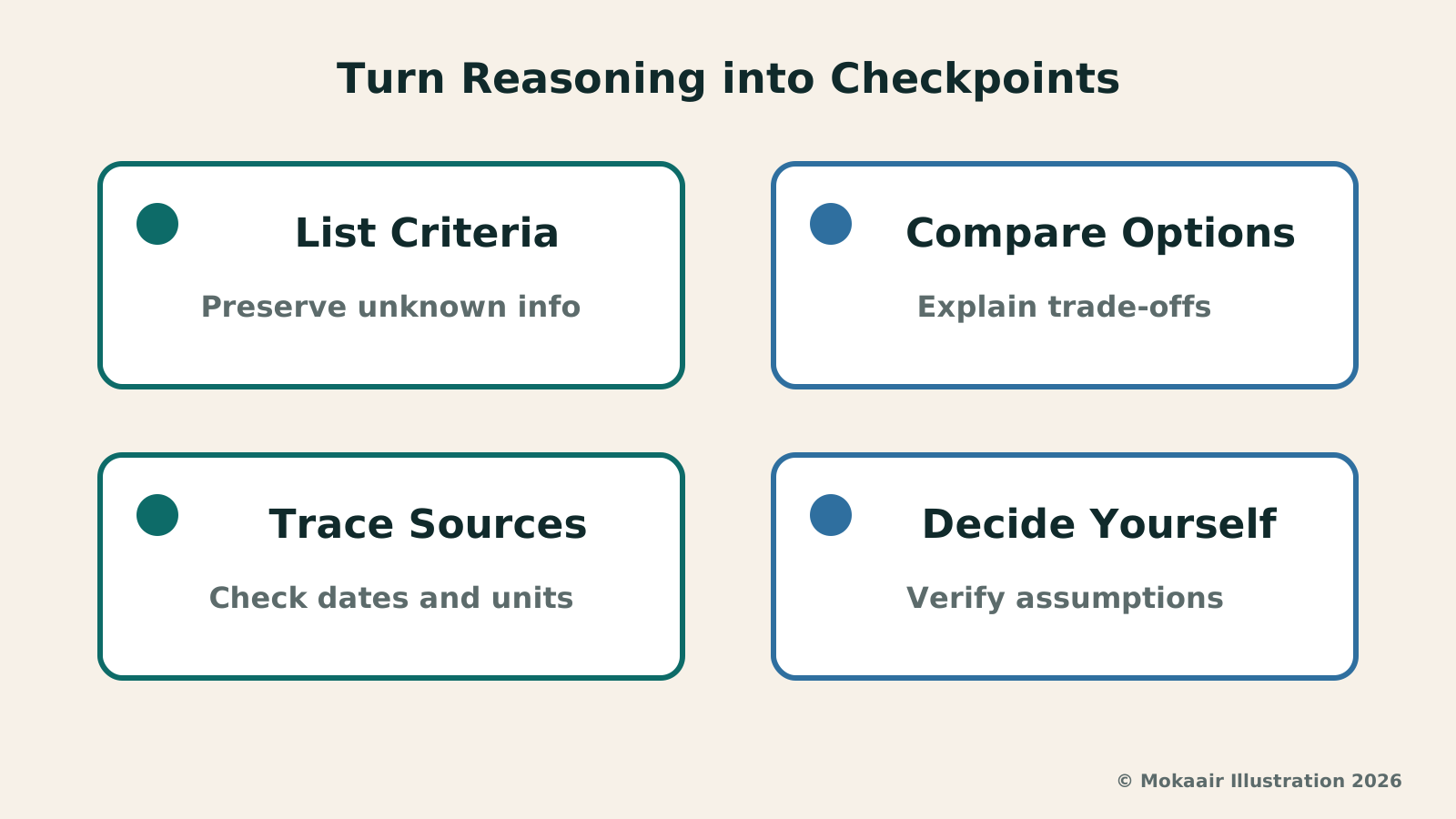
A more ideal approach is to instruct the system to build a multi-column comparison matrix, clearly separating fixed expenses, commute times, and class hours. At the same time, users must explicitly require the system to flag fields that are unannounced or lack sufficient data, such as refund policies or extra material fees. By preserving unknown information rather than forcing speculative fills, the comparison table can faithfully reflect reality, preventing users from being misled into incorrect budget judgments by unverified hallucinations.
Once the comparison matrix is complete, users can further instruct the system to detail the scoring weights used behind each ranking recommendation. For example, did the system prioritize one-way commute time above all else, or did it treat the average hourly tuition as the absolute key factor? By inspecting the underlying weighting logic item by item, parents can clearly discern whether the analysis truly aligns with their core parenting values, rather than blindly accepting algorithmic recommendations.
Core Value and Limitations of Reasoning Models in Everyday Decisions
The core value of a so-called reasoning model does not lie in how quickly it outputs long articles with ornate prose, but in whether it possesses verifiable multi-step analytical capabilities to break down difficult problems sequentially. When faced with complex real-life scenarios, this architecture can progressively handle mutually exclusive conditions—such as balancing pickup routes with multiple family members' schedules under a tight budget ceiling—and attempt to identify compromise solutions among competing constraints.
However, users must remain acutely aware that advancements in reasoning capabilities do not equate to the absolute correctness of built-in facts. Even computational models that score exceptionally well on professional benchmarks essentially process symbolic associations based on probabilistic patterns, offering no guarantee of retrieving up-to-date real-time data without web verification. Mistaking an inference model for an omniscient encyclopedia creates unnecessary risks in real-world decisions involving contractual terms or safety details.
| Evaluation Dimension | Guiding Prompt Example | Manual Verification Focus |
|---|---|---|
| Fee Structure Breakdown | Break down fixed tuition and potential material incidentals, listing possible hidden costs | Verify refund mechanisms and BYO material rules against official brochures |
| Commute Time Costs | Compare door-to-door transit times across modes and flag peak-hour disparities | Personally confirm route traffic and parking feasibility during actual pickup hours |
| Faculty & Curriculum | Compile public teaching background and student-teacher ratios; mark gaps as missing | Directly check the latest instructor qualifications and certifications with organizers |
| Scheduling Flexibility | List leave/makeup rules and alternatives for scheduling conflicts, noting constraints | Confirm makeup deadlines and whether administrative handling fees apply |
Proactively Preserving Unknown Fields When Data Is Incomplete
When using various generative tools, the easiest trap for many people to fall into is expecting the system to produce seamless, complete answers. In the real world, however, information is often fragmented; for instance, some courses might not have published instructor backgrounds, waitlist turnaround times, or rainy-day contingency plans. If a system fabricates plausible details simply to maintain a smooth narrative flow, it introduces serious cognitive misdirection for decision-makers.
Therefore, building an effective collaborative workflow requires cultivating tolerance for the unknown and a habit of verification. Explicitly instruct the system to mark critical items not mentioned in the input data as 'to be confirmed' or 'data missing,' rather than attempting to speculate. While this rigorous approach will leave blanks in the final table, it provides decision-makers with a clear list of specific questions to ask organizers directly, putting a foolproof check into practice.
Guarding Against Interactive Visuals Replacing Substantive Data Evidence
As modern models become capable of rendering sophisticated interactive charts by generating code on the fly, many users are easily captivated by visual appeal, consequently overlooking the accuracy of the underlying data. While flashy animated bar graphs or colorful radar charts offer an engaging visual experience, if the underlying data they reference is flawed, these animations are essentially nothing more than well-packaged misinformation.
Before reviewing any automatically generated chart or dashboard, the first step should always be spot-checking its underlying calculation formulas and numerical units. Users need to verify whether the timeline is consistent, whether fee computations include hidden taxes, and whether comparison baselines across different dimensions are equitable. Only after confirming that data sources and algorithms are logical can visual presentations genuinely support decision-making without overshadowing what matters.
Establishing a Final Verification and Acceptance Workflow for Personalized Decisions
Regardless of how rigorous an algorithm's analytical process appears, the ultimate responsibility for any decision rests with the user. After completing initial option comparisons and weight breakdowns, a final manual verification checkpoint must be established to cross-check the compiled table item by item against original brochures or official landing pages. In particular, key assumptions underpinning inferences—such as commute transit modes or billing cycle definitions—require thorough factual verification.
Through this human-AI collaboration model, generative tools cease to be black-box decision-makers acting on people's behalf; instead, they transform into powerful assistants that efficiently organize thoughts and consolidate variables. By guiding the system with clear prompt frameworks for objective summarization and applying human common sense for final oversight, users can save time searching through mountains of data while maintaining clarity and autonomy in major life decisions.
2026 AI News Roundup: Highlights and Daily Life Applications from January to September2026 AI News Roundup: Highlights and Daily Life Applications from January to SeptemberOrganizing key AI news stories month by month from January to September 2026, linking to full analyses in five languages. Covering models, work tools, creation, costs, and transparency, explaining backgrounds, uses, and limits.Read the full article
GPT-5.4 Combines Reasoning and Computer Use: What It Means for Everyday WorkersGPT-5.4 Combines Reasoning and Computer Use: What It Means for Everyday WorkersReviewing the technical integration of GPT-5.4 released in early 2026, analyzing how everyday workers handling spreadsheets and presentations can distinguish between reasoning judgment, tool operations, and human review boundaries.Read the full article
Lifestyle
NVIDIA launches DGX Spark 64GB: on sale October 23 from $4,999, two units can be linked into 128GB
On October 2, 2026, NVIDIA announced a more affordable 64GB memory version of its DGX Spark personal AI computer, available from October 23 through six makers including Acer and ASUS. It is aimed mainly at developers and researchers who want to run AI models on their own machines. Below we summarize the specs NVIDIA published, its claims about linking two units, and what it means for general readers.
Lifestyle
Google Cloud Launches Spanner Queues: Putting Message Queues Inside Database Transactions to Make AI Agents More Reliable
Google Cloud has announced the general availability of Spanner queues, which make message creation part of a database transaction. The aim is to stop AI agents' "state" and "actions" from falling out of sync. This article covers Google Cloud's claims, the main features, and what it means for general readers.
Lifestyle
GPT-6.1 Sol Launches: New Sol Version in the API, Codex and ChatGPT Work, Not in Chat
OpenAI launched GPT-6.1 Sol on September 29, 2026, with the API name gpt-6.1-sol. The launch rollout covers Codex and ChatGPT Work on Plus, Pro, Business, Enterprise and Edu (Enterprise and Edu need an administrator to enable it); Free and Go are not included at launch, and it is not in Chat (checked September 2026).
Lifestyle
Claude Sonnet 5.5 Launches: Same List Price as Sonnet 5, Available in the API, on Cloud Platforms and in Claude.ai
Anthropic launched Claude Sonnet 5.5 on September 28, 2026. API list prices are the same as Sonnet 5 ($2 per million input tokens, $10 per million output tokens). It is available in Claude.ai, the API and several cloud platforms, and higher-risk cybersecurity requests fall back to Sonnet 5 (checked September 2026).
Articles that cite this one
Latest travel guides

GuideTokyo
Where to Stay in Tokyo: Comparing Shinjuku, Ueno, Tokyo Station, Shibuya, Asakusa, Ikebukuro, and Ginza, Plus Airport Access, Accommodation Tax, and Luggage Delivery
Where should you stay in Tokyo? Compare Shinjuku, Ueno, Tokyo Station, Shibuya, Asakusa, Ikebukuro, and Ginza by the same criteria: access from Narita and Haneda, transit routes, nearby attractions, neighborhood character, and who each area suits. Includes a comparison table, a Yamanote Line diagram, Tokyo’s accommodation tax as verified in 2026/9 (changing to 3% in 2027/4), and Airport TA-Q-BIN luggage shipping rules.
- Budget
- Hotels

GuideTokyo
How to Choose Tokyo Transit Passes: Are Suica, Welcome Suica, the Tokyo Subway Ticket, and the JR Pass Worth It?
On a first Tokyo trip, start with an IC card and pay per ride (Welcome Suica has no deposit and is valid for 28 days). If you take four or more subway rides in a day, add a 72-hour Tokyo Subway Ticket for 2,000 yen; a JR Pass is never worthwhile if you stay in Tokyo and do not go to Kansai. See what TOURIST PASMO, Suica on iPhone, and the Tokyo Metro day pass do and do not cover, with a decision chart. Prices verified in September 2026.
- Transport
- Budget

GuideTokyo
Tokyo Disneyland and DisneySea Guide: Ticket Prices, Fantasy Springs, Disney Premier Access (DPA), Standby Pass, and Which Park to Choose for Your First Visit
Tokyo Disney one-day Passport prices vary: most weekdays in 9/2026 cost ¥9,900 and weekends ¥10,900. At 14:00 daily, tickets go on sale for the same date two months later. Free Priority Pass is no longer on the official service list; only paid Disney Premier Access (¥1,000–3,500 per person per use) shortens waits. Covers hours, the 25th anniversary, Standby Pass, Entry Request, Fantasy Springs access and first-visit park choice; checked on the official site in 9/2026.
- Itineraries
- Family
Sources
- Google: Gemini 3.1 Pro · Checked:
- Google: Gemini Updates in February 2026 · Checked: