Lifestyle
Qwen3.5 Open Weights: What Is the Difference Between a Downloadable Model and Running It on Your Own PC?
Reviewing the Qwen3.5-397B-A17B open-weight model released on 2026-02-16 to clarify differences between open weights, hardware demands, and cloud hosting, offering practical evaluation guidance for SMEs.
Updated: About 8 min read
Event date: 2026-02-16; article verification date: 2026-09-14. The official repository News notes the release of the first Qwen3.5 open-weight model, Qwen3.5-397B-A17B, on February 16, 2026. The cloud Plus version date of February 15 cannot be treated as the release date for this open model.
The official model card lists total parameters of 397B and activated parameters of 17B, featuring a hybrid architecture that includes a vision encoder, with an Apache-2.0 license label. The official documentation also distinguishes self-deploying the weights from Alibaba Cloud's hosted Qwen3.5-Plus; the latter features different service capabilities and context settings. Activated parameters do not equal the entire model file or memory requirements; self-deployment still requires checking hardware, software, operations, and licensing terms. The daily life and workplace scenarios below are editor-designed examples provided for readers to verify on their own, not actual product tests by this site.
Parameters and Memory Myths Under a Mixture-of-Experts Architecture
This model adopts sparse Mixture-of-Experts technology, meaning that while the overall model possesses a massive 397B total parameters, it dynamically invokes only about 17B activated parameters each time it processes text and visual inputs. This design effectively boosts computational efficiency during inference, significantly reducing the compute load for each forward pass. However, the computational scale of activated parameters must never be taken as the sole reference benchmark for computer hardware specifications.
The complete weights still require sufficient storage space, and during execution they may be allocated to VRAM, system RAM, or other offloading methods depending on the framework and configuration. One cannot make a blanket statement that all weights must fit into the same memory pool upon boot, nor can one claim that insufficient memory will inevitably cause a system crash. Whether it can actually be loaded and whether the speed is acceptable must be evaluated alongside precision, quantization, context length, and hardware configuration.
Therefore, when planning on-premises artificial intelligence strategies, enterprises must never mistake this for an ordinary lightweight model simply upon seeing "17B activated." Official documentation does not provide unified minimum terminal hardware requirements precisely because enterprise deployments involve framework optimization, quantization settings, and memory scheduling. For teams without prior architectural planning, blindly downloading raw model files spanning hundreds of gigabytes often leads only to depleted storage space and wasted bandwidth.
The Real Technical Threshold from Downloadable to Bootable
A major advantage of open weights is allowing anyone to obtain the files from public repositories, but a rather demanding engineering hurdle lies between obtaining the files and actually launching the service successfully. Although the model card indicates an Apache-2.0 license—safeguarding regulatory flexibility for weight acquisition and modification—a legal license does not mean the system is plug-and-play. From low-level drivers and tensor parallelism libraries to model serving engines, every single link requires highly specialized system tuning.
Beyond its massive core large language model architecture, the model also incorporates a built-in vision encoder, meaning the inference pipeline must simultaneously handle image feature extraction and cross-modal tensor alignment. When teams attempt to combine multiple compute cards locally for distributed inference, inter-node communication latency, driver version compatibility, and the inference framework's maturity in supporting multimodal Mixture-of-Experts architectures will directly determine whether the system can boot smoothly and output text stably.
Teams lacking relevant maintenance experience can first list their expected tasks and data constraints, and then ask a technical partner to evaluate whether self-building is appropriate. We do not predict that it will necessarily take a set number of weeks or months, nor do we recommend buying hardware first and looking for use cases later. Using a small sample of data first to verify loading, answers, and output formats, and then gradually testing longer content and multi-user access, makes costs and maintenance requirements much easier to estimate.
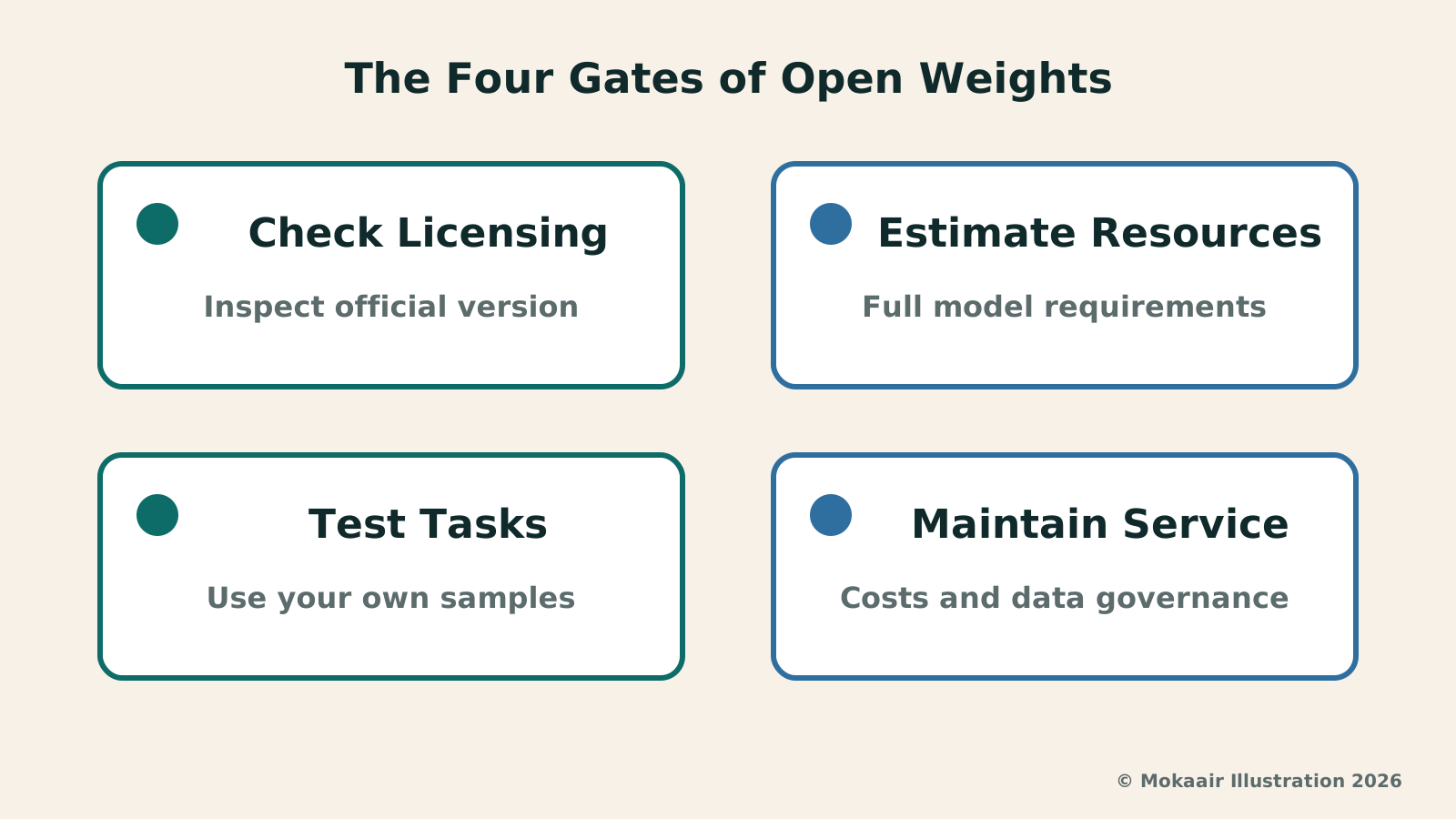
| Evaluation Stage | Core Technical Conditions & Resource Considerations | Key Enterprise Decisions & Acceptance Criteria |
|---|---|---|
| Downloadable | Verify download, storage space, and bandwidth according to the official file manifest and selected precision | Confirm whether official version release notes and the Apache-2.0 license scope are compatible with business uses |
| Bootable | Validate loading based on framework, quantization, and offload configs; do not estimate all needs using 17B activated params | Inference engine initializes successfully and completes baseline multimodal forward pass without out-of-memory errors |
| Usable | Perform Q&A on internal non-public schematics and proprietary spec sheets; compare cloud-hosted vs. on-premises performance | Verify Q&A accuracy and multimodal recognition precision using 20 to 30 internal typical sample sets |
| Maintainable | Bear server power, cooling, redundancy mechanisms, and specialized systems engineer maintenance costs | Establish service offline fault-tolerance plans, security perimeter management, and long-term TCO analysis mechanisms |
A Pragmatic Workflow for Internal Product Schematics and Specification Q&A
Suppose a local retail shop has accumulated thousands of internal, non-public product structure diagrams and complex specification sheets, and hopes to build an intelligent assistant that enables shop clerks to quickly look up inventory and part characteristics. Faced with this kind of real-world business scenario, the operator's first dilemma is whether to directly use an external cloud-hosted API for proof of concept, or to seek an external technical partner to assist in building a small-scale local inference system.
If the data is permitted to be processed in the cloud, one can use public, sanitized, or specially crafted examples to test the hosted service's Q&A approach. Before data policies are confirmed, do not upload non-public diagrams to the cloud first and only then decide whether to keep them confidential. Qwen3.5-Plus and this open-weight model are also not the same service; cloud testing can help clarify requirements, but cannot directly substitute for the acceptance testing of the model intended for self-hosted deployment.
If schematics must remain internal, they should be handled from the very beginning in an environment compliant with data governance rules. You can commission technical partners to evaluate the local model or other suitable solutions using an authorized small sample, and then check answer correctness, query times, and resource requirements. The key is to first determine where data is allowed to go before choosing testing portals; do not send confidential content to unconfirmed external services simply for the sake of testing convenience.
Long-Term Trade-Offs Between Hosted Services and Self-Built Infrastructure
Hosted services can reduce the burden of managing servers on your own, but pricing, regions, data retention, and service commitments still need verification. Open weights give teams more deployment choices, while also requiring them to shoulder corresponding maintenance responsibilities. When comparing, one can estimate expenses based on the same set of qualified output requirements, and separately log needed engineering support, backups, and troubleshooting, rather than merely checking whether the model file is free to download.
Self-deployment can align the location of data processing more closely with internal arrangements, but it does not automatically grant complete privacy or security assurances. Access permissions, logs, backups, external connections, and maintenance procedures all require management. Beyond hardware costs, power, maintenance, and personnel hours should also be logged, and then evaluated for reasonableness based on usage volume; these expenditures may be substantial, but one cannot assert beforehand that they will definitely be higher or lower than cloud services.
Methods for handling service disruptions should also be included in the comparison. Self-built systems require personnel responsible for troubleshooting; hosted services depend on the provider's actual contract and service terms, and one cannot assume that every portal guarantees automatic failover or a specific uptime. For a small shop, keeping original specification documents and manual lookup methods allows staff to continue answering basic questions whenever any tool is temporarily unavailable.
Licensing Boundaries of Open Weights and Data Governance Realities
When discussing open-source technology, many easily mistake "open weights" for "complete open-source transparency." Although Qwen3.5-397B-A17B is labeled with a permissive Apache-2.0 software license in the repository, permitting commercial use and custom modifications, this does not mean that the model's complete raw training data, data cleaning pipelines, and detailed mixing ratios are made publicly available. What users can control are the model parameters themselves, not all the historical raw ingredients that produced those parameters.
At the same time, open weights do not mean one has unconditional freedom in all derivative scenarios. When enterprises integrate such large models into their own product recommendations or customer service workflows, they must still establish comprehensive data governance standards. This includes auditing model output compliance, preventing hallucinations from causing false commercial commitments, and verifying that sensitive customer data fed to the model complies with local personal data protection regulations—governance responsibilities that rest entirely upon the deployer.
Taken together, mastering open weights indeed frees technical teams from total dependence on a single cloud vendor, granting the possibility of exploring deep customization and offline operation. However, only by clearly understanding the sequential challenges from downloading files, assembling environments, and validating tasks to long-term operations can enterprises make rational decisions behind glamorous technical headlines that best align with operational efficiency and information security.
2026 AI News Roundup: Highlights and Daily Life Applications from January to September2026 AI News Roundup: Highlights and Daily Life Applications from January to SeptemberOrganizing key AI news stories month by month from January to September 2026, linking to full analyses in five languages. Covering models, work tools, creation, costs, and transparency, explaining backgrounds, uses, and limits.Read the full article
Gemini 3.1 Pro Released: Turning Complex Questions into Verifiable AnswersGemini 3.1 Pro Released: Turning Complex Questions into Verifiable AnswersLooking back at Google's Gemini 3.1 Pro launch in 2026, exploring how to break down complex life decisions like course selection into verifiable reasoning steps and information verification workflows.Read the full article
Lifestyle
NVIDIA launches DGX Spark 64GB: on sale October 23 from $4,999, two units can be linked into 128GB
On October 2, 2026, NVIDIA announced a more affordable 64GB memory version of its DGX Spark personal AI computer, available from October 23 through six makers including Acer and ASUS. It is aimed mainly at developers and researchers who want to run AI models on their own machines. Below we summarize the specs NVIDIA published, its claims about linking two units, and what it means for general readers.
Lifestyle
Google Cloud Launches Spanner Queues: Putting Message Queues Inside Database Transactions to Make AI Agents More Reliable
Google Cloud has announced the general availability of Spanner queues, which make message creation part of a database transaction. The aim is to stop AI agents' "state" and "actions" from falling out of sync. This article covers Google Cloud's claims, the main features, and what it means for general readers.
Lifestyle
GPT-6.1 Sol Launches: New Sol Version in the API, Codex and ChatGPT Work, Not in Chat
OpenAI launched GPT-6.1 Sol on September 29, 2026, with the API name gpt-6.1-sol. The launch rollout covers Codex and ChatGPT Work on Plus, Pro, Business, Enterprise and Edu (Enterprise and Edu need an administrator to enable it); Free and Go are not included at launch, and it is not in Chat (checked September 2026).
Lifestyle
Claude Sonnet 5.5 Launches: Same List Price as Sonnet 5, Available in the API, on Cloud Platforms and in Claude.ai
Anthropic launched Claude Sonnet 5.5 on September 28, 2026. API list prices are the same as Sonnet 5 ($2 per million input tokens, $10 per million output tokens). It is available in Claude.ai, the API and several cloud platforms, and higher-risk cybersecurity requests fall back to Sonnet 5 (checked September 2026).
Articles that cite this one
Latest travel guides

GuideTokyo
Where to Stay in Tokyo: Comparing Shinjuku, Ueno, Tokyo Station, Shibuya, Asakusa, Ikebukuro, and Ginza, Plus Airport Access, Accommodation Tax, and Luggage Delivery
Where should you stay in Tokyo? Compare Shinjuku, Ueno, Tokyo Station, Shibuya, Asakusa, Ikebukuro, and Ginza by the same criteria: access from Narita and Haneda, transit routes, nearby attractions, neighborhood character, and who each area suits. Includes a comparison table, a Yamanote Line diagram, Tokyo’s accommodation tax as verified in 2026/9 (changing to 3% in 2027/4), and Airport TA-Q-BIN luggage shipping rules.
- Budget
- Hotels

GuideTokyo
How to Choose Tokyo Transit Passes: Are Suica, Welcome Suica, the Tokyo Subway Ticket, and the JR Pass Worth It?
On a first Tokyo trip, start with an IC card and pay per ride (Welcome Suica has no deposit and is valid for 28 days). If you take four or more subway rides in a day, add a 72-hour Tokyo Subway Ticket for 2,000 yen; a JR Pass is never worthwhile if you stay in Tokyo and do not go to Kansai. See what TOURIST PASMO, Suica on iPhone, and the Tokyo Metro day pass do and do not cover, with a decision chart. Prices verified in September 2026.
- Transport
- Budget

GuideTokyo
Tokyo Disneyland and DisneySea Guide: Ticket Prices, Fantasy Springs, Disney Premier Access (DPA), Standby Pass, and Which Park to Choose for Your First Visit
Tokyo Disney one-day Passport prices vary: most weekdays in 9/2026 cost ¥9,900 and weekends ¥10,900. At 14:00 daily, tickets go on sale for the same date two months later. Free Priority Pass is no longer on the official service list; only paid Disney Premier Access (¥1,000–3,500 per person per use) shortens waits. Covers hours, the 25th anniversary, Standby Pass, Entry Request, Fantasy Springs access and first-visit park choice; checked on the official site in 9/2026.
- Itineraries
- Family
Sources
- Qwen: Official Repository Release Notes · Checked:
- Qwen: Qwen3.5-397B-A17B Official Model Card · Checked: