Lifestyle
NVIDIA Rubin Unveiled at CES: How Will AI Compute Upgrades Affect Daily Services?
Analyzing the practical impact of the NVIDIA Rubin data center compute platform on daily cloud AI services, exploring the links between inference costs, queue latency, and actual enterprise billing.
Updated: About 8 min read
Event date: 2026-01-05; verification date: 2026-09-14. NVIDIA announced the Rubin six-chip platform on January 5, encompassing Vera CPUs, Rubin GPUs, interconnects, networking, and data processing.
The company claims it can lower inference costs for specific workloads compared to Blackwell; this is a vendor-specified benchmark comparison, not a subscription price promise. The announcement states that the platform is in full production, with partner products expected in the second half of 2026; production, delivery, and cloud deployment are separate phases. The daily and work scenarios below are editorial examples designed for readers to verify independently, not actual product tests by this publication.
Fundamental Differences Between Data Center Compute Specs and Personal End-User Devices
Rubin refers to a data center compute platform, not a retail launch of consumer graphics cards. The CPU, GPU, interconnect, and networking components operate together to serve systems requiring heavy computational capacity. Average users are more likely to interact with these resources indirectly through cloud applications. Therefore, when reading news reports, one should first look at which layer of capability is being provided, and then distinguish between one's own computer, cloud models, and application services.
The company stated that the platform is in full production and anticipates partner products will become available in the second half of the year. These two pieces of information should be read together: production status does not mean every cloud provider has completed deployment, nor does it mean every user account will gain access to new resources on day one. Confirming whether the services you use are affected requires official announcements regarding deployment, capacity, and plans from those service providers, rather than relying solely on chip launch press releases.
Furthermore, the inference cost improvements claimed by the company compared to the previous-generation architecture were measured under vendor-specified workloads and specific benchmark conditions. This technical metric serves as a hardware engineering reference and does not guarantee an equivalent proportional reduction in end-user software subscription fees. Commercial service pricing involves licensing fees, cooling and electricity, network bandwidth, and amortized R&D, which cannot be deduced purely from single-component hardware efficiency.
Impact of Increased Inference Throughput on Daily Queues and Long Tasks
Inference refers to the computational process whereby a model, after completing training, generates text, code, or images based on user-input prompts. When data center inference processing capacity increases, the overall capacity of cloud platforms rises. The most immediate impact is not an instantaneous zeroing out of individual input latency, but rather the gradual alleviation of system busy alerts and queue wait times during peak hours.
Long tasks may simultaneously involve model computation, memory, data transmission, and external tools, any of which can become a source of waiting. Hardware upgrades provide conditions for improving capacity or efficiency, but they cannot be used to determine the exact cause of a specific failure. To observe differences, you can hold the same documents and requirements constant, record completion rates and wait times before and after service updates, and then decide whether work methods need adjustment.
The actual number of concurrent task slots provided by a platform is also influenced by resource allocation, demand volume, and plan design. Higher hardware efficiency may be used to increase capacity, offer more complex features, or adjust pricing; the announcement does not guarantee which of these will happen. Users should rely on their own plan quotas and provider update notes, without presuming how a specific vendor will allocate cost improvements.
| Evaluation Dimension | Core Definition & Measurement Basis | Substantive Impact on End Users |
|---|---|---|
| Model Training Cost | Massive electricity, high-end interconnect chips, and months of compute capital expenditures required for clusters to build foundation models | Borne by model developers or trainers; does not directly equal the user's monthly subscription fee |
| Per-Inference Cost | Fractional hardware compute resources and memory bandwidth consumed when a server processes specific character inputs and outputs results | A technical metric helping data centers increase total capacity; does not equal a proportional reduction in individual fees in commercial settings |
| Application Service Pricing | Fixed or token-based tier plans designed by software vendors factoring in labor, data center operations, security compliance, and profit | Subject to actual plan announcements and billing statements; hardware news cannot substitute for pricing notices |
| Actual End-User Billing | Comprehensive business expenditure encompassing cloud bills, error retry costs, and manual review/proofreading labor hours | Reflects the true cost of workflow integration; reductions in raw compute fees alone rarely offset the inherent cost of manual checking |
Real-World Cost Estimation for Automated E-commerce Spec Organization
To tangibly understand cloud costs, imagine a local small e-commerce team planning to use a language model to automatically extract and standardize 10,000 unorganized vendor purchase orders into an online catalog. The system needs to read messy specification strings one by one, cross-reference inventory SKU codes, and output structured data. If one only looks at the token unit pricing displayed on cloud dashboards, the apparent cost to process 10,000 records appears extremely low.
In this hypothetical workflow, missing fields, confusing names, or misplaced units could require data to be reworked. The team can track success rates and retry counts, calculate how many inputs and outputs were actually consumed, and then factor in manual spot-checking time. No assumption is made here that retries will double or labor will account for a fixed multiple, as the ratio varies depending on data quality, prompts, and acceptance criteria, and should be derived from small sample runs.
Only after factoring in the time staff spend catching errors, refining prompts, and reorganizing data can the full cost per qualified product entry be calculated. Labor expenses may represent a significant portion, but their share must be obtained from actual logs and cannot be assumed to be a fixed multiple of cloud fees. If new hardware or services only optimize a small compute segment, the overall benefit must still be compared against this workflow log to determine whether the change is worthwhile.
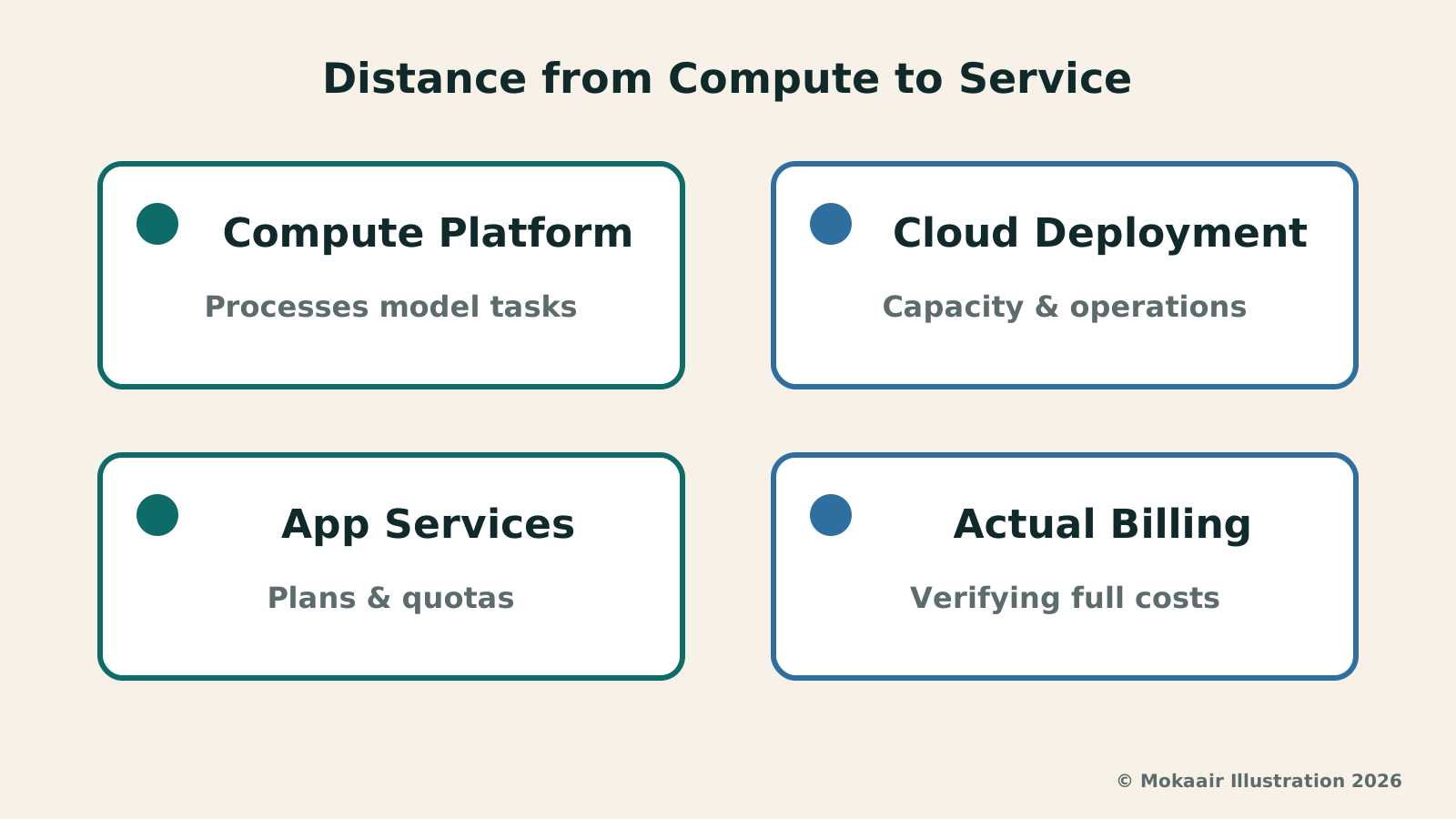
Read the full description
Compute Platform: processes models; Cloud Deployment: capacity and ops; App Services: plans and limits; Actual Billing: verifying total costs.
Structural Gaps Between Cloud Pricing Models and Monthly User Expenses
Software services may adopt subscriptions, pay-as-you-go pricing, or other models, with hardware procurement representing only a fraction of total costs. Providers must also cover expenditures such as maintenance, development, networking, and support; therefore, improvements in chip efficiency do not automatically translate into a fixed retail discount. For everyday readers, the most direct evidence remains their own service plan notices and invoices, rather than projecting hardware cost comparisons directly onto monthly subscription fees.
When reading subsequent updates, one can track pricing, usage limits, and available features separately. If monthly fees remain unchanged while usage limits increase, that only offers value if you actually need more volume; if new features require additional payment, evaluation should be based on your specific workflow. These represent possible service designs; this article does not infer which approach most vendors will inevitably take, nor does it treat second-half hardware plans as a confirmed timetable for price drops.
Therefore, when assessing daily budgets, individuals and teams should evaluate whether business output delivers equivalent value. If existing standard models already satisfy daily summarization needs, high-end plans introduced by platforms due to advanced server adoptions may merely represent an unnecessary premium burden for existing workflows. One must dispassionately evaluate whether actual work truly requires more intensive computational capability.
Enterprise Technology Acceptance Guidelines Amid Infrastructure Iterations
In the face of frequent architectural updates announced by hardware vendors, technical decision-makers must establish pragmatic acceptance procedures when migrating systems or signing long-term enterprise agreements. The first step is to establish standardized test datasets based on unstructured text genuinely encountered within the enterprise, running them continuously for several days to track request success rates and response latencies across different time periods, thereby verifying cloud providers' stability claims.
The second step is evaluating the cost structure of error recovery. When services throw exception codes due to network congestion or formatting errors, does the application possess an elegant fallback plan, such as automatically switching to lightweight local models or traditional rule-based filters? Thorough technical acceptance should evaluate not only response speeds under optimal conditions, but also fault tolerance and operational overhead under extreme workloads.
Finally, enterprises should not hastily refactor existing IT architectures or commit to purchasing specific plans simply based on hardware launch news. A prudent strategy is to monitor partners' actual server delivery statuses in the second half of the year, waiting until most mainstream cloud providers complete commercial deployment and price competition emerges before evaluating upgrade timing based on business empirical testing, thereby maximizing IT budget efficiency.
2026 AI News Roundup: Highlights and Daily Life Applications from January to September2026 AI News Roundup: Highlights and Daily Life Applications from January to SeptemberOrganizing key AI news stories month by month from January to September 2026, linking to full analyses in five languages. Covering models, work tools, creation, costs, and transparency, explaining backgrounds, uses, and limits.Read the full article
ChatGPT Health Launches Early This Year: Understanding Its Purpose and Boundaries Before Organizing Health DataChatGPT Health Launches Early This Year: Understanding Its Purpose and Boundaries Before Organizing Health DataChatGPT Health launched a dedicated space for organizing health data in January. This article explains regional restrictions from the initial launch and July update, using pre-consultation record preparation as an example to discuss sources, dates, family consent, and the boundaries of professional interpretation.Read the full article
Lifestyle
NVIDIA launches DGX Spark 64GB: on sale October 23 from $4,999, two units can be linked into 128GB
On October 2, 2026, NVIDIA announced a more affordable 64GB memory version of its DGX Spark personal AI computer, available from October 23 through six makers including Acer and ASUS. It is aimed mainly at developers and researchers who want to run AI models on their own machines. Below we summarize the specs NVIDIA published, its claims about linking two units, and what it means for general readers.
Lifestyle
Google Cloud Launches Spanner Queues: Putting Message Queues Inside Database Transactions to Make AI Agents More Reliable
Google Cloud has announced the general availability of Spanner queues, which make message creation part of a database transaction. The aim is to stop AI agents' "state" and "actions" from falling out of sync. This article covers Google Cloud's claims, the main features, and what it means for general readers.
Lifestyle
GPT-6.1 Sol Launches: New Sol Version in the API, Codex and ChatGPT Work, Not in Chat
OpenAI launched GPT-6.1 Sol on September 29, 2026, with the API name gpt-6.1-sol. The launch rollout covers Codex and ChatGPT Work on Plus, Pro, Business, Enterprise and Edu (Enterprise and Edu need an administrator to enable it); Free and Go are not included at launch, and it is not in Chat (checked September 2026).
Lifestyle
Claude Sonnet 5.5 Launches: Same List Price as Sonnet 5, Available in the API, on Cloud Platforms and in Claude.ai
Anthropic launched Claude Sonnet 5.5 on September 28, 2026. API list prices are the same as Sonnet 5 ($2 per million input tokens, $10 per million output tokens). It is available in Claude.ai, the API and several cloud platforms, and higher-risk cybersecurity requests fall back to Sonnet 5 (checked September 2026).
Articles that cite this one
Latest travel guides

GuideTokyo
Where to Stay in Tokyo: Comparing Shinjuku, Ueno, Tokyo Station, Shibuya, Asakusa, Ikebukuro, and Ginza, Plus Airport Access, Accommodation Tax, and Luggage Delivery
Where should you stay in Tokyo? Compare Shinjuku, Ueno, Tokyo Station, Shibuya, Asakusa, Ikebukuro, and Ginza by the same criteria: access from Narita and Haneda, transit routes, nearby attractions, neighborhood character, and who each area suits. Includes a comparison table, a Yamanote Line diagram, Tokyo’s accommodation tax as verified in 2026/9 (changing to 3% in 2027/4), and Airport TA-Q-BIN luggage shipping rules.
- Budget
- Hotels

GuideTokyo
How to Choose Tokyo Transit Passes: Are Suica, Welcome Suica, the Tokyo Subway Ticket, and the JR Pass Worth It?
On a first Tokyo trip, start with an IC card and pay per ride (Welcome Suica has no deposit and is valid for 28 days). If you take four or more subway rides in a day, add a 72-hour Tokyo Subway Ticket for 2,000 yen; a JR Pass is never worthwhile if you stay in Tokyo and do not go to Kansai. See what TOURIST PASMO, Suica on iPhone, and the Tokyo Metro day pass do and do not cover, with a decision chart. Prices verified in September 2026.
- Transport
- Budget

GuideTokyo
Tokyo Disneyland and DisneySea Guide: Ticket Prices, Fantasy Springs, Disney Premier Access (DPA), Standby Pass, and Which Park to Choose for Your First Visit
Tokyo Disney one-day Passport prices vary: most weekdays in 9/2026 cost ¥9,900 and weekends ¥10,900. At 14:00 daily, tickets go on sale for the same date two months later. Free Priority Pass is no longer on the official service list; only paid Disney Premier Access (¥1,000–3,500 per person per use) shortens waits. Covers hours, the 25th anniversary, Standby Pass, Entry Request, Fantasy Springs access and first-visit park choice; checked on the official site in 9/2026.
- Itineraries
- Family
Sources
- NVIDIA: Rubin Platform Announcement · Checked:
- NVIDIA: CES 2026 Presentation Content · Checked: