Lifestyle
ChatGPT Health Launches Early This Year: Understanding Its Purpose and Boundaries Before Organizing Health Data
ChatGPT Health launched a dedicated space for organizing health data in January. This article explains regional restrictions from the initial launch and July update, using pre-consultation record preparation as an example to discuss sources, dates, family consent, and the boundaries of professional interpretation.
Updated: About 7 min read
Event date: 2026-01-07; Verification date: 2026-09-14. On January 7, the personal health experience Health was announced, capable of connecting to supported health data and applications; it is a separate space.
Official sources explicitly state that Health is not intended for diagnosis or treatment, and does not replace clinical care; Health conversations are not used to train foundation models. At the beginning of the year, it adopted a small-scale pilot rollout and a waitlist; the original source was updated on July 23 to announce availability for US users aged 18 and older across web and iOS. Medical record integrations and certain applications carry US-only restrictions, and connecting Apple Health requires iOS. It cannot be presumed that Taiwan accounts have access; the January 8 healthcare organization offering was a separate announcement. The daily life and work scenarios below are editorial examples designed for reader self-verification, not product tests conducted by this site.
Organize Documents First, Then Decide What to Ask
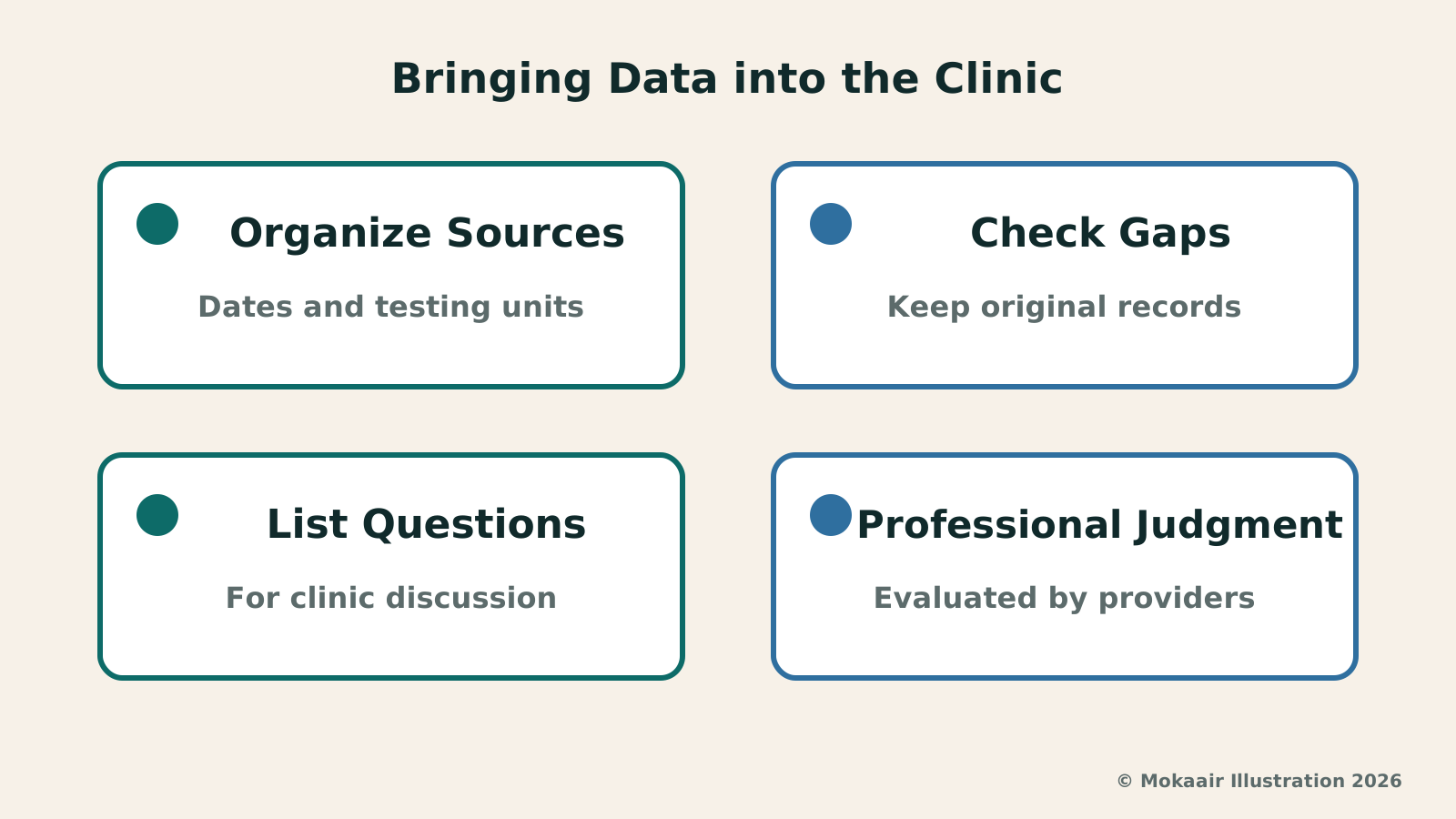
When preparing for a medical visit, you may have paper reports, electronic files sent by clinics, and self-recorded questions all at the same time. These materials come in different formats, and the first priority is making sure they can be located. You can start by drafting a list detailing document names, dates, healthcare facilities, and original file locations. The purpose of this list is purely to aid retrieval; there is no need to interpret every number into a health conclusion beforehand, nor should you fill in nonexistent data just to make the table look complete.
If you hand over some documents to a tool for organizational assistance, you can request that every summary retain the corresponding document name and page number. When you see the model output a value, check the original report for the test name, units, date, and notes before deciding whether to include it in your list. Where scans are unclear or difficult to decipher, marking them directly as pending verification is generally far easier to explain in the clinic than asking the model to guess a plausible-sounding answer.
You can also test the output format first with a sample that contains no personal information. For instance, verify whether it can sort by date, whether it preserves blank fields, and whether it merges two reports into a single record. Once you understand its organizational method, choose what content to provide based on actual needs. The tool reduces the burden of finding materials and formatting layouts, but the organized results still require item-by-item verification from you and cannot become a substitute for the original reports.
Preserve Dates, Units, and Missing Values Together
Historical reports and recent examinations have different chronological contexts. When organizing, retain the original date on each document so healthcare providers can evaluate its relevance to the current discussion; do not arbitrarily set a universal validity expiration date across all reports. If a field lacks a figure, preserve the reason for the blank or the original text notes; do not label missing data as normal results, and never automatically populate fields with data from other years.
The same test name across different documents might use different units or come with different notes. For general readers, the most straightforward check to perform is a word-for-word comparison without unauthorized unit conversions or merely copying down numbers. If you wish to compile a table, you can add two columns: 'Original Text' and 'Questions to Ask,' saving unclear points for clinic discussion so a tidy layout does not obscure underlying uncertainties in the data.
| Scope of Use | Primary Tasks and Operations | Attribution of Responsibility and Limits |
|---|---|---|
| Document Organization | List dates, names, units, and sources | Verify against originals; do not guess missing values |
| Terminology Comprehension | Help list terms you want to ask about | Explanations do not equal personal diagnosis |
| Consultation Questions | Preserve own concerns and chronological records | Allow healthcare providers to respond based on the full picture |
| Clinical Decisions | Bring original records for professional evaluation | Do not adjust medication or arrange treatment based on model content |
State Questions Clearly to Anchor Clinic Discussions
Your list of questions can start from your own uncertainties, such as 'Which parts of this report need further explanation?' or 'Which portion of my historical records should I bring for your reference?' These types of questions help express your needs while leaving room for healthcare professionals to assess the complete picture. The model can help shorten sentences and remove duplicate phrasing, but it should not decide which tests or treatments you need.
If you have already noted recent conditions you wish to explain, you can ask the tool to arrange your notes chronologically while preserving your original wording. Do not let it rewrite 'I am not sure when it started' into a specific date, or turn your questions into confirmed symptomatic conclusions. You can bring both the original documents and these notes to your consultation, letting medical staff know which are existing records and which are simply questions you wish to clarify.
When there is a lot of material, you might prioritize a few topics you most want to discuss this time, listing other questions afterward. This is a suggestion for structuring communication priority, not an indication that omitted items lack medical importance. Above all, do not delete medication or test records simply because the model deems a record irrelevant to the current specialty; which information is relevant to clinical care must be evaluated by healthcare personnel who understand the full clinical context.
Confirm Your Own Data Scope; Obtain Separate Consent for Family Members
Before inputting health information into any cloud tool, verify the product, account, and workspace you are currently using. Health data policies cannot be automatically applied to all general chat tools, nor should privacy handling be assumed identical simply because product names sound similar. If you are merely practicing table organization, use fictional examples; when entering real data, read the portal's documentation and adjustable settings first.
When helping adult family members organize documents, explain beforehand what content you plan to provide, which service will process it, and how it will be stored afterward, obtaining their consent first. Removing unnecessary names or identifying details reduces exposure, but does not mean the remaining health content is no longer sensitive. If they prefer not to share records with cloud services, local files or paper lists can achieve the exact same organizational objective.
After organizing, review which applications are connected and which copies still need to be retained, managing data according to currently available settings. Deleting chats, disconnecting apps, and deleting original data can be separate operations; do not assume performing one automatically handles the others. Whichever tool you use, retain original documents you control for future verification and medical review.
How Readers in Taiwan Should View This Launch
This news describes OpenAI's personal health product and does not mean it has integrated with Taiwanese medical institutions or National Health Insurance data. Official announcements regarding US medical record integration, age criteria, and device requirements all require separate verification. If your account does not have the corresponding access point, do not treat general chat windows as an identical dedicated health space, nor conflate data policies between different products.
For those who currently only want to prepare medical visit materials clearly, a structured list is effective on its own without needing to wait for a specific feature to roll out. You can use familiar document tools to list sources, dates, items needing verification, and questions, then evaluate as needed whether new services actually eliminate organizational steps. Regardless of how tools update, the premise that Health is not intended for diagnosis or treatment, and the division of labor leaving medical data interpretation to professionals, must both be maintained.
2026 AI News Roundup: Highlights and Daily Life Applications from January to September2026 AI News Roundup: Highlights and Daily Life Applications from January to SeptemberOrganizing key AI news stories month by month from January to September 2026, linking to full analyses in five languages. Covering models, work tools, creation, costs, and transparency, explaining backgrounds, uses, and limits.Read the full article
Gemini Personal Intelligence: Where Does Convenience Come from After AI Connects Emails and Photos?Gemini Personal Intelligence: Where Does Convenience Come from After AI Connects Emails and Photos?Reviewing Google's 2026 beta launch of Gemini Personal Intelligence, analyzing personalization mechanisms across email and photo integration, potential misinterpretation risks, and key review principles.Read the full article
Lifestyle
NVIDIA launches DGX Spark 64GB: on sale October 23 from $4,999, two units can be linked into 128GB
On October 2, 2026, NVIDIA announced a more affordable 64GB memory version of its DGX Spark personal AI computer, available from October 23 through six makers including Acer and ASUS. It is aimed mainly at developers and researchers who want to run AI models on their own machines. Below we summarize the specs NVIDIA published, its claims about linking two units, and what it means for general readers.
Lifestyle
Google Cloud Launches Spanner Queues: Putting Message Queues Inside Database Transactions to Make AI Agents More Reliable
Google Cloud has announced the general availability of Spanner queues, which make message creation part of a database transaction. The aim is to stop AI agents' "state" and "actions" from falling out of sync. This article covers Google Cloud's claims, the main features, and what it means for general readers.
Lifestyle
GPT-6.1 Sol Launches: New Sol Version in the API, Codex and ChatGPT Work, Not in Chat
OpenAI launched GPT-6.1 Sol on September 29, 2026, with the API name gpt-6.1-sol. The launch rollout covers Codex and ChatGPT Work on Plus, Pro, Business, Enterprise and Edu (Enterprise and Edu need an administrator to enable it); Free and Go are not included at launch, and it is not in Chat (checked September 2026).
Lifestyle
Claude Sonnet 5.5 Launches: Same List Price as Sonnet 5, Available in the API, on Cloud Platforms and in Claude.ai
Anthropic launched Claude Sonnet 5.5 on September 28, 2026. API list prices are the same as Sonnet 5 ($2 per million input tokens, $10 per million output tokens). It is available in Claude.ai, the API and several cloud platforms, and higher-risk cybersecurity requests fall back to Sonnet 5 (checked September 2026).
Articles that cite this one
Latest travel guides

GuideTokyo
Where to Stay in Tokyo: Comparing Shinjuku, Ueno, Tokyo Station, Shibuya, Asakusa, Ikebukuro, and Ginza, Plus Airport Access, Accommodation Tax, and Luggage Delivery
Where should you stay in Tokyo? Compare Shinjuku, Ueno, Tokyo Station, Shibuya, Asakusa, Ikebukuro, and Ginza by the same criteria: access from Narita and Haneda, transit routes, nearby attractions, neighborhood character, and who each area suits. Includes a comparison table, a Yamanote Line diagram, Tokyo’s accommodation tax as verified in 2026/9 (changing to 3% in 2027/4), and Airport TA-Q-BIN luggage shipping rules.
- Budget
- Hotels

GuideTokyo
How to Choose Tokyo Transit Passes: Are Suica, Welcome Suica, the Tokyo Subway Ticket, and the JR Pass Worth It?
On a first Tokyo trip, start with an IC card and pay per ride (Welcome Suica has no deposit and is valid for 28 days). If you take four or more subway rides in a day, add a 72-hour Tokyo Subway Ticket for 2,000 yen; a JR Pass is never worthwhile if you stay in Tokyo and do not go to Kansai. See what TOURIST PASMO, Suica on iPhone, and the Tokyo Metro day pass do and do not cover, with a decision chart. Prices verified in September 2026.
- Transport
- Budget

GuideTokyo
Tokyo Disneyland and DisneySea Guide: Ticket Prices, Fantasy Springs, Disney Premier Access (DPA), Standby Pass, and Which Park to Choose for Your First Visit
Tokyo Disney one-day Passport prices vary: most weekdays in 9/2026 cost ¥9,900 and weekends ¥10,900. At 14:00 daily, tickets go on sale for the same date two months later. Free Priority Pass is no longer on the official service list; only paid Disney Premier Access (¥1,000–3,500 per person per use) shortens waits. Covers hours, the 25th anniversary, Standby Pass, Entry Request, Fantasy Springs access and first-visit park choice; checked on the official site in 9/2026.
- Itineraries
- Family
Sources
- OpenAI: Introducing ChatGPT Health · Checked:
- OpenAI: OpenAI for Healthcare · Checked: