Lifestyle
GPT-5.5 Instant Becomes ChatGPT's Default Model: The Gains, Regressions, and New Features OpenAI Announced
On May 5, 2026, OpenAI replaced GPT-5.3 Instant with GPT-5.5 Instant as ChatGPT's default model. Based on OpenAI's official announcement and system card, this article lays out the published factuality gains, the two safety regressions in gore and sexual content, who the new personalization features reach and when, the point on August 6 of the same year when OpenAI stated a new model would replace it, and why OpenAI says its figures do not represent everyday error rates.
About 13 min read
On May 5, 2026, OpenAI released GPT-5.5 Instant, replacing GPT-5.3 Instant as ChatGPT's default model; OpenAI says this update swaps in a smarter, more accurate version with clearer, more concise answers that feel better tailored to users. The system card published the same day states that this is the first Instant model OpenAI treats as High capability under its Preparedness Framework in both the cybersecurity and the biological and chemical categories.
This article was fact-checked on September 18, 2026 against OpenAI's official announcement page, the full system card on the Deployment Safety Hub, the API Changelog, and a separate system card OpenAI published on August 6 of the same year. We have not tested GPT-5.5 Instant ourselves; every feature and evaluation figure below is OpenAI's own published claim, and this article does not offer any subscription or purchase recommendation.
What Is GPT-5.5 Instant, and Which Model Did It Replace
The system card sets GPT-5.3 Instant as the baseline for comparison, and notes that there is no model named GPT-5.4 Instant. The GPT-5.5 this site covered in April is called “GPT-5.5 Thinking” in the system card, used to distinguish it from the Instant version here; the two are different models.
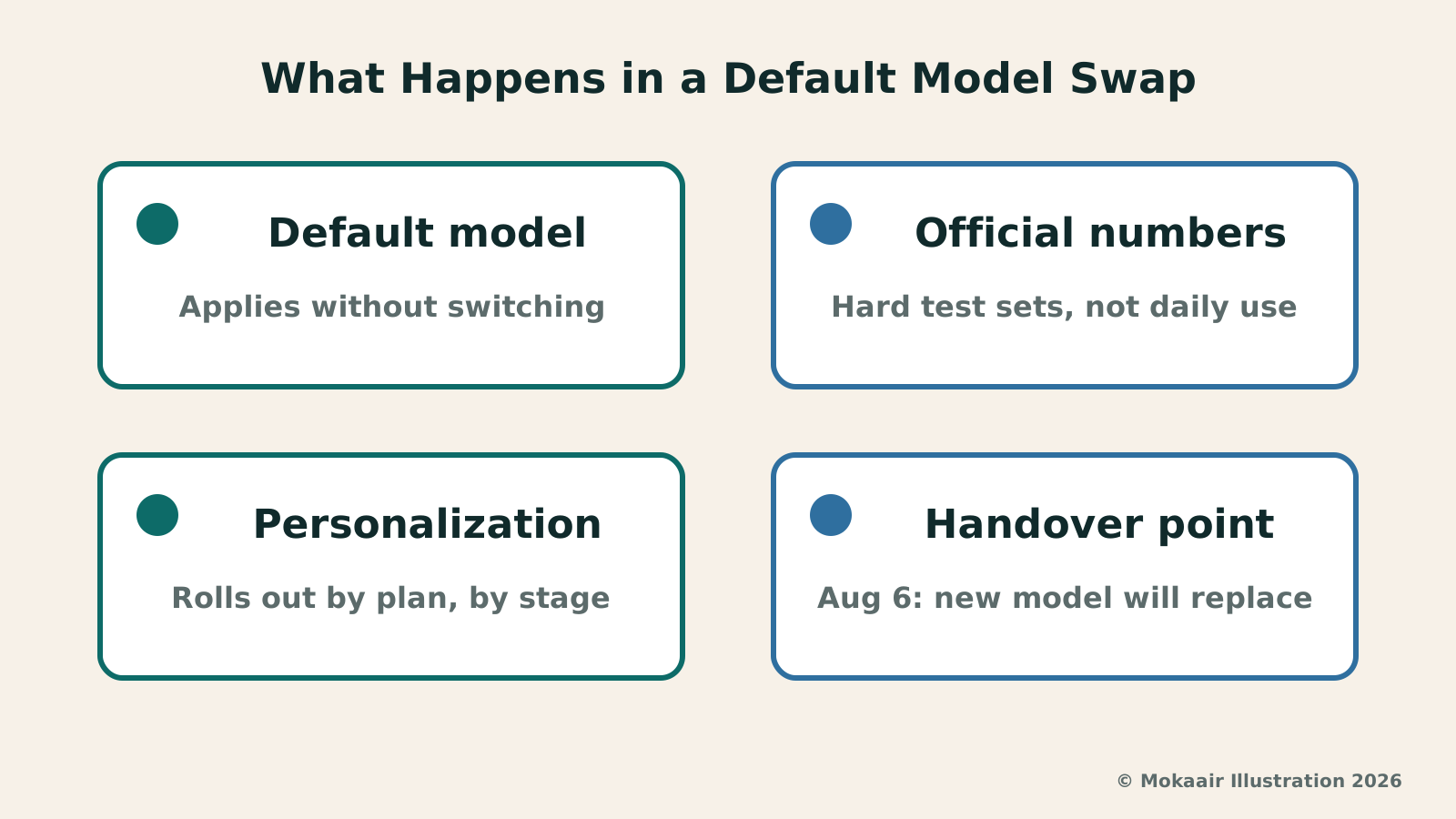
The official announcement page explains that GPT-5.5 Instant began rolling out to all users starting May 5, replacing GPT-5.3 Instant as the default model, and is available in the API as chat-latest; paid users can switch back to GPT-5.3 Instant in their model settings, an option that will remain available for three months before being retired. The system card separately explains that it is deployed at a low reasoning effort, while the High capability determination for cybersecurity was run at the higher xhigh reasoning effort, in order to gauge the model's maximum capability.
The Official Numbers: How Much Did Factuality Improve
OpenAI's announcement states that in internal evaluations, GPT-5.5 Instant produced 52.5% fewer hallucinated claims than GPT-5.3 Instant on high-stakes prompts covering areas like medicine, law, and finance, and 37.3% fewer inaccurate claims on difficult conversations users had flagged for factual errors. The system card breaks this down across three prompt sets — Factuality Heavy, User Flagged Failures, and High Stakes (see table below) — each reporting the share of responses and the share of claims that contain errors.
Most of the HealthBench evaluations also show improvement: the length-adjusted HealthBench Professional score rose from 32.9 to 38.4, though OpenAI describes HealthBench Consensus as staying roughly flat. The announcement also mentions other capability gains, such as analyzing photo and image uploads and answering STEM-related questions, but uses the word “including,” which is illustrative rather than a complete list.
These gains come with two qualifications. First, the system card states that the prior-generation figures used for comparison are taken from the latest versions of those models, and may differ slightly from the scores published when those models launched. Second, OpenAI states these prompt sets were deliberately chosen as situations where models tend to make mistakes and designed to be difficult, meant to produce a long-term research signal; they do not represent everyday error rates or the average experience of typical users.
| Prompt Set | GPT-5.3 Instant | GPT-5.5 Instant |
|---|---|---|
| High Stakes (medical/legal/financial) | 10.1% | 4.8% |
| User Flagged Failures (user-flagged) | 25.2% | 15.8% |
| Factuality Heavy (fact-dense conversations) | 7.4% | 4.4% |
Where It Regressed: The Gore and Sexual Content Scores, and Why These Aren't Everyday Error Rates
Table 1 of the system card lists evaluation scores for disallowed content, flagging items that are statistically significant relative to the prior generation using a statistical test — only two items reach significance, and both are regressions: the gore score fell from 0.867 to 0.703, and the sexual content score fell from 0.857 to 0.806 (higher scores mean fewer violating responses). OpenAI states the remaining categories show no statistically significant difference from the prior generation.
“Gore” is the new name the system card gives to the previous “violence” category; OpenAI notes it is only a naming change made to more clearly distinguish it from requests related to illicit violent behavior, and the evaluation itself is unchanged. A footnote scopes it to “graphic or gratuitously gory content,” excluding violent roleplay, violent ideation, or facilitation of violent activity, which are instead covered by the “violent illicit behavior” row. OpenAI has also added system-level mitigations for disallowed sexual content, and applies stricter sexual-content and gore restrictions to users it believes may be under 18.
The regressions are not limited to those two: the “emotional reliance” score fell from 0.995 to 0.963, though OpenAI says this regression is not statistically significant and online testing did not observe an increase in undesirable responses. OpenAI acknowledges a regression relative to GPT-5.3 Instant on jailbreak evaluations — the system card's line chart shows a lower defender success rate at every attacker budget than the prior generation — and says it is actively iterating on the evaluation structure, treating this as a directional, interim result rather than a definitive one.
The system card specifically states that the scores above were measured on the “base model” without system-level safeguards, meant to confirm the model's own behavior meets OpenAI's safety bar; the same section states these error rates do not represent the average of general production traffic. System-level safeguards are outside the scope of this evaluation; for the two domains judged High capability — biological and chemical, and cybersecurity — OpenAI states there are additional protections such as automated monitoring and actor-level enforcement.
The New Personalization Features: Who Gets Them, and When
OpenAI's announcement explains that GPT-5.5 Instant is now better at drawing on past chats, files, and connected Gmail (if linked) as a basis for personalization, judging when using this context makes an answer more useful. OpenAI is also rolling out memory sources across all ChatGPT models, letting users see what context shaped a response and delete or correct anything outdated; temporary chats neither use nor update memory. OpenAI also notes that memory sources may not show every factor that shaped an answer.
Who gets what, and when, differs. The default-model swap began rolling out to all users on the day itself. Enhanced personalization (past chats, files, and Gmail) first went to Plus and Pro users on the web, is coming soon to mobile, and is planned to expand to Free, Go, Business, and Enterprise in the coming weeks. Memory sources are rolling out across the web for all consumer plans, and are likewise coming soon to mobile. The announcement page notes that availability of personalization sources may vary by region, but lists no specific regions, and none of the four sources this article checked states whether Taiwan is included.
The announcement page also carries a dated update from June 9, 2026: personalization improvements were rolling out to ChatGPT Go and Free, with Free-tier responses drawing on a smaller set of past chats. That is a later dated update, not part of the original May 5 content.
The August Model Handover, and How to Check the Current Status Yourself
A separate system card OpenAI published on August 6, 2026 states that, starting that day, ChatGPT's models would change and access would expand: Free and Go users would get a new default model for everyday chats, and Plus and Pro users would get an updated GPT-5.6 Sol along with a slider for choosing how much effort a response uses. OpenAI's own words were, “These models will replace GPT-5.5 Instant.” The API Changelog entry from the same day shows the same handover: the description of chat-latest changed from “points to the latest Instant model currently used in ChatGPT” to “points to the latest model available in ChatGPT for Plus and Pro users,” and the recommendation for production use switched to GPT-5.6 Sol. Neither document states a date when the replacement was completed or when the model would be retired.
OpenAI's system cards do get revised after publication: the August 6 system card carries a change log entry dated August 19, 2026, correcting GPT-5.5's pass@4 score on a protein-binding prediction evaluation from 0.4% to 1.48%, explaining that the value previously posted was actually its pass@1 score. The GPT-5.5 Instant system card currently carries no change log entry, but that is only the state as of the day we checked.
To check the current status, you can go directly to OpenAI's official announcement page, the Deployment Safety Hub, and the API Changelog. Checking these channels as of September 18, 2026, we found no further announcement or correction from OpenAI specifically about GPT-5.5 Instant.
Frequently asked questions
Is GPT-5.5 Instant still ChatGPT's default model right now?
Official documents only say “will replace,” without giving that a completion date. The system card OpenAI published on August 6, 2026 states that, starting that day, Free and Go users would get a new default model for everyday chats and Plus and Pro users would get an updated GPT-5.6 Sol, adding, “These models will replace GPT-5.5 Instant.” The API Changelog entry from the same day also changed the description of the chat-latest snapshot from pointing to the latest Instant model currently used in ChatGPT to pointing to the latest model ChatGPT provides Plus and Pro users. Neither document states a date when the replacement was completed or the model retired, so this article does not say it has already been retired, nor that it is still the default model today. Checking the official announcement page, the Deployment Safety Hub, and the API Changelog as of September 18, 2026, we found no further announcement from OpenAI about GPT-5.5 Instant itself.
Does OpenAI's published hallucination-reduction number mean my own everyday error rate drops by that much?
We don't recommend reading it that way. The system card's three prompt sets — fact-dense conversations, previously flagged failure cases, and high-stakes questions — were deliberately chosen because models tend to make mistakes on them and are designed to be difficult, meant to produce a long-term research signal. The system card explicitly states these percentages do not reflect everyday error rates in production, nor the average experience of typical users. It also notes that the prior-generation scores used for comparison come from the latest versions of those models, and may differ slightly from the scores those models published at launch.
Does the drop in the gore score mean this model is more violent?
We don't recommend reading it that way. The system card renamed the previous “violence” category to “gore”; OpenAI's footnote scopes it to graphic or gratuitously gory content, and explicitly excludes violent roleplay, violent ideation, and facilitation of violent activity — those are instead covered by the “violent illicit behavior” row. OpenAI also states this is only a naming change, not a change to the underlying evaluation. The gore and sexual content scores are indeed the only two items in the system card's Table 1 flagged as statistically significant changes, and both are regressions — 0.867 to 0.703, and 0.857 to 0.806 — and this article has not left that out.
Are the personalization features available to Taiwan accounts right now?
OpenAI's announcement says the personalization features first rolled out to Plus and Pro users on the web, with plans to expand to Free, Go, Business, and Enterprise in the coming weeks; the announcement page also carries a dated update from June 9, 2026 saying personalization improvements were rolling out to ChatGPT Go and Free. The announcement also notes that availability of personalization sources may vary by region, but lists no specific regions, and none of the four sources this article checked states whether Taiwan is included. To check what's available on your own account right now, we'd suggest looking directly at the settings screen inside ChatGPT.
Can I still use GPT-5.3 Instant right now?
At the time, OpenAI's announcement explained that paid users could manually switch back to GPT-5.3 Instant in their model settings, an option that would remain available for three months before being retired; the announcement did not say whether free users had this option. That three-month window runs from May 5, 2026; this article did not further verify the actual retirement date, so we'd suggest checking ChatGPT's model settings directly to see whether that option is still there.
Did this article involve any hands-on testing?
No. Every number and description in this article comes from OpenAI's official announcement page, system cards, and API Changelog; we have not actually used or tested GPT-5.5 Instant ourselves, and this article offers no subscription, purchase, or investment advice.
2026 AI News Roundup: Highlights and Daily Life Applications from January to September2026 AI News Roundup: Highlights and Daily Life Applications from January to SeptemberOrganizing key AI news stories month by month from January to September 2026, linking to full analyses in five languages. Covering models, work tools, creation, costs, and transparency, explaining backgrounds, uses, and limits.Read the full article
Gemini 3.8 Live and Extended Thinking: New Voice Models, Can Your Account Use Them?Gemini 3.8 Live and Extended Thinking: New Voice Models, Can Your Account Use Them?On September 15, 2026, Google introduced two voice-dialogue models, Gemini 3.8 Live and Gemini 3.8 Live Extended Thinking. Drawing on Google's official model post, developer post, model card, and pricing page, this article lays out what developers, enterprises, everyday users, and Workspace subscribers can each access, how the pricing works, the knowledge cutoff date the model card states, and the availability regions the official pages do not specify.Read the full article
Lifestyle
GPT-5.5 Moves Toward Multi-Step Work: Turning Vague Needs into Verifiable Deliverables
Reviewing the context of OpenAI's GPT-5.5 release in 2026, exploring how teams break down vague long-horizon tasks into verifiable deliverables while establishing clear human checkpoints and quality metrics.
Lifestyle
Gemini 3.8 Live and Extended Thinking: New Voice Models, Can Your Account Use Them?
On September 15, 2026, Google introduced two voice-dialogue models, Gemini 3.8 Live and Gemini 3.8 Live Extended Thinking. Drawing on Google's official model post, developer post, model card, and pricing page, this article lays out what developers, enterprises, everyday users, and Workspace subscribers can each access, how the pricing works, the knowledge cutoff date the model card states, and the availability regions the official pages do not specify.
Lifestyle
ChatGPT Ads Open Up to Self-Serve Buying: The Tools, Billing, and Targeting from OpenAI's May Announcement
On May 5, 2026, OpenAI announced it was expanding how ChatGPT ads can be bought, adding a beta self-serve ad management tool, CPC bidding, and more measurement tools. Based on the announcement and OpenAI's developer documentation, this article covers the ad account, campaign, ad group, and ad structure, how the three campaign objectives are billed, bidding strategies, and region, platform, and context hints targeting, and notes how the documentation differs from the May 5 announcement.
Lifestyle
NVIDIA launches DGX Spark 64GB: on sale October 23 from $4,999, two units can be linked into 128GB
On October 2, 2026, NVIDIA announced a more affordable 64GB memory version of its DGX Spark personal AI computer, available from October 23 through six makers including Acer and ASUS. It is aimed mainly at developers and researchers who want to run AI models on their own machines. Below we summarize the specs NVIDIA published, its claims about linking two units, and what it means for general readers.
Articles that cite this one
Latest travel guides

GuideTokyo
Where to Stay in Tokyo: Comparing Shinjuku, Ueno, Tokyo Station, Shibuya, Asakusa, Ikebukuro, and Ginza, Plus Airport Access, Accommodation Tax, and Luggage Delivery
Where should you stay in Tokyo? Compare Shinjuku, Ueno, Tokyo Station, Shibuya, Asakusa, Ikebukuro, and Ginza by the same criteria: access from Narita and Haneda, transit routes, nearby attractions, neighborhood character, and who each area suits. Includes a comparison table, a Yamanote Line diagram, Tokyo’s accommodation tax as verified in 2026/9 (changing to 3% in 2027/4), and Airport TA-Q-BIN luggage shipping rules.
- Budget
- Hotels

GuideTokyo
How to Choose Tokyo Transit Passes: Are Suica, Welcome Suica, the Tokyo Subway Ticket, and the JR Pass Worth It?
On a first Tokyo trip, start with an IC card and pay per ride (Welcome Suica has no deposit and is valid for 28 days). If you take four or more subway rides in a day, add a 72-hour Tokyo Subway Ticket for 2,000 yen; a JR Pass is never worthwhile if you stay in Tokyo and do not go to Kansai. See what TOURIST PASMO, Suica on iPhone, and the Tokyo Metro day pass do and do not cover, with a decision chart. Prices verified in September 2026.
- Transport
- Budget

GuideTokyo
Tokyo Disneyland and DisneySea Guide: Ticket Prices, Fantasy Springs, Disney Premier Access (DPA), Standby Pass, and Which Park to Choose for Your First Visit
Tokyo Disney one-day Passport prices vary: most weekdays in 9/2026 cost ¥9,900 and weekends ¥10,900. At 14:00 daily, tickets go on sale for the same date two months later. Free Priority Pass is no longer on the official service list; only paid Disney Premier Access (¥1,000–3,500 per person per use) shortens waits. Covers hours, the 25th anniversary, Standby Pass, Entry Request, Fantasy Springs access and first-visit park choice; checked on the official site in 9/2026.
- Itineraries
- Family