Lifestyle
Gemini 3.8 Live and Extended Thinking: New Voice Models, Can Your Account Use Them?
On September 15, 2026, Google introduced two voice-dialogue models, Gemini 3.8 Live and Gemini 3.8 Live Extended Thinking. Drawing on Google's official model post, developer post, model card, and pricing page, this article lays out what developers, enterprises, everyday users, and Workspace subscribers can each access, how the pricing works, the knowledge cutoff date the model card states, and the availability regions the official pages do not specify.
About 12 min read
On September 15, 2026, Google announced two voice-dialogue models across two posts, a model post and a developer post: Gemini 3.8 Live and Gemini 3.8 Live Extended Thinking. Google positions the two models differently: 3.8 Live is "built for scale and cost efficiency, combining conversational intelligence with fluid dialogue and visual grounding"; Extended Thinking is "built for high-complexity tasks, with increased intelligence and multi-step reasoning."
This article was fact-checked on September 18, 2026, against Google's model post, developer post, the DeepMind model card, and the Gemini API pricing page; the content reflects that day. We have not actually used either model ourselves — the capabilities, leaderboard rankings, and prices described here are Google's own claims, marked "Google says" where they are the vendor's statements; this article is not advice on using or purchasing them.
What Was Announced: Two Models, Two Positions
The model post lists several of Gemini 3.8 Live's capabilities in the same passage: it can process visual input in near real time, so the conversation has something to reference; it can automatically detect and switch languages, with the post citing 97 supported languages; and it can run tool and API calls in the background while the conversation continues, so users hear a reply first while the work finishes behind the scenes.
Extended Thinking differs in how it reasons: Google explains that this model "reasons and speaks simultaneously," and when a task needs deeper reasoning, it first bridges naturally with early verbal cues like "Let me check that…", then uses progress narration to walk the user through multi-step work happening in the background; the developer post calls the pair together "a more streamlined alternative to cascaded architectures."
The developer post separately lists key capabilities using the word "including": asynchronous function calling, visual context, alphanumeric precision (accurately parsing confirmation codes, claim numbers, and technical data), multilingual support ("97+" languages while maintaining consistent accents), and progressive content updates. The model post says voice generated by Google AI products all carries a SynthID watermark, keeping AI-generated content detectable.
Four Types of Users, and Which Model Each Can Use
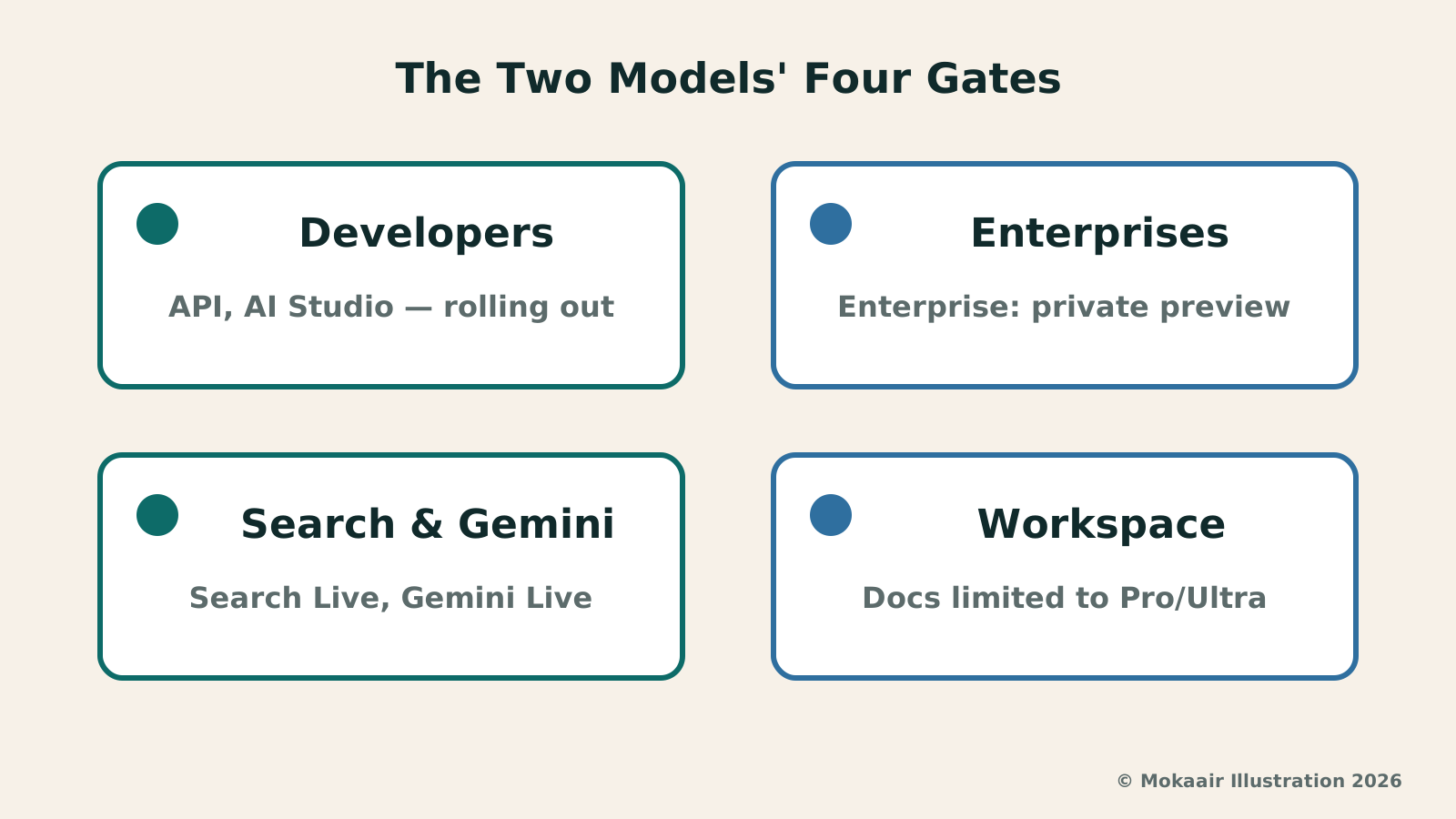
The developer side is stated most clearly: Google writes "rolling out starting today" for both models, through the Gemini API and AI Studio. On the enterprise side, availability is private preview only, in Gemini Enterprise; the Customer Experience scenario, and — for Extended Thinking only — Workspace enterprise customers, are both still marked "coming soon," with no timeline given.
On the model post's availability list, the consumer-side split is: for 3.8 Live, the "For everyone" line names only Search Live; for Extended Thinking, it names Gemini Live, plus Workspace's Docs, limited to Google AI Pro and Ultra subscribers, while Gmail and Keep are open to all Google AI subscribers — so the subscription bar for Docs is higher than for Gmail and Keep. Separately, the same model post's video captions also place Extended Thinking in the Gemini App, and both the running text and a section heading name the two models together there too.
The model card's channel list is different: both models alike list Gemini API, Gemini App, AI Studio, and Vertex AI, with 3.8 Live additionally listed under Search Live, and Extended Thinking additionally listed under the Workspace that holds Gmail, Docs, and Keep. The model post's own availability list does not name Vertex AI, and does not put Gemini App under 3.8 Live either; this article presents both lists as they are, without deciding on Google's behalf which one is authoritative. The model post is also marked at the top as having been updated on September 17.
| User type | Model(s) available | What's available | Status |
|---|---|---|---|
| Developers | Both | Gemini API, AI Studio | Rolling out starting today |
| Enterprises | Both | Gemini Enterprise | Private preview |
| Everyday users | 3.8 Live | Search Live | Rolling out starting today |
| Everyday users | Extended Thinking | Gemini Live, Gemini App | Rolling out starting today |
| Workspace subscribers | Extended Thinking | Docs limited to AI Pro/Ultra; Gmail and Keep limited to Google AI subscribers | Rolling out starting today |
"Rolling Out Starting Today" Does Not Mean "Available Right Now"
Google's own English reads "rolling out starting today" — a start, not a completion; the enterprise side is explicitly private preview, and the scenarios marked "coming soon" carry no timeline either. As checked through September 18, 2026, the three documents, in describing availability, name only products and subscription tiers, and not one sentence states which country, region, or market is open — so this article cannot determine whether Taiwan accounts are already within the available range.
The enterprise private preview likewise states no application channel or eligibility criteria, and Google does not say when the rollout counts as complete, so users have no way to judge when they will get it.
The two posts state the language figure differently: the model post writes that 3.8 Live automatically switches among "97 supported languages" mid-conversation, while the developer post's capability list says "97+ languages." Both figures come from Google itself, and this article presents them side by side as given, without merging them into one.
Pricing and Data: One Price List for Both Models
The Gemini API pricing page lists gemini-3.8-live, gemini-3.8-live-extended-thinking, and the earlier gemini-3.1-flash-live-preview in the same pricing block, sharing the same set of prices, and it does not say the new models replace or deprecate it. The model post's line that 3.8 Live is "built for scale and cost efficiency" is a positioning statement, not a claim that its list price is lower.
On the pricing page's paid tier: input is $0.75 per 1M tokens for text, $3 for audio ($0.005/minute), and $1 for image/video; output (including thinking tokens) is $4.50 per 1M tokens for text and $12 for audio ($0.018/minute). When the developer post cites the per-minute figures, it adds a footnote explaining that they are estimates converted from the per-1M-token prices.
The pricing page also has a free tier: both input and output are listed as "free of charge," and that data is used to improve Google's products, unlike the paid tier. The quota for grounding with Google Search — real-time search verification — is listed under the paid tier: 5,000 free search requests per month, shared across the Gemini 3.x family, then $14 per 1,000 requests after that; a single request may trigger more than one query, and each one is billed.
The model card also states the specs: both models are based on Gemini 3 Pro; input covers audio, images, video, and text, with a context window of up to 128K tokens; output is audio and text, at 64K tokens. The knowledge cutoff date is January 2025, meaning what the model remembers ends there, and time-sensitive content still needs the separately billed search grounding to fill in.
What Google Has Not Said, and One Scenario Designed by the Editors
All benchmark figures come from Google's model post: Extended Thinking took the "#1 overall spot (82.6)" on Artificial Analysis's Speech to Speech Quality Index, 68.6% on τ-Voice, 35.1% on Sierra's τ-Voice-banking benchmark, and 97.7% on Big Bench Audio; 3.8 Live, meanwhile, took "second place" in the Speech Agent Arena. These are snapshots from September 15; we have not tested them ourselves, and leaderboards keep changing.
On safety, the model card states that the model Google assessed under its frontier safety framework was Gemini 3.7 Flash, and the result reached none of the "Tracked or Critical Capability Levels"; because the two new models show no meaningful new capability or material performance increase over 3.7 Flash, Google says they are "not likely" to reach those levels either — an inference from another model's results, not an assessment run on these two models themselves. The model card also notes possible hallucinations and occasional slowness or timeouts, and says work is ongoing to improve resistance to jailbreak attempts.
The following is a scenario designed by the editors, not a hands-on test result. Suppose a user is looking at a trip comparison table and asks Extended Thinking by voice to summarize the key points: by Google's account, the model would respond first, push the summarizing work to the background, and narrate its progress as it goes. That stacks three conditions that are not yet settled: the account has to be in an eligible region, and has to use the right interface and subscription tier; on top of that, the January 2025 knowledge cutoff means date-sensitive details would still depend on the separately billed search grounding.
Frequently asked questions
Can a Taiwan Google account use Gemini 3.8 Live or Extended Thinking right now?
As checked through September 18, 2026, Google's model post, developer post, and model card, in describing availability, name only products and subscription tiers, and not one sentence states which country, region, or market is open — the official pages do not specify availability regions. What this article can find is only a breakdown by user type (developers, enterprises, everyday users, Workspace subscribers) and by interface, with no breakdown by region, so this article cannot confirm on Google's behalf whether Taiwan accounts can already use it.
What is the difference between Gemini 3.8 Live and Gemini 3.8 Live Extended Thinking?
Google positions Gemini 3.8 Live as built for scale and cost efficiency, and the model post's availability list names only Search Live as the channel for everyday users; Extended Thinking is positioned for high-complexity, multi-step reasoning tasks, and everyday users can reach it in Gemini Live, as well as in Workspace's Docs (limited to Google AI Pro and Ultra subscribers), Gmail, and Keep (open to all Google AI subscribers). The two models share one price list on the Gemini API, where the pricing page notes the output price as including thinking tokens.
Can these two new models be used inside the Gemini App?
On the model post's availability list, 3.8 Live's "For everyone" line names only Search Live, while Extended Thinking's names Gemini Live and Workspace; however, that same model post's video captions also place Extended Thinking in the Gemini App, and both the running text and a section heading name the two models together there too, without separating out which one. DeepMind's model card, meanwhile, lists both Gemini App and Google Cloud/Vertex AI as channels shared by both models, while the model post's availability list does not name Vertex AI at all, and does not put Gemini App under 3.8 Live either. The two lists are written differently, and this article lays out each version as it is; we cannot determine on Google's behalf which one is the most current or most accurate.
Is using voice more expensive than using text?
By the Gemini API pricing page's figures, audio input is $3 per 1M tokens versus $0.75 per 1M tokens for text input, so the per-unit price for audio is indeed higher; both the pricing page and the developer post print "$0.005 per minute" and "$0.018 per minute," and the developer post's footnote explains that these are estimates converted from the per-1M-token prices, with the pricing table itself still priced per 1M tokens. There is also a free tier where neither input nor output is charged, though that data is used to improve Google's products.
Do these two models know about things that happened recently?
The model card states a knowledge cutoff date of January 2025 — meaning what the model itself remembers ends there, and being built around live conversation does not automatically mean it knows what has happened since. Verifying time-sensitive content depends on Google Search's grounding feature; the pricing page's paid-tier column lists a monthly quota of 5,000 free requests, shared usage across the whole Gemini 3.x family, then $14 per 1,000 requests after that, while the free-tier column just says "Supported," with no quota or price listed.
Which 97 languages are the "97 languages"?
None of the four documents this article checked lists the language names. The model post writes that Gemini 3.8 Live automatically switches among "97 supported languages" mid-conversation, while the developer post's capability list says "97+ languages"; both figures come from Google itself, and this article presents them side by side as given, without merging them into one. One more note: this figure describes the languages the model can hear and speak within a conversation — Google does not, in these four documents, describe the interface language of each surface itself, or the regions where each is available.
2026 AI News Roundup: Highlights and Daily Life Applications from January to September2026 AI News Roundup: Highlights and Daily Life Applications from January to SeptemberOrganizing key AI news stories month by month from January to September 2026, linking to full analyses in five languages. Covering models, work tools, creation, costs, and transparency, explaining backgrounds, uses, and limits.Read the full article
GPT-Live 1 Comes to the API: Can It Take Customer Service Calls, Whose Voice Is It, Will It Record?GPT-Live 1 Comes to the API: Can It Take Customer Service Calls, Whose Voice Is It, Will It Record?On September 10, 2026, OpenAI’s API changelog noted that voice model GPT-Live 1 is now generally available in the API, so developers can wire it into phone support, apps, or their own products. Drawing on OpenAI’s developer documentation, this article covers the model’s API specs, how calls connect, the documentation’s note that outbound calls are not supported, its 12 named voices and unlisted spoken languages, and how recording and per-minute billing work; this site has not tested it.Read the full article
Lifestyle
GPT-Live 1 Comes to the API: Can It Take Customer Service Calls, Whose Voice Is It, Will It Record?
On September 10, 2026, OpenAI’s API changelog noted that voice model GPT-Live 1 is now generally available in the API, so developers can wire it into phone support, apps, or their own products. Drawing on OpenAI’s developer documentation, this article covers the model’s API specs, how calls connect, the documentation’s note that outbound calls are not supported, its 12 named voices and unlisted spoken languages, and how recording and per-minute billing work; this site has not tested it.
Lifestyle
GPT-5.5 Instant Becomes ChatGPT's Default Model: The Gains, Regressions, and New Features OpenAI Announced
On May 5, 2026, OpenAI replaced GPT-5.3 Instant with GPT-5.5 Instant as ChatGPT's default model. Based on OpenAI's official announcement and system card, this article lays out the published factuality gains, the two safety regressions in gore and sexual content, who the new personalization features reach and when, the point on August 6 of the same year when OpenAI stated a new model would replace it, and why OpenAI says its figures do not represent everyday error rates.
Lifestyle
GPT-Live Lets ChatGPT Voice Listen as It Talks: Interruptions, Plan Limits, Recordings
OpenAI released GPT-Live in July 2026, letting ChatGPT Voice listen and speak at the same time and be interrupted, while search and reasoning are handed to a background model. Based on OpenAI's official documentation, this article covers how the flow of conversation changes, each plan's model and usage limits after the September adjustment, use cases such as cooking and speaking practice, and audio retention and training settings, with a brief note on API pricing.
Lifestyle
NVIDIA launches DGX Spark 64GB: on sale October 23 from $4,999, two units can be linked into 128GB
On October 2, 2026, NVIDIA announced a more affordable 64GB memory version of its DGX Spark personal AI computer, available from October 23 through six makers including Acer and ASUS. It is aimed mainly at developers and researchers who want to run AI models on their own machines. Below we summarize the specs NVIDIA published, its claims about linking two units, and what it means for general readers.
Articles that cite this one
Latest travel guides

GuideTokyo
Where to Stay in Tokyo: Comparing Shinjuku, Ueno, Tokyo Station, Shibuya, Asakusa, Ikebukuro, and Ginza, Plus Airport Access, Accommodation Tax, and Luggage Delivery
Where should you stay in Tokyo? Compare Shinjuku, Ueno, Tokyo Station, Shibuya, Asakusa, Ikebukuro, and Ginza by the same criteria: access from Narita and Haneda, transit routes, nearby attractions, neighborhood character, and who each area suits. Includes a comparison table, a Yamanote Line diagram, Tokyo’s accommodation tax as verified in 2026/9 (changing to 3% in 2027/4), and Airport TA-Q-BIN luggage shipping rules.
- Budget
- Hotels

GuideTokyo
How to Choose Tokyo Transit Passes: Are Suica, Welcome Suica, the Tokyo Subway Ticket, and the JR Pass Worth It?
On a first Tokyo trip, start with an IC card and pay per ride (Welcome Suica has no deposit and is valid for 28 days). If you take four or more subway rides in a day, add a 72-hour Tokyo Subway Ticket for 2,000 yen; a JR Pass is never worthwhile if you stay in Tokyo and do not go to Kansai. See what TOURIST PASMO, Suica on iPhone, and the Tokyo Metro day pass do and do not cover, with a decision chart. Prices verified in September 2026.
- Transport
- Budget

GuideTokyo
Tokyo Disneyland and DisneySea Guide: Ticket Prices, Fantasy Springs, Disney Premier Access (DPA), Standby Pass, and Which Park to Choose for Your First Visit
Tokyo Disney one-day Passport prices vary: most weekdays in 9/2026 cost ¥9,900 and weekends ¥10,900. At 14:00 daily, tickets go on sale for the same date two months later. Free Priority Pass is no longer on the official service list; only paid Disney Premier Access (¥1,000–3,500 per person per use) shortens waits. Covers hours, the 25th anniversary, Standby Pass, Entry Request, Fantasy Springs access and first-visit park choice; checked on the official site in 9/2026.
- Itineraries
- Family
Sources
- Google: Introducing Gemini 3.8 Live and 3.8 Live Extended Thinking · Checked:
- Google: Build real-time voice applications with Gemini 3.8 Live and 3.5 Transcribe · Checked:
- Google DeepMind: Gemini 3.8 Audio (Live, Live Extended Thinking) Model Card · Checked:
- Google: Gemini Developer API Pricing · Checked: