Lifestyle
OpenAI's Frontier Governance Framework Goes Public: The 50-Person, $1 Billion Threshold, and Who Can Track It
On May 28, 2026, OpenAI published a 22-page Frontier Governance Framework addressing both California's Transparency in Frontier Artificial Intelligence Act and the EU's General-Purpose AI Code of Practice. Checked against the FGF, the Preparedness Framework, and California's current code, this article explains the 50-death, $1 billion risk threshold, what the three risk tiers say, who can track the document, and why it does not cover users in Taiwan.
About 16 min read
On May 28, 2026, OpenAI published a 22-page Frontier Governance Framework (FGF), setting out the company's current assessment and mitigation practices for four categories of systemic risk: cyber offense, CBRN (chemical, biological, radiological, and nuclear), harmful manipulation, and loss of control. OpenAI says the FGF is designed to meet the baseline legal requirements of various frontier AI laws, and names two: in California, it is what the Transparency in Frontier Artificial Intelligence Act calls a “Frontier AI Framework”; in the EU, it is the public summary of OpenAI's safety and security framework under the General-Purpose AI Code of Practice.
This article was fact-checked on September 18, 2026, by reading the full text of both the FGF and the existing Preparedness Framework Version 2 PDFs directly, the current text of the Transparency in Frontier Artificial Intelligence Act in the California code, and the publication date recorded on OpenAI's official news channel. We have not tested anything ourselves; we only summarize what the documents say and do not say, and we do not provide legal advice.
One Document, Two Sets of Legal Requirements
Based on this article's full-text check of the 22 pages, the FGF prints no date, version number, or changelog anywhere in it; the May 28, 2026 publication date comes from the announcement on OpenAI's official news channel. The file's header shows a last-modified time of May 27, and the hash pulled again on the day of this check matches the earlier record, which shows this particular file has not been overwritten since then — though it cannot prove no newer version exists elsewhere.
The document states that OpenAI built the FGF to explain how it fulfills its regulatory obligations and to document its current practices for assessing and mitigating systemic risk, and that it overlaps in some areas with the existing Preparedness Framework (PF): the PF may use a different definition of “catastrophic risk” and is not tied to a statutory compute threshold like the FGF's. The FGF does not name a version when it refers to the “existing PF”; the news channel's most recent PF update announcement is dated April 15, 2025, which matches “Version 2” printed on that PDF's cover.
The FGF also explains that its risk-assessment process draws on OpenAI's own internal research and signals, and “where appropriate” incorporates feedback from academic researchers, independent domain experts, industry bodies (the document names the Frontier Model Forum as an example), and government agencies such as the U.S. government and the European Commission. The section on external experts states, “We may solicit and obtain input from external experts,” without naming any third-party evaluator or committing to mandatory external review.
The 50-Death, $1 Billion Threshold Is Actually California's
The FGF's definition of “systemic risk” “includes” foreseeable and material risks of severe harm from the development, storage, use, or deployment of its most advanced frontier models, including risks that a model will materially contribute to more than 50 deaths or $1 billion in property damage or losses from a single incident. The FGF does not cite a source for these two figures, but it says the California side of this addresses the catastrophic risk defined by the Transparency in Frontier Artificial Intelligence Act (TFAIA, i.e., SB 53), and the statute's threshold is more than 50 deaths or serious injuries, or more than $1 billion in property damage or losses. All seven sections of this chapter of the code are marked effective January 1, 2026, with none marked as amended, while the FGF was published on May 28 of the same year.
The statute's definition goes beyond the two numbers: the incident must also involve a model providing expert-level assistance in creating or releasing a chemical, biological, radiological, or nuclear weapon; engaging in a cyberattack with no meaningful human oversight; or, absent such oversight, conduct that would be murder, assault, extortion, or theft if a human did it — or escaping the control of its frontier developer or user. The same section lists three exclusions: information otherwise publicly accessible in “substantially similar” form from a source other than a foundation model, lawful federal government activity, and harm from a frontier model combined with other software where the frontier model did not materially contribute. The statute defines “property” as tangible or intangible property, and separately states that a loss in the value of equity does not count as property damage or loss.
The gate for these rules is the “frontier model”: a “foundation model” trained using more than 10^26 integer or floating-point operations. Whoever trains or initiates training of such a model is a “frontier developer”; one that, together with its affiliates, had aggregate annual gross revenue of more than $500 million in the preceding calendar year is further termed a “large frontier developer” — framework publication, annual review, and the penalties apply only at this level, while transparency reports and safety-incident reporting are required of every frontier developer. In the FGF, OpenAI calls this document the “Frontier AI Framework” it is submitting under the TFAIA.
OpenAI's PF sets the bar for “severe harm” higher — the death or grave injury of thousands of people, or hundreds of billions of dollars of economic damage — but the same footnote also states, “Our safety stack addresses a broad spectrum of risks, including many with harms below this severity.”
| Item | FGF (under California SB 53) | Preparedness Framework |
|---|---|---|
| Severe-harm threshold | More than 50 deaths or $1 billion in property damage | Thousands of deaths or serious injuries, or hundreds of billions of dollars in economic damage |
| Risk categories | 4: cyber offense, CBRN, harmful manipulation, loss of control | 3 Tracked Categories: biological and chemical, cybersecurity, AI self-improvement |
| Tiering | 3 tiers (except harmful manipulation) | Two thresholds: High and Critical |
| Basis | California's TFAIA, the EU's Code of Practice, etc. | OpenAI's own design, not tied to a statutory compute threshold |
Three Risk Tiers, and One Category Still Without a Tier Table
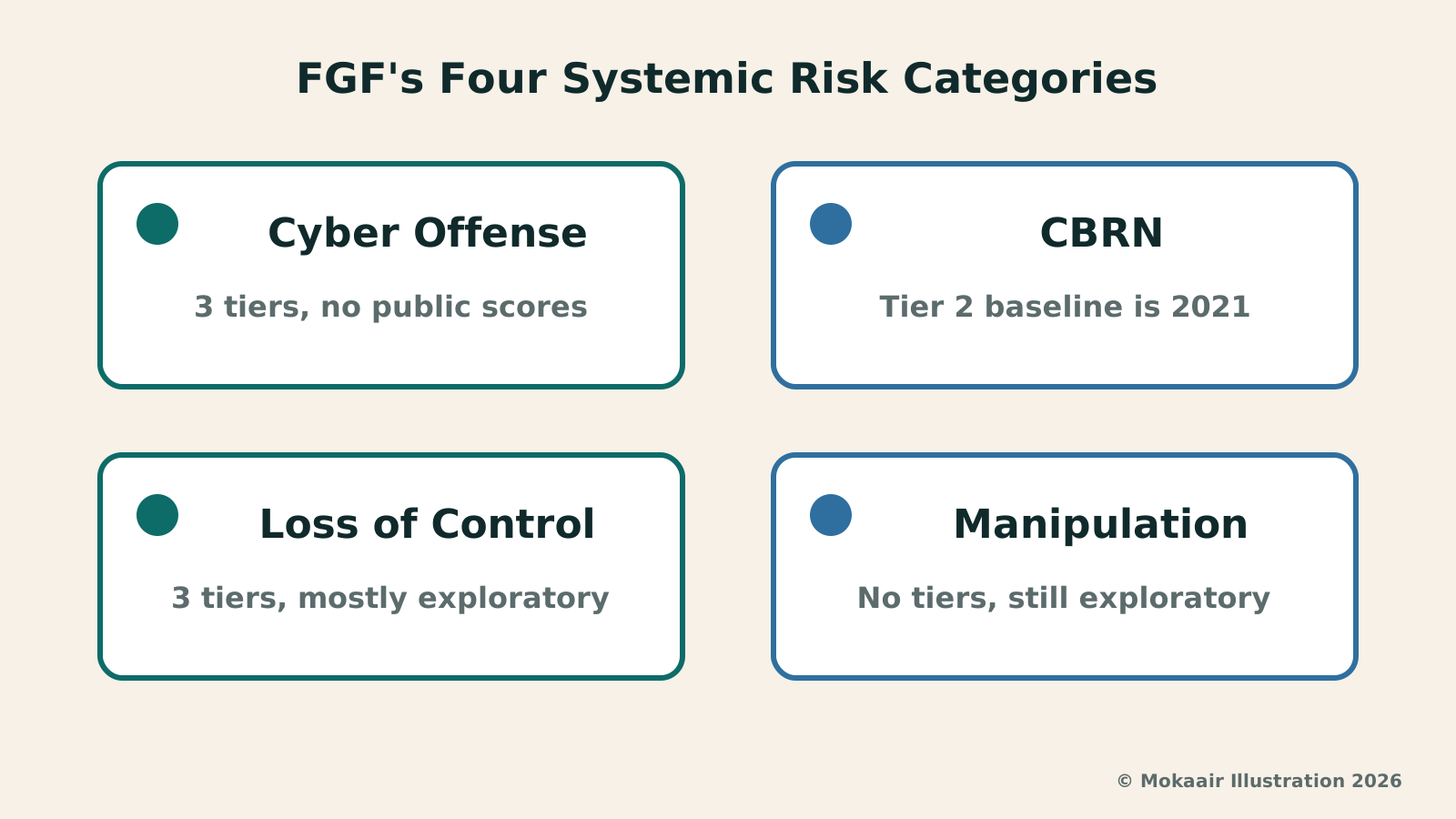
The FGF assigns three of its four systemic-risk categories — cyber offense, CBRN, and loss of control — three tiers each, describing in words what a model can do at each tier, without publishing any public-facing scores or cut-offs. The wording differs across the three: for cyber offense, the tiers “seek to quantify” model capability and are used as “measurable thresholds” for decision-making; for CBRN, the tiers “quantify” model capability; for loss of control, the FGF says only that the tiers “describe” capability, and notes that outside of risks related to AI self-improvement, these risk tiers remain exploratory and may evolve substantially.
Take CBRN as an example: Tier 2 is a model that can provide “meaningful counterfactual assistance” (the baseline for comparison being “unlimited access to tools available in 2021”) to a “novice” with only a basic relevant technical background, enabling them to create a known biological or chemical threat; Tier 3 is a model that can enable an expert to develop an entirely new, highly dangerous threat, or that can be connected to tools and equipment to complete the full cycle from development to synthesis without human intervention.
The fourth category, harmful manipulation — which the document describes as influence operations, election interference, or other coordinated campaigns to manipulate public opinion or undermine democratic processes — has no tier table yet. The FGF says OpenAI's approach here “remains exploratory,” that this risk tier may change substantially in the future, and that this kind of risk “may” be better addressed through deployment-level, system-wide monitoring rather than pre-deployment model evaluation.
After Publication, Who Can Track Whether This Document Is Kept
OpenAI commits to completing a “Framework Assessment” at least once every 12 months, counted from the respective effective dates of the TFAIA and the EU Code of Practice; material changes go to the OpenAI Foundation board's Safety and Security Committee and to the OpenAI Ireland Limited board for oversight, with a changelog and the reasons for it published within 30 days of the update.
A separate section covers updates to the “Model Report,” opening with a scope limited to “models in scope of this Framework that are subject to the EU AI Act”: if there are reasonable grounds to believe the basis for considering a model's systemic risk acceptable has been materially undermined, the report will be updated “as appropriate” after completing an assessment. The document then states that “in any event,” OpenAI will decide every 6 months whether to update the report for its most capable frontier models, with three exceptions from needing an update: no material capability change since the last update, a more capable model planned for release within a month, or the model being assessed as similarly safe or safer under Appendix 2.2 of the Code of Practice.
California's statutory timeline has two layers: a large frontier developer must review, and update as appropriate, its own framework at least once a year, publishing the modified framework and its justification within 30 days of a material change; every frontier developer, meanwhile, must publish a “transparency report” before or at the same time as deploying a new frontier model or a substantially modified version of one (the FGF notes that its own “Model Report” is what the TFAIA calls a “Transparency Report”). A frontier developer that discovers a critical safety incident must report it to California's Office of Emergency Services within 15 days, and if it poses an imminent risk of death or serious physical injury, must notify the authority with jurisdiction within 24 hours.
The consequences of falling short are written into the statute, not into the FGF: a large frontier developer that fails to publish or submit required documents, makes a materially false or misleading statement, fails to report an incident as required, or fails to comply with its own framework, faces a civil penalty of up to $1 million per violation, depending on the severity, and only California's Attorney General may bring such an action.
Taiwan Goes Unmentioned, and There Is No Interface Announcement
Based on this article's full-text comparison on September 18, 2026, the words Taiwan, Japan, and Korea do not appear anywhere in the FGF; the only jurisdictions named in it are the United States (California) and the EU/Ireland. None of the four primary sources checked for this article shows this framework imposing obligations on, or offering protections to, users in Taiwan — the TFAIA is a California law, the EU Code of Practice is an EU regulation, and Taiwan's own rules are outside the scope of what this article verifies.
The document also announces no change a user would see: the full text has no mention of any consumer-facing product, price, plan, region, or language, and does not say the ChatGPT interface will be adjusted.
Frequently asked questions
Will this document change how I use ChatGPT today?
Not based on what this article found in the document. The FGF makes no mention of any consumer-facing product, price, plan, region, or language change; it lays out OpenAI's internal process for assessing and mitigating systemic risk, used to account for regulatory compliance externally — it is not a product announcement.
Did OpenAI itself set the 50-death, $1 billion figures?
The FGF does not cite a source for these two figures, but it states that California addresses the catastrophic risk defined by the Transparency in Frontier Artificial Intelligence Act, whose statutory threshold for “catastrophic risk” is exactly a single incident causing more than 50 deaths or serious injuries, or more than $1 billion in property damage or losses. The statute's definition is not just the numbers: the incident must involve a model giving expert-level assistance to create or release a chemical, biological, radiological, or nuclear weapon; a cyberattack with no meaningful human oversight; or conduct that would be murder, assault, extortion, or theft if a human did it — or escaping the control of its frontier developer or user. The statute defines “property” as tangible or intangible, excludes lost equity value, and applies to a “frontier model” trained using more than 10^26 integer or floating-point operations.
Does this framework have any legal meaning for users in Taiwan?
Based on what this article verified as of September 18, 2026, no. The only jurisdictions the FGF names are California in the United States and the EU/Ireland; a full-text comparison finds no mention of Taiwan anywhere, and this site found no provision imposing obligations on, or offering protections to, users in Taiwan. Taiwan's own AI-governance rules would need to be checked separately, in Taiwan's own regulations, which are outside what this article verifies.
What happens if OpenAI does not comply with the framework it wrote?
The consequences are written into California's statute, not into the FGF. SB 53 provides that a large frontier developer that fails to publish or submit required documents, makes a materially false or misleading statement, fails to report a safety incident as required, or fails to comply with its own published framework faces a civil penalty of up to $1 million per violation, depending on severity, and only California's Attorney General may bring such an action. The statute also states that the false-statement provision does not apply to a statement made in good faith and reasonable under the circumstances.
Why is there no tier table for “harmful manipulation”?
The FGF itself explains that harmful manipulation is still a new area as a systemic-risk category, and that OpenAI believes this kind of risk “may” be better addressed through deployment-level, system-wide monitoring measures rather than pre-deployment model evaluation — so it does not yet have 3 tiers the way cyber offense, CBRN, and loss of control do. The document covers this in two sentences: OpenAI's approach to harmful manipulation “remains exploratory,” and this risk tier is subject to further research and may change substantially over time.
How does the FGF differ from OpenAI's original Preparedness Framework?
The document itself says the two overlap in some areas, that the PF may use a different definition of “catastrophic risk,” and that it is not tied to a statutory compute threshold like the FGF's. This site extracted both PDFs to full text and compared them as contiguous strings, finding the overlap deeper than the document's own description suggests: FGF's CBRN Tier 3 is word-for-word identical to PF's Biological and Chemical Critical threshold, and Tier 2 differs from the High threshold only in the quotation marks around “novice.” FGF's cyber offense Tier 3 differs from PF's Cybersecurity Critical threshold only by one article (FGF has an extra “the”) and one hyphenation (high-level versus high level). This comparison covers only CBRN and cyber offense — FGF's loss of control and harmful manipulation have no counterpart among PF's three Tracked Categories — and neither document says its tiers map onto the other's.
After these documents are published, how much can the public actually see?
Being published is not the same as being fully visible. California's statute lets a frontier developer redact what is necessary to protect trade secrets, cybersecurity, public safety, or U.S. national security, or to comply with federal or state law; it must describe the redaction's nature and justification in the published version, to the extent the redaction's own grounds permit, and keep the unredacted information for five years. Only a large frontier developer must include, in its transparency report, summaries of catastrophic-risk assessments, their results, and third-party evaluator involvement. Incident reports filed with California's Office of Emergency Services, and a large frontier developer's internal risk-assessment summaries, are exempt from the California Public Records Act, so the public cannot obtain them that way; the Office must instead produce an annual de-identified, aggregated incident report from January 1, 2027, for the Legislature and the Governor.
How can I check this document myself?
You can search OpenAI's official website for the full Frontier Governance Framework PDF; California's statutory text can be found on the California Legislative Information website by searching bill number SB 53 or Business and Professions Code Chapter 25.1 for the current text — both are public, primary sources anyone can read again for themselves.
2026 AI News Roundup: Highlights and Daily Life Applications from January to September2026 AI News Roundup: Highlights and Daily Life Applications from January to SeptemberOrganizing key AI news stories month by month from January to September 2026, linking to full analyses in five languages. Covering models, work tools, creation, costs, and transparency, explaining backgrounds, uses, and limits.Read the full article
GPT-5.5 Instant Becomes ChatGPT's Default Model: The Gains, Regressions, and New Features OpenAI AnnouncedGPT-5.5 Instant Becomes ChatGPT's Default Model: The Gains, Regressions, and New Features OpenAI AnnouncedOn May 5, 2026, OpenAI replaced GPT-5.3 Instant with GPT-5.5 Instant as ChatGPT's default model. Based on OpenAI's official announcement and system card, this article lays out the published factuality gains, the two safety regressions in gore and sexual content, who the new personalization features reach and when, the point on August 6 of the same year when OpenAI stated a new model would replace it, and why OpenAI says its figures do not represent everyday error rates.Read the full article
Lifestyle
GPT-5.5 Instant Becomes ChatGPT's Default Model: The Gains, Regressions, and New Features OpenAI Announced
On May 5, 2026, OpenAI replaced GPT-5.3 Instant with GPT-5.5 Instant as ChatGPT's default model. Based on OpenAI's official announcement and system card, this article lays out the published factuality gains, the two safety regressions in gore and sexual content, who the new personalization features reach and when, the point on August 6 of the same year when OpenAI stated a new model would replace it, and why OpenAI says its figures do not represent everyday error rates.
Lifestyle
OpenAI Confidentially Submits a Draft S-1: What the One-Line Announcement Doesn't Say
On June 8, 2026, OpenAI confirmed it had confidentially submitted a draft S-1 to the SEC, with no decision yet on timing. Based on OpenAI's announcement, the Securities Act of 1933's confidential-submission rules, and a May 2026 SEC proposed rule, this article explains what the announcement does and does not represent, and confirms by full-text search that, as of the check date, no public registration statement under OpenAI's filer name could be found.
Lifestyle
NVIDIA launches DGX Spark 64GB: on sale October 23 from $4,999, two units can be linked into 128GB
On October 2, 2026, NVIDIA announced a more affordable 64GB memory version of its DGX Spark personal AI computer, available from October 23 through six makers including Acer and ASUS. It is aimed mainly at developers and researchers who want to run AI models on their own machines. Below we summarize the specs NVIDIA published, its claims about linking two units, and what it means for general readers.
Lifestyle
Google Cloud Launches Spanner Queues: Putting Message Queues Inside Database Transactions to Make AI Agents More Reliable
Google Cloud has announced the general availability of Spanner queues, which make message creation part of a database transaction. The aim is to stop AI agents' "state" and "actions" from falling out of sync. This article covers Google Cloud's claims, the main features, and what it means for general readers.
Articles that cite this one
Latest travel guides

GuideTokyo
Where to Stay in Tokyo: Comparing Shinjuku, Ueno, Tokyo Station, Shibuya, Asakusa, Ikebukuro, and Ginza, Plus Airport Access, Accommodation Tax, and Luggage Delivery
Where should you stay in Tokyo? Compare Shinjuku, Ueno, Tokyo Station, Shibuya, Asakusa, Ikebukuro, and Ginza by the same criteria: access from Narita and Haneda, transit routes, nearby attractions, neighborhood character, and who each area suits. Includes a comparison table, a Yamanote Line diagram, Tokyo’s accommodation tax as verified in 2026/9 (changing to 3% in 2027/4), and Airport TA-Q-BIN luggage shipping rules.
- Budget
- Hotels

GuideTokyo
How to Choose Tokyo Transit Passes: Are Suica, Welcome Suica, the Tokyo Subway Ticket, and the JR Pass Worth It?
On a first Tokyo trip, start with an IC card and pay per ride (Welcome Suica has no deposit and is valid for 28 days). If you take four or more subway rides in a day, add a 72-hour Tokyo Subway Ticket for 2,000 yen; a JR Pass is never worthwhile if you stay in Tokyo and do not go to Kansai. See what TOURIST PASMO, Suica on iPhone, and the Tokyo Metro day pass do and do not cover, with a decision chart. Prices verified in September 2026.
- Transport
- Budget

GuideTokyo
Tokyo Disneyland and DisneySea Guide: Ticket Prices, Fantasy Springs, Disney Premier Access (DPA), Standby Pass, and Which Park to Choose for Your First Visit
Tokyo Disney one-day Passport prices vary: most weekdays in 9/2026 cost ¥9,900 and weekends ¥10,900. At 14:00 daily, tickets go on sale for the same date two months later. Free Priority Pass is no longer on the official service list; only paid Disney Premier Access (¥1,000–3,500 per person per use) shortens waits. Covers hours, the 25th anniversary, Standby Pass, Entry Request, Fantasy Springs access and first-visit park choice; checked on the official site in 9/2026.
- Itineraries
- Family
Sources
- OpenAI's Frontier Governance Framework, full text (PDF) · Checked:
- California Codes, Business and Professions Code Chapter 25.1 (Transparency in Frontier Artificial Intelligence Act), current text · Checked:
- OpenAI's Preparedness Framework Version 2, full text (PDF) · Checked:
- OpenAI's official news RSS feed (publication date record) · Checked: