Lifestyle
GPT-5.6 Luna and Terra Price Cut: Which Usage Costs Are Affected?
OpenAI lowered usage prices for GPT-5.6 Luna and Terra on July 30, 2026, but monthly subscription fees and credit budgets were not reduced alongside them. This article separates API unit prices, ChatGPT Work and Codex credit consumption, and standard chat subscriptions into three distinct costs, using data processing and batch workflows to explain cost comparisons so you don't assume your bill will automatically decrease.
Updated: About 7 min read
On July 30, 2026, OpenAI announced price cuts for GPT-5.6 Luna and Terra. The announcement indicated that Luna's price was reduced by 80% and Terra's by 20%, which is reflected in credit consumption across ChatGPT Work and Codex; subscription prices and credit budgets remain unchanged. Verified on September 14, 2026, this article outlines the scope of impact for this adjustment and does not treat historical announcements as a complete price list for all current products.
How this news relates to the average user depends on how you pay. Building your own tools via the API, consuming credits within workplace products, and paying a monthly subscription for chat services represent entirely different billing scenarios. When you see a "price cut," first identify the line items on your bill to understand whether the change will carry over to you. The following cost examples are analytical methods and editorial suggestions, not actual billing estimates for any specific account.
First, distinguish between the three types of fees
When the API is billed based on usage, model input and output pricing constitutes a portion of the cost. Input can be understood as the content provided for the model to read, while output refers to the responses it generates; services may also incur charges for tools, storage, or other items. If your tool utilizes multiple services simultaneously, a price drop for a single model only changes one component and will not reduce your overall bill by the same proportion.
For ChatGPT Work and Codex, the scenario revolves around how many credits or how much quota a task consumes. This announcement stated that cheaper models consume fewer credits, but it did not lower the monthly subscription fees alongside that change. Users may find that the same budget allows them to accomplish more work; the exact increase still depends on task length, number of retries, and the features used.
If you simply pay a fixed monthly fee to use chat functionality, you should review your plan's billing statements and feature descriptions. Do not assume, simply because a specific model's API price dropped, that your subscription will receive a refund, your next monthly fee will decrease, or all tools will become unlimited. These are separate product conditions that require explicit supporting announcements of their own.
How to interpret the unit prices in the announcement
According to the API pricing at the time of this release, Terra is $2 per million input tokens and $12 for output; Luna is $0.20 and $1.20, respectively. These are US dollar unit prices announced on July 30, 2026—not per-query costs, nor monthly fees for subscription plans in Taiwan. To place orders or establish budgets, you should still check the current pricing page.
A token is not permanently equivalent to one Chinese character or one English word. Actual counts vary across different texts, formats, and languages, meaning you cannot simply multiply an article's word count by an imagined fixed ratio. When comparing tools, it is best to observe usage with the same set of actual work logs, incorporating the consumption from long attachments, repetitive background context, and iterative revisions.
Another common misconception is focusing solely on input pricing. If a task requires lengthy reports or repeatedly generates entire documents, the output component can become quite significant. Editors recommend first asking the model to provide an outline and confirming the direction before expanding; when revising, modify only specified sections. Whether this working method genuinely saves usage should be verified against your product logs—do not assume your bill will drop just because answers are shorter.
| Billing Scenario | How to Interpret This Adjustment | Where to Check |
|---|---|---|
| API Usage | Luna and Terra announced unit prices lowered | Model pricing and actual usage |
| Work / Codex | Related models consume fewer credits | Task usage and plan conditions |
| Fixed Subscription | Announcement did not reduce monthly subscription | Your own renewal bill |
| Complete Workflow | Retries and manual review must also be counted | Total cost of qualified deliverables |
Translating unit prices into cost per qualified deliverable
Suppose a small shop compiles customer inquiries each week. First, create a batch of sample queries with personal data removed and correct classifications pre-labeled, then process them across different models. In addition to total consumption, record misclassifications, omitted items, and areas requiring manual rewrites. If a lower-priced model meets the criteria, there is no need to deploy the highest-capability model for every simple piece of data.
Conversely, if an aggregated result takes a long time to correct, a low unit price does not necessarily equal low cost. You can document the process of a task from input to delivery: model processing, human review, retries, and final export. What truly needs comparison is how many resources are required to reach the same quality, and whether errors disrupt subsequent workflows.
Such comparisons are best limited to specific use cases first. Converting messy notes into a fixed format and reviewing a contract to provide risk assessments are fundamentally different tasks; the latter cannot be decided merely by price or benchmark scores. Clearly defining which answers can be adopted automatically and which must be verified against source material will establish a stable foundation for model selection.
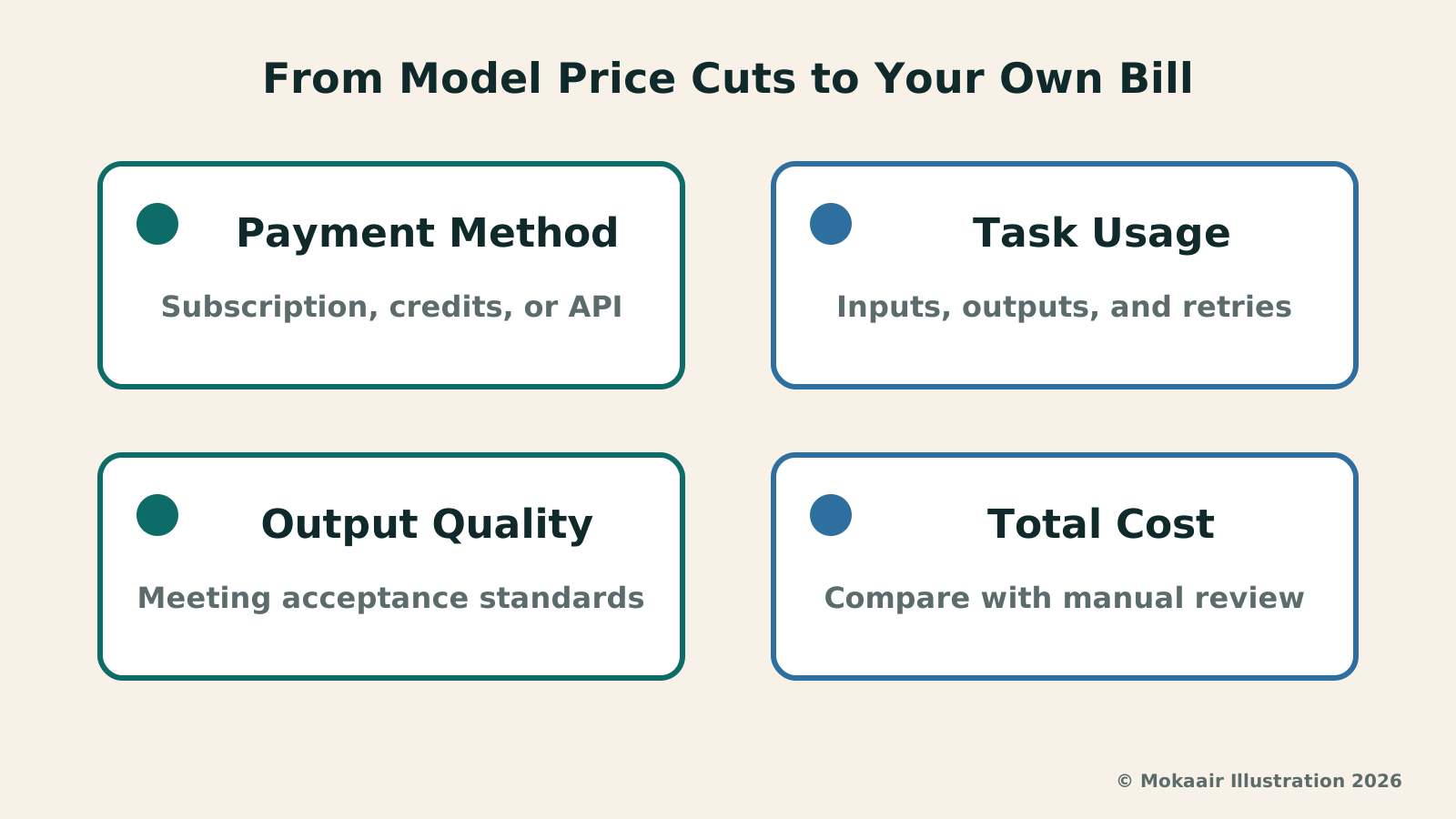
Setting up a small-scale comparison within existing budgets
You do not need to replace your entire workflow at the outset. Pick a recurring task with clear data boundaries that is easy to correct if errors occur, such as generating product tags for your own inventory descriptions. Keep your current version and let candidate models process the exact same batch of materials, evaluating results in a simple table: completion rate, volume of edits, latency, and accessible usage records.
Keep input materials, output formats, and acceptance criteria consistent throughout the comparison. If one side writes only a summary while the other is asked to provide a comprehensive analysis, the cost difference cannot simply be attributed to the model. When external tool calls are involved, record whether the tool succeeded, or you might mistake a data retrieval failure for a model capability shortcoming.
Once effectiveness is verified, gradually scale up task volume while setting acceptable spending boundaries. For continuously running services, regularly check whether usage rises due to longer data or increased retries. A dropping unit price and rising total expenditure can happen simultaneously, as you may be delegating more tasks to the tool within the same timeframe.
Checks general users can perform right now
First, open your payment history to identify whether you are currently paying for a fixed subscription, extra credits, or API usage. Next, list your most frequent tasks to see whether your main bottleneck is insufficient quota, excessive latency, or answers requiring rework. Only by identifying bottlenecks will you know if this price adjustment warrants altering how you work.
If you do not use the API at all and have not encountered task credit limits, you can treat this news as an industry trend and continue using the tools you are already familiar with. If you are building high-volume repetitive workflows, you can benchmark anew using small-scale, verifiable materials. Document your test dates and configuration settings so you retain a continuous baseline when prices adjust again in the future.
ChatGPT Free Tier and Thinking Feature Updates: What Changes in Daily Use?ChatGPT Free Tier and Thinking Feature Updates: What Changes in Daily Use?On August 6, 2026, OpenAI announced updates to daily ChatGPT chats, expanding text chat and thinking features for free users while updating Sol for paid users. This guide explains quotas for text, files, and images, how to decide whether to spend extra thinking time based on complexity, and how to verify answers using itinerary, comparison, and writing scenarios—avoiding the misconception that better reasoning means always being correct.Read the full article
Gemini 3.8 Flash Launched: What Model Upgrades Mean for Everyday ToolsGemini 3.8 Flash Launched: What Model Upgrades Mean for Everyday ToolsGoogle launched Gemini 3.8 Flash and restricted-access Flash Cyber on September 2, 2026, highlighting coding, agents, and multi-step reasoning. Exploring search, spreadsheets, and data organization, this article distinguishes model upgrades from product entry points, subscription access, developer promo pricing and deadlines, and why identical unit rates might still lead to differing total usage costs.Read the full article
Lifestyle
NVIDIA launches DGX Spark 64GB: on sale October 23 from $4,999, two units can be linked into 128GB
On October 2, 2026, NVIDIA announced a more affordable 64GB memory version of its DGX Spark personal AI computer, available from October 23 through six makers including Acer and ASUS. It is aimed mainly at developers and researchers who want to run AI models on their own machines. Below we summarize the specs NVIDIA published, its claims about linking two units, and what it means for general readers.
Lifestyle
Google Cloud Launches Spanner Queues: Putting Message Queues Inside Database Transactions to Make AI Agents More Reliable
Google Cloud has announced the general availability of Spanner queues, which make message creation part of a database transaction. The aim is to stop AI agents' "state" and "actions" from falling out of sync. This article covers Google Cloud's claims, the main features, and what it means for general readers.
Lifestyle
GPT-6.1 Sol Launches: New Sol Version in the API, Codex and ChatGPT Work, Not in Chat
OpenAI launched GPT-6.1 Sol on September 29, 2026, with the API name gpt-6.1-sol. The launch rollout covers Codex and ChatGPT Work on Plus, Pro, Business, Enterprise and Edu (Enterprise and Edu need an administrator to enable it); Free and Go are not included at launch, and it is not in Chat (checked September 2026).
Lifestyle
Claude Sonnet 5.5 Launches: Same List Price as Sonnet 5, Available in the API, on Cloud Platforms and in Claude.ai
Anthropic launched Claude Sonnet 5.5 on September 28, 2026. API list prices are the same as Sonnet 5 ($2 per million input tokens, $10 per million output tokens). It is available in Claude.ai, the API and several cloud platforms, and higher-risk cybersecurity requests fall back to Sonnet 5 (checked September 2026).
Articles that cite this one
Latest travel guides

GuideTokyo
Where to Stay in Tokyo: Comparing Shinjuku, Ueno, Tokyo Station, Shibuya, Asakusa, Ikebukuro, and Ginza, Plus Airport Access, Accommodation Tax, and Luggage Delivery
Where should you stay in Tokyo? Compare Shinjuku, Ueno, Tokyo Station, Shibuya, Asakusa, Ikebukuro, and Ginza by the same criteria: access from Narita and Haneda, transit routes, nearby attractions, neighborhood character, and who each area suits. Includes a comparison table, a Yamanote Line diagram, Tokyo’s accommodation tax as verified in 2026/9 (changing to 3% in 2027/4), and Airport TA-Q-BIN luggage shipping rules.
- Budget
- Hotels

GuideTokyo
How to Choose Tokyo Transit Passes: Are Suica, Welcome Suica, the Tokyo Subway Ticket, and the JR Pass Worth It?
On a first Tokyo trip, start with an IC card and pay per ride (Welcome Suica has no deposit and is valid for 28 days). If you take four or more subway rides in a day, add a 72-hour Tokyo Subway Ticket for 2,000 yen; a JR Pass is never worthwhile if you stay in Tokyo and do not go to Kansai. See what TOURIST PASMO, Suica on iPhone, and the Tokyo Metro day pass do and do not cover, with a decision chart. Prices verified in September 2026.
- Transport
- Budget

GuideTokyo
Tokyo Disneyland and DisneySea Guide: Ticket Prices, Fantasy Springs, Disney Premier Access (DPA), Standby Pass, and Which Park to Choose for Your First Visit
Tokyo Disney one-day Passport prices vary: most weekdays in 9/2026 cost ¥9,900 and weekends ¥10,900. At 14:00 daily, tickets go on sale for the same date two months later. Free Priority Pass is no longer on the official service list; only paid Disney Premier Access (¥1,000–3,500 per person per use) shortens waits. Covers hours, the 25th anniversary, Standby Pass, Entry Request, Fantasy Springs access and first-visit park choice; checked on the official site in 9/2026.
- Itineraries
- Family