Lifestyle
2026 Crypto News Roundup: Key Developments in Regulation, Technology and Industry
This site's 2026 crypto news explainers, in six jurisdictions — Taiwan, the US, the UK, the EU, Japan, South Korea: the Virtual Asset Service Act, the proposed GENIUS Act rules, the joint SEC–CFTC interpretation and the SEC's own proposal, the end of MiCA's transitional period and its link to the payment rules, the FCA's perimeter guidance, Japan's FSA reports and South Korea's manipulation referrals. Regulation, technology and industry only, no prices, with official sources and a check date.
Updated: About 18 min read
This index gathers this site's 2026 crypto news explainers, a set whose event dates fall between February and September 2026. It is arranged by six jurisdictions — Taiwan, the United States, the United Kingdom, the European Union, Japan and South Korea — and each entry goes back to the competent authority's announcement, to the text of the law itself or to the Federal Register before linking on to the full explainer.
This index was checked on September 17, 2026 and expanded on September 27, 2026. This site ran no tests of its own on any platform, wallet or token, and it gives no investment, legal or tax advice. The series writes about regulation, technology and how the industry works; it does not write about coin prices, percentage moves, market capitalization or trading volume, and it does not write about when to buy or sell. This site neither compares nor recommends any asset, exchange, wallet or issuer, and market figures such as capitalization and volume are left out even where a supervisory document quotes them. Each article's check date is given at its head, and the status of a document follows whatever the competent authority in question announces at the time.
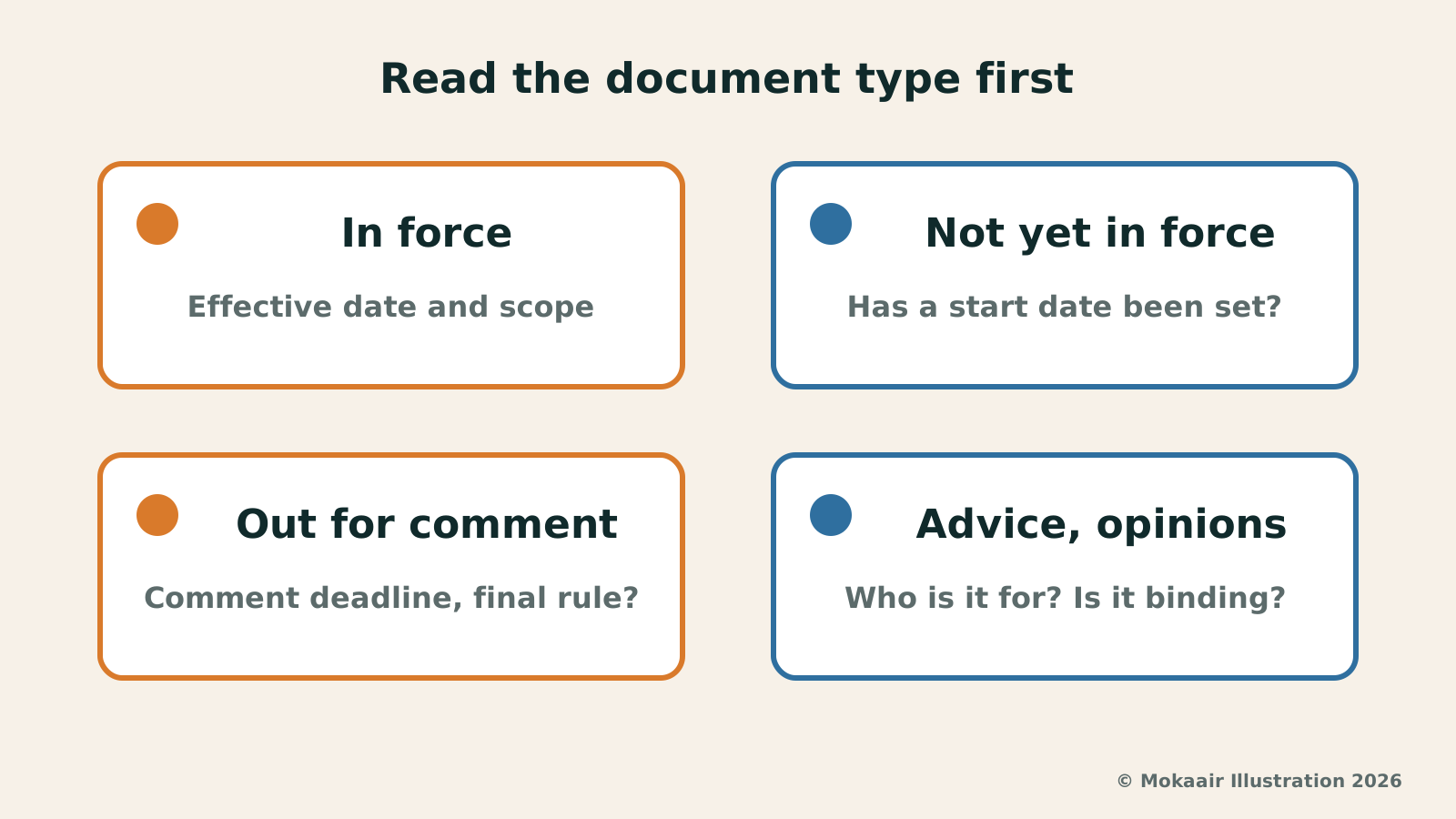
First, what kind of document it is: in force, promulgated but not in force, proposal, recommendation
Documents that all get called new rules can differ a great deal in legal effect. Among the documents at the center of this set, the one that prints an effective date of its own is the joint interpretation of the U.S. Securities and Exchange Commission (SEC) and the Commodity Futures Trading Commission (CFTC): it was published in the Federal Register on March 23, 2026, and the effective date its DATES field carries is that same day. It is the authorities' interpretation of existing law, and the document itself states that it creates no new legal obligations.
Promulgated but not yet in force is Taiwan's Virtual Asset Service Act (虛擬資產服務法): third reading on June 30, 2026, promulgation on July 22, 2026, with the commencement date to be set separately by the Executive Yuan. Then come the proposals: in the United States, the Office of the Comptroller of the Currency (OCC), the Federal Deposit Insurance Corporation (FDIC), the National Credit Union Administration (NCUA), and the Financial Crimes Enforcement Network (FinCEN) together with the Office of Foreign Assets Control (OFAC), have all put forward proposed rules under the GENIUS Act; the SEC's Regulation Crypto Assets is a proposal too, with a comment deadline of October 20, 2026.
A further class is made up of recommendations, opinions and research papers: the Opinion of the European Banking Authority (EBA) is advice addressed to the national competent authorities; the report of the Working Group under Japan's Financial System Council is a recommendation, while the cybersecurity research paper published by the Financial Services Agency (FSA) is commissioned research, and the agency states plainly that it does not represent its own views. One more kind of news is not a new document at all but a deadline the law had written down long before: the transitional period under the EU's Markets in Crypto-Assets Regulation (MiCA) expired on July 1, 2026. Going back to the document itself to see which class it belongs to and what its dates are, whenever a headline says that some country has already set rules, is what every article in this series does.
| Kind of document | Examples in this set | What to look at first |
|---|---|---|
| An interpretation in force | The joint U.S. SEC and CFTC interpretation | The effective date, and the scope the document sets for itself |
| Promulgated, not yet in force | Taiwan's Virtual Asset Service Act | Whether a commencement date has been announced |
| A proposal out for comment | The U.S. proposals of the OCC, the FDIC, the NCUA, FinCEN and OFAC, and the SEC | The comment deadline, and whether there is a final rule |
| Recommendation, opinion and research | The EBA Opinion, the report of Japan's Financial System Council, and the commissioned research and the policy approaches published by the FSA | Who wrote it, whom it is addressed to, and whether it binds anyone |
Taiwan: the law is promulgated, the commencement date is undecided
The Virtual Asset Service Act sorts the businesses that provide virtual asset services to others in Taiwan into seven kinds, and a business has to obtain the license and license certificate of the Financial Supervisory Commission (FSC) separately for each kind; issuing a stablecoin in Taiwan requires an application to the FSC for a license, the FSC is to consult the Central Bank of the Republic of China (Taiwan) and obtain its consent before granting one, and the issuer has to maintain full reserve assets.
The easiest thing to overlook is the timing. Article 56 leaves the commencement date to the Executive Yuan, and the 12 months to apply and the 21 months to obtain the license certificate that article 55 gives to operators that have completed anti-money laundering registration, and to financial institutions already providing services in accordance with the regulations, both run from after the Act comes into force; while no commencement date has been announced, neither of those periods has begun. Until then, what applies in Taiwan is the anti-money laundering registration system, and the dedicated page of the FSC's Securities and Futures Bureau lists the operators and its own update date.
On September 17, 2026, Taiwan's Central Bank compared stablecoins, deposit tokens and central bank digital currency (CBDC) in the written materials of its post-meeting press conference, saying the three can coexist and complement each other across different layers and that there is no urgency for Taiwan to issue a retail CBDC; those materials are a written question-and-answer the Central Bank prepared itself, not a resolution of its board, and they give no timetable for issuing one.
The United States: one stablecoin statute, several agencies each with a proposal
The public law text of the GENIUS Act (Guiding and Establishing National Innovation for U.S. Stablecoins Act, Public Law 119-27) records at its end that it was approved on July 18, 2025. It divides the licensing and supervision of payment stablecoins among several federal agencies and the states, which is why one statute produces several proposals. The OCC's proposal was published on March 2, 2026 and deals with approval to issue, reserve assets and redemption for the entities subject to its jurisdiction. The joint proposal of FinCEN and OFAC was published on April 10 and would bring issuers within the Bank Secrecy Act and require a sanctions compliance program.
The FDIC's proposal was published on April 10 as well and deals with the depository institutions it supervises and their subsidiaries approved to issue, and with the related custodians it supervises; the reach of its deposit insurance section is wider, extending to every insured depository institution that holds deposits of this kind. It proposes to insure the deposits held as reserves to the issuer under the rules for corporate deposits, and not to insure them to holders on a pass-through basis. The NCUA's supplemental proposal was published on May 18 and states that a credit union may not itself be the issuer and can issue only through a subsidiary.
The FDIC's and the NCUA's proposals both cite the GENIUS Act in stating expressly that payment stablecoins are not guaranteed by the U.S. Government and are subject to neither Federal deposit insurance nor Federal share insurance, and that representing otherwise is unlawful; the OCC's proposal puts the same point as a prohibition on what an issuer may represent. All four are still proposals and a final rule may read differently; each of these four articles sets out how to use the docket number, the Regulation Identifier Number (RIN) or the Federal Register citation to get back to the official page and check the current status.
On the securities law side, an interpretation and a proposed rule are different things. The joint interpretation of March 2026 sorts crypto assets into five categories and explains which categories are not themselves securities and when an investment contract begins and ends; that is a classification in law, not an assessment of an investment. Regulation Crypto Assets, of August 2026, is a proposed rule of the SEC's that would set up offering exemptions and an investment contract safe harbor, and the document carries no effective date.
On the commodities side, on September 17, 2026 the CFTC's Market Participants Division issued staff no-action letter 26-25, extending to every passive software provider that meets ten conditions the position that Letter 26-09 had given a single applicant in March; it is a staff letter at division level, which says itself that it does not bind the Commission, and it carries no expiry date.
The European Union: the transitional period expires, and where MiCA meets the payment rules
Article 143(3) of MiCA let crypto-asset service providers already operating under the old regime carry on providing services, at the latest until July 1, 2026; each Member State could shorten that grandfathering period, and the lengths are not the same. The official question and answer of the European Securities and Markets Authority (ESMA) states that an entity not authorised by the end of the transitional period must cease providing crypto-asset services until it is granted authorisation under MiCA, and that a pending application does not extend the deadline; ESMA also invites clients to check on its register whether their own provider is authorised.
The EBA's Opinion deals with a different overlap: e-money tokens fall under the Payment Services Directive (PSD2) and under MiCA at the same time. The EBA had earlier given a transition period by way of a No-Action Letter, ending on March 2, 2026 as the Opinion has it, while the letter's own executive summary prints March 1; the Opinion of February 12, 2026 sets out what follows once that period ends, advising the national competent authorities to treat providers differently according to their authorisation and application status. Its wording is advice and its addressees are the authorities, not a rule that takes direct effect on firms.
The United Kingdom: perimeter guidance finalised, and enforcement against peer-to-peer trading
On September 16, 2026 the Financial Conduct Authority published policy statement PS26/18, its cryptoasset perimeter guidance on when a cryptoasset activity needs FCA authorisation: the application window opens on September 30, the regime itself commences on October 25, 2027, and existing registrations do not convert automatically. On September 17 the FCA announced the action it had taken on September 10 with HM Revenue & Customs and the Metropolitan Police at three London premises suspected of illegal peer-to-peer cryptoasset trading, all three served with cease and desist notices; the registration duty reaches only those trading by way of business, and peer-to-peer trading on a personal basis needs no registration.
Japan: a report of recommendations, the legislation that followed, cybersecurity and an onchain finance forum
The report of the Working Group under the Financial System Council is dated December 10, 2025 in its Japanese version, and a Provisional Translation into English was published on February 16, 2026; its central recommendation is to move the legal basis for crypto-assets from the Payment Services Act to the Financial Instruments and Exchange Act. The report itself is a recommendation; the FSA's Japanese-language 「国会提出法案等」 page, which lists bills submitted to the Diet, states that the related bill was submitted on April 10, 2026 and enacted on July 15, and when that article checked the FSA page it cites, no commencement date for the crypto-asset provisions was to be found.
On July 23, 2026 the FSA published a commissioned cybersecurity research paper on its website; the cover is dated June 30, 2026, and the FSA states plainly that the paper does not represent its own views. The paper says that one class of the incidents it analyzed did not involve the theft of the signing keys themselves but tampering with the system components that come before signing. The policy approaches the FSA itself set out on April 3, 2026 say that against indirect attacks of this kind the safe management of crypto-assets cannot be ensured by cold wallets alone, and that the cybersecurity management systems of the entire supply chain, outsourcees included, have to be strengthened. Neither the research paper nor the policy approaches adds a statutory obligation or a penalty, but the policy approaches do set dated expectations, among them that all crypto-asset exchange service providers will be requested to conduct a cybersecurity self-assessment from Program Year 2026 onward.
On September 25, 2026 the FSA announced that, together with relevant ministries and agencies, it is setting up the 「AI時代を見据えたオンチェーン金融フォーラム」 (an Onchain Finance Forum With an Eye on the AI Era), putting stablecoins, tokenized deposits and the tokenization of government bonds into a cross-ministry review; it sets up a place for review, not a change of law or the approval of any product.
South Korea: suspected market manipulation cases referred to investigators
On September 23, 2026, at its 16th regular meeting, South Korea's Financial Services Commission (a different agency from Taiwan's Financial Supervisory Commission) resolved on four suspected virtual-asset market manipulation cases it had investigated together with the Financial Supervisory Service: one criminal complaint and three notifications to the investigative authorities. Three of the cases were ultra-short-term price manipulation in which automated trading programs (APIs) repeated small orders to make the order book look active; in the fourth, executives and employees of a virtual-asset operating company hired a market maker and traded between borrowed-name accounts to inflate volume, falsely meeting an exchange's listing-maintenance requirements. The announcement named no virtual asset, exchange or individual and gave no figure for illicit gains; the parties in all four cases are suspects only, not people who have been indicted or convicted.
Frequently asked questions
Why does this series not write about coin prices or the market?
It is the editorial line for this site's finance content: systems and methods only, no product recommendations. Coin prices, percentage moves, market capitalization, trading volume and the timing of a purchase or a sale change quickly and are easily read as investment advice, so none of them is written here; market figures such as capitalization and volume are left out even where a supervisory document quotes them. Regulatory figures such as fine amounts, capital thresholds and deadlines are written, with an official source and a check date.
When does a proposal become a rule?
That depends on whether the authority later issues a final rule; this series writes only the status read on each article's check date and predicts no timing. A proposed rule in the United States is put out for public comment first, and what is finally adopted may differ from the proposal. Each of the U.S. articles lists the docket number, the regulation identifier number or the Federal Register citation for its rulemaking; the articles on other jurisdictions list the document's reference number and its announcement page on the authority's own website, and explain how to get back to that page to confirm the current status.
What do these foreign rules have to do with readers in Taiwan?
These foreign documents govern the operators and issuers of their own jurisdictions; when each article was checked, no provision addressed to users in Taiwan was read in any of them. They are useful to readers in Taiwan in two ways. When a headline says that some country has already set rules, you know to ask first whether that means a rule in force, a proposal or a recommendation. And when using a service based abroad, you know where the limits of protection lie: the FDIC's and the NCUA's proposals, for instance, both cite the statute in stating expressly that payment stablecoins are subject to neither Federal deposit insurance nor Federal share insurance. For Taiwan's own regime, see the article on the Virtual Asset Service Act.
Are the articles kept up to date?
Each one is a news explainer as of its check date, not live tracking. The status of a document may change afterwards — a proposal is adopted, a commencement date is announced, a register is updated — so every article sets out how to go back to the official page and check the current state yourself. This index is updated as the series grows.
Taiwan
Taiwan's Virtual Asset Service Act Clears Third Reading: Seven Kinds of Provider, Stablecoin Licensing, No Commencement Date YetTaiwan's Virtual Asset Service Act Clears Third Reading: Seven Kinds of Provider, Stablecoin Licensing, No Commencement Date YetOn June 30, 2026 Taiwan's Legislative Yuan passed the Virtual Asset Service Act (虛擬資產服務法) on third reading, and its 56 articles were promulgated on July 22, 2026. Working from the Financial Supervisory Commission's press release and two official legal databases, this article sets out the seven kinds of virtual asset service provider, licensing kind by kind, the reserve-asset rules for stablecoins, and why the 12- and 21-month transition periods in article 55 have not started running.Read the full article
Taiwan's Central Bank on Stablecoins, Deposit Tokens and CBDC: Layers Can Coexist, No Urgency Yet for Retail CBDCTaiwan's Central Bank on Stablecoins, Deposit Tokens and CBDC: Layers Can Coexist, No Urgency Yet for Retail CBDCOn September 17, 2026, the Central Bank of the Republic of China (Taiwan) compared stablecoins, deposit tokens and central bank digital currency (CBDC), saying there is no urgency to issue a retail CBDC while research and trials continue on the wholesale side. This article covers who issues each, how they circulate and are regulated, and Taiwan's trial progress; the FSC's separate deposit-token pilot five days later is a different story (checked September 2026).Read the full article
The United States: the proposed rules under the GENIUS Act
The OCC's Proposed Stablecoin Rules: One-to-One Reserves, Redemption in Two Business Days and Periodic ReportingThe OCC's Proposed Stablecoin Rules: One-to-One Reserves, Redemption in Two Business Days and Periodic ReportingOn March 2, 2026 the U.S. Office of the Comptroller of the Currency published a proposed rule on payment stablecoins implementing the GENIUS Act in the Federal Register, cited as 91 FR 10202 and running to 102 pages, with comments due by May 1, 2026. Working from the Federal Register full text and the public law text of the GENIUS Act, this article sets out whom the new 12 CFR part 15 would reach, what it would require on reserves and redemption, and why it is not yet a rule in force.Read the full article
FinCEN and OFAC's Joint AML and Sanctions Compliance Proposal for Stablecoin Issuers, Not Yet in EffectFinCEN and OFAC's Joint AML and Sanctions Compliance Proposal for Stablecoin Issuers, Not Yet in EffectOn April 10, 2026 a joint FinCEN and OFAC proposed rule, from two U.S. Treasury agencies, was published in the Federal Register (91 FR 18582). From the full text, FinCEN's fact sheet, the Treasury release and the Federal Register's docket lookup, this article sets out how the proposal would bring permitted payment stablecoin issuers under the Bank Secrecy Act, the four AML program requirements, the $5,000 suspicious activity reporting threshold, and OFAC's proposed sanctions compliance program.Read the full article
FDIC Stablecoin Proposal: Reserve Deposits Insured to the Issuer, Not Passed Through to HoldersFDIC Stablecoin Proposal: Reserve Deposits Insured to the Issuer, Not Passed Through to HoldersOn April 7, 2026 the board of the U.S. Federal Deposit Insurance Corporation (FDIC) approved a proposal implementing the GENIUS Act, published in the Federal Register on April 10 at 91 FR 18534. Working from that full text and the FDIC's own press release, this article sets out whom the proposal would reach, the proposed reserve asset and redemption requirements, and why it would count the deposit insurance on reserve deposits as the issuer's rather than each stablecoin holder's.Read the full article
NCUA's Proposed Stablecoin Standards: Credit Unions Could Issue Only Through a Subsidiary; Stablecoins Get No Share InsuranceNCUA's Proposed Stablecoin Standards: Credit Unions Could Issue Only Through a Subsidiary; Stablecoins Get No Share InsuranceOn May 18, 2026 the U.S. National Credit Union Administration's supplemental proposed rule implementing the GENIUS Act was published in the Federal Register (91 FR 28956). From that full text, the NCUA press release, the enacted GENIUS Act and the agency's February licensing proposal: why a credit union could issue payment stablecoins only through a subsidiary, how tokenized shares and the coin differ on share insurance, and why every line here reads as a proposal.Read the full article
The United States: the securities law interpretation, the proposal and a CFTC staff letter
Joint SEC and CFTC Interpretation: Five Categories of Crypto Assets, Effective the Day It Was PublishedJoint SEC and CFTC Interpretation: Five Categories of Crypto Assets, Effective the Day It Was PublishedOn March 17, 2026 the Securities and Exchange Commission (SEC) and the Commodity Futures Trading Commission (CFTC) jointly issued an interpretation of the securities laws for crypto assets; it was published in the Federal Register on March 23, 2026 and took effect that day. From the Federal Register full text and document data, the as-published PDF and the CFTC press release: the five categories, how an investment contract begins and ends, and what the release says it does not address.Read the full article
SEC Proposes Regulation Crypto Assets: Two Offering Exemptions and a Safe Harbor, Not Yet AdoptedSEC Proposes Regulation Crypto Assets: Two Offering Exemptions and a Safe Harbor, Not Yet AdoptedOn August 21, 2026, the Regulation Crypto Assets proposed by the U.S. SEC was published in the Federal Register at 91 FR 54510. Working from the Federal Register full text and the official GovInfo PDF, this article sets out the two offering exemptions, the investment contract safe harbor and the state law preemption in this 146-page proposal, and why it has no effective date and why the comment period runs to October 20, 2026.Read the full article
CFTC No-Action Letter Expands to All Passive Software Providers: The Line Drawn by Ten ConditionsCFTC No-Action Letter Expands to All Passive Software Providers: The Line Drawn by Ten ConditionsOn September 17, 2026, the CFTC's Market Participants Division issued no-action letter Letter 26-25, extending Letter 26-09 -- until then available only to a single applicant, Phantom -- to all passive software providers. Drawing on both letters' full text and the press release, this article explains the ten conditions, what is and is not allowed, and how a no-action letter differs from a Commission rule in effect; it offers no investment or legal advice, and was checked on September 18, 2026.Read the full article
The European Union
EU MiCA Transitional Period Ends July 1: Grandfathering Differs by Country, a Pending Application Is Not an ExtensionEU MiCA Transitional Period Ends July 1: Grandfathering Differs by Country, a Pending Application Is Not an ExtensionThe transitional period in Article 143(3) of the EU's MiCA expired on July 1, 2026. Drawing on ESMA's public statement of June 23, 2026, its statement of April 17, 2026, the list of grandfathering periods decided by each Member State and the official question and answer ESMA_QA_2220, this article sets out what ended, why the grandfathering periods differ from one Member State to another, why a pending application is not an extension, and what ESMA said to providers and to clients.Read the full article
EBA Opinion as the PSD2 Transition Period for E-Money Tokens Ends: Three Scenarios, Four ConditionsEBA Opinion as the PSD2 Transition Period for E-Money Tokens Ends: Three Scenarios, Four ConditionsOn February 12, 2026, the European Banking Authority published Opinion EBA/OP/2026/01, setting out what national competent authorities are advised to do once the transition period in its No-Action Letter ends on March 2, 2026. Working from the Opinion and the No-Action Letter themselves, this article explains the three scenarios, the four conditions and the two restrictions, and why this is advice rather than a rule that takes direct effect on firms.Read the full article
The United Kingdom
UK FCA Publishes Final Cryptoasset Perimeter Guidance PS26/18: Applications Open September 30, New Regime Takes Effect October 2027UK FCA Publishes Final Cryptoasset Perimeter Guidance PS26/18: Applications Open September 30, New Regime Takes Effect October 2027On September 16, 2026, the UK's Financial Conduct Authority (FCA) published policy statement PS26/18, Cryptoasset Perimeter Guidance, explaining when cryptoasset activities require FCA authorisation. Drawing on the FCA's press release and the 140-page PS26/18, this article sets out three separate dates — guidance published, applications open, new regime in effect — the seven newly regulated activities, and places this timeline beside Taiwan's Virtual Asset Service Act.Read the full article
FCA Cracks Down on Illegal Peer-to-Peer Crypto Trading in London: Action on September 10, Announced September 17FCA Cracks Down on Illegal Peer-to-Peer Crypto Trading in London: Action on September 10, Announced September 17On September 17, 2026, the UK's Financial Conduct Authority (FCA) announced that it, HMRC and the Metropolitan Police Service had acted against 3 premises in London on September 10 over suspected illegal peer-to-peer crypto trading. Drawing on two FCA press releases and its Firm Checker help page, this article lays out why the registration duty applies only to those trading by way of business, the carve-out for trades between individuals, and the limits of the consumer lookup tool itself.Read the full article
Japan
Japan's Financial System Council Report Recommends Moving Crypto-Assets to the FIEA: The Related Act Has Been Enacted, No Commencement Date SeenJapan's Financial System Council Report Recommends Moving Crypto-Assets to the FIEA: The Related Act Has Been Enacted, No Commencement Date SeenOn February 16, 2026 Japan's FSA published on its English website a Provisional Translation of the report of the Financial System Council's Working Group on Crypto-asset Systems; the report itself is dated December 10, 2025. From the FSA's announcement page, the full report and its reference material: why it recommends moving crypto-assets from the Payment Services Act to the Financial Instruments and Exchange Act, and how the related bill has progressed since.Read the full article
Japan's FSA Publishes a Crypto-Asset Cybersecurity Research Paper: One Class of Outflow Was Not Key Theft but Tampering Before SigningJapan's FSA Publishes a Crypto-Asset Cybersecurity Research Paper: One Class of Outflow Was Not Key Theft but Tampering Before SigningOn July 23, 2026 Japan's Financial Services Agency published a commissioned research paper. The cover is dated June 30, 2026, and the FSA states plainly that the paper does not represent its own views. Working from the FSA's publication page, the paper's English version and the FSA's own policy approaches, this article explains which class of outflow the paper re-attributes to the systems before signing, what obligations this publication does not add, and why the four dates cannot be swapped.Read the full article
Japan's FSA Sets Up an Onchain Finance Forum: Stablecoins, Tokenized Deposits and JGB Tokenization Go Into a Cross-Ministry ReviewJapan's FSA Sets Up an Onchain Finance Forum: Stablecoins, Tokenized Deposits and JGB Tokenization Go Into a Cross-Ministry ReviewOn September 25, 2026, Japan's Financial Services Agency announced a cross-ministry 「AI時代を見据えたオンチェーン金融フォーラム」 (an Onchain Finance Forum With an Eye on the AI Era), putting stablecoins, tokenized deposits, JGB tokenization and quantum-computing risk on one review list. This sets up a forum for review, not a law change or approval of any product; its first meeting is scheduled for September 30 and is closed to the public (verified September 2026).Read the full article
South Korea
South Korea Refers 4 Suspected Virtual-Asset Manipulation Cases to Investigators: API-Made Fake Activity, Issuer-Inflated Volume to Keep a ListingSouth Korea Refers 4 Suspected Virtual-Asset Manipulation Cases to Investigators: API-Made Fake Activity, Issuer-Inflated Volume to Keep a ListingOn September 23, 2026, South Korea's Financial Services Commission resolved at its 16th regular meeting to refer or notify investigators about 4 suspected virtual-asset market manipulation cases it investigated together with the Financial Supervisory Service; this article summarizes the methods described in each case and the regulator's warnings to ordinary investors from the official press-reference material, without naming any coin, exchange or amount (checked September 2026).Read the full article
Lifestyle
Brazil's Petrobras tests Cardano blockchain to track claims about cleaner jet fuel and diesel
According to CoinDesk, Brazil's state-owned energy company Petrobras is testing the Cardano blockchain in two research projects: one to stop the same emissions cut from sustainable aviation fuel being counted twice, the other to record the history of its partly renewable Diesel R. Both are still research work, with no timeline for wider use.
Lifestyle
Cboe and S&P Dow Jones Indices extend their S&P 500 options deal to 2051 and leave the door open to tokenized options
According to CoinDesk, exchange operator Cboe and index provider S&P Dow Jones Indices have extended Cboe's exclusive right to offer S&P 500 options by 25 years, to 2051. The deal says they may explore blockchain-based 'tokenized' options, but no product, timeline or details were announced. Here is what that means and what it does not.
Lifestyle
SEC Charges Two Groups of Entities Allegedly Behind Crypto Frauds Using WhatsApp and "AI Trading" Claims
On September 29, 2026, the US SEC charged two groups of entities, Cryptoaiml and TSAI, alleging they defrauded hundreds of individual investors, many in the US. The SEC says they falsely claimed to be SEC-regulated and used AI trading signals and bots as bait in schemes totaling at least $15 million. Here is what the SEC alleges and the warning signs readers can watch for.
Lifestyle
Ethereum's Glamsterdam upgrade will go live on the Sepolia test network on October 6; no mainnet date yet
The Ethereum Foundation says its Glamsterdam upgrade, which changes how blocks are built and how fees are counted, is scheduled for the Sepolia test network on October 6, 2026. Test-network node operators and app developers need to prepare. No mainnet date is set, and the Foundation says ordinary users and ETH holders need not act.
Articles that cite this one
- Taiwan's Central Bank on Stablecoins, Deposit Tokens and CBDC: Layers Can Coexist, No Urgency Yet for Retail CBDC
- South Korea Refers 4 Suspected Virtual-Asset Manipulation Cases to Investigators: API-Made Fake Activity, Issuer-Inflated Volume to Keep a Listing
- Japan's FSA Sets Up an Onchain Finance Forum: Stablecoins, Tokenized Deposits and JGB Tokenization Go Into a Cross-Ministry Review
- UK FCA Publishes Final Cryptoasset Perimeter Guidance PS26/18: Applications Open September 30, New Regime Takes Effect October 2027
- FCA Cracks Down on Illegal Peer-to-Peer Crypto Trading in London: Action on September 10, Announced September 17
- CFTC No-Action Letter Expands to All Passive Software Providers: The Line Drawn by Ten Conditions
- Taiwan's Virtual Asset Service Act Clears Third Reading: Seven Kinds of Provider, Stablecoin Licensing, No Commencement Date Yet
- FinCEN and OFAC's Joint AML and Sanctions Compliance Proposal for Stablecoin Issuers, Not Yet in Effect
Latest travel guides

GuideTokyo
Where to Stay in Tokyo: Comparing Shinjuku, Ueno, Tokyo Station, Shibuya, Asakusa, Ikebukuro, and Ginza, Plus Airport Access, Accommodation Tax, and Luggage Delivery
Where should you stay in Tokyo? Compare Shinjuku, Ueno, Tokyo Station, Shibuya, Asakusa, Ikebukuro, and Ginza by the same criteria: access from Narita and Haneda, transit routes, nearby attractions, neighborhood character, and who each area suits. Includes a comparison table, a Yamanote Line diagram, Tokyo’s accommodation tax as verified in 2026/9 (changing to 3% in 2027/4), and Airport TA-Q-BIN luggage shipping rules.
- Budget
- Hotels

GuideTokyo
How to Choose Tokyo Transit Passes: Are Suica, Welcome Suica, the Tokyo Subway Ticket, and the JR Pass Worth It?
On a first Tokyo trip, start with an IC card and pay per ride (Welcome Suica has no deposit and is valid for 28 days). If you take four or more subway rides in a day, add a 72-hour Tokyo Subway Ticket for 2,000 yen; a JR Pass is never worthwhile if you stay in Tokyo and do not go to Kansai. See what TOURIST PASMO, Suica on iPhone, and the Tokyo Metro day pass do and do not cover, with a decision chart. Prices verified in September 2026.
- Transport
- Budget

GuideTokyo
Tokyo Disneyland and DisneySea Guide: Ticket Prices, Fantasy Springs, Disney Premier Access (DPA), Standby Pass, and Which Park to Choose for Your First Visit
Tokyo Disney one-day Passport prices vary: most weekdays in 9/2026 cost ¥9,900 and weekends ¥10,900. At 14:00 daily, tickets go on sale for the same date two months later. Free Priority Pass is no longer on the official service list; only paid Disney Premier Access (¥1,000–3,500 per person per use) shortens waits. Covers hours, the 25th anniversary, Standby Pass, Entry Request, Fantasy Springs access and first-visit park choice; checked on the official site in 9/2026.
- Itineraries
- Family
Sources
- FSC: the plenary session of the Legislative Yuan passes the Virtual Asset Service Act on third reading · Checked:
- Federal Register, Volume 91 Issue 40 (Monday, March 2, 2026): full text of FR Doc. 2026-04089 · Checked:
- Federal Register: Permitted Payment Stablecoin Issuer Anti-Money Laundering/Countering the Financing of Terrorism Program and Sanctions Compliance Program Requirements (91 FR 18582, official PDF) · Checked:
- GENIUS Act Requirements and Standards for FDIC-Supervised Permitted Payment Stablecoin Issuers and Insured Depository Institutions (91 FR 18534, full text of the proposal) · Checked:
- Federal Register: Implementing the GENIUS Act for the Issuance of Stablecoins by Entities Subject to the Jurisdiction of the National Credit Union Administration (91 FR 28956, govinfo PDF) · Checked:
- Federal Register full text: Application of the Federal Securities Laws to Certain Types of Crypto Assets and Certain Transactions Involving Crypto Assets (91 FR 13714) · Checked:
- Regulation Crypto Assets (Proposed Rule), 91 FR 54510: Federal Register full text · Checked:
- ESMA public statement: the MiCA transitional period ends and ESMA calls on unauthorised crypto-asset service providers to wind down in an orderly way (ESMA75-113276571-1710, June 23, 2026) · Checked:
- EBA: The EBA advises national authorities on actions to take at the end of the transition period under its No-Action Letter on the interplay between PSD2 and MiCA (press release of 2026-02-12) · Checked:
- Japan's FSA: Publication of the Report by the Working Group on Crypto-asset Systems of the Financial System Council · Checked:
- Japan's FSA: イノベーション推進に向けた金融庁の取組み (the page where the research paper is published, Japanese version) · Checked:
- CFTC Staff Issues No-Action Position to Providers of Passive Software (Release Number 9300-26) · Checked:
- Crypto firms get guidance on how the new regime applies (press release) · Checked:
- FCA: FCA and partners continues crackdown on illegal crypto trading (press release, first published 2026-09-17) · Checked: