Lifestyle
Taiwan's Virtual Asset Service Act Clears Third Reading: Seven Kinds of Provider, Stablecoin Licensing, No Commencement Date Yet
On June 30, 2026 Taiwan's Legislative Yuan passed the Virtual Asset Service Act (虛擬資產服務法) on third reading, and its 56 articles were promulgated on July 22, 2026. Working from the Financial Supervisory Commission's press release and two official legal databases, this article sets out the seven kinds of virtual asset service provider, licensing kind by kind, the reserve-asset rules for stablecoins, and why the 12- and 21-month transition periods in article 55 have not started running.
About 18 min read
On June 30, 2026 the plenary session of the Legislative Yuan passed the draft Virtual Asset Service Act (虛擬資產服務法) on its third reading; the Financial Supervisory Commission (FSC) issued a press release the same day, grouping the main points of the legislation into four: stronger supervision of virtual asset service providers, rules for the issuance and management of stablecoins, prevention of unfair practices in the market, and a transitional period for existing operators. The Act was then promulgated by presidential order (華總一經字第11500067161號), with a promulgation date of July 22, 2026 and 56 articles in full.
This article was checked on September 16, 2026, and what it reads is the FSC's third-reading press release, the regulation page in the FSC's Laws and Regulations Retrieving System, the article-by-article page in the Laws & Regulations Database of the Republic of China (Taiwan), and the list of operators kept by the FSC's Securities and Futures Bureau. This site ran no tests of its own and gives no investment or tax advice; the commencement status and operators' registration status follow whatever the competent authority announces at the time, and where the official documents say nothing this article says that nothing is stated rather than working it out.
Is the Act in force yet? The commencement date is for the Executive Yuan to set
Promulgation is not commencement. Article 56 is a single sentence and reads, in translation: "The date on which this Act comes into force shall be set by the Executive Yuan." On the regulation page in the FSC's Laws and Regulations Retrieving System, a note beside the promulgation date says, again in our translation, that all or some of the articles published this time have not yet come into force; the Laws & Regulations Database says that some or all of the articles of this regulation are not yet effective and that the last effective date is undecided. Those are the states this article read on those two official pages on its check date.
The FSC's own third-reading press release also says that the date on which the Act comes into force will be set separately by the Executive Yuan. When the Executive Yuan will announce that date, and on what conditions, is written neither in article 56 nor in the press release. The FSC says it will continue to work actively on drafting the delegated sub-regulations and will discuss them in line with the supplementary resolution passed by the Legislative Yuan's Finance Committee and the suggestions of individual members; how many sub-regulations there are, and when they will be finished, is not in the press release.
"Undecided" is not a formality. Both of the periods article 55 gives existing operators start, in the words of the Act, after this Act comes into force; no commencement date has been announced, so neither period has begun to run and neither can be converted into a calendar date. When you come across a claim that the Act "starts in such a month", you can go straight back to those two legal-database pages and check the effective status.
The transition for existing operators: the 12 months and the 21 months both run from commencement
What article 55, paragraph 1 provides is this, in translation: a virtual asset service provider that had completed anti-money laundering registration under article 6, paragraph 1 of the Money Laundering Control Act before this Act came into force, or a financial institution that was already providing virtual asset services as prescribed by the competent authority, shall apply to the competent authority for a license within twelve months after this Act comes into force, and shall be licensed by the competent authority and issued a license certificate within twenty-one months after this Act comes into force; one that has not applied to the competent authority for a license by the deadline, or has not been licensed and issued a license certificate, may not continue to carry on virtual asset business.
Article 55, paragraph 2 is a single sentence: "The period in the preceding paragraph for obtaining the license certificate may, where necessary, be extended by three months, on one occasion only." "The period in the preceding paragraph for obtaining the license certificate" is the twenty-one-month one, so the three-month extension hangs on the deadline for obtaining the license certificate, not on the twelve months for applying for a license. The press release only says that it may be extended by 3 months, once only, and does not say which of the periods is extended.
An operator that has not completed anti-money laundering registration is not inside the transition in article 55, paragraph 1. The Act does not say whether an existing operator may carry on business as usual during the transition or what is to happen to customers' assets, and it does not say how an operator that has not obtained a license certificate by the deadline is to wind its service down. The closest thing to it is article 46, paragraphs 3 to 5: where business or finances have deteriorated markedly and the provider cannot pay its debts or there is a risk of harm to customers' interests, the competent authority may prohibit the transfer of assets, or order the provider to transfer its business to another service provider, and may designate a transferee where the provider cannot arrange one itself; the Act does not state whether this applies to the situation at the deadline.
| Period | Provision | Counted from |
|---|---|---|
| Apply for a license: 12 months | Article 55, paragraph 1 | From after the Act comes into force |
| Obtain the license certificate: 21 months | Article 55, paragraph 1 | From after the Act comes into force |
| Extension of 3 months, once only | Article 55, paragraph 2 | Hangs on the 21-month period |
| Commencement date undecided | Article 56 | To be set by the Executive Yuan |
Who has to apply: seven kinds of virtual asset service provider, licensed kind by kind
Article 6, paragraph 1 draws the range first: the virtual asset business carried on under the Act is the business of "providing the following services to others within the territory of Taiwan", and seven items are listed — exchange between virtual assets and the New Taiwan dollar, foreign currencies, or the currencies of mainland China, Hong Kong or Macau; exchange between virtual assets; transfer of virtual assets; custody or management of virtual assets or of the instruments used to control them; issuance or sale of virtual assets; taking transfer of virtual assets with an agreement to return or pay the same or a greater quantity or value of virtual assets; and other virtual asset services approved by the competent authority.
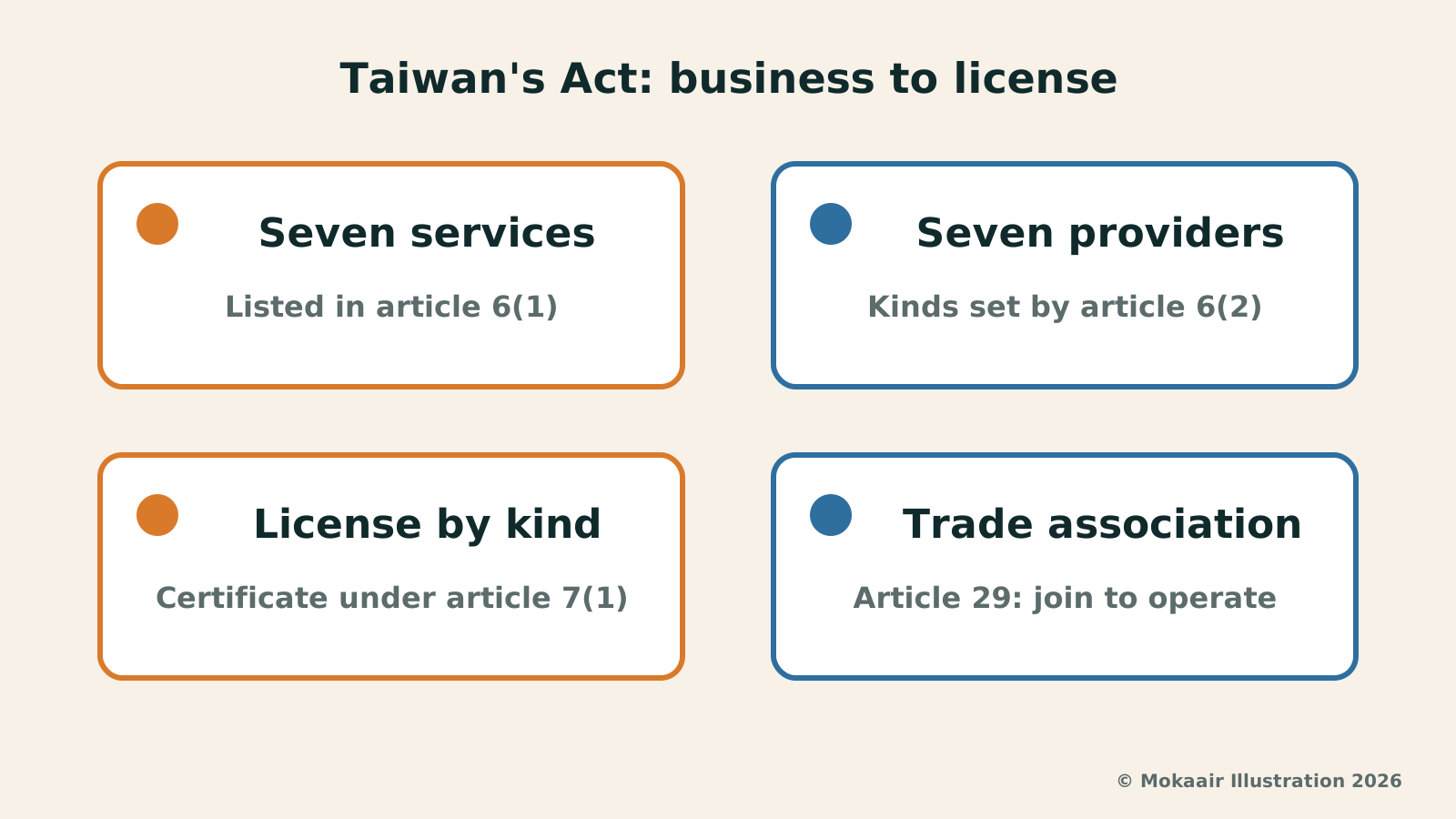
Article 6, paragraph 2 then fixes the kinds of provider by business, seven in all: virtual asset exchange provider, trading platform provider, transfer provider, custodian, underwriter, lending provider, and other virtual asset service providers. Every one of the formal names in the Act carries the words 虛擬資產, virtual asset, while the press release uses the short forms with that prefix dropped. Article 7, paragraph 1 requires a provider to obtain the competent authority's license and be issued a license certificate separately for each of these kinds before it may do business — the license is granted kind by kind.
Article 7, paragraph 3 requires an offshore virtual asset service provider that sets up a branch within the territory of Taiwan to be licensed by the competent authority and issued a license certificate, and paragraph 4 lets a financial institution carry the business on concurrently with the competent authority's license. Article 9 limits the organizational form to a company limited by shares and article 10, paragraph 1 requires the provider's name to state the words 虛擬資產; each of those two articles carries its own proviso. Article 29, paragraph 1 reads: "A virtual asset service provider may not do business unless it joins the trade association." The minimum capital and the operating bond in article 11 are to be set by the competent authority.
Stablecoins: one license, full reserve assets, no interest
Article 3, subparagraph 6 defines a stablecoin as "a virtual asset that represents a link to the value of a single fiat currency or of several, so as to keep its own value stable". Article 34, paragraph 1 provides that "to issue a stablecoin in Taiwan, the issuer shall apply to the competent authority for a license", and paragraph 2 that "before granting the license in the preceding paragraph, the competent authority shall consult the Central Bank and obtain its consent" — one license, granted by the FSC, which may not be granted until the Central Bank of the Republic of China (Taiwan) has consented, rather than one license from each of the two.
Article 36, paragraph 1 provides that a stablecoin issuer shall establish and maintain full reserve assets, held at a financial institution within the country and kept separate and independent from its own property, and that apart from the reserve deposited under paragraph 2 they shall all be placed in trust with a financial institution for safekeeping and periodically audited. That proviso is the part to watch — what is placed in trust is all of the reserve assets once the deposited reserve is taken out, not a hundred percent of them. The "certain amount" and the deposit ratio in paragraph 2 are to be set by the Central Bank in consultation with the competent authority, and the Act states no figures.
Article 37 requires an issuer to issue and redeem at face value and states expressly that "in respect of the stablecoin it issues, it may not pay interest or a return in any form"; it may not refuse a holder's application for redemption either, except where another law or the competent authority provides otherwise. Article 38 provides that where an issuer goes bankrupt the reserve assets do not form part of its bankruptcy estate, and that stablecoin holders have a priority right to be repaid out of those reserve assets.
The Act does not shut out stablecoins issued outside the country across the board. Article 35 provides that where a service provider offers any of the services in article 6, paragraph 1 and a stablecoin is involved, then unless the competent authority provides otherwise it must make sure the stablecoin has been licensed for issuance under article 34, paragraph 1, or has been approved for trading on application to the competent authority, before it may offer the service; the procedure and conditions for approval to trade are to be set separately by the competent authority in consultation with the Central Bank. The Act does not list which stablecoins may be traded in Taiwan.
Before the Act starts: what applies now is the anti-money laundering registration system
Before this Act comes into force, what Taiwan has in force is the anti-money laundering registration system. The page for these operators on the site of the FSC's Securities and Futures Bureau states, in its English version: "In accordance with Article 6, paragraph 1 of the Money Laundering Control Act, any enterprise or person providing virtual asset services must complete anti-money laundering (AML) registration with the central competent authority before offering such services. Those who have not completed AML registration are prohibited from providing virtual asset services, and anyone who does so without registration is subject to criminal liability of up to two years' imprisonment." The Chinese-language page lists operators in three groups, and in the version marked as updated on September 3, 2026 there were 10 that had completed registration, 1 that had itself applied to have its registration revoked, and 18 operators that had earlier completed an AML compliance statement but had not completed registration.
What follows is an example the editors made up, not a test. Suppose someone has assets sitting on a local platform, sees the news of the third reading, and takes it that they will have to move to another platform next month: on the text of the Act, no commencement date has been announced, and what article 55 gives is a transition for existing operators that have completed anti-money laundering registration, not an immediate cut-off. What can be done is to go to that Securities and Futures Bureau page, check which of the three groups the operator being used is listed in, and note the date the page was updated. This site neither compares operators nor recommends any.
Once the Act is in force, a few of its provisions matter more than the rest to an ordinary user: article 18 requires a provider to keep the assets it holds for customers separate and independent from its own property, and provides that on bankruptcy those customer assets do not form part of its bankruptcy estate; article 19 requires the fiat currency customers leave with the provider to be placed in trust or covered by a bank's full performance guarantee; article 20 provides that a provider may not refuse a customer's withdrawal or transfer out of their assets, although it may suspend transactions that are suspected to be unlawful or plainly abnormal. On penalties, a breach of article 42, paragraph 1 or paragraph 4 on misrepresentation and fraud and on manipulation carries, under article 47, paragraph 1, three to ten years' imprisonment and may carry an additional fine of NT$10 million to NT$200 million; carrying on virtual asset business without a license, an offshore operator setting up a branch in the country without a license, or issuing a stablecoin without a license carries up to seven years' imprisonment under article 48 and may carry an additional fine of up to NT$100 million.
Frequently asked questions
Is the Virtual Asset Service Act in force yet?
Not as of this article's check date, September 16, 2026. Article 56 reads that the date on which the Act comes into force is to be set by the Executive Yuan; the FSC's Laws and Regulations Retrieving System marks all or some of the articles published this time as not yet in force, and the Laws & Regulations Database reads that some or all of the articles of this regulation are not yet effective and that the last effective date is undecided. When the commencement date will be announced, and on what conditions, is not explained in the official documents.
Will the platform I use now stop working straight away?
The Act does not say so. What article 55, paragraph 1 gives existing operators is 12 months after the Act comes into force to apply for a license and 21 months to obtain the license certificate, counted from the commencement date; no commencement date has been announced, so neither period has begun. Whether an existing operator may carry on business as usual during the transition, what is to happen to customers' assets, and how an operator that has not obtained the license certificate by the deadline is to wind its service down are none of them spelled out in the Act.
What calendar dates do the 12 months and the 21 months work out to?
They cannot be worked out at the moment. Both periods run from after the Act comes into force, and the commencement date is to be set separately by the Executive Yuan and had not been announced as of this article's check date, so there is no expiry date to write down. The three-month extension in article 55, paragraph 2 also hangs only on the 21-month period for obtaining the license certificate; the Act does not hang it on the deadline for applying for a license.
Whose consent is needed to issue a stablecoin in Taiwan?
Article 34, paragraph 1 has the issuer apply to the competent authority for a license, and paragraph 2 requires the competent authority to consult the Central Bank and obtain its consent before granting that license. So it is one license granted by the FSC, which cannot be granted until the Central Bank has consented, rather than one license from each of the two. An issuer must be a company limited by shares, and its minimum paid-in capital is to be set by the competent authority; the Act states no amount.
How do I check an operator's current status?
What can be checked at the moment is the list kept under the anti-money laundering registration system, not a list of licenses under this Act, because no list of licenses under this Act exists before it comes into force. The Chinese-language version of the page "Enterprises or Persons Providing Virtual Asset Services" on the site of the FSC's Securities and Futures Bureau lists operators in three groups: those that have completed anti-money laundering registration, those that have themselves applied to have their registration revoked, and those that have not completed registration. The update date shown on that version is September 3, 2026. The lists change with every update, so note the update date as you read them.
What does a stablecoin issuer have to disclose?
Article 41, paragraph 1 lists six kinds of information to be disclosed: the issuance disclosure document; the reserve-asset management policy and the stablecoin redemption policy; the outstanding balance of stablecoins in circulation; the composition and value of the reserve assets and the results of the periodic audit under article 36, paragraph 1; the external audit report on the reserve assets; and any other information designated by the competent authority. The regulations on how often and in what manner to disclose are to be set by the competent authority in consultation with the Central Bank.
Does the Act have anything to say about my own use of an offshore platform?
The Act has no provision on an individual's use of an offshore platform. The range of article 6, paragraph 1 is the business of providing services to others within Taiwan, and what article 7, paragraph 3 governs is an offshore provider setting up a branch in the country. What the Act does not say cannot be inferred, and nor can it be read the other way round as official confirmation that such use is freely permitted.
Are non-fungible tokens covered by the Act as well?
Article 3, subparagraph 1 excludes from the definition of a virtual asset non-fungible tokens whose represented value is not replaceable, and also excludes digital representations of the New Taiwan dollar, foreign currencies, the currencies issued in mainland China, Hong Kong or Macau, securities, and financial assets issued under other laws. The Act does not say who regulates those instead, which falls under what the official documents do not explain.
2026 Crypto News Roundup: Key Developments in Regulation, Technology and Industry2026 Crypto News Roundup: Key Developments in Regulation, Technology and IndustryThis site's 2026 crypto news explainers, in six jurisdictions — Taiwan, the US, the UK, the EU, Japan, South Korea: the Virtual Asset Service Act, the proposed GENIUS Act rules, the joint SEC–CFTC interpretation and the SEC's own proposal, the end of MiCA's transitional period and its link to the payment rules, the FCA's perimeter guidance, Japan's FSA reports and South Korea's manipulation referrals. Regulation, technology and industry only, no prices, with official sources and a check date.Read the full article
EU MiCA Transitional Period Ends July 1: Grandfathering Differs by Country, a Pending Application Is Not an ExtensionEU MiCA Transitional Period Ends July 1: Grandfathering Differs by Country, a Pending Application Is Not an ExtensionThe transitional period in Article 143(3) of the EU's MiCA expired on July 1, 2026. Drawing on ESMA's public statement of June 23, 2026, its statement of April 17, 2026, the list of grandfathering periods decided by each Member State and the official question and answer ESMA_QA_2220, this article sets out what ended, why the grandfathering periods differ from one Member State to another, why a pending application is not an extension, and what ESMA said to providers and to clients.Read the full article
Lifestyle
Brazil's Petrobras tests Cardano blockchain to track claims about cleaner jet fuel and diesel
According to CoinDesk, Brazil's state-owned energy company Petrobras is testing the Cardano blockchain in two research projects: one to stop the same emissions cut from sustainable aviation fuel being counted twice, the other to record the history of its partly renewable Diesel R. Both are still research work, with no timeline for wider use.
Lifestyle
Cboe and S&P Dow Jones Indices extend their S&P 500 options deal to 2051 and leave the door open to tokenized options
According to CoinDesk, exchange operator Cboe and index provider S&P Dow Jones Indices have extended Cboe's exclusive right to offer S&P 500 options by 25 years, to 2051. The deal says they may explore blockchain-based 'tokenized' options, but no product, timeline or details were announced. Here is what that means and what it does not.
Lifestyle
SEC Charges Two Groups of Entities Allegedly Behind Crypto Frauds Using WhatsApp and "AI Trading" Claims
On September 29, 2026, the US SEC charged two groups of entities, Cryptoaiml and TSAI, alleging they defrauded hundreds of individual investors, many in the US. The SEC says they falsely claimed to be SEC-regulated and used AI trading signals and bots as bait in schemes totaling at least $15 million. Here is what the SEC alleges and the warning signs readers can watch for.
Lifestyle
Ethereum's Glamsterdam upgrade will go live on the Sepolia test network on October 6; no mainnet date yet
The Ethereum Foundation says its Glamsterdam upgrade, which changes how blocks are built and how fees are counted, is scheduled for the Sepolia test network on October 6, 2026. Test-network node operators and app developers need to prepare. No mainnet date is set, and the Foundation says ordinary users and ETH holders need not act.
Articles that cite this one
- Taiwan's Central Bank on Stablecoins, Deposit Tokens and CBDC: Layers Can Coexist, No Urgency Yet for Retail CBDC
- FinCEN and OFAC's Joint AML and Sanctions Compliance Proposal for Stablecoin Issuers, Not Yet in Effect
- SEC Proposes Regulation Crypto Assets: Two Offering Exemptions and a Safe Harbor, Not Yet Adopted
- Joint SEC and CFTC Interpretation: Five Categories of Crypto Assets, Effective the Day It Was Published
- NCUA's Proposed Stablecoin Standards: Credit Unions Could Issue Only Through a Subsidiary; Stablecoins Get No Share Insurance
- EU MiCA Transitional Period Ends July 1: Grandfathering Differs by Country, a Pending Application Is Not an Extension
- Japan's Financial System Council Report Recommends Moving Crypto-Assets to the FIEA: The Related Act Has Been Enacted, No Commencement Date Seen
- Japan's FSA Publishes a Crypto-Asset Cybersecurity Research Paper: One Class of Outflow Was Not Key Theft but Tampering Before Signing
Latest travel guides

GuideTokyo
Where to Stay in Tokyo: Comparing Shinjuku, Ueno, Tokyo Station, Shibuya, Asakusa, Ikebukuro, and Ginza, Plus Airport Access, Accommodation Tax, and Luggage Delivery
Where should you stay in Tokyo? Compare Shinjuku, Ueno, Tokyo Station, Shibuya, Asakusa, Ikebukuro, and Ginza by the same criteria: access from Narita and Haneda, transit routes, nearby attractions, neighborhood character, and who each area suits. Includes a comparison table, a Yamanote Line diagram, Tokyo’s accommodation tax as verified in 2026/9 (changing to 3% in 2027/4), and Airport TA-Q-BIN luggage shipping rules.
- Budget
- Hotels

GuideTokyo
How to Choose Tokyo Transit Passes: Are Suica, Welcome Suica, the Tokyo Subway Ticket, and the JR Pass Worth It?
On a first Tokyo trip, start with an IC card and pay per ride (Welcome Suica has no deposit and is valid for 28 days). If you take four or more subway rides in a day, add a 72-hour Tokyo Subway Ticket for 2,000 yen; a JR Pass is never worthwhile if you stay in Tokyo and do not go to Kansai. See what TOURIST PASMO, Suica on iPhone, and the Tokyo Metro day pass do and do not cover, with a decision chart. Prices verified in September 2026.
- Transport
- Budget

GuideTokyo
Tokyo Disneyland and DisneySea Guide: Ticket Prices, Fantasy Springs, Disney Premier Access (DPA), Standby Pass, and Which Park to Choose for Your First Visit
Tokyo Disney one-day Passport prices vary: most weekdays in 9/2026 cost ¥9,900 and weekends ¥10,900. At 14:00 daily, tickets go on sale for the same date two months later. Free Priority Pass is no longer on the official service list; only paid Disney Premier Access (¥1,000–3,500 per person per use) shortens waits. Covers hours, the 25th anniversary, Standby Pass, Entry Request, Fantasy Springs access and first-visit park choice; checked on the official site in 9/2026.
- Itineraries
- Family
Sources
- FSC: The plenary session of the Legislative Yuan passes the Virtual Asset Service Act on third reading · Checked:
- FSC Laws and Regulations Retrieving System: Virtual Asset Service Act (text of the regulation) · Checked:
- Laws & Regulations Database of the Republic of China (Taiwan): Virtual Asset Service Act (all articles) · Checked:
- FSC Securities and Futures Bureau: Enterprises or Persons Providing Virtual Asset Services · Checked: