Lifestyle
Japan's Financial System Council Report Recommends Moving Crypto-Assets to the FIEA: The Related Act Has Been Enacted, No Commencement Date Seen
On February 16, 2026 Japan's FSA published on its English website a Provisional Translation of the report of the Financial System Council's Working Group on Crypto-asset Systems; the report itself is dated December 10, 2025. From the FSA's announcement page, the full report and its reference material: why it recommends moving crypto-assets from the Payment Services Act to the Financial Instruments and Exchange Act, and how the related bill has progressed since.
About 16 min read
On February 16, 2026 Japan's Financial Services Agency (FSA) published on its English website a Provisional Translation of the report of the Financial System Council's Working Group on Crypto-asset Systems. This article uses the report's own English term, crypto-assets, which the FSA's Japanese pages write as 暗号資産. The announcement page states that the working group, chaired by Professor MORISHITA Tetsuo of the Faculty of Law at Sophia University, has compiled and published a report. The English cover page is marked Provisional Translation and carries the report's own date, December 10, 2025.
This article was verified on September 17, 2026, and what it reads is that English announcement page, the Provisional Translation of the full report (62 pages), the report's reference material (6 pages) and the FSA's Japanese-language page 「国会提出法案等」, which lists bills submitted to the Diet. On the day of checking the announcement page also carried the line Updated on August 3, 2026, and the server reported the same day as the last-modified time of the full report file. We have tested nothing ourselves, and this article offers neither investment nor legal advice.
Who wrote this report: three dates that must not be run together
The Financial System Council is one of the FSA's advisory councils. The report's background section sets out the sequence. On April 10, 2025 the FSA published its findings in a discussion paper reviewing the regulatory framework for crypto-assets. On June 25, 2025, at the joint session of the 55th General Meeting of the Financial System Council and the 43rd Meeting of the Sectional Committee on the Financial System, the Minister of State for Financial Services asked the Council to review an appropriate regulatory framework that balances user protection with the promotion of innovation. The Council set up this working group, which the report says held six meetings beginning in July 2025.
Keep the three dates apart. The report itself is dated December 10, 2025, and the English announcement page states that the Japanese version was published that day. The Provisional Translation was published on February 16, 2026, which is also the event date this site puts in the article's address. The August 3, 2026 that the announcement page carries separately is the day that English page was updated.
The nature of the report needs saying plainly as well: these are a working group's recommendations, not a law and not a Cabinet Office ordinance, so every "should" and every requirement below is a direction the report recommends. The report's concluding section limits its own reach. This review focuses primarily on transactions conducted through domestic crypto-asset exchange service providers, abbreviated CASPs in the English version, and covers only a portion of global crypto-asset trading.
Why change it: the report lists five pressing issues
The report begins with the framework already in place. In 2016, responding to international demands for stronger anti-money-laundering and counter-terrorist-financing measures, and after one exchange service provider had failed, Japan amended the Payment Services Act (PSA; in Japanese, 資金決済に関する法律) and related laws, introducing a registration system and a user protection framework. The 2019 amendment required CASPs, in principle, to manage users' crypto-assets in cold wallets, and the 2022 amendment was to the Act on Prevention of Transfer of Criminal Proceeds (APTCP), which introduced the so-called Travel Rule.
The reason for changing it is that users already treat crypto-assets as something to invest in. The figures the report cites: the number of accounts opened with domestic CASPs exceeds 13 million (as of October 2025), and more than 80 percent of individual accounts hold assets of less than JPY 0.1 million. Among people with investment experience, the proportion holding crypto-assets is 7.3 percent, which comes from an FSA survey dated July 5, 2024; the predominant reason for holding them (86.6 percent) is the expectation of long-term price appreciation, and the footnote on that figure points back to a survey by an industry association the report lists, not to FSA statistics.
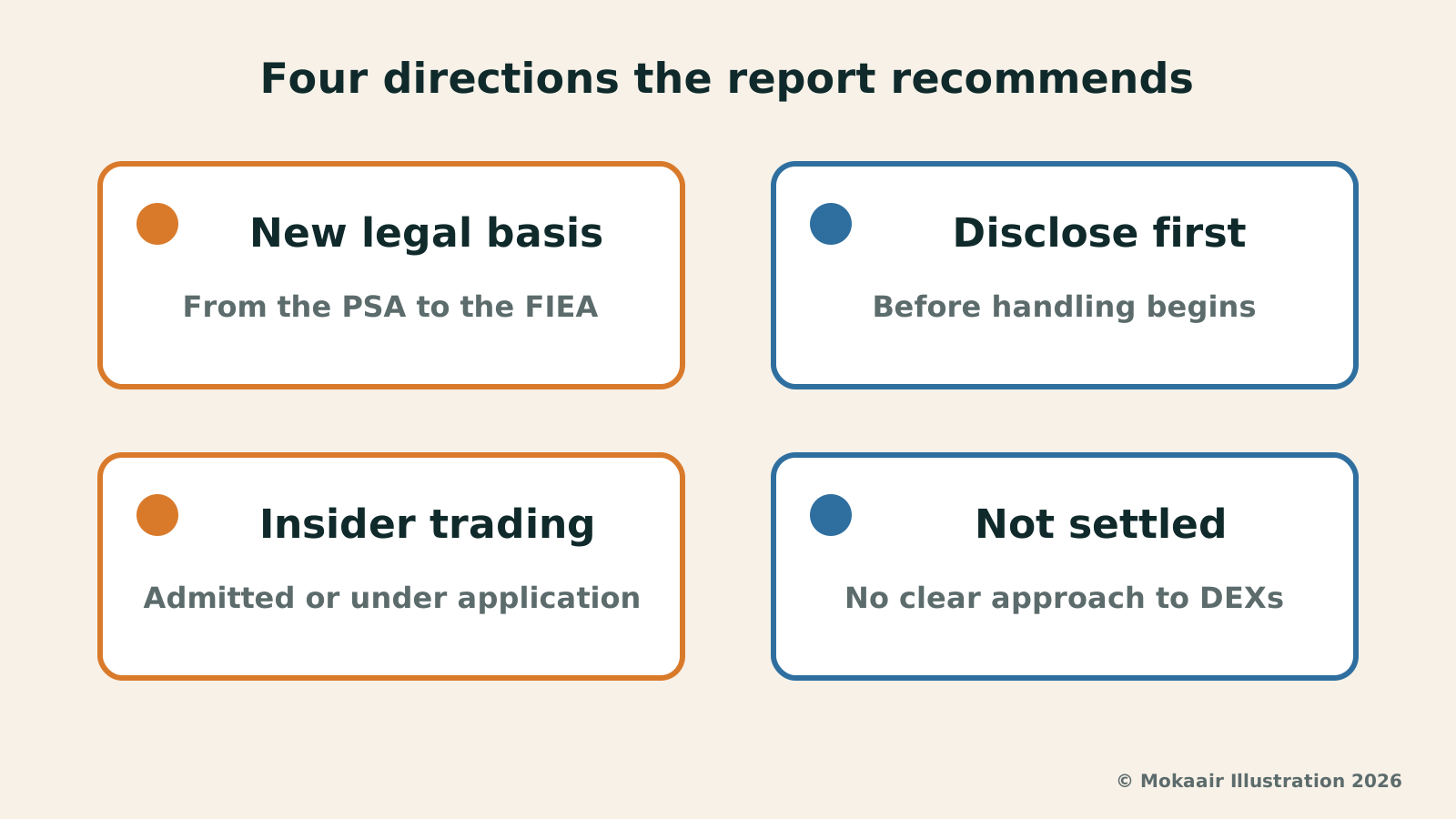
On the other side are the complaints. The report says the FSA's Financial Services User Consultation Office receives, on average, more than 350 crypto-asset-related inquiries and complaints per month, the majority of them concerning fraudulent investment solicitations or transactions. From this the report lists five pressing issues: enhancing disclosure; ensuring appropriate transactions and addressing unregistered operators; addressing inappropriate conduct in investment management; ensuring fairness in price formation and trading; and strengthening cybersecurity. The report also states of its own accord that such regulatory revisions should not be interpreted as an official endorsement of investment in crypto-assets. Its central recommendation is to change the legal basis: to move crypto-assets from the PSA to the Financial Instruments and Exchange Act (FIEA), to position them as a regulated instrument distinct from securities, and to remove the crypto-asset-related provisions from the PSA so that the two regimes do not overlap. On the regulation of operators, the report recommends that operators engaged in the purchase and sale of crypto-assets should, in principle, be subject to regulations equivalent to those applicable to Type I Financial Instruments Business; the insider trading rules would apply to crypto-assets admitted or under application for admission to trading on domestic CASPs, irrespective of trading venue.
| Item | Current | Direction the report recommends |
|---|---|---|
| Minimum capital | 10 million yen | 50 million yen |
| Prohibited conduct | Under self-regulation | Raised to laws and regulations |
| Liability reserves | — | Added |
| Penalty for unregistered business | Imprisonment for not more than 3 years | Imprisonment for not more than 5 years |
| Penalty for unregistered solicitation | — | Imprisonment for not more than 1 year |
| Certified self-regulatory body | JVCEA | JVCEA, organizational frameworks to be strengthened |
Three things an ordinary user would notice
The first is disclosure before a crypto-asset is first handled. The report recommends distinguishing three cases. Where an issuer sells a crypto-asset while raising funds through an offering, the issuer prepares and discloses the information, and a CASP handling the asset also publishes what the issuer prepared. Where an identifiable issuer is not raising funds and a CASP is to handle the asset, and where there is no identifiable issuer, the CASP prepares and discloses the information itself. The items to be disclosed include the features and functions of the crypto-asset, the total volume issued, the underlying technology, the rights and obligations attached to it and the associated risks; where there is an identifiable issuer, information about the issuer, the intended use of the funds raised and the content of the project are added. Exemptions include solicitations equivalent to a private placement (to 49 or fewer persons, or to qualified institutional investors only, with transfer restrictions imposed), offers provided free of charge, and distributions created automatically as a reward for mining or staking.
The second is a warning before a transfer out. The report recommends requiring CASPs, by laws and regulations, to warn of fraud risk and confirm the purpose of the transfer when a user transfers crypto-assets to an unhosted wallet or to a wallet operated by an unregistered operator, to conduct appropriate transaction monitoring, and to establish a cooling-off period or other deliberation period immediately after account opening and before a transfer to a newly designated wallet; the report does not say how long that period should be. The third is what happens with an unregistered operator: the report recommends allowing a court to issue an emergency injunction, giving the Securities and Exchange Surveillance Commission (SESC) the power to petition for it and to conduct criminal investigations for that purpose, and considering civil provisions under which such purchase contracts may be deemed void in certain cases.
What follows is an example designed by the editors, not something we tested. Suppose someone sees a token they have never heard of about to be handled by a platform in Japan. What they can read today is mostly the project's own white paper, and the report notes that white papers often contain unclear descriptions or discrepancies with the underlying code. Under the regime the report recommends, the issuer or the CASP would have to disclose the items above before handling begins, and material misstatements or omissions would carry criminal penalties, civil liability and an administrative monetary penalty.
Where the report deliberately gives no answer
Decentralized exchanges (DEXs) are the clearest case. The report states that a clear regulatory approach to DEXs has not yet been established and recommends continuing to examine proportionate regulatory frameworks that are technically aligned and distinct from those currently applied to CASPs, while watching regulatory developments in other jurisdictions. There is only one measure for now: the government and registered operators should fully inform users that trading through a DEX, or through an operator not registered in Japan, may expose them to unforeseeable losses. Figures are missing too. Where an issuer raises funds broadly from retail investors without a financial audit by an audit firm, the report recommends an investment cap along the lines of equity crowdfunding, but gives no amount for crypto-assets; for liability reserves it writes only "an appropriate level".
Banks and insurance companies are split in two. Allowing them to issue, purchase or sell crypto-assets themselves still requires careful consideration, for reasons including money laundering, the systems risk of managing crypto-assets, price volatility and the reputational risk if such risks materialize, and the possibility that some customers would trade without properly assessing the risks simply because a bank or an insurance company is offering the product; conducting investment management business themselves should remain prohibited. But provided that adequate risk management and governance frameworks are in place, the report takes the view that it may be appropriate to permit them to hold crypto-assets for their own investment purposes.
After the report: a related bill submitted and enacted in 2026
On the FSA's Japanese-language page 「国会提出法案等」, the section for the 221st session of the Diet lists 『金融商品取引法及び資金決済に関する法律の一部を改正する法律』, an act partially amending the Financial Instruments and Exchange Act and the Payment Services Act, with the line 「令和8年4月10日提出、令和8年7月15日成立」 in parentheses beneath it: submitted on April 10 of Reiwa 8 (2026) and enacted on July 15 of the same year. The page explains that this act establishes arrangements for, among other things, 「暗号資産」, sustainability disclosure and assurance, funding for start-ups and rules against unfair trading.
Enactment is not commencement. Checked against the four FSA pages this article cites, as of September 17, 2026 no commencement date for the crypto-asset provisions is to be found, and neither is any provision-by-provision comparison between the final text and the report's recommendations, which is why this article gives no promulgation date, no law number and no year and month of commencement. The penalty levels in the report are recommendations in the same way. A footnote records that under the current PSA, providing crypto-asset exchange services without registration is punishable by imprisonment for up to three years, a fine of up to three million yen, or both, and that under the FIEA conducting financial instruments business without registration is punishable by up to five years, a fine of up to five million yen, or both; it has also been suggested that the maximum term be raised to 10 years, which is a discussion the report records, not the final legislative outcome.
For readers in Taiwan there are two uses here. The first is to keep the three states apart: the report is a recommendation, the related act has been enacted, and a commencement date has not yet appeared on these four official pages. When you see the claim that Japan has already changed its law, it is fair to ask which of them it refers to. The second is the method of checking. All three files of the report hang off the FSA's English announcement page, and the bill's dates are on the Japanese 「国会提出法案等」 page. Taiwan's own rules and timetable have a separate article on this site, and this one draws no comparison between the two jurisdictions.
Frequently asked questions
Have the rules for buying and selling crypto in Japan already changed?
What this article describes is a recommendation report by a Council working group, not a law already in force. The FSA's 「国会提出法案等」 page states that the related bill was submitted on April 10 of Reiwa 8 (2026) and enacted on July 15 of the same year, but enactment is not commencement; checked against the four FSA pages this article cites, as of September 17, 2026 no commencement date for the crypto-asset provisions is to be found.
What are the three dates in this story?
The report itself is dated December 10, 2025, and the English announcement page states that the Japanese version was published that day. The Provisional Translation was published on the English website on February 16, 2026. The August 3, 2026 that the announcement page carries separately is the day that English page was updated, and it is also the last-modified time the server reports for the full report file. The three dates refer to three different things.
Will non-fungible tokens and stablecoins be brought in as well?
The report recommends keeping the current definition of crypto-assets. For so-called NFTs, which fall outside the definition of crypto-assets under the Payment Services Act, the report takes the view that they often involve the provision of goods or services in practice and vary widely in nature, so whether to bring them all under financial regulation needs careful consideration. So-called stablecoins of the digital-money type are issued at a price linked to a fiat currency and redeemable at the issue price or an equivalent amount; the report says they are not currently generally regarded as investment targets, and they are at present regulated under the Payment Services Act as electronic payment instruments.
Does moving crypto-assets to the FIEA amount to official endorsement of investing in them?
The report denies that reading itself. Its section on the purpose of the revisions states that such regulatory revisions should not be interpreted as an official endorsement of investment in crypto-assets; its premise is that users make reasonable trading decisions after fully understanding the risks and the characteristics of the products, and trade within the risk they can bear. The report also recommends prohibiting CASPs from making representations that impede proper risk recognition or encourage speculative trading, for instance by unduly emphasizing past performance or future projections.
I am in Taiwan and use a Japanese platform. Does this report reach me?
The report says this regulatory review focuses primarily on transactions conducted through domestic crypto-asset exchange service providers, and states of its own accord that it covers only a portion of global crypto-asset trading. It does not say when users outside Japan would see these changes reach their own accounts. The sentence with the most bearing on ordinary users is this one: the government and registered operators should fully inform users that trading through a decentralized exchange, or through an operator not registered in Japan, may expose them to unforeseeable losses.
How can I check the current state of play on the official pages myself?
The FSA's English announcement page carries three files: the Provisional Translation of the full report, the report's overview and the reference material. The page prints both the publication date and the update date. Later legislative progress is on the FSA's Japanese-language page for bills submitted to the Diet, which lists, by session of the Diet, the name of each bill, the dates on which it was submitted and enacted, and attached documents such as the outline and the summary of the bill.
2026 Crypto News Roundup: Key Developments in Regulation, Technology and Industry2026 Crypto News Roundup: Key Developments in Regulation, Technology and IndustryThis site's 2026 crypto news explainers, in six jurisdictions — Taiwan, the US, the UK, the EU, Japan, South Korea: the Virtual Asset Service Act, the proposed GENIUS Act rules, the joint SEC–CFTC interpretation and the SEC's own proposal, the end of MiCA's transitional period and its link to the payment rules, the FCA's perimeter guidance, Japan's FSA reports and South Korea's manipulation referrals. Regulation, technology and industry only, no prices, with official sources and a check date.Read the full article
Taiwan's Virtual Asset Service Act Clears Third Reading: Seven Kinds of Provider, Stablecoin Licensing, No Commencement Date YetTaiwan's Virtual Asset Service Act Clears Third Reading: Seven Kinds of Provider, Stablecoin Licensing, No Commencement Date YetOn June 30, 2026 Taiwan's Legislative Yuan passed the Virtual Asset Service Act (虛擬資產服務法) on third reading, and its 56 articles were promulgated on July 22, 2026. Working from the Financial Supervisory Commission's press release and two official legal databases, this article sets out the seven kinds of virtual asset service provider, licensing kind by kind, the reserve-asset rules for stablecoins, and why the 12- and 21-month transition periods in article 55 have not started running.Read the full article
Lifestyle
Japan's FSA Publishes a Crypto-Asset Cybersecurity Research Paper: One Class of Outflow Was Not Key Theft but Tampering Before Signing
On July 23, 2026 Japan's Financial Services Agency published a commissioned research paper. The cover is dated June 30, 2026, and the FSA states plainly that the paper does not represent its own views. Working from the FSA's publication page, the paper's English version and the FSA's own policy approaches, this article explains which class of outflow the paper re-attributes to the systems before signing, what obligations this publication does not add, and why the four dates cannot be swapped.
Lifestyle
Brazil's Petrobras tests Cardano blockchain to track claims about cleaner jet fuel and diesel
According to CoinDesk, Brazil's state-owned energy company Petrobras is testing the Cardano blockchain in two research projects: one to stop the same emissions cut from sustainable aviation fuel being counted twice, the other to record the history of its partly renewable Diesel R. Both are still research work, with no timeline for wider use.
Lifestyle
Cboe and S&P Dow Jones Indices extend their S&P 500 options deal to 2051 and leave the door open to tokenized options
According to CoinDesk, exchange operator Cboe and index provider S&P Dow Jones Indices have extended Cboe's exclusive right to offer S&P 500 options by 25 years, to 2051. The deal says they may explore blockchain-based 'tokenized' options, but no product, timeline or details were announced. Here is what that means and what it does not.
Lifestyle
SEC Charges Two Groups of Entities Allegedly Behind Crypto Frauds Using WhatsApp and "AI Trading" Claims
On September 29, 2026, the US SEC charged two groups of entities, Cryptoaiml and TSAI, alleging they defrauded hundreds of individual investors, many in the US. The SEC says they falsely claimed to be SEC-regulated and used AI trading signals and bots as bait in schemes totaling at least $15 million. Here is what the SEC alleges and the warning signs readers can watch for.
Articles that cite this one
Latest travel guides

GuideTokyo
Where to Stay in Tokyo: Comparing Shinjuku, Ueno, Tokyo Station, Shibuya, Asakusa, Ikebukuro, and Ginza, Plus Airport Access, Accommodation Tax, and Luggage Delivery
Where should you stay in Tokyo? Compare Shinjuku, Ueno, Tokyo Station, Shibuya, Asakusa, Ikebukuro, and Ginza by the same criteria: access from Narita and Haneda, transit routes, nearby attractions, neighborhood character, and who each area suits. Includes a comparison table, a Yamanote Line diagram, Tokyo’s accommodation tax as verified in 2026/9 (changing to 3% in 2027/4), and Airport TA-Q-BIN luggage shipping rules.
- Budget
- Hotels

GuideTokyo
How to Choose Tokyo Transit Passes: Are Suica, Welcome Suica, the Tokyo Subway Ticket, and the JR Pass Worth It?
On a first Tokyo trip, start with an IC card and pay per ride (Welcome Suica has no deposit and is valid for 28 days). If you take four or more subway rides in a day, add a 72-hour Tokyo Subway Ticket for 2,000 yen; a JR Pass is never worthwhile if you stay in Tokyo and do not go to Kansai. See what TOURIST PASMO, Suica on iPhone, and the Tokyo Metro day pass do and do not cover, with a decision chart. Prices verified in September 2026.
- Transport
- Budget

GuideTokyo
Tokyo Disneyland and DisneySea Guide: Ticket Prices, Fantasy Springs, Disney Premier Access (DPA), Standby Pass, and Which Park to Choose for Your First Visit
Tokyo Disney one-day Passport prices vary: most weekdays in 9/2026 cost ¥9,900 and weekends ¥10,900. At 14:00 daily, tickets go on sale for the same date two months later. Free Priority Pass is no longer on the official service list; only paid Disney Premier Access (¥1,000–3,500 per person per use) shortens waits. Covers hours, the 25th anniversary, Standby Pass, Entry Request, Fantasy Springs access and first-visit park choice; checked on the official site in 9/2026.
- Itineraries
- Family
Sources
- FSA: Publication of the Report by the Working Group on Crypto-asset Systems of the Financial System Council · Checked:
- Report by the Working Group on Crypto-asset Systems of the Financial System Council, full text (Provisional Translation, 62 pages) · Checked:
- Report by the Working Group on Crypto-asset Systems of the Financial System Council, reference material (Provisional Translation, 6 pages) · Checked:
- FSA: 国会提出法案等 (bills submitted to the Diet) · Checked: