Lifestyle
Japan's FSA Publishes a Crypto-Asset Cybersecurity Research Paper: One Class of Outflow Was Not Key Theft but Tampering Before Signing
On July 23, 2026 Japan's Financial Services Agency published a commissioned research paper. The cover is dated June 30, 2026, and the FSA states plainly that the paper does not represent its own views. Working from the FSA's publication page, the paper's English version and the FSA's own policy approaches, this article explains which class of outflow the paper re-attributes to the systems before signing, what obligations this publication does not add, and why the four dates cannot be swapped.
About 18 min read
On July 23, 2026, Japan's Financial Services Agency (金融庁, the FSA) published a research paper on cybersecurity issues and countermeasures in crypto-asset-related businesses, on the innovation policy page of its website. The date printed on the paper's cover is June 30, 2026, and the author named on it is Deloitte Tohmatsu LLC (合同会社デロイトトーマツ). On the same day, on a separate announcement page, the FSA also added the English version of the cybersecurity policy approaches it had itself set out on April 3, 2026.
This article was fact-checked on September 17, 2026, against the Japanese version of that policy page, the English PDF of the research paper, the FSA's announcement page of April 3, and the English policy approaches filed as Annex 3 on that page. One thing has to be settled first: this paper is not the FSA's view. On the publication page the FSA states plainly 「※上記リサーチペーパーは、当庁の見解、意見等を示すものではありません。」 — the research paper above does not represent the views or opinions of the agency — and page 2 of the paper says its contents do not represent the official views of the Financial Services Agency and that any errors in it are the sole responsibility of the contractor. So this article writes “the report says” throughout for the paper, and “the FSA says” only for the policy approaches; we have tested nothing ourselves, and this is not investment or legal advice.
What was published on July 23: one commissioned research paper
The paper was published in the latest-information list on that policy page, as the first item under 2026, with three PDFs beneath it — the Japanese paper, the English paper and a Japanese summary — and the disclaimer line printed immediately below the links. On the day this article was checked the page was marked 「令和8年7月23日更新」, that is, updated July 23, 2026. That is the page's update date: update the page again and the date changes.
The paper's own disclaimer is worth reading too. Page 2 says any errors in the report are the sole responsibility of the contractor, and that its case studies were compiled for research purposes from information published about each case and do not indicate the attribution of responsibility or any legal assessment. The acknowledgments on the same page also record advice and comments from officials of the Financial Services Agency — which is exactly where the line between commissioned research and an official view sits. The document the FSA signs itself is the policy approaches, and it opens with the lines April 3, 2026 and Financial Services Agency.
Four dates, kept apart: draft, adoption, cover, publication
The policy approaches did not first appear on July 23. The FSA's announcement page of April 3, 2026 says the draft was put out for public comment from 令和8年2月10日 to 令和8年3月11日, that is from February 10 to March 11, 2026, and that 「計18件のコメント」, 18 comments in all, were received; the FSA then made the necessary additions and corrections in the light of those comments before settling the document.
The head of that same page carries 「令和8年4月3日」 and 「令和8年7月23日更新」, and after Annex 1 and Annex 2 it says 「令和8年7月23日、以下の英語版を公表しました。」 — on July 23, 2026 the following English versions were published — and then lists Annex 3 and Annex 4. So the policy approaches were set out on April 3, 2026, July 23, 2026 is the date the English version was published, and the June 30, 2026 on the paper's cover is the date of the paper itself.
| Date | What happened that day | Where it is printed |
|---|---|---|
| February 10 to March 11, 2026 | Public comment on the draft; 18 comments received | The FSA's announcement page of April 3 |
| April 3, 2026 | The FSA sets out the policy approaches (Annex 1) | The date at the head of that same page |
| June 30, 2026 | The date printed on the research paper's cover | The cover of the paper's PDF |
| July 23, 2026 | The paper is published; the English policy approaches are added | The policy page's update date; the April 3 announcement page |
How the report re-reads the asset outflows of recent years
The paper's summary of findings says attacks on crypto-asset-related businesses have continued and grown in scale in recent years, and that the routes taken have become more varied, more sophisticated and more organized year by year. Attackers, the report says, are increasingly targeting not only systems themselves but also operational infrastructure, and the examples it gives are signing keys, wallets, access controls, CI/CD, cloud IAM/KMS and signing services. A signing key is the secret key defined in note 1 of the policy approaches: the key used for proving that a transaction was conducted by a person with the legitimate authority.
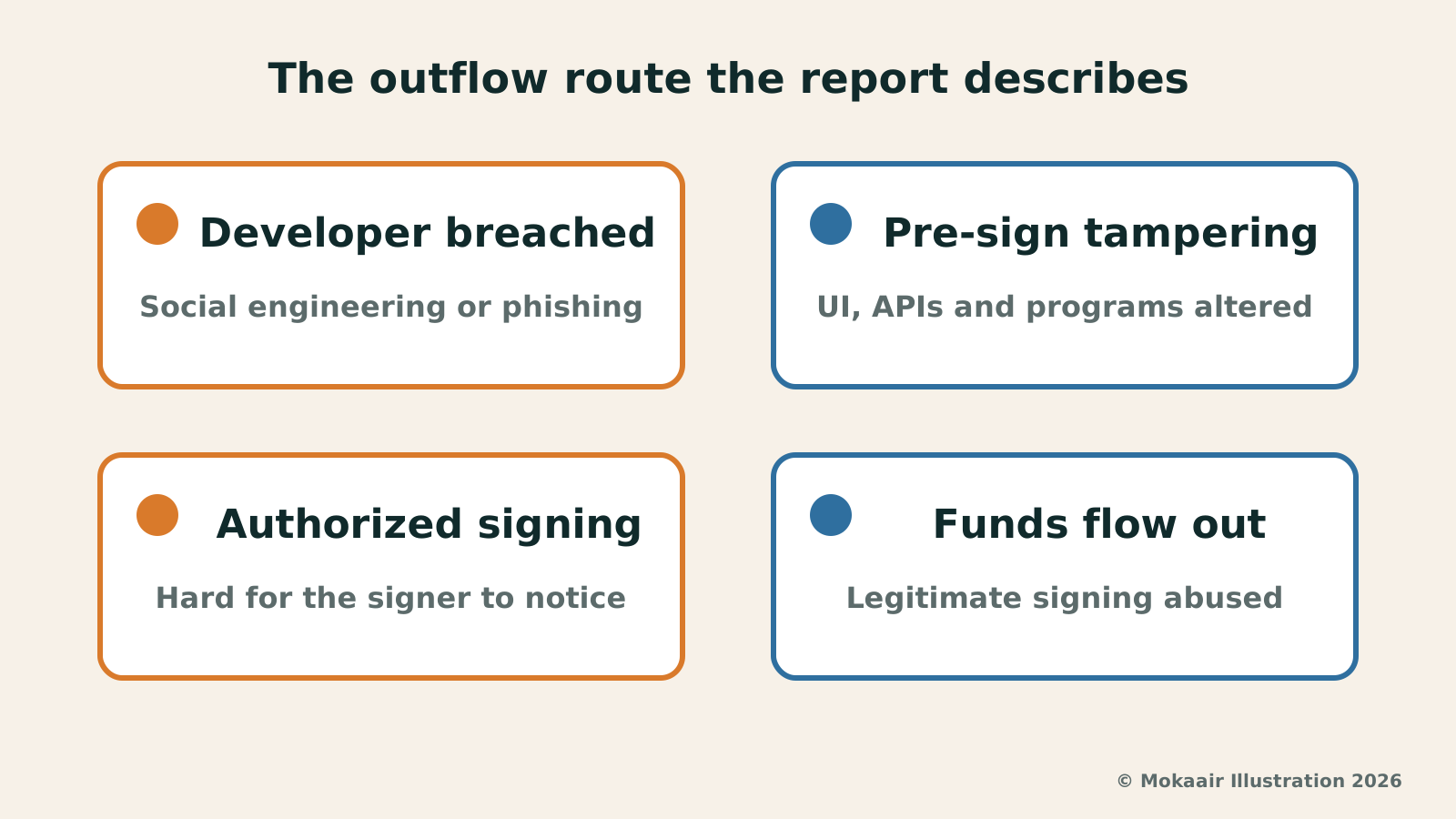
The most important sentence comes straight after it. Having analyzed recent incidents, the report says, it confirmed attacks that did not involve the theft of signing keys themselves, but instead tampered with components, for example the user interface, APIs, CI/CD, unsigned transaction generation logic and production programs, causing fund outflows by abusing legitimate signing processes. The lessons it draws from the case studies go on to say that the starting point of these incidents is the compromise of developer privileges through social engineering or phishing, or the deployment of malware, and that tampering with UIs and APIs made it difficult for signers to notice that the transaction is fraudulent, and thus they proceeded with signing.
The report also makes a structural judgement: crypto-asset-related services in the real world do not operate in a purely decentralized model, so a risk assessment has to encompass not only on-chain code and protocols but also off-chain components, operational controls, external dependencies and governance. Its case studies are numbered (1) to (10); by the report's own account it analyzed recent cases of crypto-asset-related services including DeFi, focusing on major attack methods that resulted in large losses, and the examples it gives are third-party compromises, smart contract vulnerabilities, flash loan attacks and malware attacks. This article does not name the businesses or protocols in those cases, and the loss amounts and incident counts the report cites all come from outside organizations, so they are not written here either.
The FSA's own policy approaches: cold wallets alone are not enough
Chapter 1 of the policy approaches says recent cases involving the outflow of cryptoassets are not necessarily caused by the theft of signing keys, and that various sophisticated methods have become prominent instead, including indirect attacks such as social engineering and intrusions into outsourcees, with cases where attackers spent time preparing in advance without the provider noticing. Against that background the document writes its key sentence: the safe management of cryptoassets cannot be ensured only by the use of cold wallets; rather, it is definitely necessary to strengthen the cybersecurity management systems of the entire supply chain, including outsourcees. The policy approaches also record that a case of an outflow of cryptoassets deposited by users had actually occurred in Japan, and in the passage on focused supervision they say that, in light of the large-scale outflow of cryptoassets in the past, the FSA has intensively monitored countermeasures against outflow risks and system risk management at individual providers.
The document divides its policy framework into self-help, mutual assistance and public assistance. On self-help, the FSA says that from Program Year 2026 onward it will request all cryptoasset exchange service providers (暗号資産交換業者) to conduct the cybersecurity self-assessment (CSSA) it has asked other types of financial institution to do, or otherwise hold dialogue with them as needed; note 10 explains that the CSSA is a self-assessment against questions consistent with the Guidelines on Cybersecurity for the Financial Sector, which lets a provider understand the position of its own organization within the industry and improve autonomously. The FSA also says it will endeavor to raise the levels of cybersecurity expected of these providers by revising the Guidelines for Supervision, and the directions it gives as examples are requirements for cybersecurity staffing, for external audits and for outsourcees. On public assistance, the FSA will keep requesting providers to take part in Delta Wall, the cross-industry exercise, aiming to achieve the participation of all service providers within three years, and within 2026 it will conduct threat-led penetration testing (TLPT) targeting several providers regarding their actual operational environments.
On mutual assistance, the body of the document says only “the self-regulatory organization”; JVCEA appears in note 11, which links to that association's organizational chart. The FSA also encourages providers to participate in information sharing organizations, such as JPCrypto-ISAC. None of this is a newly added statutory obligation, though: the policy approaches carry no penalty, on the Guidelines for Supervision they go no further than revising them and endeavoring to raise the levels, and they set out neither an amended provision nor an effective date; the participation of all providers within three years has no stated starting point; and the TLPT does not say which providers, only that the assessment results go to the targeted providers individually and the common issues extracted from them go back to the industry as a whole.
What this has to do with readers in Taiwan
The boundary first. The policy approaches are addressed to Japan's cryptoasset exchange service providers; neither document mentions Taiwan, and neither says Japan's rules apply to users or platforms in Taiwan. What a reader here can take away is the shape of the problem. The report says that where a provider's wallet system uses a third-party service, it remains important — even if signing keys are not entrusted to the third party — to confirm that the third party has appropriately established and operates controls such as cyberattack countermeasures, production-environment access management and program/change management. Separately, the report says a compromise at an outside service provider may spill over into the provider's own service or its users' assets.
The other layer is what people who hold their own wallets do every day. One page of the report is given to verifying transaction details at the time of signing and to blind signing: with a complex smart contract transaction a wallet may not be able to present the details in a human-readable format, and a hardware wallet is further constrained by screen size and UI design. So the report writes one sentence for the person doing the signing: when signing a complex transaction involving a smart contract, signers should understand not only the recipient address and transfer amount, but also what operation the transaction will perform, what privileges it will grant, and to whom.
The report records that on May 12, 2026 the Ethereum Foundation, together with wallet developers, security firms and other ecosystem participants, announced Clear Signing, and that ERC-7730, the core technology of Clear Signing, is a JSON-based descriptor standard. It warns in the same breath that the effect depends on whether the information displayed is correct, whether the descriptor is trustworthy and which model each wallet adopts; an error in a descriptor or a compromised distribution channel could produce a misleading display, so what it shows cannot be treated as unconditionally safe. One more boundary: this report is written for businesses and regulators, and the version checked for this article carries no self-protection checklist for ordinary users. The following is an example designed by the editors, not official advice: when a phone wallet raises an approval you cannot read, one question to start with is what this transaction is asking me to authorize, and to whom.
Frequently asked questions
Is this report the Japanese FSA's position?
No. On the policy page where the paper is published, the FSA states plainly that the research paper above does not represent the views or opinions of the agency, and the disclaimer on page 2 of the paper says its contents do not represent the official views of the Financial Services Agency and that any errors in it are the sole responsibility of the contractor. The acknowledgments on the same page also record advice and comments on the paper from officials of the Financial Services Agency. For the FSA's own position, the document to read is the policy approaches it set out on April 3, 2026 and whose English version it added on July 23 — that is the document the FSA signs.
Does this publication add obligations providers have to meet?
It adds no statutory obligation and no penalty. What the policy approaches say is that the FSA will endeavor to raise the level of cybersecurity the Guidelines for Supervision expect of cryptoasset exchange service providers; the words used are revising and endeavoring to raise the levels, and the document itself sets out no amended provision and no effective date. It does write down expectations with dates attached: all providers to conduct the cybersecurity self-assessment from Program Year 2026 onward, threat-led penetration testing at several providers within 2026, and the cross-industry exercise aiming for the participation of all providers within three years. So saying there is no timetable at all is not accurate; the accurate statement is that there is no new legal obligation and no penalty.
How does the report say the money was taken?
The report says that among the recent incidents it analyzed there was a class of attack that did not involve the theft of signing keys themselves, but instead tampered with components, for example the user interface, APIs, CI/CD, unsigned transaction generation logic and production programs, causing fund outflows by abusing legitimate signing processes. The lessons it draws from the case studies say the starting point of these incidents is the compromise of developer privileges through social engineering or phishing, or the deployment of malware; once the interfaces and APIs had been tampered with, signers found it difficult to notice that the transaction is fraudulent and proceeded with signing. This article does not describe the finer methods, and gives no indicators of compromise.
What is blind signing?
One page of the lessons learned from the case studies explains it: with complex smart contract transactions, such as a DeFi protocol or an update to a wallet-related contract, a wallet may not be able to present the transaction details in a human-readable format, and calldata or an EIP-712 message may appear only as a hexadecimal string or as data a person finds hard to read; hardware wallets, in particular, may have limited ability to clearly present complex transaction details due to constraints such as screen size and UI design. So the report writes that when signing a complex transaction involving a smart contract, signers should understand not only the recipient address and transfer amount, but also what operation the transaction will perform, what privileges it will grant, and to whom.
With Clear Signing in place, can what the wallet shows be trusted?
The report says plainly that it cannot. It records that on May 12, 2026 the Ethereum Foundation, together with wallet developers, security firms and other ecosystem participants, announced Clear Signing, and that ERC-7730, its core technology, is a JSON-based descriptor standard whose goal is that at the moment of signing what you see is what you sign. But the report also says the effect depends on whether the information displayed is correct, whether the descriptor is trustworthy, and which model each wallet adopts; an error in a descriptor or a compromised distribution channel could produce a misleading display, so the information presented through Clear Signing should not be treated as unconditionally safe and has to be used together with other measures. The report also does not say which wallets already support it, or when it will be widespread.
Does the report give ordinary users a self-protection checklist?
No. The report is addressed to crypto-asset-related businesses and regulators, and its recommendations are written as controls for the businesses; from a comparison with existing standards it extracted five priority areas: enhancement of third-party risk management; measures to prevent malicious code injection or program tampering; measures to prevent unauthorized transfers of crypto-assets; measures for smart contracts and DeFi; and leveraging external assessments. The version checked for this article has no section on what users should do, so do not read a list of controls written for businesses as the FSA's instructions to users.
Do Japan's requirements reach platforms in Taiwan, or my account?
Neither document says so. The policy approaches are addressed to Japan's cryptoasset exchange service providers, and neither the report nor the policy approaches mentions Taiwan or says Japan's rules apply to users or platforms in Taiwan. Taiwan's own regime is a separate matter, and the second link at the end of this article goes to an article about it.
How do I read the original documents myself?
The research paper sits in the latest-information list on the FSA's policy page about promoting innovation, with three PDFs beneath it — the Japanese paper, the English paper and a Japanese summary — and the disclaimer printed right below the links. The FSA's own policy approaches are on the announcement page of April 3, 2026: Annex 1 is the full Japanese text, Annex 2 the Japanese summary, and Annexes 3 and 4 are the English versions added on July 23, 2026. The update date shown on both pages moves whenever the page is updated again, so note the date on which you read it as well.
2026 Crypto News Roundup: Key Developments in Regulation, Technology and Industry2026 Crypto News Roundup: Key Developments in Regulation, Technology and IndustryThis site's 2026 crypto news explainers, in six jurisdictions — Taiwan, the US, the UK, the EU, Japan, South Korea: the Virtual Asset Service Act, the proposed GENIUS Act rules, the joint SEC–CFTC interpretation and the SEC's own proposal, the end of MiCA's transitional period and its link to the payment rules, the FCA's perimeter guidance, Japan's FSA reports and South Korea's manipulation referrals. Regulation, technology and industry only, no prices, with official sources and a check date.Read the full article
Taiwan's Virtual Asset Service Act Clears Third Reading: Seven Kinds of Provider, Stablecoin Licensing, No Commencement Date YetTaiwan's Virtual Asset Service Act Clears Third Reading: Seven Kinds of Provider, Stablecoin Licensing, No Commencement Date YetOn June 30, 2026 Taiwan's Legislative Yuan passed the Virtual Asset Service Act (虛擬資產服務法) on third reading, and its 56 articles were promulgated on July 22, 2026. Working from the Financial Supervisory Commission's press release and two official legal databases, this article sets out the seven kinds of virtual asset service provider, licensing kind by kind, the reserve-asset rules for stablecoins, and why the 12- and 21-month transition periods in article 55 have not started running.Read the full article
Lifestyle
Japan's Financial System Council Report Recommends Moving Crypto-Assets to the FIEA: The Related Act Has Been Enacted, No Commencement Date Seen
On February 16, 2026 Japan's FSA published on its English website a Provisional Translation of the report of the Financial System Council's Working Group on Crypto-asset Systems; the report itself is dated December 10, 2025. From the FSA's announcement page, the full report and its reference material: why it recommends moving crypto-assets from the Payment Services Act to the Financial Instruments and Exchange Act, and how the related bill has progressed since.
Lifestyle
Brazil's Petrobras tests Cardano blockchain to track claims about cleaner jet fuel and diesel
According to CoinDesk, Brazil's state-owned energy company Petrobras is testing the Cardano blockchain in two research projects: one to stop the same emissions cut from sustainable aviation fuel being counted twice, the other to record the history of its partly renewable Diesel R. Both are still research work, with no timeline for wider use.
Lifestyle
Cboe and S&P Dow Jones Indices extend their S&P 500 options deal to 2051 and leave the door open to tokenized options
According to CoinDesk, exchange operator Cboe and index provider S&P Dow Jones Indices have extended Cboe's exclusive right to offer S&P 500 options by 25 years, to 2051. The deal says they may explore blockchain-based 'tokenized' options, but no product, timeline or details were announced. Here is what that means and what it does not.
Lifestyle
SEC Charges Two Groups of Entities Allegedly Behind Crypto Frauds Using WhatsApp and "AI Trading" Claims
On September 29, 2026, the US SEC charged two groups of entities, Cryptoaiml and TSAI, alleging they defrauded hundreds of individual investors, many in the US. The SEC says they falsely claimed to be SEC-regulated and used AI trading signals and bots as bait in schemes totaling at least $15 million. Here is what the SEC alleges and the warning signs readers can watch for.
Articles that cite this one
Latest travel guides

GuideTokyo
Where to Stay in Tokyo: Comparing Shinjuku, Ueno, Tokyo Station, Shibuya, Asakusa, Ikebukuro, and Ginza, Plus Airport Access, Accommodation Tax, and Luggage Delivery
Where should you stay in Tokyo? Compare Shinjuku, Ueno, Tokyo Station, Shibuya, Asakusa, Ikebukuro, and Ginza by the same criteria: access from Narita and Haneda, transit routes, nearby attractions, neighborhood character, and who each area suits. Includes a comparison table, a Yamanote Line diagram, Tokyo’s accommodation tax as verified in 2026/9 (changing to 3% in 2027/4), and Airport TA-Q-BIN luggage shipping rules.
- Budget
- Hotels

GuideTokyo
How to Choose Tokyo Transit Passes: Are Suica, Welcome Suica, the Tokyo Subway Ticket, and the JR Pass Worth It?
On a first Tokyo trip, start with an IC card and pay per ride (Welcome Suica has no deposit and is valid for 28 days). If you take four or more subway rides in a day, add a 72-hour Tokyo Subway Ticket for 2,000 yen; a JR Pass is never worthwhile if you stay in Tokyo and do not go to Kansai. See what TOURIST PASMO, Suica on iPhone, and the Tokyo Metro day pass do and do not cover, with a decision chart. Prices verified in September 2026.
- Transport
- Budget

GuideTokyo
Tokyo Disneyland and DisneySea Guide: Ticket Prices, Fantasy Springs, Disney Premier Access (DPA), Standby Pass, and Which Park to Choose for Your First Visit
Tokyo Disney one-day Passport prices vary: most weekdays in 9/2026 cost ¥9,900 and weekends ¥10,900. At 14:00 daily, tickets go on sale for the same date two months later. Free Priority Pass is no longer on the official service list; only paid Disney Premier Access (¥1,000–3,500 per person per use) shortens waits. Covers hours, the 25th anniversary, Standby Pass, Entry Request, Fantasy Springs access and first-visit park choice; checked on the official site in 9/2026.
- Itineraries
- Family
Sources
- FSA: イノベーション推進に向けた金融庁の取組み — the FSA's initiatives to promote innovation (the page where the research paper is published, Japanese version) · Checked:
- Cybersecurity Issues and Countermeasures in Crypto-Asset-Related Businesses (the research paper, English version, cover dated June 30, 2026) · Checked:
- FSA: 「暗号資産交換業等におけるサイバーセキュリティ強化に向けた取組方針(案)」に対するパブリック・コメントの結果等の公表について — publication of the results of the public comment on the draft policy approaches · Checked:
- Policy Approaches to Strengthen Cybersecurity for Cryptoasset Exchange Services (the policy approaches, English version, Annex 3) · Checked: