Lifestyle
Joint SEC and CFTC Interpretation: Five Categories of Crypto Assets, Effective the Day It Was Published
On March 17, 2026 the Securities and Exchange Commission (SEC) and the Commodity Futures Trading Commission (CFTC) jointly issued an interpretation of the securities laws for crypto assets; it was published in the Federal Register on March 23, 2026 and took effect that day. From the Federal Register full text and document data, the as-published PDF and the CFTC press release: the five categories, how an investment contract begins and ends, and what the release says it does not address.
About 16 min read
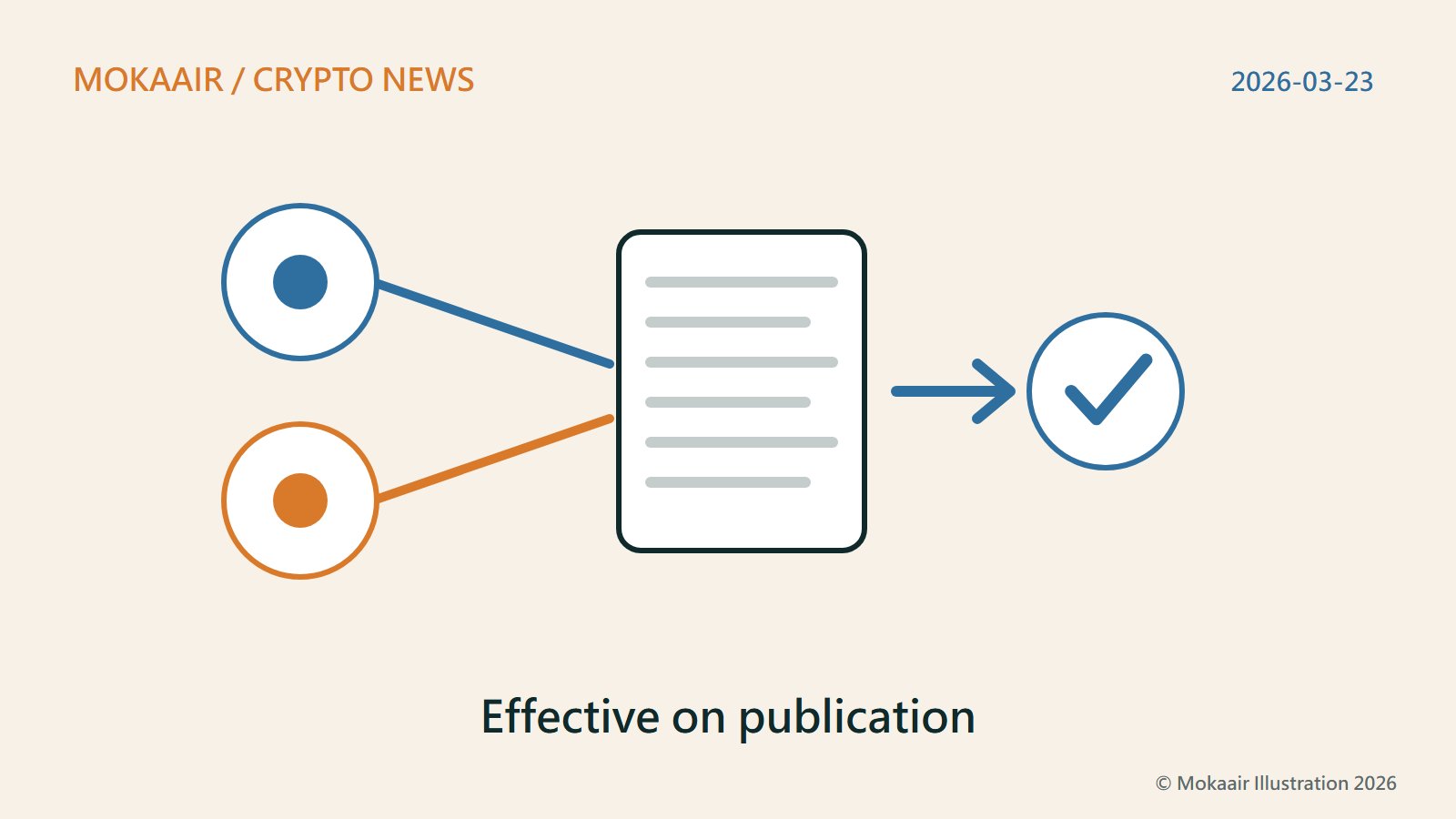
On March 23, 2026 a crypto asset document issued jointly by the Securities and Exchange Commission (SEC) and the Commodity Futures Trading Commission (CFTC) was published in the Federal Register at citation 91 FR 13714, and the effective date printed in its DATES field is that same day. The two Commissions dated the document March 17, 2026, and in between, on March 20, 2026, it was filed with the Office of the Federal Register.
This article was verified on September 17, 2026 against the Federal Register full-text endpoint, the as-published PDF on govinfo from the U.S. Government Publishing Office (GPO), CFTC press release 9198-26, and the Federal Register's own document data for this document. This site ran no hands-on test and offers neither investment nor legal advice; where the agencies wrote nothing, we say they wrote nothing, and we do not read "outside the scope of this release" as "therefore it is a security" or "therefore it may now be done".
Two agencies together, and it says it creates no new obligations
The AGENCY field of the document lists both agencies, and the signature block reads "By the Commissions. Dated: March 17, 2026." above the names of the two Commissions' secretaries: the two Commissions issued it and the secretaries attested it, so this is not an announcement the SEC made on its own. The SUMMARY field sets out the division of labor — the SEC makes the interpretation and the CFTC provides guidance relating to that interpretation — and states that "we" and "our" throughout the release refer only to the Commission, that is, the SEC.
The document type is the easiest thing to misread. The ACTION field reads "Final rule; interpretation; guidance" and the Federal Register records the document type as Rule, yet the text itself says the interpretation "does not itself create any new legal obligations", and states that it does not supersede or replace the Howey test, which is binding legal precedent. So this is not a new law; it is the agencies putting in writing how they read the law that already exists.
Three dates: dated, filed, published and effective
The date the document carries, March 17, 2026, also appears in the two interpretive-release tables the document adds to 17 CFR parts 231 and 241 — the date column for Release No. 33-11412 and for 34-105020 carries that day; the CFTC issued press release 9198-26 the same day, saying that it had joined the SEC "today" in issuing the interpretation. The filing date rests on the line at the end of the document, "[FR Doc. 2026-05635 Filed 3-20-26; 8:45 am]", and the publication date, March 23, 2026, is the effective date in the DATES field.
In its "Other Matters" section the release says that, pursuant to the Congressional Review Act, the Office of Management and Budget (OMB) has designated the interpretation a "major rule", but that the interpretation may take effect immediately pursuant to 5 U.S.C. 808(2) because it is an interpretive rule and thus exempt from the Administrative Procedure Act's notice and comment requirements; the document does not explain why the DATES field carries March 23. As for comments: the release solicits public comment on the views it sets out and says it may refine, revise or expand upon the interpretation in light of the feedback, but the DATES field carries only the one effective-date line, and the Federal Register's comment-deadline field for this document is empty as well.
| Date | What the document prints | What the day is |
|---|---|---|
| March 17, 2026 | Dated: March 17, 2026. | Issued by the two Commissions; CFTC press release the same day |
| March 20, 2026 | Filed 3-20-26; 8:45 am | Filed with the Office of the Federal Register |
| March 23, 2026 | Effective Date: March 23, 2026. | Published as 91 FR 13714, effective the same day |
| Not printed | The DATES field carries only the effective-date line | Comment solicited, no deadline printed |
Five categories, and what "not themselves securities" settles
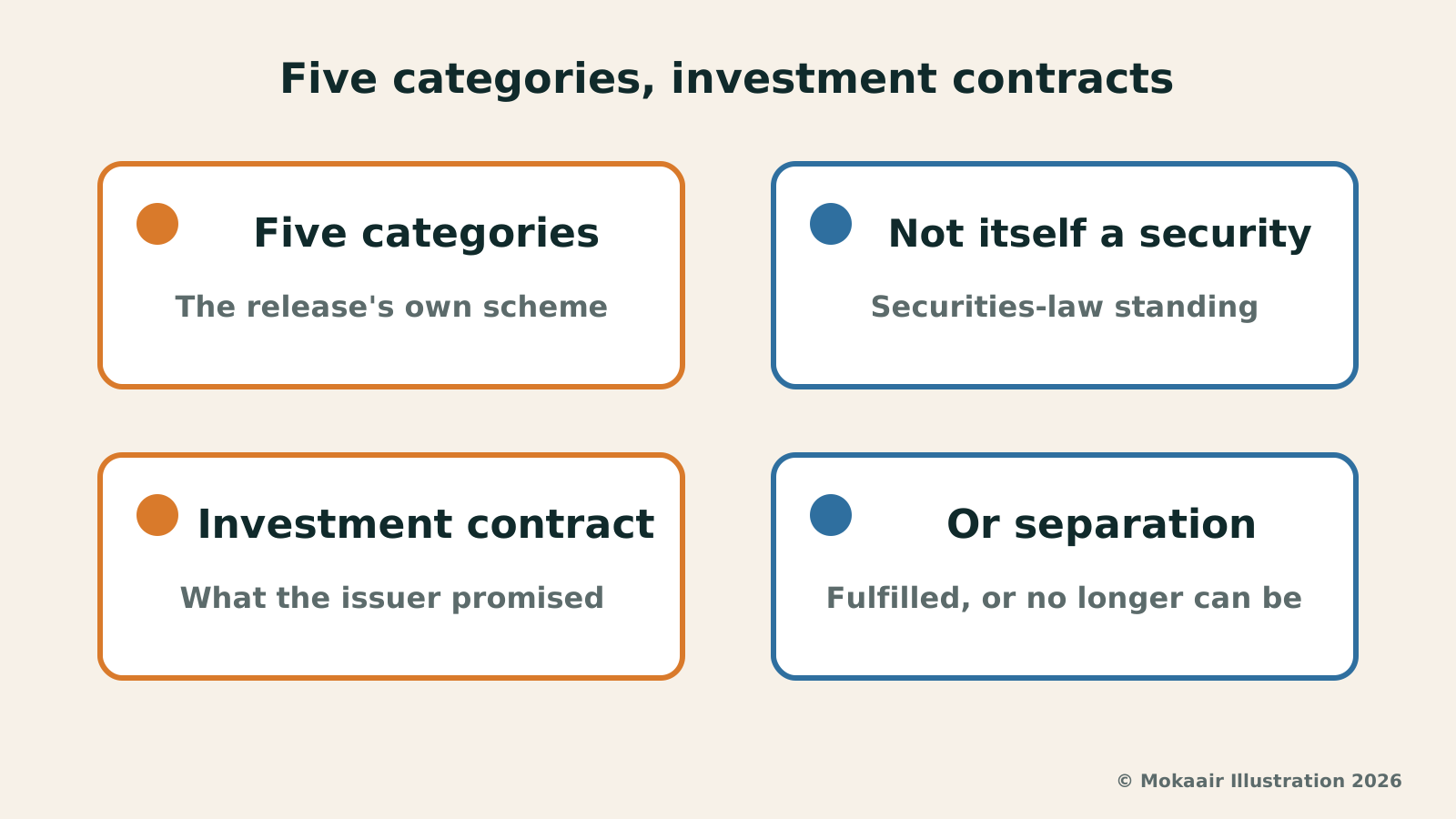
The release classifies crypto assets into five categories based on their characteristics, uses and functions: digital commodities, digital collectibles, digital tools, stablecoins and digital securities. It writes down the legal standing of each separately: the first three are not themselves securities; stablecoins are a broad category of crypto assets that may or may not be securities depending on their characteristics; digital securities are securities. It also states that a non-security crypto asset can still be offered and sold subject to an investment contract, and that the investment contract is itself a security.
The scheme comes with its own provisos. Because crypto assets differ from one another and the markets, including the underlying technology, continue to evolve, the release says there may be crypto assets that do not fall within any of these five categories, as well as crypto assets with hybrid characteristics that may fall within more than one category. Named examples appear under only three of the categories — digital commodities, digital collectibles and digital tools — each list opens with "include", so it is illustrative and not a complete list, and the release states plainly that its conclusions are based on the Commission's understanding of each asset's characteristics, terms and functions as of the date of the release. This article does not transcribe those names: in this document they are no more than illustrations of a legal classification.
The stablecoin passage carries a timing condition too. Section 17 of the GENIUS Act excludes from the definition of "security" any "payment stablecoin issued by a permitted payment stablecoin issuer", but the release says those crypto assets categorically will not be securities by operation of statute only after the effective date of the GENIUS Act, and that the Act was not yet effective when the release was issued: its effective date is a formula — the earlier of 18 months after its date of enactment, July 18, 2025, or 120 days after the date on which the primary Federal payment stablecoin regulators issue any final regulations implementing the Act. Until then, the basis is the Commission's interpretation applying the Howey test to Covered Stablecoins.
An investment contract can begin, and it can end
The release then asks when a crypto asset that is not itself a security becomes subject to an investment contract. Its answer: when an issuer offers it by inducing an investment of money in a common enterprise with representations or promises to undertake essential managerial efforts from which a purchaser would reasonably expect to derive profits. Whose words count is spelled out as well. Explicit representations or promises made by or on behalf of the issuer and conveyed to purchasers count; those made by third parties, such as unaffiliated proponents of the relevant crypto system or holders of the relevant crypto asset, do not, unless the representations or promises are authorized by the issuer and conveyed to purchasers; where the third party and the issuer collude to convey them, however, it would be reasonable for a purchaser to expect profits based on those explicit representations or promises.
Timing matters too: an issuer's post-sale representations or promises would not convert the prior sale into an offer or sale of an investment contract. In the other direction, the release sets out two non-exclusive indicia of separation — the issuer has fulfilled the essential managerial efforts it represented or promised, or a purchaser would no longer reasonably expect the issuer to be able to fulfill or to continue those efforts. Being subject to an investment contract does not transform the crypto asset itself into a security; and separation does not erase past liability, since an offering that was not registered and did not qualify for an available exemption still violated the Securities Act, and liability under the antifraud provisions remains.
The release also addresses mining, staking, wrapping and airdrops. Mining digital commodities on public, permissionless crypto networks that use proof-of-work is called Protocol Mining, and staking digital commodities on such networks that use proof-of-stake is called Protocol Staking; the mining it takes in is Self (or Solo) Mining and mining pools, and the staking it takes in is Self (or Solo) Staking, staking directly with a third party via self-custody, custodial arrangements and liquid staking. The conclusion is that these activities, "in the manner and under the circumstances described in this release", do not involve the offer and sale of a security within the meaning of section 2(a)(1) of the Securities Act and section 3(a)(10) of the Exchange Act. The conditions sit in the sentences and in the footnotes: an alternative payment of rewards, for one, comes with the proviso that the reward amounts are not fixed, guaranteed, or greater than those awarded by the PoS Network's software protocol.
What it says it does not address
One passage draws the boundary explicitly: the interpretation concerns the federal securities laws, the guidance included in it concerns the administration of the Commodity Exchange Act by the CFTC, and no interference is intended with respect to any other legal regime, including the federal tax laws under the Internal Revenue Code or the Bank Secrecy Act of 1970 and the Anti-Money Laundering Act of 2020. A separate footnote states that to the extent service providers provide services not discussed in that section, their activities are outside the scope of the release too. Outside the scope means not addressed, and this article therefore does not read it as "therefore it is a security", nor as "therefore it may now be done".
What follows is an example designed by the editors, not a hands-on test: someone used a staking feature on an offshore platform, saw a headline saying that staking is not a securities transaction, and wanted to ask whether that means the platform is regulated from now on. Read against the document, the inference does not hold. The release addresses a named set of arrangements; it does not say whether any operator is registered or licensed, and it lists no names. It also expressly places outside its scope arrangements in which a custodian or a liquid staking provider decides whether, when, or how much to stake, or guarantees or otherwise sets the amount of rewards.
Taiwan is read off the document in the same way. Checking the Federal Register full text, the as-published PDF and the CFTC press release used here through September 17, 2026, we saw no wording that mentions Taiwan or Taiwan's regulators. To confirm that yourself, the Federal Register citation 91 FR 13714 finds the same document; as of this article's verification date, the list of corrections the Federal Register records for it is empty.
Frequently asked questions
Is this interpretation a new law?
No. Its ACTION field reads "Final rule; interpretation; guidance" and the Federal Register records the document type as Rule, but the text itself says the interpretation does not itself create any new legal obligations for issuers of, and investors in, digital securities and crypto asset-related securities, and that it does not supersede or replace the Howey test, which is binding legal precedent. It is the agencies putting in writing how they read the law that already exists — not a new statute, and not a new substantive rule.
Did the SEC issue this on its own?
No. The AGENCY field lists both the Securities and Exchange Commission and the Commodity Futures Trading Commission, the signature block says the document was issued by the Commissions and is dated March 17, 2026, and the two secretaries are named. The division of labor is that the SEC makes the interpretation and the CFTC provides guidance relating to it, stating that the CFTC and its staff will administer the Commodity Exchange Act consistent with that interpretation and that certain non-security crypto assets could meet the definition of "commodity" under that Act. A further footnote states that nothing in the release should be construed as altering the respective statutory authorities of the two agencies.
Does "not themselves securities" mean they are safe to hold?
No. That is an answer about how the U.S. federal securities laws classify something, not about risk, quality, or whether holding it suits anyone. The same document states that the classification may change over time, that assets with hybrid characteristics exist, that its conclusions are based on the Commission's understanding of each asset as of the date of the release, and that liability for past unregistered offerings and under the antifraud provisions remains. It also does not deal with tax law, anti-money-laundering law or non-U.S. law. Its own example: a crypto asset may be offered and sold initially as a meme coin that has no functionality within an associated functional crypto system (and no related representations or promises to create such functionality or crypto system) and that derives its value from the asset's artistic, entertainment, social, or cultural significance, but later become a digital commodity because it becomes functional within an associated system.
Staking and mining are described as not involving the offer and sale of a security. Does that mean the platforms are now regulated?
The document does not say so. What it addresses is a named set of arrangements: mining is limited to Self (or Solo) Mining and mining pools, staking to Self (or Solo) Staking, staking directly with a third party via self-custody, custodial arrangements and liquid staking, and the conclusion is qualified by "in the manner and under the circumstances described in this release". It does not say whether any exchange, custodian or staking service provider is registered or licensed, and it lists no names. It also expressly places certain arrangements outside its own scope, for instance where a service provider guarantees or otherwise sets the amount of rewards; outside the scope means not addressed — not that those are securities, and not that they may now be done.
When does the comment period close?
The document prints no deadline. The release says it is soliciting public comment on the views set forth in the interpretation and that it may refine, revise or expand upon the interpretation in light of the feedback, but the DATES field carries a single effective-date line, and the Federal Register's comment-deadline field for this document is empty as well. If you come across a claim about some deadline, the DATES field of the document settles it for you. The comment file number is File No. S7-2026-09.
Why does the stablecoin passage separate now from later?
Because the basis differs. Section 17 of the GENIUS Act excludes from the definition of security any payment stablecoin issued by a permitted payment stablecoin issuer, but the release says that effect follows by operation of statute only after the effective date of that Act, and the Act was not yet effective when the release was issued; its effective date is written as a formula — the earlier of 18 months after its date of enactment, July 18, 2025, or 120 days after the date on which the primary Federal payment stablecoin regulators issue any final regulations implementing the Act. Until then, the basis is the Commission's interpretation applying the Howey test to Covered Stablecoins. Another footnote states that payment stablecoins issued by a foreign permitted stablecoin issuer registered with the Comptroller of the Currency will generally not meet the definition of security, because such payment stablecoins will generally be considered Covered Stablecoins.
What conditions apply to wrapping and airdrops?
Wrapping is limited to depositing a crypto asset with a custodian or a cross-chain bridge that generates redeemable wrapped tokens on a one-to-one basis, without directly or indirectly offering any return, yield, profit opportunity, or additional good or service; the holder can redeem one-to-one, and the wrapped tokens are burned on redemption. Airdrops are addressed only where the recipient provides the issuer with no money, goods, services or other consideration; the interpretation does not apply where the recipient performs a service in exchange, and the services the release gives as examples include following the issuer's social media account, reposting, writing an article, referring others, or fixing a bug. A further footnote states that the airdrop interpretation does not apply to, or otherwise affect, existing Commission or staff positions regarding employee compensation and benefit arrangements involving the issuance or award of securities.
2026 Crypto News Roundup: Key Developments in Regulation, Technology and Industry2026 Crypto News Roundup: Key Developments in Regulation, Technology and IndustryThis site's 2026 crypto news explainers, in six jurisdictions — Taiwan, the US, the UK, the EU, Japan, South Korea: the Virtual Asset Service Act, the proposed GENIUS Act rules, the joint SEC–CFTC interpretation and the SEC's own proposal, the end of MiCA's transitional period and its link to the payment rules, the FCA's perimeter guidance, Japan's FSA reports and South Korea's manipulation referrals. Regulation, technology and industry only, no prices, with official sources and a check date.Read the full article
Taiwan's Virtual Asset Service Act Clears Third Reading: Seven Kinds of Provider, Stablecoin Licensing, No Commencement Date YetTaiwan's Virtual Asset Service Act Clears Third Reading: Seven Kinds of Provider, Stablecoin Licensing, No Commencement Date YetOn June 30, 2026 Taiwan's Legislative Yuan passed the Virtual Asset Service Act (虛擬資產服務法) on third reading, and its 56 articles were promulgated on July 22, 2026. Working from the Financial Supervisory Commission's press release and two official legal databases, this article sets out the seven kinds of virtual asset service provider, licensing kind by kind, the reserve-asset rules for stablecoins, and why the 12- and 21-month transition periods in article 55 have not started running.Read the full article
Lifestyle
SEC Proposes Regulation Crypto Assets: Two Offering Exemptions and a Safe Harbor, Not Yet Adopted
On August 21, 2026, the Regulation Crypto Assets proposed by the U.S. SEC was published in the Federal Register at 91 FR 54510. Working from the Federal Register full text and the official GovInfo PDF, this article sets out the two offering exemptions, the investment contract safe harbor and the state law preemption in this 146-page proposal, and why it has no effective date and why the comment period runs to October 20, 2026.
Lifestyle
Brazil's Petrobras tests Cardano blockchain to track claims about cleaner jet fuel and diesel
According to CoinDesk, Brazil's state-owned energy company Petrobras is testing the Cardano blockchain in two research projects: one to stop the same emissions cut from sustainable aviation fuel being counted twice, the other to record the history of its partly renewable Diesel R. Both are still research work, with no timeline for wider use.
Lifestyle
Cboe and S&P Dow Jones Indices extend their S&P 500 options deal to 2051 and leave the door open to tokenized options
According to CoinDesk, exchange operator Cboe and index provider S&P Dow Jones Indices have extended Cboe's exclusive right to offer S&P 500 options by 25 years, to 2051. The deal says they may explore blockchain-based 'tokenized' options, but no product, timeline or details were announced. Here is what that means and what it does not.
Lifestyle
SEC Charges Two Groups of Entities Allegedly Behind Crypto Frauds Using WhatsApp and "AI Trading" Claims
On September 29, 2026, the US SEC charged two groups of entities, Cryptoaiml and TSAI, alleging they defrauded hundreds of individual investors, many in the US. The SEC says they falsely claimed to be SEC-regulated and used AI trading signals and bots as bait in schemes totaling at least $15 million. Here is what the SEC alleges and the warning signs readers can watch for.
Articles that cite this one
Latest travel guides

GuideTokyo
Where to Stay in Tokyo: Comparing Shinjuku, Ueno, Tokyo Station, Shibuya, Asakusa, Ikebukuro, and Ginza, Plus Airport Access, Accommodation Tax, and Luggage Delivery
Where should you stay in Tokyo? Compare Shinjuku, Ueno, Tokyo Station, Shibuya, Asakusa, Ikebukuro, and Ginza by the same criteria: access from Narita and Haneda, transit routes, nearby attractions, neighborhood character, and who each area suits. Includes a comparison table, a Yamanote Line diagram, Tokyo’s accommodation tax as verified in 2026/9 (changing to 3% in 2027/4), and Airport TA-Q-BIN luggage shipping rules.
- Budget
- Hotels

GuideTokyo
How to Choose Tokyo Transit Passes: Are Suica, Welcome Suica, the Tokyo Subway Ticket, and the JR Pass Worth It?
On a first Tokyo trip, start with an IC card and pay per ride (Welcome Suica has no deposit and is valid for 28 days). If you take four or more subway rides in a day, add a 72-hour Tokyo Subway Ticket for 2,000 yen; a JR Pass is never worthwhile if you stay in Tokyo and do not go to Kansai. See what TOURIST PASMO, Suica on iPhone, and the Tokyo Metro day pass do and do not cover, with a decision chart. Prices verified in September 2026.
- Transport
- Budget

GuideTokyo
Tokyo Disneyland and DisneySea Guide: Ticket Prices, Fantasy Springs, Disney Premier Access (DPA), Standby Pass, and Which Park to Choose for Your First Visit
Tokyo Disney one-day Passport prices vary: most weekdays in 9/2026 cost ¥9,900 and weekends ¥10,900. At 14:00 daily, tickets go on sale for the same date two months later. Free Priority Pass is no longer on the official service list; only paid Disney Premier Access (¥1,000–3,500 per person per use) shortens waits. Covers hours, the 25th anniversary, Standby Pass, Entry Request, Fantasy Springs access and first-visit park choice; checked on the official site in 9/2026.
- Itineraries
- Family
Sources
- Federal Register full text: Application of the Federal Securities Laws to Certain Types of Crypto Assets and Certain Transactions Involving Crypto Assets (91 FR 13714) · Checked:
- govinfo (U.S. Government Publishing Office): the Federal Register issue of March 23, 2026 as published, PDF, FR Doc 2026-05635 · Checked:
- CFTC press release 9198-26: CFTC Joins SEC to Clarify the Application of Federal Securities Laws to Crypto Assets · Checked:
- Federal Register document data (API): the agencies, type, effective date and correction record for FR Doc 2026-05635 · Checked: