Lifestyle
CFTC No-Action Letter Expands to All Passive Software Providers: The Line Drawn by Ten Conditions
On September 17, 2026, the CFTC's Market Participants Division issued no-action letter Letter 26-25, extending Letter 26-09 -- until then available only to a single applicant, Phantom -- to all passive software providers. Drawing on both letters' full text and the press release, this article explains the ten conditions, what is and is not allowed, and how a no-action letter differs from a Commission rule in effect; it offers no investment or legal advice, and was checked on September 18, 2026.
About 14 min read
On September 17, 2026, the Market Participants Division (MPD) of the U.S. Commodity Futures Trading Commission (CFTC) issued no-action letter CFTC Letter No. 26-25 (Release Number 9300-26), extending CFTC Letter No. 26-09 -- which, as of its March 17, 2026 header date, only a single applicant could rely on -- to all "Passive Software Providers" (PSPs). The position the letter takes is this: subject to ten specified conditions, MPD will not recommend that the Commission take enforcement action against such a provider or its relevant personnel solely because they engage in the "Covered Activities" the letter defines without registering as an introducing broker (IB) or as an IB's associated person (AP).
This article was checked on September 18, 2026, based on this CFTC press release and the full-text PDFs of both no-action letters, Letter 26-25 and Letter 26-09. This site has not used any passive software provider's product, does not test one, and offers no investment or legal advice; the scope, conditions and duration described here follow strictly from the CFTC's own documents as currently published.
What Happened: A Letter One Company Could Rely On Now Extended to Everyone
The press release states that MPD "today announced it has issued a no-action position for the benefit of providers of passive software," and that "the position is similar to that provided in Staff Letter 26-09 and now is broadly available to such providers." The header of Letter 26-25 reads, verbatim, "CFTC Letter No. 26-25 No-Action September 17, 2026," and is signed by DJ Hennes, Director of the Market Participants Division.
Letter 26-09 is headed March 17, 2026, and responds to an application Phantom Technologies, Inc. ("Phantom" in the letter) -- a developer of self-custodial crypto-asset wallet software -- submitted on March 13, 2026. Under Commission Regulation 17 CFR 140.99(a)(2), only the beneficiary of a no-action letter may rely on it, so no provider other than Phantom could rely on that letter. Letter 26-25 states that after it was issued, MPD received inquiries from other similarly situated passive software providers and their counsel seeking a comparable position, and the Division writes that it believes a no-action position for all PSPs on substantially the same terms as Letter 26-09 is warranted.
The Registration Question It Set Out to Resolve
Section 4d(g) of the Commodity Exchange Act makes it unlawful to act as an introducing broker without registering with the Commission as one; Section 4k(1) of the Act and Commission Regulation 3.12(a) impose the same requirement on an introducing broker's associated persons. The Commission has long read "soliciting and accepting" orders broadly, not limited to literally soliciting or accepting a customer's order.
Before this letter, Commission staff had, under appropriate circumstances, issued interpretive letters to certain "Technology Service Vendors" (TSVs) finding that they were not introducing brokers and need not register; but those letters rested on a set of representations made by the vendor, six of which the letter groups together as the "TSV Letter Requirements," the first being that each customer must already have a pre-existing relationship with a futures commission merchant or introducing broker, independent of the vendor. Some of the activities proposed by the Letter 26-09 applicant fell outside those requirements -- the letter's own example is that the registrant and the user need not have a pre-existing relationship -- so the applicant could not rely on the older interpretive letters and had to apply for a new no-action letter instead.
| Item | Letter 26-09 (2026-03-17) | Letter 26-25 (2026-09-17) |
|---|---|---|
| Beneficiary | Phantom Technologies, Inc. only | All qualifying PSPs |
| How it is obtained | Individual application by the applicant | Qualifying providers file a notice |
| Rule relied on | 17 CFR 140.99 | 17 CFR 140.99 |
| Who may rely on it | The beneficiary alone | Anyone meeting the ten conditions |
| Binds the Commission | No | No |
The Line This Letter Draws: What a Passive Software Provider May and May Not Do
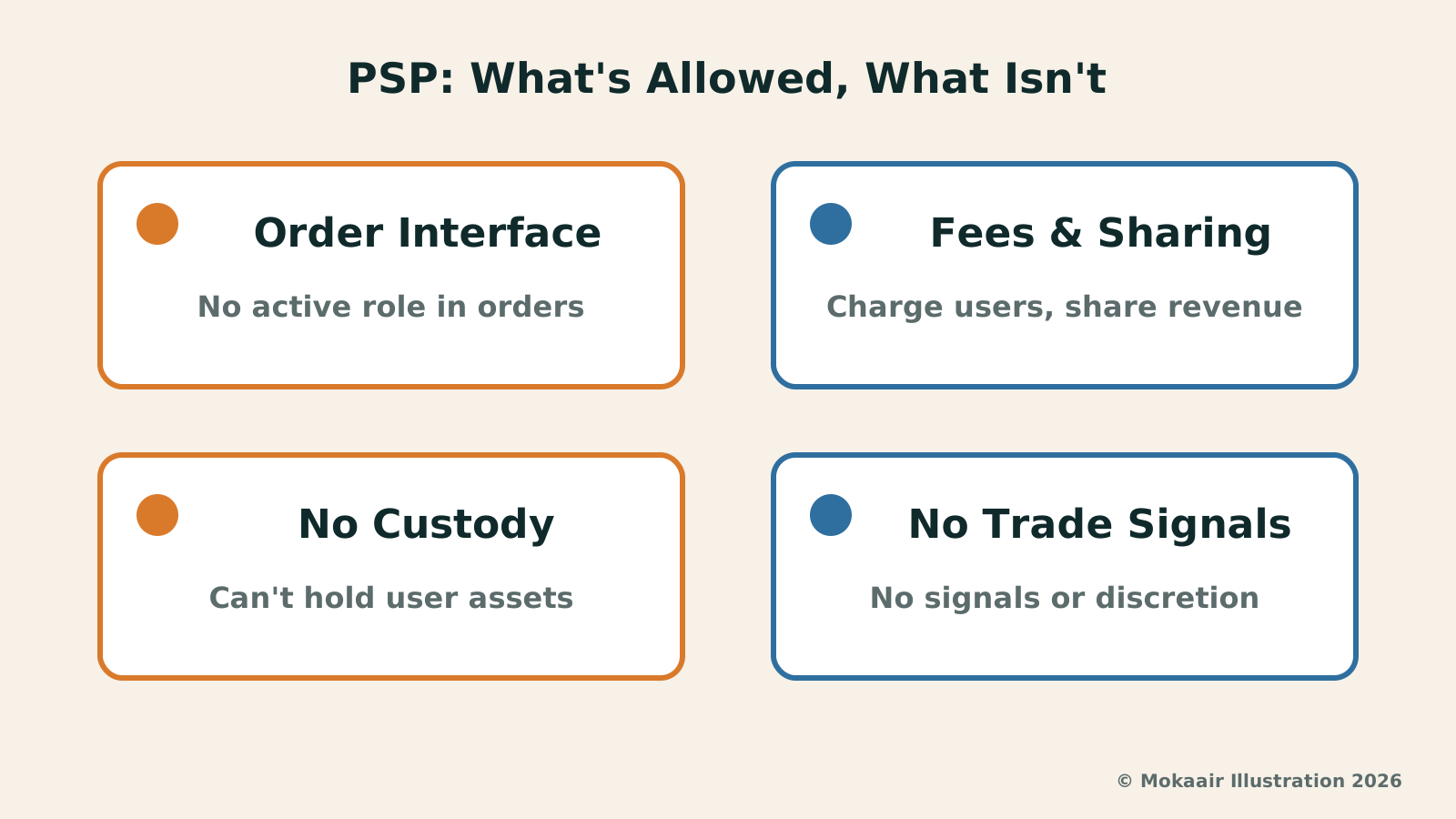
Letter 26-25 defines "Covered Activities" to include only what it lists: developing and distributing front-end interface software that lets users view market information, aggregate their positions and view product information, and submit orders directly to a designated contract market or to a registered futures commission merchant or introducing broker, for derivatives contracts including event contracts, perpetual contracts and other Commission-regulated derivatives, with the provider's role limited to providing the software on the user's device and no affirmative involvement in any particular order; contracting with one or more registered entities, which may agree to share a specified portion of related revenue with the provider, and which may also let the provider charge users a transaction-based fee directly, for example through its terms of use; marketing its own service and its relationship with registered entities, including promoting the availability of specific derivatives contracts; referring users to a specific registered entity, provided users remain able to reach that entity directly without going through the provider; and offering the interface either as a standalone product or as a feature embedded in existing wallet software -- in the latter case, the interface must clearly and conspicuously distinguish when a user is engaging in a regulated activity.
The same letter also draws a line the provider may not cross: at no point may it hold, control or take into custody user assets, generate an express buy or sell signal, or exercise discretion over the routing or execution of a user's orders. The Covered Activities carry structural limits too: users may trade only on a designated contract market, either directly as a member of that market or indirectly as a customer of a futures commission merchant or introducing broker that is a member of it, and the funds or other property securing a position must be held at that market's clearing organization and/or a clearing member futures commission merchant of that clearing organization -- what the letter calls a "custodial" trading model consistent with the structure of existing on-exchange derivatives markets. A footnote also expressly rules out reading this as crypto-specific: passive software providers are not limited to those offering crypto-asset-related software.
Which of the Ten Conditions Matter Most to an Ordinary User
A provider must disclose to each user its relationship with the relevant registered entities and any potential conflicts of interest, including fees, and obtain the user's acknowledgment of receipt; it must provide the risk disclosures covered by the Commission Regulation 1.55(b) risk disclosure statement, to the extent relevant to the trading activity the software facilitates, and retain a record of the user's acknowledgment -- except that this condition does not apply where the registered entity is itself registered and already obligated under Regulation 1.55 to provide the user the same risk disclosure statement; and users must open their accounts as a direct member of a designated contract market, or as a customer of a futures commission merchant or introducing broker, and must continue to be able to access the underlying registered entity directly, without going through the provider.
The rest lean toward compliance process: absent a waiver by the Division, the provider, its principals and anyone involved in soliciting users must not be subject to statutory disqualification, and must notify the Division promptly if that changes; the provider must sign a written undertaking with each registered entity it works with, accepting joint and several liability if the provider or its personnel violate the Commodity Exchange Act or Commission regulations while engaged in Covered Activities, and agreeing to submit to the Commission's investigative and enforcement jurisdiction, with the undertaking filed with the Division; the provider must adopt and enforce policies and procedures reasonably designed to ensure that its external communications and marketing comply with the Commission and National Futures Association rules that apply to a registered introducing broker, and must not engage in advertising or promotion that would require the Association's prior approval if the provider were registered; the provider must keep records of its compliance and regulated business under Commission Regulation 1.31, and must notify the Division if it becomes insolvent or enters bankruptcy proceedings; and the tenth condition is that the provider files a notice with the Division agreeing to satisfy these conditions and consenting to the Commission's jurisdiction.
How to Read a Headline Like "The U.S. Just Gave the Green Light"
On seeing a headline like "U.S. regulator green-lights crypto wallet trading," separate the levels of the document first: a rule the Commission adopts and a division-level "no-action letter" are not the same thing. Letter 26-25 closes with three statements: that the letter and the position it takes represent the views of the Division only and do not necessarily represent the views of the Commission or any other office or division; that the letter and the no-action position it takes do not bind the Commission; and that the position rests on the facts and circumstances presented to Division staff, and that any different, changed or omitted material fact could render it unavailable. The letter also states that, as with all staff letters, the Division retains the authority to further condition, modify, suspend, terminate or otherwise restrict the position, in its discretion.
The boundary the letter itself draws is not a date either, but a condition: it applies "until the effective date of a Commission rulemaking or guidance addressing the application of the IB registration requirement to software developers." On March 23, 2026, a joint interpretive release from the U.S. Securities and Exchange Commission and the CFTC, addressing how the federal securities laws apply to certain types of crypto assets and related transactions, was published in the Federal Register -- a Commission-level joint document that took effect the day it was published. Letter 26-25 deals with a different question -- whether a software developer offering an order-entry interface must register as an introducing broker -- and is a division-level no-action letter, different in both nature and binding force.
Frequently asked questions
Does this letter mean the CFTC has adopted a new rule that makes order placement inside a crypto wallet legal from now on?
No. CFTC Letter No. 26-25 is a "no-action letter" the Market Participants Division issued under 17 CFR 140.99, not a rule the Commission adopted. The letter states that it represents only the Division's views, does not necessarily represent the views of the Commission or any other office or division, does not bind the Commission, and that the Division retains the authority, in its discretion, to modify, suspend or terminate the position.
What does this letter allow a passive software provider to do?
Subject to the ten conditions, a PSP may develop and distribute front-end interface software that lets users view market information and positions and submit orders directly to a designated contract market or to a registered futures commission merchant or introducing broker; it may contract with registered entities, which may agree to share a specified portion of related revenue with it, and may also charge users a transaction-based fee directly; it may market its own service and refer users to a specific registered entity; and it may offer the interface either as a standalone product or as a feature embedded in existing wallet software, provided that, when embedded, the software interface clearly and conspicuously distinguishes when a user is engaging in an activity regulated by the Commission.
What does this letter not allow a passive software provider to do?
The letter draws several lines a provider may not cross: at no point may it hold, control or take into custody a user's assets; it may not generate an express buy or sell signal; and it may not exercise discretion over the routing or execution of a user's orders. Users must also remain able to reach the underlying registered entity directly, without going through the provider -- they may not be locked into the software.
When does this position expire?
The letter gives no specific date. The boundary it draws for itself is "until the effective date of a Commission rulemaking or guidance addressing the application of the IB registration requirement to software developers" -- a condition, not a calendar date. The letter does not say when the Commission might take up that rulemaking, and this article does not speculate; the Division also retains the authority to modify, suspend or terminate the position earlier, in its discretion.
Is this a crypto-specific measure?
No. A footnote in the letter states explicitly that passive software providers are not limited to providers of crypto-asset-related software. This expansion applies to any passive software provider that satisfies the ten conditions, whether or not it originally offered crypto-asset wallet software.
Does this letter affect users or businesses in Taiwan?
As checked on September 18, 2026, the word "Taiwan" does not appear in the full English text of either letter, and both deal with registration obligations under the U.S. Commodity Exchange Act. This article does not speculate about any effect on Taiwanese users or businesses.
Why couldn't the earlier Technology Service Vendor interpretive letters simply be applied here?
CFTC staff had, under appropriate circumstances, issued interpretive letters to certain "Technology Service Vendors" finding they need not register as introducing brokers, but those letters rested on a set of representations made by the vendor, six of which the letter groups together as the "TSV Letter Requirements"; the first is that each customer must already have a pre-existing relationship with a futures commission merchant or introducing broker, independent of the vendor. Some of the activities proposed by the Letter 26-09 applicant fell outside those requirements -- the letter's own example being that the registrant and the user need not have a pre-existing relationship -- so the applicant could not rely on the older interpretive letters and had to obtain a new no-action letter instead.
2026 Crypto News Roundup: Key Developments in Regulation, Technology and Industry2026 Crypto News Roundup: Key Developments in Regulation, Technology and IndustryThis site's 2026 crypto news explainers, in six jurisdictions — Taiwan, the US, the UK, the EU, Japan, South Korea: the Virtual Asset Service Act, the proposed GENIUS Act rules, the joint SEC–CFTC interpretation and the SEC's own proposal, the end of MiCA's transitional period and its link to the payment rules, the FCA's perimeter guidance, Japan's FSA reports and South Korea's manipulation referrals. Regulation, technology and industry only, no prices, with official sources and a check date.Read the full article
Joint SEC and CFTC Interpretation: Five Categories of Crypto Assets, Effective the Day It Was PublishedJoint SEC and CFTC Interpretation: Five Categories of Crypto Assets, Effective the Day It Was PublishedOn March 17, 2026 the Securities and Exchange Commission (SEC) and the Commodity Futures Trading Commission (CFTC) jointly issued an interpretation of the securities laws for crypto assets; it was published in the Federal Register on March 23, 2026 and took effect that day. From the Federal Register full text and document data, the as-published PDF and the CFTC press release: the five categories, how an investment contract begins and ends, and what the release says it does not address.Read the full article
Lifestyle
Joint SEC and CFTC Interpretation: Five Categories of Crypto Assets, Effective the Day It Was Published
On March 17, 2026 the Securities and Exchange Commission (SEC) and the Commodity Futures Trading Commission (CFTC) jointly issued an interpretation of the securities laws for crypto assets; it was published in the Federal Register on March 23, 2026 and took effect that day. From the Federal Register full text and document data, the as-published PDF and the CFTC press release: the five categories, how an investment contract begins and ends, and what the release says it does not address.
Lifestyle
UK FCA Publishes Final Cryptoasset Perimeter Guidance PS26/18: Applications Open September 30, New Regime Takes Effect October 2027
On September 16, 2026, the UK's Financial Conduct Authority (FCA) published policy statement PS26/18, Cryptoasset Perimeter Guidance, explaining when cryptoasset activities require FCA authorisation. Drawing on the FCA's press release and the 140-page PS26/18, this article sets out three separate dates — guidance published, applications open, new regime in effect — the seven newly regulated activities, and places this timeline beside Taiwan's Virtual Asset Service Act.
Lifestyle
Brazil's Petrobras tests Cardano blockchain to track claims about cleaner jet fuel and diesel
According to CoinDesk, Brazil's state-owned energy company Petrobras is testing the Cardano blockchain in two research projects: one to stop the same emissions cut from sustainable aviation fuel being counted twice, the other to record the history of its partly renewable Diesel R. Both are still research work, with no timeline for wider use.
Lifestyle
Cboe and S&P Dow Jones Indices extend their S&P 500 options deal to 2051 and leave the door open to tokenized options
According to CoinDesk, exchange operator Cboe and index provider S&P Dow Jones Indices have extended Cboe's exclusive right to offer S&P 500 options by 25 years, to 2051. The deal says they may explore blockchain-based 'tokenized' options, but no product, timeline or details were announced. Here is what that means and what it does not.
Articles that cite this one
Latest travel guides

GuideTokyo
Where to Stay in Tokyo: Comparing Shinjuku, Ueno, Tokyo Station, Shibuya, Asakusa, Ikebukuro, and Ginza, Plus Airport Access, Accommodation Tax, and Luggage Delivery
Where should you stay in Tokyo? Compare Shinjuku, Ueno, Tokyo Station, Shibuya, Asakusa, Ikebukuro, and Ginza by the same criteria: access from Narita and Haneda, transit routes, nearby attractions, neighborhood character, and who each area suits. Includes a comparison table, a Yamanote Line diagram, Tokyo’s accommodation tax as verified in 2026/9 (changing to 3% in 2027/4), and Airport TA-Q-BIN luggage shipping rules.
- Budget
- Hotels

GuideTokyo
How to Choose Tokyo Transit Passes: Are Suica, Welcome Suica, the Tokyo Subway Ticket, and the JR Pass Worth It?
On a first Tokyo trip, start with an IC card and pay per ride (Welcome Suica has no deposit and is valid for 28 days). If you take four or more subway rides in a day, add a 72-hour Tokyo Subway Ticket for 2,000 yen; a JR Pass is never worthwhile if you stay in Tokyo and do not go to Kansai. See what TOURIST PASMO, Suica on iPhone, and the Tokyo Metro day pass do and do not cover, with a decision chart. Prices verified in September 2026.
- Transport
- Budget

GuideTokyo
Tokyo Disneyland and DisneySea Guide: Ticket Prices, Fantasy Springs, Disney Premier Access (DPA), Standby Pass, and Which Park to Choose for Your First Visit
Tokyo Disney one-day Passport prices vary: most weekdays in 9/2026 cost ¥9,900 and weekends ¥10,900. At 14:00 daily, tickets go on sale for the same date two months later. Free Priority Pass is no longer on the official service list; only paid Disney Premier Access (¥1,000–3,500 per person per use) shortens waits. Covers hours, the 25th anniversary, Standby Pass, Entry Request, Fantasy Springs access and first-visit park choice; checked on the official site in 9/2026.
- Itineraries
- Family
Sources
- CFTC Staff Issues No-Action Position to Providers of Passive Software (Release Number 9300-26) · Checked:
- CFTC Letter No. 26-25 (PDF) — No-Action Position regarding IB Registration Requirement under Section 4d(g) and AP Registration Requirement under Section 4k(1) of the Commodity Exchange Act · Checked:
- CFTC Letter No. 26-09 — No-Action Position issued to Phantom Technologies, Inc. (PDF) · Checked: