Lifestyle
UK FCA Publishes Final Cryptoasset Perimeter Guidance PS26/18: Applications Open September 30, New Regime Takes Effect October 2027
On September 16, 2026, the UK's Financial Conduct Authority (FCA) published policy statement PS26/18, Cryptoasset Perimeter Guidance, explaining when cryptoasset activities require FCA authorisation. Drawing on the FCA's press release and the 140-page PS26/18, this article sets out three separate dates — guidance published, applications open, new regime in effect — the seven newly regulated activities, and places this timeline beside Taiwan's Virtual Asset Service Act.
About 14 min read
On September 16, 2026, the United Kingdom's Financial Conduct Authority (FCA) published policy statement PS26/18, Cryptoasset Perimeter Guidance. The FCA's publication page marks all three fields — policy statement, first published and last updated — with this same date; the finalised guidance is added to the FCA's Perimeter Guidance manual as a new chapter, PERG 18, and the legal instrument in the appendix states that this chapter takes effect the same day. It explains when cryptoasset activities require FCA authorisation; it is not a new piece of legislation.
This article was checked on September 18, 2026, drawing on the FCA's press release, the PS26/18 publication page, the full policy statement PDF, and the article-by-article page of the Virtual Asset Service Act in the Laws & Regulations Database of the Republic of China (Taiwan). We have not applied for authorisation, and we have not tested the FCA's authorisation process ourselves; we offer no assessment of any cryptoasset, exchange, wallet or issuer and no investment or legal advice. Regulatory requirements and timelines follow the FCA's own current announcements throughout.
What happened: the FCA publishes final guidance PS26/18
The rules this guidance addresses are not new in themselves. Their legal basis is the Financial Services and Markets Act 2000 (Cryptoassets) Regulations 2026 — what the FCA calls the Cryptoasset Regulations — passed by the UK Parliament on February 4, 2026. Paragraph 1.7 of PS26/18 notes that this guidance corresponds to that already-enacted legislation and does not yet cover the government's subsequent amendments: paragraph 1.6 states that the government first published a draft during the consultation period and has since laid that statutory instrument before Parliament. This article has not read the text of that statutory instrument and does not quote from it.
This final guidance follows consultation paper CP26/13, open from April 15 to June 3, 2026. Paragraph 1.9 of PS26/18 records a total of 78 responses received, and paragraph 1.10 records that a majority (60%) generally supported the proposed perimeter guidance and agreed that it would clarify how the regulatory perimeter applies to regulated cryptoasset activities; PS26/18 does not state what that percentage is a share of.
Four dates: guidance published, applications open, the transitional deadline, and the new regime takes effect
Publishing the guidance is not the same as the new regime taking effect, and several dates sit in between — conflating them is the easiest way to misread this story: February 4, 2026, Parliament passed the Cryptoasset Regulations that form the legal basis; September 16, 2026, the FCA published the final guidance PS26/18; September 30, 2026, the authorisation application window opens; October 25, 2027, the new regime formally takes effect — the FCA's press release states, in the original English, "The regime comes into force on 25 October 2027."
September 30, 2026, when the application window opens, is not the same thing as the application deadline — and that deadline is not the same for everyone either. PS26/18's publication page states both facts in a single sentence: the application window opens on September 30, 2026 and closes on February 28, 2027, but that closing date applies only to firms wanting to use the transitional arrangements, not as a uniform deadline for every applicant.
Existing registrations or permissions do not automatically become authorisation under the new regime. Both the PS26/18 publication page and the full policy statement state the same thing: firms currently authorised under the Financial Services and Markets Act, registered under the Money Laundering Regulations (MLRs), or authorised or registered under the Payment Services Regulations or the Electronic Money Regulations, must obtain the appropriate authorisation if they carry on one or more regulated cryptoasset activities by way of business in the UK and no exclusion or exemption is available.
| Date | What happened | Who it affects |
|---|---|---|
| 2026-02-04 | Parliament passes the Cryptoasset Regulations (legal basis) | Establishes the legal basis; brings no new authorisation duty yet |
| 2026-09-16 | FCA publishes final guidance PS26/18 | Sets out the new regime's scope for firms to prepare against |
| 2026-09-30 | Authorisation application window opens | Firms seeking authorisation under the new regime can start applying |
| 2027-02-28 | Deadline to apply for the transitional arrangements | Applies only to firms wanting to use the transitional arrangements |
| 2027-10-25 | New regime formally takes effect | From this date, regulated activity carried on by way of business in the UK requires authorisation |
What the guidance covers: seven new activities, and which assets are excluded
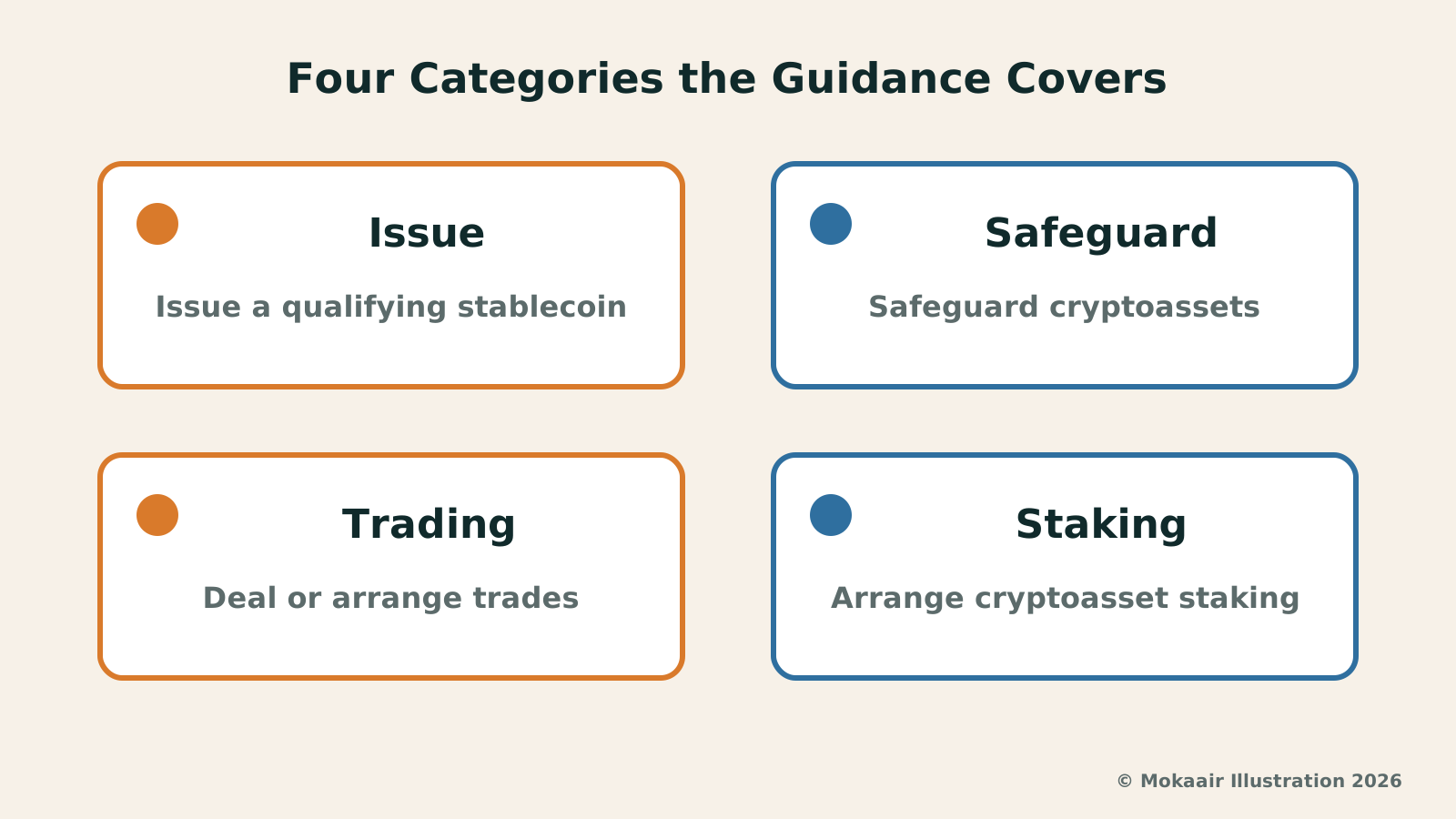
Paragraph 4.1 of PS26/18 lists the newly regulated cryptoasset activities added this time — seven in total: issuing a qualifying stablecoin (the FCA's defined term) in the UK; safeguarding, and arranging the safeguarding of, qualifying cryptoassets (again the FCA's defined term) and related specified investment cryptoassets; operating a qualifying cryptoasset trading platform (QCATP); dealing in qualifying cryptoassets as principal, in the firm's own name; dealing in qualifying cryptoassets as agent; arranging deals in qualifying cryptoassets; and arranging qualifying cryptoasset staking. Paragraph 4.2 separately explains that lending cryptoassets is not a separate, eighth category, but falls within the scope of the dealing and/or arranging activities.
Not every cryptoasset counts as a qualifying cryptoasset. Paragraph 3.3 of PS26/18 lists the types excluded from that definition, including electronic money, fiat currency, central bank digital currency, and cryptoassets that can only be redeemed with the issuer and used to buy goods or services from the issuer, or that can only be redeemed with the issuer and used within a limited network; paragraph 3.4 separately excludes cryptoassets that already fall into another specified investment category. This is an "including"-led illustrative list, not a declaration that only these listed types are excluded.
All regulated cryptoasset activities are also subject to two general exclusions: activities carried on for the sale of goods or the supply of services, and activities incidental to the carrying on of a profession or business — the latter limited to cases where that profession or business is itself supervised and regulated by a designated professional body. Paragraph 5.3 of PS26/18 warns that Parliament did not carry over all of the other general exclusions that already exist in the Regulated Activities Order, or carry them over unchanged, onto cryptoasset activities — so it cannot be assumed that an exclusion available to a traditional regulated activity applies to a cryptoasset activity in the same way, or at all.
What the guidance cannot do: who sets the perimeter, and what is still undecided
Paragraphs 1.14 to 1.16 of PS26/18 set out this guidance's own standing: PERG is the FCA's interpretation of the regulatory perimeter Parliament set in legislation, not a perimeter the FCA draws according to its own preferred policy outcome; PERG cannot be used to expand, narrow or otherwise alter the perimeter set by legislation, only the courts can give an authoritative interpretation of legislation, and changing the perimeter itself requires a change in the law. The FCA also states that PERG is general guidance, not suited to giving detailed guidance on individual business models, and that anyone can seek independent legal advice or apply to the FCA for individual guidance.
This guidance does not yet cover everything. The FCA states that the government has made targeted amendments to the related legislation; this article has not read the text of those amendments and can only quote what the FCA itself says: these changes will not affect most cryptoasset firms, which can use this guidance now to prepare for authorisation; the FCA will consult in October on updates to this guidance arising from those legal changes, covering UK qualifying stablecoins, proprietary trading and market making, certain technology providers, decentralised protocols, safeguarding arrangements involving central securities depositories, and financial promotions. The publication page places that same consultation in "late 2026" and states the goal of publishing updated guidance in early 2027.
The FCA states that this guidance follows on from the series of policy statements it published on June 30, 2026 — on admission and disclosure and market abuse (PS26/9), stablecoin issuance (PS26/10), regulated cryptoasset activities (PS26/11), prudential rules (PS26/12), and the application of the FCA Handbook (PS26/13). This article records only these five documents' numbers and their respective topics, without describing their contents further.
How Taiwanese readers can read this: separate it into the Act, the guidance, and the commencement date
When you see a headline like "country X is about to regulate crypto," the way to avoid misreading it is to separate it into three things: whether what Parliament or the legislature passed is the law itself; whether what the regulator published is guidance on, or subordinate legislation under, that law; and what date the new regime actually takes effect. In the UK's case here, those three dates are: the legal basis passed on February 4, 2026; the guidance published on September 16, 2026; and the new regime not taking effect until October 25, 2027.
Taiwan's own timeline can be broken down the same way. The Virtual Asset Service Act was enacted and promulgated on July 22, 2026, with 56 articles in total; article 56 reads, in translation, "The date on which this Act comes into force shall be set by the Executive Yuan," and on the article-by-article page of the Laws & Regulations Database of the Republic of China (Taiwan), as of this article's check date, the entry still reads, in translation, "the last effective date is undecided." This only places the dates and the names of the instruments side by side — the UK legislated first, then issued guidance, then the regime takes effect later; Taiwan has already promulgated its Act, and the commencement date is still awaiting a decision from the Executive Yuan — without judging which side is stricter or faster.
If you want to confirm a firm's current UK authorisation status, note this: the three FCA documents this article read give guidance and a timeline, not a list of authorisations under the new regime, and the application window does not open until September 30, 2026. If you see a claim like "licensed in the UK" or "UK-certified," it is worth confirming first whether it refers to this still-in-preparation authorisation under the new regime, or to some other existing registration or permission.
Frequently asked questions
Can I apply for this new UK cryptoasset authorisation right now, in September 2026?
Not yet. The authorisation application window does not open until September 30, 2026; the PS26/18 guidance the FCA published on September 16, 2026 is final guidance meant to help firms prepare their applications in advance, not the application window itself. This article was checked on September 18, 2026, at which point the application window had not yet opened.
Did the new regime take effect on September 16, 2026?
No. September 16 is the date the FCA published the final guidance. The new regime itself — the newly regulated cryptoasset activities formally being brought within the FCA's regulatory perimeter — does not take effect until October 25, 2027. In between sits the September 30, 2026 stage, when applications open.
Is February 28, 2027 an application deadline every firm must meet?
No. That date applies only to firms wanting to use the transitional arrangements. PS26/18 states it in the same sentence as the September 30 application window opening, and it is restricted to firms wanting to use the transitional arrangements — what PS26/18 itself calls the "savings" provisions — not a uniform deadline for every applicant.
Which activities does the new regime bring within its scope?
Paragraph 4.1 of PS26/18 lists seven: issuing a qualifying stablecoin in the UK; safeguarding, and arranging the safeguarding of, qualifying cryptoassets and related specified investment cryptoassets; operating a qualifying cryptoasset trading platform; dealing in qualifying cryptoassets as principal, in the firm's own name; dealing in qualifying cryptoassets as agent; arranging deals in qualifying cryptoassets; and arranging qualifying cryptoasset staking. Lending cryptoassets falls within the scope of the dealing and/or arranging activities; it is not a separate, eighth category.
If the platform I use is already registered in the UK, will it automatically become authorised once the new regime takes effect?
No. The FCA explicitly states that existing registrations or permissions will not convert automatically: firms currently authorised under the Financial Services and Markets Act, registered under the Money Laundering Regulations, or authorised or registered under the Payment Services Regulations or the Electronic Money Regulations, must still obtain the appropriate authorisation if they carry on one or more regulated cryptoasset activities by way of business in the UK and no exclusion or exemption is available.
Can this guidance change the scope of what the FCA regulates?
No. The FCA states in PS26/18 that the guidance (PERG) is the FCA's interpretation of the regulatory perimeter Parliament set in legislation, and it cannot be used to expand, narrow or alter that perimeter; only the courts can give an authoritative interpretation of the law, and changing the perimeter itself requires a change in legislation.
Will the FCA adjust this guidance again later?
Yes. The FCA states that the UK government has made targeted amendments to the related legislation, that these changes will not affect most cryptoasset firms, and that firms can use this guidance now to prepare for authorisation in the meantime. The FCA expects to consult further in October on updates to the guidance arising from those legal changes, covering UK qualifying stablecoins, proprietary trading and market making, certain technology providers, decentralised protocols, safeguarding arrangements involving central securities depositories, and financial promotions, with a goal of publishing updated guidance in early 2027.
2026 Crypto News Roundup: Key Developments in Regulation, Technology and Industry2026 Crypto News Roundup: Key Developments in Regulation, Technology and IndustryThis site's 2026 crypto news explainers, in six jurisdictions — Taiwan, the US, the UK, the EU, Japan, South Korea: the Virtual Asset Service Act, the proposed GENIUS Act rules, the joint SEC–CFTC interpretation and the SEC's own proposal, the end of MiCA's transitional period and its link to the payment rules, the FCA's perimeter guidance, Japan's FSA reports and South Korea's manipulation referrals. Regulation, technology and industry only, no prices, with official sources and a check date.Read the full article
EU MiCA Transitional Period Ends July 1: Grandfathering Differs by Country, a Pending Application Is Not an ExtensionEU MiCA Transitional Period Ends July 1: Grandfathering Differs by Country, a Pending Application Is Not an ExtensionThe transitional period in Article 143(3) of the EU's MiCA expired on July 1, 2026. Drawing on ESMA's public statement of June 23, 2026, its statement of April 17, 2026, the list of grandfathering periods decided by each Member State and the official question and answer ESMA_QA_2220, this article sets out what ended, why the grandfathering periods differ from one Member State to another, why a pending application is not an extension, and what ESMA said to providers and to clients.Read the full article
Lifestyle
EU MiCA Transitional Period Ends July 1: Grandfathering Differs by Country, a Pending Application Is Not an Extension
The transitional period in Article 143(3) of the EU's MiCA expired on July 1, 2026. Drawing on ESMA's public statement of June 23, 2026, its statement of April 17, 2026, the list of grandfathering periods decided by each Member State and the official question and answer ESMA_QA_2220, this article sets out what ended, why the grandfathering periods differ from one Member State to another, why a pending application is not an extension, and what ESMA said to providers and to clients.
Lifestyle
FCA Cracks Down on Illegal Peer-to-Peer Crypto Trading in London: Action on September 10, Announced September 17
On September 17, 2026, the UK's Financial Conduct Authority (FCA) announced that it, HMRC and the Metropolitan Police Service had acted against 3 premises in London on September 10 over suspected illegal peer-to-peer crypto trading. Drawing on two FCA press releases and its Firm Checker help page, this article lays out why the registration duty applies only to those trading by way of business, the carve-out for trades between individuals, and the limits of the consumer lookup tool itself.
Lifestyle
Taiwan's Virtual Asset Service Act Clears Third Reading: Seven Kinds of Provider, Stablecoin Licensing, No Commencement Date Yet
On June 30, 2026 Taiwan's Legislative Yuan passed the Virtual Asset Service Act (虛擬資產服務法) on third reading, and its 56 articles were promulgated on July 22, 2026. Working from the Financial Supervisory Commission's press release and two official legal databases, this article sets out the seven kinds of virtual asset service provider, licensing kind by kind, the reserve-asset rules for stablecoins, and why the 12- and 21-month transition periods in article 55 have not started running.
Lifestyle
Brazil's Petrobras tests Cardano blockchain to track claims about cleaner jet fuel and diesel
According to CoinDesk, Brazil's state-owned energy company Petrobras is testing the Cardano blockchain in two research projects: one to stop the same emissions cut from sustainable aviation fuel being counted twice, the other to record the history of its partly renewable Diesel R. Both are still research work, with no timeline for wider use.
Articles that cite this one
Latest travel guides

GuideTokyo
Where to Stay in Tokyo: Comparing Shinjuku, Ueno, Tokyo Station, Shibuya, Asakusa, Ikebukuro, and Ginza, Plus Airport Access, Accommodation Tax, and Luggage Delivery
Where should you stay in Tokyo? Compare Shinjuku, Ueno, Tokyo Station, Shibuya, Asakusa, Ikebukuro, and Ginza by the same criteria: access from Narita and Haneda, transit routes, nearby attractions, neighborhood character, and who each area suits. Includes a comparison table, a Yamanote Line diagram, Tokyo’s accommodation tax as verified in 2026/9 (changing to 3% in 2027/4), and Airport TA-Q-BIN luggage shipping rules.
- Budget
- Hotels

GuideTokyo
How to Choose Tokyo Transit Passes: Are Suica, Welcome Suica, the Tokyo Subway Ticket, and the JR Pass Worth It?
On a first Tokyo trip, start with an IC card and pay per ride (Welcome Suica has no deposit and is valid for 28 days). If you take four or more subway rides in a day, add a 72-hour Tokyo Subway Ticket for 2,000 yen; a JR Pass is never worthwhile if you stay in Tokyo and do not go to Kansai. See what TOURIST PASMO, Suica on iPhone, and the Tokyo Metro day pass do and do not cover, with a decision chart. Prices verified in September 2026.
- Transport
- Budget

GuideTokyo
Tokyo Disneyland and DisneySea Guide: Ticket Prices, Fantasy Springs, Disney Premier Access (DPA), Standby Pass, and Which Park to Choose for Your First Visit
Tokyo Disney one-day Passport prices vary: most weekdays in 9/2026 cost ¥9,900 and weekends ¥10,900. At 14:00 daily, tickets go on sale for the same date two months later. Free Priority Pass is no longer on the official service list; only paid Disney Premier Access (¥1,000–3,500 per person per use) shortens waits. Covers hours, the 25th anniversary, Standby Pass, Entry Request, Fantasy Springs access and first-visit park choice; checked on the official site in 9/2026.
- Itineraries
- Family
Sources
- Crypto firms get guidance on how the new regime applies (press release) · Checked:
- PS26/18: Cryptoasset perimeter guidance (publication page) · Checked:
- Policy Statement PS26/18 — Cryptoasset Perimeter Guidance (PDF, 140 pages) · Checked:
- Laws & Regulations Database of the Republic of China (Taiwan): Virtual Asset Service Act (All Articles) · Checked: