Lifestyle
FCA Cracks Down on Illegal Peer-to-Peer Crypto Trading in London: Action on September 10, Announced September 17
On September 17, 2026, the UK's Financial Conduct Authority (FCA) announced that it, HMRC and the Metropolitan Police Service had acted against 3 premises in London on September 10 over suspected illegal peer-to-peer crypto trading. Drawing on two FCA press releases and its Firm Checker help page, this article lays out why the registration duty applies only to those trading by way of business, the carve-out for trades between individuals, and the limits of the consumer lookup tool itself.
About 13 min read
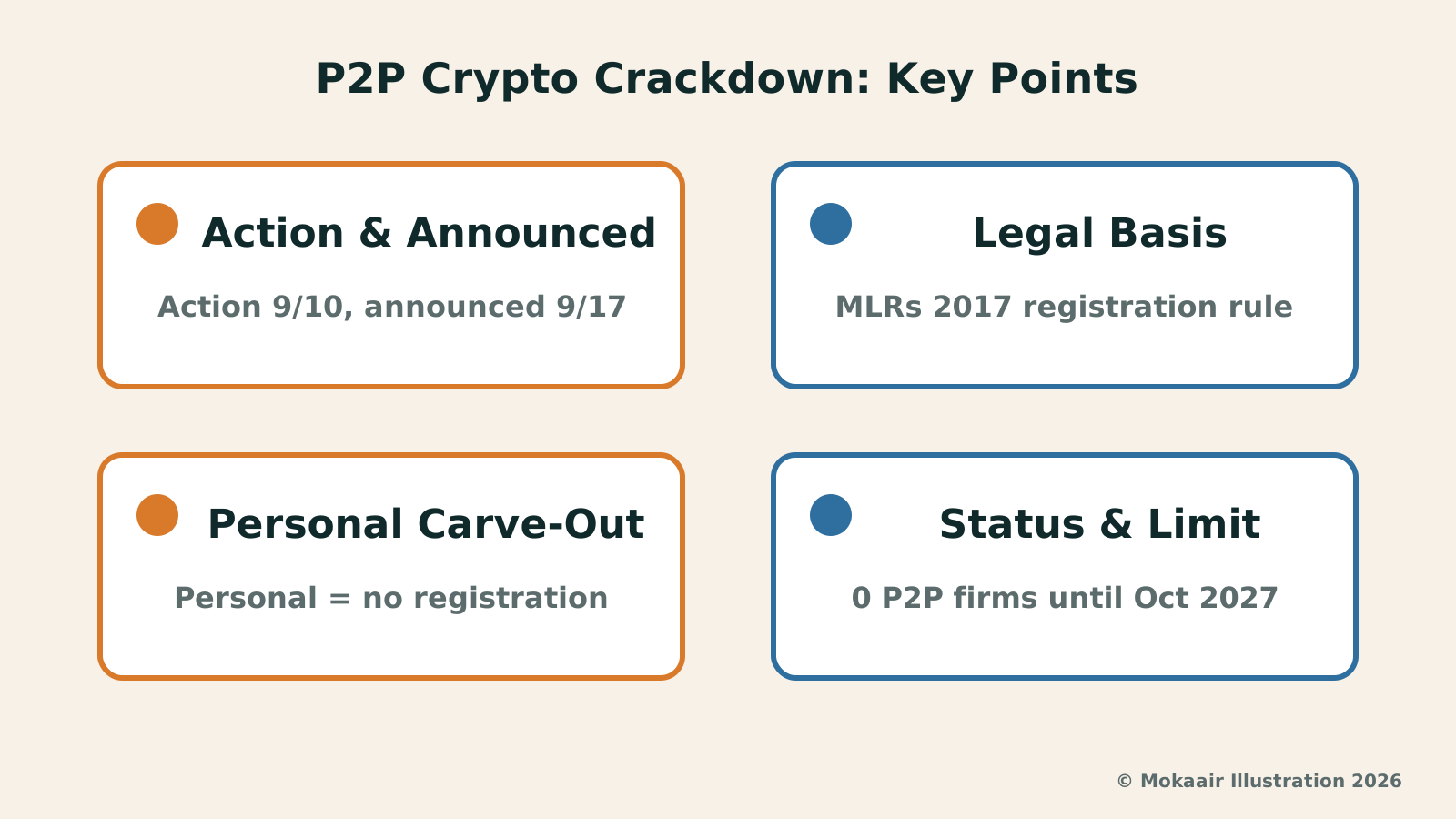
On September 17, 2026, the UK's Financial Conduct Authority (FCA) announced that it had again taken action against illegal peer-to-peer crypto trading in London, working with HM Revenue & Customs (HMRC) and the Metropolitan Police Service. The press release's "Notes to editors" section states that the action itself took place 7 days earlier, on September 10, 2026. The action targeted 3 premises in London suspected of illegal peer-to-peer crypto trading, and all 3 received cease and desist letters requiring them to stop any suspected illegal crypto business. The FCA did not disclose the premises' addresses or the traders' names, and the press release does not say that anyone was arrested, charged or penalized over this action.
This article was checked on September 18, 2026, drawing on the press release for this action, the FCA's press release for a similar action in April this year, and the Firm Checker help page. This site did not use Firm Checker to look up any business, and did not verify the identity of the 3 premises; no hands-on testing was performed. This article explains the UK regulator's enforcement and registration regime; it does not evaluate any business and does not offer investment or legal advice, and it does not speculate about any detail the press releases do not disclose.
What happened: 3 premises received cease and desist letters
The legal basis for this action is the UK's Money Laundering, Terrorist Financing and Transfer of Funds (Information on the Payer) Regulations 2017 (referred to below as MLRs 2017). The FCA states that this action was carried out together with HMRC and the Metropolitan Police Service.
The press release does not describe what kind of premises these 3 were, their addresses, or the identity of their operators, and as far as this action is concerned it does not mention any arrest, charge or penalty — only cease and desist letters. The wording used is "suspected," so this article does not describe it as "3 illegal businesses uncovered."
The FCA states that this action follows on from action it took against illegal peer-to-peer crypto trading businesses in April 2026, and that the evidence gathered then is being used to support criminal investigations and other enforcement action. The FCA's Executive Director of Enforcement and Market Oversight said the FCA continues to track and disrupt illegal crypto activity; a Metropolitan Police Service officer likewise said that the complexity of cryptocurrency and the speed at which funds can move across jurisdictions keep posing challenges for investigators. These are the agencies' own statements, not this article's assessment.
Why this counts as illegal: registration is mandatory, and the number registered is zero
The FCA defines peer-to-peer trading itself in the press release: it is when individuals buy and sell crypto directly with each other, and anyone doing this by way of business in the UK requires appropriate registration. The FCA then explains why: unregistered peer-to-peer crypto traders operating by way of business can provide a route for criminals to move and launder illicit funds, because by operating outside the FCA's registration regime, they avoid the controls designed to detect and prevent money laundering.
The key number is zero. Both this press release and April's state the same sentence: there are currently no FCA-registered peer-to-peer crypto businesses operating in the UK. In other words, as the press releases put it, not one business trading this way by way of business is registered.
The press releases do not state how many crypto businesses overall are registered under MLRs 2017 in the UK; they only state that the peer-to-peer category stands at zero. This article also does not count them itself on the FCA's register, because that register changes at any time, and a count taken at the moment of checking would only be a snapshot, not a fact stated by the press release itself.
| Situation | Current UK rule | What the FCA press releases say |
|---|---|---|
| Peer-to-peer trades on a personal basis | No FCA registration required | Carve-out added when the press release was revised on May 18, 2026 |
| Peer-to-peer crypto trading by way of business | Must complete FCA registration | Currently zero registered |
| Operating by way of business without registration | May be unlawful under MLRs 2017 | All 3 premises received letters this time |
| General crypto activity outside AML and financial promotion | Largely unregulated | This continues until October 2027 |
| Checking whether a business is registered | Almost all financial firms must be authorised or registered | FCA recommends Firm Checker; see the tool's help page for what it cannot show |
The phrase “by way of business”: trading between individuals doesn't need registration
This is the part of the story most likely to be misread. After April's press release, the FCA went back and revised its second paragraph on May 18, 2026; the update note at the top of the page states that the paragraph was changed to read: "Where the activity is carried out by way of business in the UK, it requires appropriate registration. Without registration, that activity is illegal. Peer-to-peer transactions carried out on a personal basis do not require FCA registration." This carve-out is not repeated in the September press release, but the two sentences stating the registration duty are word-for-word identical in both press releases, and both are limited to those acting "by way of business."
In other words, what the FCA is targeting is peer-to-peer crypto trading carried out "by way of business" without registration — not two people occasionally swapping crypto with each other. The press releases do not define a test for "by way of business," such as frequency, amount, or whether the activity is advertised to the public, and this article does not supply that definition on the FCA's behalf; readers who need to judge whether their own situation falls within "by way of business" should separately consult qualified professional advice or the FCA itself.
The following is an editorially constructed example, not a hands-on test: suppose two friends, each holding a different crypto-asset, privately agree to swap once — that is a peer-to-peer trade between individuals, and the FCA's wording does not count it toward the registration duty. But if someone regularly takes cash for crypto from members of the public at a fixed location, that is closer to what the press release calls "by way of business," and if that trader is not registered, they are the kind of target this action was aimed at. This site does not provide a how-to guide for "trading crypto safely in person," and does not make a judgment about any individual case.
How the two actions differ, and the current scope of regulation
This September's action differs from April's in scale and in the police unit involved. April's press release was published on April 22, 2026; that action involved HMRC and the South West Regional Organised Crime Unit (SWROCU) and targeted 8 premises. This September's action still involves HMRC, but the police unit is the Metropolitan Police Service, and it targeted 3 premises. Both actions issued cease and desist letters, and April's action also included on-site inspections; neither press release says that anyone was arrested, charged or penalized over either action.
Both press releases mention the FCA's own enforcement track record, using the word "including" — an example, not a complete list. September's press release cites prosecuting the operator of an unlawful crypto ATM network, and supporting the arrest of 2 individuals suspected of running an illegal crypto exchange; April's press release specifies that the latter took place in June 2024, working with the Metropolitan Police Service.
These two actions could be carried out because the registration requirement under MLRs 2017 is already in force; but the scope of crypto regulation in the UK is itself still expanding. The Notes to editors in this press release state: crypto is a high-risk investment and remains largely unregulated in the UK, except for anti-money laundering and financial promotion, until October 2027. In other words, until October 2027, the basis the FCA can mainly use to enforce against peer-to-peer crypto trading is the MLRs 2017 registration requirement used in this action.
What individuals can do: check registration first, and remember the tool's limits
September's press release gives consumers only one piece of advice: use the FCA's Firm Checker (a business lookup tool) to confirm whether a crypto business is correctly registered. Firm Checker's own help page states that the tool is for checking whether a financial business is authorised by the FCA and has permission to provide the service you want; the FCA also explains on the same page that almost all financial firms in the UK must be authorised or registered by the FCA.
But Firm Checker also states its own limits: the FCA explicitly says the tool cannot confirm whether Financial Services Compensation Scheme or Financial Ombudsman Service protection would definitely apply if something went wrong, and reminds users that it's still up to them to check that a product or service meets their needs. The FCA also explains that using an authorised firm with the correct permissions "won't remove all risk," though it will greatly reduce the risk of harm. Being able to find a registration is not the same as a guarantee of safety.
This approach can be applied in any country: before trading, first confirm what capacity the other party is regulated in (as an individual, or operating by way of business), what registration or permission can be found, and what cannot be found — rather than judging only by whether they have a storefront. This article covers only the UK's situation and does not speculate on whether Taiwan would take similar action; comparing this with Taiwan's current situation would require separately verifying it against Taiwanese primary sources.
Frequently asked questions
Was anyone arrested or charged over this action?
The press release doesn't say. The FCA's press release states only that all 3 premises received cease and desist letters; it does not say that anyone was arrested, charged or penalized over this action. The same press release separately mentions the FCA's past enforcement record, but that refers to other cases. The wording used is "suspected," not a finding of guilt.
My friend and I privately swapped crypto for cash once — is that illegal?
When the FCA revised its press release on May 18, 2026, it specifically added a sentence: peer-to-peer transactions carried out on a personal basis do not require FCA registration. What the FCA targets is peer-to-peer crypto trading carried out "by way of business" without registration, not an occasional swap between two people; but the FCA does not specifically define a test for "by way of business," so individual situations should be checked separately with qualified professional advice.
The action took place on September 10 — why was it announced on September 17?
The FCA states the actual date the action took place in the "Notes to editors" section of the press release, rather than in the body of the release itself. This action took place on September 10, 2026, and the FCA announced it publicly 7 days later, on September 17 — the two are different dates.
What's different between the April and September actions?
April's action involved HMRC and the South West Regional Organised Crime Unit, targeted 8 premises, and its press release was published on April 22 and then revised again on May 18. September's action still involves HMRC, but the police unit is the Metropolitan Police Service, and it targeted 3 premises. Both actions issued cease and desist letters; April's action also included on-site inspections.
Is crypto regulated in the UK at all right now?
The FCA explains that crypto remains largely unregulated in the UK, other than for anti-money laundering and financial promotion, and that this continues until October 2027. The legal basis used in both of these actions is the MLRs 2017 registration requirement, part of the anti-money laundering framework — not a complete crypto regulatory regime.
How can I check whether a crypto business is registered?
In this press release, the FCA's advice to consumers is to use the Firm Checker lookup tool. But Firm Checker itself states that it cannot confirm whether Financial Services Compensation Scheme or Financial Ombudsman Service protection would definitely apply if something went wrong, and that using an authorised firm "won't remove all risk" — it will only greatly reduce the risk of harm. Being able to find a registration is not the same as a guarantee of safety.
2026 Crypto News Roundup: Key Developments in Regulation, Technology and Industry2026 Crypto News Roundup: Key Developments in Regulation, Technology and IndustryThis site's 2026 crypto news explainers, in six jurisdictions — Taiwan, the US, the UK, the EU, Japan, South Korea: the Virtual Asset Service Act, the proposed GENIUS Act rules, the joint SEC–CFTC interpretation and the SEC's own proposal, the end of MiCA's transitional period and its link to the payment rules, the FCA's perimeter guidance, Japan's FSA reports and South Korea's manipulation referrals. Regulation, technology and industry only, no prices, with official sources and a check date.Read the full article
UK FCA Publishes Final Cryptoasset Perimeter Guidance PS26/18: Applications Open September 30, New Regime Takes Effect October 2027UK FCA Publishes Final Cryptoasset Perimeter Guidance PS26/18: Applications Open September 30, New Regime Takes Effect October 2027On September 16, 2026, the UK's Financial Conduct Authority (FCA) published policy statement PS26/18, Cryptoasset Perimeter Guidance, explaining when cryptoasset activities require FCA authorisation. Drawing on the FCA's press release and the 140-page PS26/18, this article sets out three separate dates — guidance published, applications open, new regime in effect — the seven newly regulated activities, and places this timeline beside Taiwan's Virtual Asset Service Act.Read the full article
Lifestyle
UK FCA Publishes Final Cryptoasset Perimeter Guidance PS26/18: Applications Open September 30, New Regime Takes Effect October 2027
On September 16, 2026, the UK's Financial Conduct Authority (FCA) published policy statement PS26/18, Cryptoasset Perimeter Guidance, explaining when cryptoasset activities require FCA authorisation. Drawing on the FCA's press release and the 140-page PS26/18, this article sets out three separate dates — guidance published, applications open, new regime in effect — the seven newly regulated activities, and places this timeline beside Taiwan's Virtual Asset Service Act.
Lifestyle
CFTC No-Action Letter Expands to All Passive Software Providers: The Line Drawn by Ten Conditions
On September 17, 2026, the CFTC's Market Participants Division issued no-action letter Letter 26-25, extending Letter 26-09 -- until then available only to a single applicant, Phantom -- to all passive software providers. Drawing on both letters' full text and the press release, this article explains the ten conditions, what is and is not allowed, and how a no-action letter differs from a Commission rule in effect; it offers no investment or legal advice, and was checked on September 18, 2026.
Lifestyle
Brazil's Petrobras tests Cardano blockchain to track claims about cleaner jet fuel and diesel
According to CoinDesk, Brazil's state-owned energy company Petrobras is testing the Cardano blockchain in two research projects: one to stop the same emissions cut from sustainable aviation fuel being counted twice, the other to record the history of its partly renewable Diesel R. Both are still research work, with no timeline for wider use.
Lifestyle
Cboe and S&P Dow Jones Indices extend their S&P 500 options deal to 2051 and leave the door open to tokenized options
According to CoinDesk, exchange operator Cboe and index provider S&P Dow Jones Indices have extended Cboe's exclusive right to offer S&P 500 options by 25 years, to 2051. The deal says they may explore blockchain-based 'tokenized' options, but no product, timeline or details were announced. Here is what that means and what it does not.
Articles that cite this one
Latest travel guides

GuideTokyo
Where to Stay in Tokyo: Comparing Shinjuku, Ueno, Tokyo Station, Shibuya, Asakusa, Ikebukuro, and Ginza, Plus Airport Access, Accommodation Tax, and Luggage Delivery
Where should you stay in Tokyo? Compare Shinjuku, Ueno, Tokyo Station, Shibuya, Asakusa, Ikebukuro, and Ginza by the same criteria: access from Narita and Haneda, transit routes, nearby attractions, neighborhood character, and who each area suits. Includes a comparison table, a Yamanote Line diagram, Tokyo’s accommodation tax as verified in 2026/9 (changing to 3% in 2027/4), and Airport TA-Q-BIN luggage shipping rules.
- Budget
- Hotels

GuideTokyo
How to Choose Tokyo Transit Passes: Are Suica, Welcome Suica, the Tokyo Subway Ticket, and the JR Pass Worth It?
On a first Tokyo trip, start with an IC card and pay per ride (Welcome Suica has no deposit and is valid for 28 days). If you take four or more subway rides in a day, add a 72-hour Tokyo Subway Ticket for 2,000 yen; a JR Pass is never worthwhile if you stay in Tokyo and do not go to Kansai. See what TOURIST PASMO, Suica on iPhone, and the Tokyo Metro day pass do and do not cover, with a decision chart. Prices verified in September 2026.
- Transport
- Budget

GuideTokyo
Tokyo Disneyland and DisneySea Guide: Ticket Prices, Fantasy Springs, Disney Premier Access (DPA), Standby Pass, and Which Park to Choose for Your First Visit
Tokyo Disney one-day Passport prices vary: most weekdays in 9/2026 cost ¥9,900 and weekends ¥10,900. At 14:00 daily, tickets go on sale for the same date two months later. Free Priority Pass is no longer on the official service list; only paid Disney Premier Access (¥1,000–3,500 per person per use) shortens waits. Covers hours, the 25th anniversary, Standby Pass, Entry Request, Fantasy Springs access and first-visit park choice; checked on the official site in 9/2026.
- Itineraries
- Family
Sources
- FCA: FCA and partners continues crackdown on illegal crypto trading (press release, first published 2026-09-17) · Checked:
- FCA: FCA leads first crackdown on illegal crypto trading (press release, first published 2026-04-22, updated 2026-05-18) · Checked:
- FCA: FCA Firm Checker (consumer lookup tool help page) · Checked: