Lifestyle
South Korea Refers 4 Suspected Virtual-Asset Manipulation Cases to Investigators: API-Made Fake Activity, Issuer-Inflated Volume to Keep a Listing
On September 23, 2026, South Korea's Financial Services Commission resolved at its 16th regular meeting to refer or notify investigators about 4 suspected virtual-asset market manipulation cases it investigated together with the Financial Supervisory Service; this article summarizes the methods described in each case and the regulator's warnings to ordinary investors from the official press-reference material, without naming any coin, exchange or amount (checked September 2026).
About 14 min read
On September 23, 2026, South Korea's Financial Services Commission (FSC; 금융위원회 — a different agency from Taiwan's Financial Supervisory Commission) resolved at its 16th regular meeting to file a criminal complaint (고발) or notify the investigative authorities (수사기관 통보) about the suspects in 4 cases of suspected unfair trading in the virtual-asset market that it investigated together with the Financial Supervisory Service (FSS; 금융감독원). The announcement never named any virtual asset, exchange or individual, but the methods described in all 4 cases involved artificial trades made to make buying and selling look active, 3 of them relying on small, high-frequency orders. The warning signs the financial authorities flagged are things readers can check for themselves on any platform.
This article's information was checked on September 26, 2026. The parties in all 4 cases are suspects only, not people who have been indicted or convicted; the methods described below are all allegations made by the financial authorities after investigating. This article does not make any market call, and does not offer investment or legal advice.
What Happened on September 23: 4 Suspected Cases, Two Kinds of Disposition
The Financial Services Commission states that this time, the financial authorities (the FSC and the FSS) jointly investigated and then resolved to file a criminal complaint or notify the investigative authorities regarding the suspects in 4 cases of suspected unfair trading in the virtual-asset market; 3 of them were ultra-short-term price manipulation cases carried out using tools such as automated trading programs (APIs), and the remaining 1 was a case of unfair trading and price manipulation by executives and employees of a virtual-asset operating company.
Of the 4 cases, only Case 3 was disposed of as a criminal complaint (고발); the rest — Cases 1, 2 and 4 — were disposed of as notifications to the investigative authorities (수사기관 통보). The subjects of both kinds of disposition are called suspects (혐의자); until the investigative authorities reach a conclusion, or even until a court judgment becomes final, these people remain only suspects, not convicted persons.
The announcement also does not say which specific body — prosecutors or police — these 4 cases will be referred to, calling it only the "investigative authorities"; it does not name the virtual assets, exchanges or suspects involved, does not state the total number of suspects, and gives no figure for illicit gains, no fine, and no legal provision; nor does it state the period over which the conduct or the investigation took place — the only period mentioned is "several months" for Case 4. These gaps exist because the official press-reference material itself does not state them, not because this article has left them out.
How Each of the Four Cases Worked
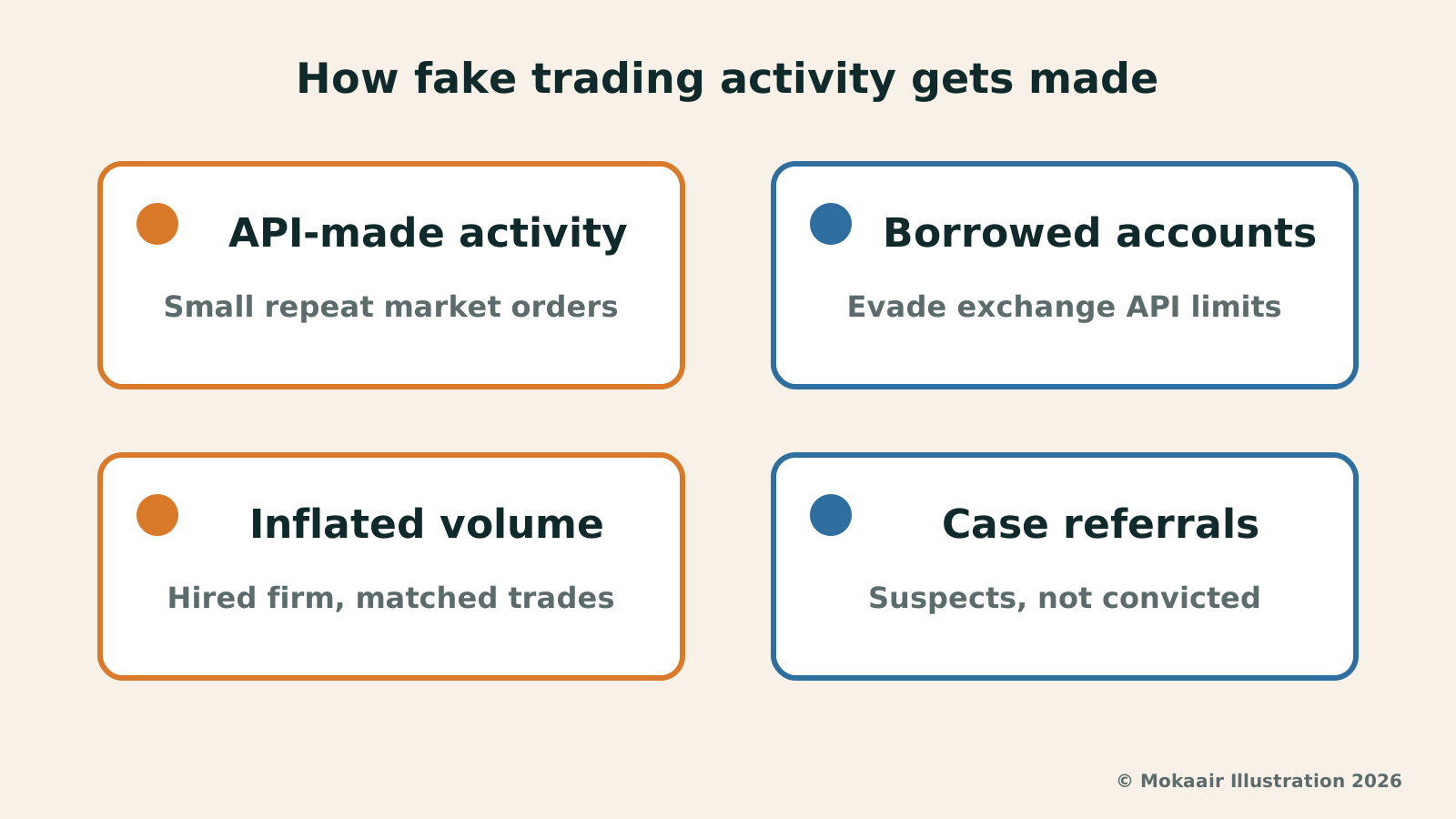
The suspects in Cases 1 and 2 are biological brothers who each used the same method on multiple virtual assets: they first used tactics such as high-price limit buy orders to quickly accumulate the quantity they intended to manipulate, then used an automated trading program (API) to repeatedly place market buy and sell orders in small, identical quantities, making the order book flicker and appear to be trading actively — an effect the authorities call the "호가창 반짝임 효과" (order-book flicker effect). At the same time, they manually placed high-price limit buy orders to drive the price up, and once the price reached the target they had set, they quickly sold everything through low-price sell orders. The Financial Services Commission has classified this as two separate cases, each carried out by one person using the same method, rather than as a single case of the brothers acting together.
Beyond a similar manipulation method, Case 3 added one more element: to evade the exchange's limit on the number of API orders, the suspect used accounts registered in other people's names in addition to their own, and first accumulated a large pre-purchase of dozens of virtual assets. The Financial Services Commission states that the exit method was to place high-price sell orders in advance and then gradually push the price up, letting those previously placed sell orders execute in sequence, thereby liquidating the holdings. Case 3 is the only one of the 4 disposed of as a criminal complaint.
Case 4 involves a conspiracy among executives and employees, among others, of a virtual-asset operating company. The Financial Services Commission states that, to make the virtual asset they issued and operated appear to be trading actively on an exchange, these people hired a professional trading firm (the so-called "마켓메이킹 업자," or market maker) and used borrowed-name accounts to trade with each other (가장매매, meaning wash trading) — artificially inflating the trading volume. The inflated volume made up more than 90% of total trading volume, and was used both to attract investors and as a qualifying condition when applying to list on a major exchange; the announcement does not say which exchange, or over what period, this "total" trading volume was measured. The Financial Services Commission states that the issuing foundation for this virtual asset was merely a shell company set up in a tax haven, with actual issuance and operation handled by a domestic corporation the suspects had set up, and that the foundation's key figures listed in the white paper were confirmed to have an unclear or fictitious identity.
The suspects in Case 4 applied several times to list on major domestic exchanges in South Korea and failed each time, so they first listed on a mid-sized exchange where listing was easier, then used wash trading to inflate volume and falsely meet the exchange's listing-maintenance requirements, leading ordinary investors to believe for several months that trading was active. The Financial Services Commission states that the purpose of doing this was to use it as a basis for additionally listing the same virtual asset on other major exchanges, but the announcement does not say whether this virtual asset ultimately succeeded in getting listed.
| Case | Key method | Disposition |
|---|---|---|
| Cases 1 & 2 (brothers, acting separately) | Repeated small market buy/sell orders via API made the order book flicker, combined with manual high-price limit buy orders to drive up the price, then a full sell-off once the target price was reached | Notification to investigative authorities (수사기관 통보) |
| Case 3 | Also used accounts in other people's names to evade the exchange's limit on API orders; placed high-price sell orders in advance, then gradually pushed the price up to liquidate | Criminal complaint (고발) |
| Case 4 | Executives and employees of the operating company hired a market maker and used borrowed-name accounts to trade with each other and inflate volume, making up more than 90% of total trading volume | Notification to investigative authorities (수사기관 통보) |
What Happens After the Resolution: Still Suspicion, Not a Conviction
The parties in all 4 cases are called suspects (혐의자) throughout the announcement; the disposition is a criminal complaint or a notification to the investigative authorities, not a court judgment. Whether these people are found to have committed a crime will only be known after the investigative authorities investigate, or even after a court hears the case.
In other words, this resolution only sends the suspects to the starting point of the next process; the announcement does not say how long that will take or what the outcome will be. The financial authorities state that they will strengthen monitoring of abnormal trading, including trading patterns similar to those in this case, going forward, and will respond firmly when unfair trading is found — but this is the regulator's statement about the future, without a specific timeline.
Warning Signs the Financial Authorities Flagged
The Financial Services Commission and the Financial Supervisory Service advise: "이용자들은 이유 없이 시세가 급등하는 종목에 대한 추격매수를 자제하고, 투자종목 선정시 가상자산 설명서와 백서 등을 꼼꼼히 확인할 필요" (users should refrain from chasing prices on assets that surge for no clear reason, and should carefully check materials such as a virtual asset's prospectus and white paper when choosing an investment). The reason is that some actors may use tools such as automated trading programs (APIs) to execute a large number of trades, making trading look active or prices look highly volatile; chasing the price based only on this appearance can lead to a sudden drop at any time and losses for ordinary users. This is a warning from the regulators to investors, not buy-or-sell advice.
The second warning sign is concentration: the financial authorities point out that when a virtual asset that previously traded thinly sees its trading volume and price surge for no clear reason, or when trading volume is concentrated only on a specific exchange, artificial trading may be involved. The third warning sign concerns the issuer: the financial authorities advise that, especially when the issuing foundation is based in an offshore tax haven with an unclear substance, investors should carefully check the actual operating entity, the amount in circulation inside and outside South Korea, project progress and other such matters, and carefully check materials such as the virtual asset's prospectus (가상자산 설명서) and white paper, rather than judging only by the surface appearance of trading activity.
How to Verify This Yourself, and What It Means for Readers in Taiwan
To see the original announcement, you can find this September 23, 2026 item in the Financial Services Commission's "보도자료" (press release) list on its official website; the page itself has only the title, the date and the handling contact, with the actual content in the attached PDF press-reference material. As of the check date, September 26, 2026, the latest item on the Financial Services Commission's English press-release list was still stuck at September 16, and did not yet include this one — readers who look only at the English version would miss this announcement.
This announcement is about a case in South Korea; it does not mention Taiwan, and this article does not speculate about whether Taiwan might take similar action. But the two warning signs the financial authorities describe — "creating a false appearance of active trading through small, high-frequency trades" and "an issuing foundation based in an offshore tax haven with an unclear substance" — are things readers can check for themselves whenever they see some obscure asset suddenly look "very active" on any platform, rather than looking only at the number of trades shown on screen.
Frequently asked questions
Have the parties in these 4 cases already been convicted?
No. The Financial Services Commission's disposition is a criminal complaint or a notification to the investigative authorities; the parties in the announcement are called suspects (혐의자) throughout, not people who have been indicted or convicted. Whether a crime is established will only be known after the investigative authorities investigate, or even after a court hears the case.
Was the disposition the same for all 4 cases?
No. Case 3 was disposed of as a criminal complaint (고발), while Cases 1, 2 and 4 were disposed of as notifications to the investigative authorities (수사기관 통보). The 4 cases also did not use the same method: Cases 1 and 2 involved brothers each repeatedly placing small trades via API to create a false appearance of activity; Case 3 added the use of another person's account to evade the exchange's limit on the number of API orders; Case 4 involved the operating company's executives and employees, among others, hiring a market maker and trading with each other through borrowed-name accounts to inflate volume — only Case 4 was described in the announcement as "가장매매" (wash trading).
Did the announcement name a specific virtual asset or exchange?
No. The announcement uses only generic terms such as "a major domestic virtual-asset exchange," "a mid-sized exchange" and "a virtual-asset exchange," without naming any virtual asset, exchange or suspect, and without stating the amount of illicit gains, any fine, or a specific legal provision.
Is South Korea's Financial Services Commission the same agency as Taiwan's Financial Supervisory Commission?
No. The Financial Services Commission (금융위원회, Financial Services Commission) is South Korea's financial regulator, a different agency in a different country from Taiwan's Financial Supervisory Commission (金管會). This investigation was also carried out by the Financial Services Commission together with the Financial Supervisory Service (금융감독원).
Case 4 says the inflated trading volume made up more than 90%. What does that mean?
This is a proportion determined by the financial authorities (the Financial Services Commission and the Financial Supervisory Service) after investigation: the trading volume the suspects in Case 4 inflated made up more than 90% of "total trading volume," and was used both to attract investors and as a qualifying condition for applying to list on a major exchange. The announcement does not say which exchange, or over what period, this "total trading volume" was measured.
How can an ordinary person tell whether a virtual asset's activity is "manufactured"?
Warning signs the financial authorities flag include: a previously thinly traded asset whose trading volume and price surge for no clear reason; trading volume concentrated on a specific exchange; and an issuing foundation based in an offshore tax haven with an unclear substance. The financial authorities also advise refraining from chasing prices on assets that surge for no clear reason, and carefully checking materials such as a virtual asset's prospectus and white paper — these are all warnings from the regulators, not buy-or-sell advice.
2026 Crypto News Roundup: Key Developments in Regulation, Technology and Industry2026 Crypto News Roundup: Key Developments in Regulation, Technology and IndustryThis site's 2026 crypto news explainers, in six jurisdictions — Taiwan, the US, the UK, the EU, Japan, South Korea: the Virtual Asset Service Act, the proposed GENIUS Act rules, the joint SEC–CFTC interpretation and the SEC's own proposal, the end of MiCA's transitional period and its link to the payment rules, the FCA's perimeter guidance, Japan's FSA reports and South Korea's manipulation referrals. Regulation, technology and industry only, no prices, with official sources and a check date.Read the full article
FCA Cracks Down on Illegal Peer-to-Peer Crypto Trading in London: Action on September 10, Announced September 17FCA Cracks Down on Illegal Peer-to-Peer Crypto Trading in London: Action on September 10, Announced September 17On September 17, 2026, the UK's Financial Conduct Authority (FCA) announced that it, HMRC and the Metropolitan Police Service had acted against 3 premises in London on September 10 over suspected illegal peer-to-peer crypto trading. Drawing on two FCA press releases and its Firm Checker help page, this article lays out why the registration duty applies only to those trading by way of business, the carve-out for trades between individuals, and the limits of the consumer lookup tool itself.Read the full article
Lifestyle
Japan's FSA Sets Up an Onchain Finance Forum: Stablecoins, Tokenized Deposits and JGB Tokenization Go Into a Cross-Ministry Review
On September 25, 2026, Japan's Financial Services Agency announced a cross-ministry 「AI時代を見据えたオンチェーン金融フォーラム」 (an Onchain Finance Forum With an Eye on the AI Era), putting stablecoins, tokenized deposits, JGB tokenization and quantum-computing risk on one review list. This sets up a forum for review, not a law change or approval of any product; its first meeting is scheduled for September 30 and is closed to the public (verified September 2026).
Lifestyle
Taiwan's Central Bank on Stablecoins, Deposit Tokens and CBDC: Layers Can Coexist, No Urgency Yet for Retail CBDC
On September 17, 2026, the Central Bank of the Republic of China (Taiwan) compared stablecoins, deposit tokens and central bank digital currency (CBDC), saying there is no urgency to issue a retail CBDC while research and trials continue on the wholesale side. This article covers who issues each, how they circulate and are regulated, and Taiwan's trial progress; the FSC's separate deposit-token pilot five days later is a different story (checked September 2026).
Lifestyle
Brazil's Petrobras tests Cardano blockchain to track claims about cleaner jet fuel and diesel
According to CoinDesk, Brazil's state-owned energy company Petrobras is testing the Cardano blockchain in two research projects: one to stop the same emissions cut from sustainable aviation fuel being counted twice, the other to record the history of its partly renewable Diesel R. Both are still research work, with no timeline for wider use.
Lifestyle
Cboe and S&P Dow Jones Indices extend their S&P 500 options deal to 2051 and leave the door open to tokenized options
According to CoinDesk, exchange operator Cboe and index provider S&P Dow Jones Indices have extended Cboe's exclusive right to offer S&P 500 options by 25 years, to 2051. The deal says they may explore blockchain-based 'tokenized' options, but no product, timeline or details were announced. Here is what that means and what it does not.
Articles that cite this one
Latest travel guides
GuideTokyo
Where to Stay in Tokyo: Comparing Shinjuku, Ueno, Tokyo Station, Shibuya, Asakusa, Ikebukuro, and Ginza, Plus Airport Access, Accommodation Tax, and Luggage Delivery
Where should you stay in Tokyo? Compare Shinjuku, Ueno, Tokyo Station, Shibuya, Asakusa, Ikebukuro, and Ginza by the same criteria: access from Narita and Haneda, transit routes, nearby attractions, neighborhood character, and who each area suits. Includes a comparison table, a Yamanote Line diagram, Tokyo’s accommodation tax as verified in 2026/9 (changing to 3% in 2027/4), and Airport TA-Q-BIN luggage shipping rules.
- Budget
- Hotels

GuideTokyo
How to Choose Tokyo Transit Passes: Are Suica, Welcome Suica, the Tokyo Subway Ticket, and the JR Pass Worth It?
On a first Tokyo trip, start with an IC card and pay per ride (Welcome Suica has no deposit and is valid for 28 days). If you take four or more subway rides in a day, add a 72-hour Tokyo Subway Ticket for 2,000 yen; a JR Pass is never worthwhile if you stay in Tokyo and do not go to Kansai. See what TOURIST PASMO, Suica on iPhone, and the Tokyo Metro day pass do and do not cover, with a decision chart. Prices verified in September 2026.
- Transport
- Budget

GuideTokyo
Tokyo Disneyland and DisneySea Guide: Ticket Prices, Fantasy Springs, Disney Premier Access (DPA), Standby Pass, and Which Park to Choose for Your First Visit
Tokyo Disney one-day Passport prices vary: most weekdays in 9/2026 cost ¥9,900 and weekends ¥10,900. At 14:00 daily, tickets go on sale for the same date two months later. Free Priority Pass is no longer on the official service list; only paid Disney Premier Access (¥1,000–3,500 per person per use) shortens waits. Covers hours, the 25th anniversary, Standby Pass, Entry Request, Fantasy Springs access and first-visit park choice; checked on the official site in 9/2026.
- Itineraries
- Family
Sources
- Financial Services Commission press release: Referral of Suspects in Virtual-Asset Market Unfair Trading to Investigative Authorities — Resolved at the 16th FSC Regular Meeting (Sep 23, '26) · Checked:
- (FSC) 260923 press reference: Referral of Suspects in Virtual-Asset Unfair Trading to Investigators.pdf (FSC and FSS press-reference material, 5 pages) · Checked:
- Financial Services Commission press release list (Korean-language list) · Checked:
- Financial Services Commission: Press Releases (English press-release list) · Checked: