Lifestyle
The OCC's Proposed Stablecoin Rules: One-to-One Reserves, Redemption in Two Business Days and Periodic Reporting
On March 2, 2026 the U.S. Office of the Comptroller of the Currency published a proposed rule on payment stablecoins implementing the GENIUS Act in the Federal Register, cited as 91 FR 10202 and running to 102 pages, with comments due by May 1, 2026. Working from the Federal Register full text and the public law text of the GENIUS Act, this article sets out whom the new 12 CFR part 15 would reach, what it would require on reserves and redemption, and why it is not yet a rule in force.
About 16 min read
On March 2, 2026 the Office of the Comptroller of the Currency (OCC), a bureau of the U.S. Department of the Treasury, published a proposed rule on payment stablecoins in the Federal Register, cited as 91 FR 10202 and running to 102 pages, to implement the GENIUS Act. It would do that by adding a new 12 CFR part 15 and amending the existing parts 3, 6, 8 and 19.
This article was checked on September 17, 2026, reading the plain-text full text of the document as the Federal Register serves it, the metadata for that same document, and the public law text of the GENIUS Act on the U.S. Government Publishing Office's govinfo. We have tested nothing ourselves and we give no investment or legal advice; every requirement below comes from the text of the proposal and may still change before a final rule.
This is a proposal, not a rule already in force
The document carries Docket ID OCC-2025-0372 and RIN 1557-AF41, and the comment deadline the document prints is May 1, 2026. The Federal Register's metadata records the type as Proposed Rule, the document's ACTION field reads Notice of proposed rulemaking, and the fields for the effective date and the signing date are both null. Section III of the document is a whole section of questions for comment, numbered from Question 1 to Question 211.
The GENIUS Act's own timetable has to be counted separately. It is Public Law 119-27; the approval date printed at the end of the public law text is July 18, 2025, and section 20 gives a formula rather than a date, the Act becoming effective on the earlier of 18 months after the date of enactment, or 120 days after the primary Federal payment stablecoin regulators issue any final regulations implementing the Act. Footnote 12 of the proposal keeps two further dates apart: the prohibition on a digital asset service provider offering or selling a payment stablecoin not issued by a permitted payment stablecoin issuer begins on July 18, 2028, while the same kind of prohibition for stablecoins not issued by foreign payment stablecoin issuers that meet certain requirements applies from the GENIUS Act's effective date. Both provisions bind digital asset service providers, and the prohibitions apply to an issuer too, to the extent that the issuer is a digital asset service provider.
Whom the proposal would reach, and the gate to clear before issuing
Proposed § 15.1(b) lists six categories of covered entity: national banks, Federal savings associations and Federal branches, together with their respective subsidiaries; foreign payment stablecoin issuers; nonbank entities seeking or holding approval as a Federal qualified payment stablecoin issuer; and State qualified payment stablecoin issuers over which the OCC would have supervisory or enforcement authority under proposed § 15.15 or § 15.16. Footnote 93 states that the OCC would not approve an insured national bank or Federal savings association to issue directly, as opposed to through a subsidiary. The proposed definition also carries one key exclusion: the issuer must be obligated to convert, redeem or repurchase for a fixed amount of monetary value, and that amount does not include a digital asset denominated in a fixed amount of monetary value.
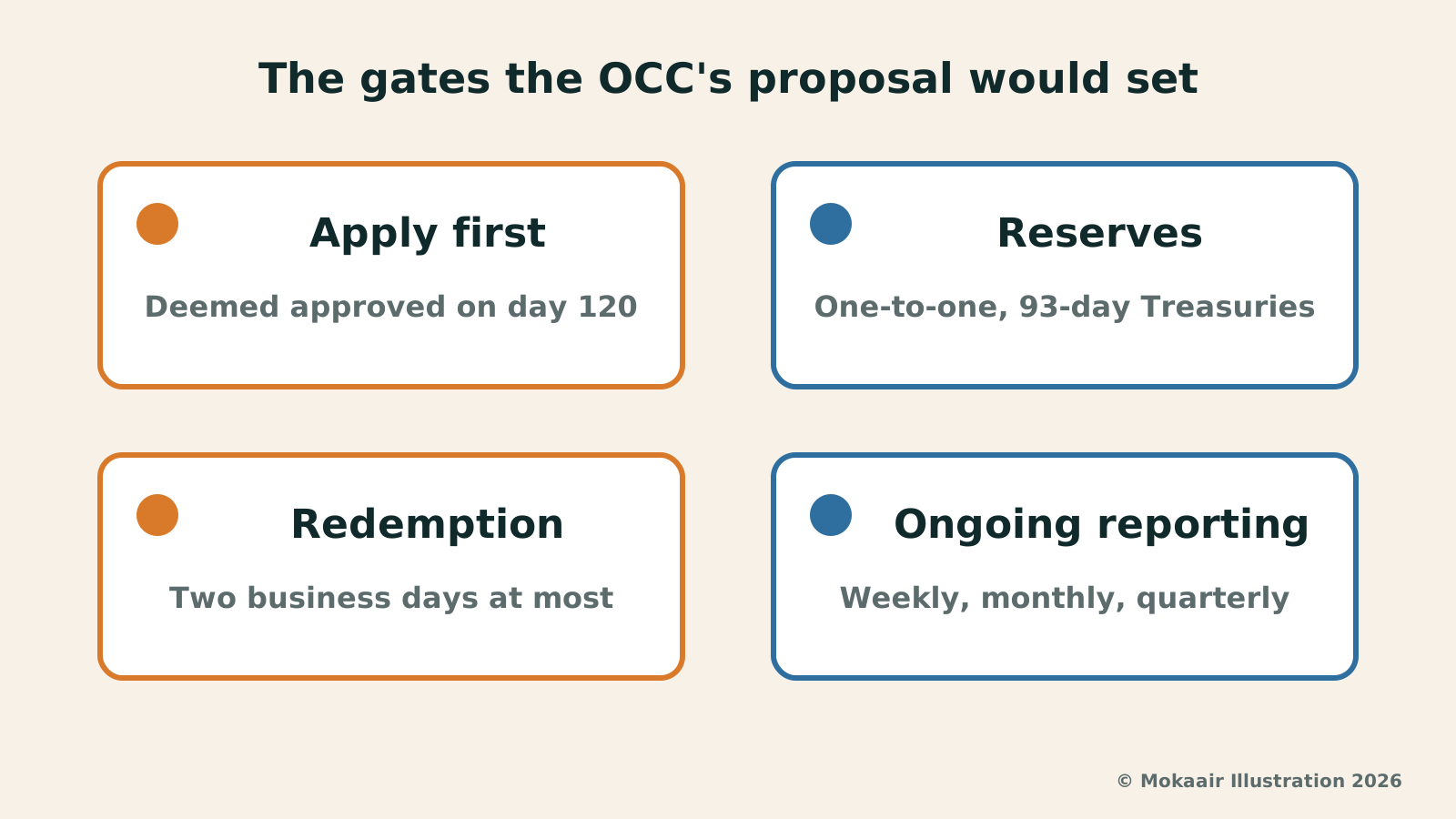
Proposed § 15.30(a) would require approval in advance: on the insured bank side through a subsidiary, and on the nonbank side by applying as a Federal qualified payment stablecoin issuer. The OCC would notify an applicant not later than 30 days after receipt whether the application is substantially complete; a substantially complete application would be deemed approved as of the 120th day after the OCC received the information that made it complete, unless the OCC denies it. Foreign issuers would register instead, and proposed § 15.31(a) sets four requirements, among them that the Secretary of the Treasury has determined the regime of the issuer's home-country regulator to be comparable to the Act, and that the issuer holds reserves at a United States financial institution sufficient to meet the demands of its U.S. customers (unless otherwise permitted under a reciprocal arrangement). Where a State qualified nonbank issuer has an outstanding issuance value of more than $10 billion, proposed § 15.15(b) would require it to move into the Federal framework within a set period, failing which it could not increase its outstanding issuance value on a net basis.
| Item | Proposed section | Period |
|---|---|---|
| Whether an application is substantially complete | Proposed § 15.30(b)(3) | Notice not later than 30 days after receipt |
| Deemed approved | Proposed § 15.30(b)(5) | The 120th day after the application is complete |
| Foreign issuer registration | Proposed § 15.32(b)(4) | The 30th day after the filing is received |
| Requesting a hearing after a denial | Proposed § 15.30(e)(1) | Within 30 days of receiving the notice |
| Anti-money laundering compliance certification | Proposed § 15.14(k) | Not later than 180 days after approval, annually thereafter |
The proposed reserves: one for one against par value, and only eight categories of asset
Proposed § 15.11(a)(1) would require reserve assets to be identifiable, held separately from the issuer's other assets and not commingled with them, and at all times to have a total fair value that equals or exceeds the issuer's outstanding issuance value; outstanding issuance value means the total consolidated par value of all of that issuer's payment stablecoins. Proposed § 15.11(b) would limit eligible reserve assets to eight categories; at their core are funds in an account at a Federal Reserve Bank or United States coins and currency, demand deposits or insured shares at insured depository institutions, and U.S. Treasury bills, notes and bonds with a remaining maturity of 93 days or less. Most of the remaining categories are derivative forms of those assets, such as repurchase and reverse repurchase agreements with a term of not more than overnight, and one of them is any other similarly liquid Federal Government-issued asset approved by the OCC.
On diversification and concentration the proposal sets out two versions side by side and says only one of them would be selected for a final rule: Option A is a principles-based requirement with an optional set of safe harbors, and Option B turns the same figures into mandatory limits. The figures are the same in both: on each business day at least 10 percent in demand deposits, insured shares or funds in an account at a Federal Reserve Bank, at least 30 percent in those plus receivables maturing unconditionally within five business days, no more than 40 percent at any one eligible financial institution, no more than 50 percent of that 10 percent tranche at any one institution, and a weighted average maturity of no more than 20 days. Where reserves fall short, proposed § 15.11(g) would require notice the same day and an immediate halt to new issuance (except as necessary to facilitate a transfer of payment stablecoins from one distributed ledger to another and provided that the net outstanding issuance value does not increase), and after 15 consecutive business days below the minimum, which the OCC may extend in its discretion, the issuer would have to begin liquidating reserve assets and redeeming, charging no redemption fee.
Redemption deadlines, disclosure and periodic reporting
Proposed § 15.12(b)(1)(i) would set timely redemption at no more than two business days following the date of the requested redemption, and the OCC explains that this is an outer limit. The discretionary limitations in (ii) of the same paragraph could be imposed only by the OCC, or, for a State qualified payment stablecoin issuer, by the OCC, the Federal Reserve or the State payment stablecoin regulator, as applicable. The proposal also states that these requirements would apply only to redemptions by the issuer and those acting on its behalf, and would not apply to secondary market trading. For stressed conditions there is an automatic provision: under proposed § 15.12(c)(1), when redemption requests in a single 24-hour period exceed 10 percent of the outstanding issuance value, the timely redemption period is immediately extended to seven calendar days by operation of that paragraph, and the issuer must report within 24 hours of crossing the threshold.
One further authority belongs beside that. Proposed § 15.16 would implement section 7 of the GENIUS Act: where the OCC finds unusual and exigent circumstances and has reasonable cause to believe that a nonbank State qualified payment stablecoin issuer's continuation of an activity, including a failure to act, poses a substantial risk to its financial safety, soundness or stability, the OCC would impose the limitations it considers necessary through a directive with the effect of a final cease-and-desist order, and the first limitation on the list is redemptions of payment stablecoins. Reporting runs on more than one cycle, and the proposal would require at least the following: a confidential report to the OCC each week; publication, before noon on the last day of each month, of the composition of the reserves as of the end of the previous month, examined by a registered public accounting firm and certified by the chief executive officer and the chief financial officer; a report of condition within 30 days after the end of each quarter; and a certification by the board of directors, not later than 180 days after approval and annually thereafter, that anti-money laundering and economic sanctions compliance programs are in place.
The parts that are not settled yet
In the capital section the OCC describes several variable add-on components but states expressly that they are not part of the proposed text; proposed § 15.42 would separately give the OCC case-by-case authority to impose additional capital or backstop requirements in the light of an individual issuer's circumstances, and lists seven example situations. What the proposed text does set is a minimum capital for a de novo issuer of the greater of the amount set as a condition of its charter or license and $5 million, plus an operational backstop equal to 12 months of total expenses. An issuer below those levels at the end of a quarter could not issue new payment stablecoins from the first day of the following month, and one below them at the end of two consecutive quarters would have to begin liquidating and redeeming. Proposed § 15.41(d) would also let an uninsured national trust bank elect these requirements in place of the capital and leverage requirements of 12 CFR part 3.
The fee amounts are not set yet: the proposal puts the same stablecoin reserve asset deduction in two places, amended § 8.2 and proposed § 8.10, and the actual percentage is published each year in the OCC's annual Notice of Fees. On the bank side there is proposed § 3.22(i): an insured national bank or Federal savings association that consolidates a permitted payment stablecoin issuer would have to deconsolidate that issuer when it calculates its capital ratios. The standards for anti-money laundering and sanctions compliance are left by the proposal to a different proposed rule.
What this proposal would bind is the categories of U.S. institution in proposed § 15.1(b), not readers in Taiwan; but what it would have them publish is something a reader can see. Proposed § 15.12(d)(1) would require an issuer to disclose in plain language its own name, the entity obligated to convert, a link to the monthly report on the composition of the reserves described above, and all fees associated with purchasing or redeeming; proposed § 15.10(c)(3) would separately prohibit an issuer from representing, directly or through implication, that its payment stablecoin is backed by the full faith and credit of the United States, guaranteed by the United States Government, or subject to Federal deposit insurance or share insurance.
Frequently asked questions
Is this rule already in force?
Not yet. The document's ACTION field reads Notice of proposed rulemaking, the Federal Register classifies it as a Proposed Rule, the effective date field in the metadata is null, and the comment deadline the document prints is May 1, 2026. The GENIUS Act's own effective date is still a formula as well: the earlier of 18 months after the date of enactment, or 120 days after the primary Federal payment stablecoin regulators issue any final regulations implementing the Act. To see whether a final rule has appeared, search the Federal Register by Docket ID OCC-2025-0372 or RIN 1557-AF41.
Does this have anything to do with the platforms I use in Taiwan?
This is a rule the Office of the Comptroller of the Currency proposes for the issuance of payment stablecoins by the institutions it supervises, and proposed § 15.1(b) says whom it would cover: national banks, Federal savings associations, Federal branches and their subsidiaries; foreign payment stablecoin issuers; nonbank entities seeking to become Federal qualified payment stablecoin issuers; and State qualified payment stablecoin issuers over which the OCC would have supervisory or enforcement authority. In the text of the proposal as checked for this article on September 17, 2026, obligations are imposed on issuers, custodians and regulators, and we saw no provision imposing an obligation on holders. Taiwan's own rules are a matter for Taiwan's law, which this article's sources do not cover; the second link at the end sets that act out.
Is redemption within two business days a guarantee?
What the proposal sets is a ceiling on the obligation, not a guarantee. Proposed § 15.12(b)(1)(i) sets timely redemption at no more than two business days after the request, but under proposed § 15.12(c)(1), once redemption requests in a single 24-hour period exceed 10 percent of the outstanding issuance value, the period is automatically extended to seven calendar days, unless the OCC determines the issuer can redeem earlier in an orderly manner through a fair and transparent process, or the OCC gives notice that the extended period no longer applies; proposed § 15.12(c)(5) would let the OCC extend it again where it finds a threat to safety and soundness or to financial stability, or that an extension is in the public interest; and proposed § 15.16 would let the OCC impose limitations on a nonbank State qualified issuer in unusual and exigent circumstances, the first of them being redemptions. All of this is still a proposal.
What does one-to-one reserves mean?
Proposed § 15.11(a)(1) would require reserve assets at all times to have a total fair value that equals or exceeds the issuer's outstanding issuance value, which is the total consolidated par value of that issuer's payment stablecoins. The comparison is fair value against par value. Proposed § 15.11(b) would also limit reserve assets to eight categories, in which U.S. Treasury securities may have a remaining maturity of 93 days or less; a money market fund that invests in any other assets, including such securities maturing in more than 93 days, would not qualify. Here is an editorially designed example: if a coin's par value is one dollar and a million are issued, the reserve assets would need a fair value of at least a million dollars, not what it fetches in the market. Proposed § 15.11(d) would also require an issuer with $25 billion or more outstanding to keep at least 0.5 percent of reserve assets, up to $500 million, in insured deposits or insured shares each business day.
Why does every sentence in this article say proposed?
Because the document is a proposal. Writing proposed in front of a section number is a reminder that the OCC has put the text forward and asked for comment, and that a final rule may differ. The clearest case in the proposal is reserve diversification and concentration: it sets Option A and Option B side by side, the document itself says only one of them would be selected for a final rule, and so 10 percent, 30 percent, 40 percent, 50 percent and 20 days are all, for now, figures in a proposal.
How do I check the current status of this case myself?
Use three identifiers: Docket ID OCC-2025-0372, RIN 1557-AF41, and the citation 91 FR 10202 or document number 2026-04089. Searching the Federal Register by the docket ID or the RIN lists every document filed under the same case, including any later extension notice or final rule. Incidentally, the title of the part 15 this document would add is printed two ways: the amendatory instruction reads PART 15--PAYMENT STABLECOINS and the authority citation list reads PART 15--STABLECOIN, and this article gives both as the source does.
2026 Crypto News Roundup: Key Developments in Regulation, Technology and Industry2026 Crypto News Roundup: Key Developments in Regulation, Technology and IndustryThis site's 2026 crypto news explainers, in six jurisdictions — Taiwan, the US, the UK, the EU, Japan, South Korea: the Virtual Asset Service Act, the proposed GENIUS Act rules, the joint SEC–CFTC interpretation and the SEC's own proposal, the end of MiCA's transitional period and its link to the payment rules, the FCA's perimeter guidance, Japan's FSA reports and South Korea's manipulation referrals. Regulation, technology and industry only, no prices, with official sources and a check date.Read the full article
Taiwan's Virtual Asset Service Act Clears Third Reading: Seven Kinds of Provider, Stablecoin Licensing, No Commencement Date YetTaiwan's Virtual Asset Service Act Clears Third Reading: Seven Kinds of Provider, Stablecoin Licensing, No Commencement Date YetOn June 30, 2026 Taiwan's Legislative Yuan passed the Virtual Asset Service Act (虛擬資產服務法) on third reading, and its 56 articles were promulgated on July 22, 2026. Working from the Financial Supervisory Commission's press release and two official legal databases, this article sets out the seven kinds of virtual asset service provider, licensing kind by kind, the reserve-asset rules for stablecoins, and why the 12- and 21-month transition periods in article 55 have not started running.Read the full article
Lifestyle
FinCEN and OFAC's Joint AML and Sanctions Compliance Proposal for Stablecoin Issuers, Not Yet in Effect
On April 10, 2026 a joint FinCEN and OFAC proposed rule, from two U.S. Treasury agencies, was published in the Federal Register (91 FR 18582). From the full text, FinCEN's fact sheet, the Treasury release and the Federal Register's docket lookup, this article sets out how the proposal would bring permitted payment stablecoin issuers under the Bank Secrecy Act, the four AML program requirements, the $5,000 suspicious activity reporting threshold, and OFAC's proposed sanctions compliance program.
Lifestyle
FDIC Stablecoin Proposal: Reserve Deposits Insured to the Issuer, Not Passed Through to Holders
On April 7, 2026 the board of the U.S. Federal Deposit Insurance Corporation (FDIC) approved a proposal implementing the GENIUS Act, published in the Federal Register on April 10 at 91 FR 18534. Working from that full text and the FDIC's own press release, this article sets out whom the proposal would reach, the proposed reserve asset and redemption requirements, and why it would count the deposit insurance on reserve deposits as the issuer's rather than each stablecoin holder's.
Lifestyle
NCUA's Proposed Stablecoin Standards: Credit Unions Could Issue Only Through a Subsidiary; Stablecoins Get No Share Insurance
On May 18, 2026 the U.S. National Credit Union Administration's supplemental proposed rule implementing the GENIUS Act was published in the Federal Register (91 FR 28956). From that full text, the NCUA press release, the enacted GENIUS Act and the agency's February licensing proposal: why a credit union could issue payment stablecoins only through a subsidiary, how tokenized shares and the coin differ on share insurance, and why every line here reads as a proposal.
Lifestyle
Brazil's Petrobras tests Cardano blockchain to track claims about cleaner jet fuel and diesel
According to CoinDesk, Brazil's state-owned energy company Petrobras is testing the Cardano blockchain in two research projects: one to stop the same emissions cut from sustainable aviation fuel being counted twice, the other to record the history of its partly renewable Diesel R. Both are still research work, with no timeline for wider use.
Articles that cite this one
Latest travel guides

GuideTokyo
Where to Stay in Tokyo: Comparing Shinjuku, Ueno, Tokyo Station, Shibuya, Asakusa, Ikebukuro, and Ginza, Plus Airport Access, Accommodation Tax, and Luggage Delivery
Where should you stay in Tokyo? Compare Shinjuku, Ueno, Tokyo Station, Shibuya, Asakusa, Ikebukuro, and Ginza by the same criteria: access from Narita and Haneda, transit routes, nearby attractions, neighborhood character, and who each area suits. Includes a comparison table, a Yamanote Line diagram, Tokyo’s accommodation tax as verified in 2026/9 (changing to 3% in 2027/4), and Airport TA-Q-BIN luggage shipping rules.
- Budget
- Hotels

GuideTokyo
How to Choose Tokyo Transit Passes: Are Suica, Welcome Suica, the Tokyo Subway Ticket, and the JR Pass Worth It?
On a first Tokyo trip, start with an IC card and pay per ride (Welcome Suica has no deposit and is valid for 28 days). If you take four or more subway rides in a day, add a 72-hour Tokyo Subway Ticket for 2,000 yen; a JR Pass is never worthwhile if you stay in Tokyo and do not go to Kansai. See what TOURIST PASMO, Suica on iPhone, and the Tokyo Metro day pass do and do not cover, with a decision chart. Prices verified in September 2026.
- Transport
- Budget

GuideTokyo
Tokyo Disneyland and DisneySea Guide: Ticket Prices, Fantasy Springs, Disney Premier Access (DPA), Standby Pass, and Which Park to Choose for Your First Visit
Tokyo Disney one-day Passport prices vary: most weekdays in 9/2026 cost ¥9,900 and weekends ¥10,900. At 14:00 daily, tickets go on sale for the same date two months later. Free Priority Pass is no longer on the official service list; only paid Disney Premier Access (¥1,000–3,500 per person per use) shortens waits. Covers hours, the 25th anniversary, Standby Pass, Entry Request, Fantasy Springs access and first-visit park choice; checked on the official site in 9/2026.
- Itineraries
- Family