Lifestyle
EBA Opinion as the PSD2 Transition Period for E-Money Tokens Ends: Three Scenarios, Four Conditions
On February 12, 2026, the European Banking Authority published Opinion EBA/OP/2026/01, setting out what national competent authorities are advised to do once the transition period in its No-Action Letter ends on March 2, 2026. Working from the Opinion and the No-Action Letter themselves, this article explains the three scenarios, the four conditions and the two restrictions, and why this is advice rather than a rule that takes direct effect on firms.
About 15 min read
On February 12, 2026, the European Banking Authority (EBA) published Opinion EBA/OP/2026/01, advising the national competent authorities (NCAs) under the EU's revised Payment Services Directive (PSD2) on how to proceed, once the transition period set in the No-Action Letter it issued in 2025 ends on March 2, 2026, with transactions in electronic money tokens (EMTs) that qualify as payment services.
This article was fact-checked on September 17, 2026, and all four official documents were re-fetched and read in full that day: the Opinion PDF, the EBA press release of February 12, 2026, the EBA press release that announced the No-Action Letter in 2025, and the No-Action Letter PDF. This is an Opinion addressed to national competent authorities, and the word it uses is "advises"; it is not a rule that takes direct effect on firms. This site has tested nothing itself and offers neither investment nor legal advice; the status of an individual firm and the practice in a given country follow that authority's own current announcements.
What this document is: an Opinion addressed to national competent authorities
The cover of the Opinion PDF carries the reference EBA/OP/2026/01 and the date 12 February 2026. Checked against the two files as they were read on September 17, 2026, that reference appears only on the cover of the Opinion PDF and was not found on the press release page.
Competence and procedure are stated in the document itself. Paragraph 5 says the EBA competence to deliver the Opinion is based on Article 29(1)(a) of Regulation (EU) No 1093/2010; paragraph 6 says the Board of Supervisors adopted it in accordance with Article 14(7) of its Rules of Procedure, and that it is addressed to the NCAs designated under Article 22(1) of PSD2 and Article 93(1) of MiCA, not to firms. Every operative sentence in the document advises authorities to allow, to require or to coordinate; it does not state what follows in law where a firm does not comply, nor that Member States must act on it.
Why one and the same activity is seen by two pieces of EU law
Paragraph 1 of the Opinion gives the formal reference of each: on the payments side, Directive (EU) 2015/2366 (PSD2); on the crypto-asset side, Regulation (EU) 2023/1114 (MiCA). Paragraph 1 of the No-Action Letter explains where the overlap comes from: under Article 48(2) of MiCA, e-money tokens are deemed to be electronic money, and EMTs therefore fall within the definition of 'funds' set out in Article 4(25) of PSD2.
Paragraph 2 of the No-Action Letter goes on to say that this means EMTs have a dual nature: crypto-assets regulated under MiCA and, at the same time, electronic money or funds within the meaning of PSD2. Article 70(4) of MiCA provides that crypto-asset service providers (CASPs) which intend to provide payment services related to the crypto-asset service they offer may either do it themselves or partner with a payment service provider (PSP), provided that the CASP or the partner PSP is authorised to provide the respective payment services; the same paragraph also says that MiCA does not spell out which services constitute payment services, which is where the dual authorisation question comes from.
The No-Action Letter did two things at once. To the EU Commission, the EU Council and the EU Parliament it advised that, in the long term, EU law needs to avoid a dual authorisation under two pieces of EU law for the activity of transacting electronic money tokens, and paragraph 24 argues for amending MiCA so that CASPs providing crypto-asset services with EMTs qualifying as payment services need only be authorised and supervised under MiCA, and are not required to be authorised under PSD2 or the forthcoming PSD3. To national competent authorities it advised treating only some of the services involving electronic money tokens as payment services, and requiring PSD2 authorisation only after a transition period that ends on March 2, 2026.
| Date | What it is | Where it is printed |
|---|---|---|
| 2025-06-10 | The date of the No-Action Letter | The letter's cover and signature |
| 2025-06-02 | The letter's date as a press release gives it | The February 2026 press release |
| 2026-02-12 | Publication date of the Opinion | The Opinion's cover and the press release |
| 2026-03-01 | End of the transition period per the executive summary | The letter's executive summary |
| 2026-03-02 | End of the transition period | The Opinion and paragraph 18 of the letter |
| 2026-07-01 | Cap on the transitional period under Article 143(3) of MiCA | Condition D and paragraph 12 of the Opinion |
The three scenarios when the transition period ends
The EBA says that, since the publication of the letter, more than 100 crypto-asset service providers have approached national competent authorities informally or have submitted an application for authorisation as payment service providers; both the press release and paragraph 4 of the Opinion say more than 100, in slightly different words. Paragraph 4 of the Opinion adds that the authorisation workload will differ across Member States, which is why the EBA issued this Opinion to guide authorities in prioritising their reviews.
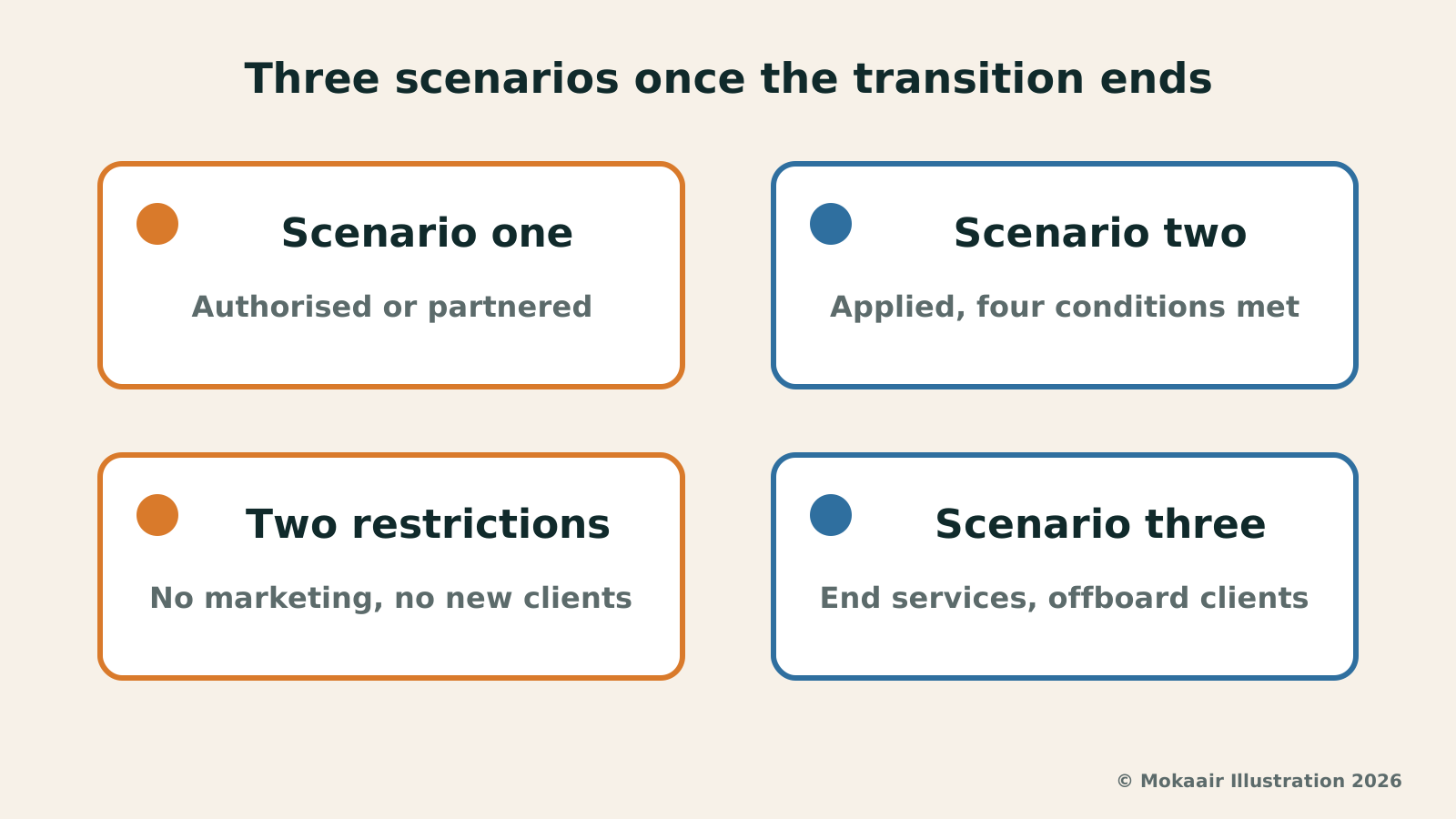
Paragraph 7 of the Opinion says that three scenarios may arise, by the time the transition period comes to an end, for a provider that intends to continue carrying out EMT transactions that qualify as payment services. Scenario one (paragraph 8): the CASP has successfully obtained an authorisation as a payment institution (PI) or an electronic money institution (EMI), or has partnered with a PSP authorised to provide the respective services, and such a provider may carry on with EMT transactions to the extent commensurate with its own authorisation or that of its partner. Paragraph 14 adds that a CASP could also, for example, act as an agent of an authorised PSP, in which case NCAs are advised to assess whether the partner PSP requires authorisation under Article 59 of MiCA.
Scenario two (paragraph 9): the application has been made but the authorisation has not yet been obtained. The EBA advises that the NCA under PSD2 allow the CASP to continue carrying out EMT transactions that qualify as payment services, including the continuation of such services on a cross-border basis, pending its decision, provided all of the following conditions are met. A: the application has been duly submitted and the authority has obtained all information and documents required under Article 5 of PSD2 and the EBA Guidelines on the authorisation of payment institutions (EBA-GL-2017-09). B: the applicant responds to queries from the authority in an exhaustive, transparent and expeditious manner. C: the authority has checked that the applicant has not been subject to any supervisory measures, nor has it infringed any requirements under MiCA (or national VASP regimes) or other EU law that would be material and relevant for an authorisation under PSD2, including by interacting with the respective NCA under MiCA where needed. D: based on its preliminary assessment, the authority has no reason to expect the applicant is not able to comply with PSD2, and there are reasonable grounds to expect that the application will be approved within a very short time frame. A separate sentence follows condition D: that preliminary assessment does not prevent the NCA under PSD2 from eventually rejecting the application.
For a scenario-two provider that is allowed to carry on, paragraph 10 advises the authority to make sure that, pending the outcome, it ceases all marketing activities related to EMTs that qualify as a payment service and does not provide to any new clients services with EMT that qualify as a payment service; paragraph 11 advises NCAs under PSD2 to coordinate the possible imposition of these restrictions with NCAs under MiCA, for example by inserting corresponding restrictions to existing CASP authorisations. Scenario three (paragraph 13) is the provider that has not applied, or has applied but does not meet one or more of the conditions: the Opinion advises authorities to require it, from March 2, 2026, to stop providing such services and to offboard clients of EMT services that qualify as a payment service.
Two transition periods, two dates: the easiest things to run together
Condition D carries a special case: where a country has set the transitional period under Article 143(3) of MiCA at the statutory cap of July 1, 2026, the respective NCA under PSD2 is advised to ensure that the aforementioned very short time frame does in any case not extend beyond that date, or the date on which such an entity is granted or refused authorisation pursuant to Article 63 of MiCA, whichever occurs earlier. Paragraph 12 also carves the two restrictions in paragraph 10 out: they do not apply to crypto-asset service providers that are permitted under national law transposing Article 143(3) of MiCA to continue providing their services until that same point. These are two different transition periods: the March 2 one governs PSD2 payment authorisation, and the July 1 one is the statutory cap on the national MiCA transitional periods.
The dates do not agree either. The EBA press release of February 12, 2026 puts the No-Action Letter at June 2, 2025, while paragraph 1 of the Opinion, the letter's cover and the signature at its end say June 10, 2025; both are the EBA's own official documents, and this article sets the two readings side by side and names where each is printed. The letter's executive summary has one further place that says March 1, 2026, which differs from paragraph 18 of that same document and from every place in the Opinion, all of which say March 2, 2026.
What this has to do with readers in Taiwan, and how to check it yourself
What this Opinion deals with is PSD2 authorisation inside the EU. The versions read on this article's fact-check date do not mention users or services outside the EU, and they state neither what was enforced nor any figures after March 2, 2026. The documents do not say how readers in Taiwan are affected, and this article does not presume. What follows is an example the editors constructed, not a description of any provider: whether an electronic money token transfer feature on some EU platform is still there afterwards, and how wide its scope is, depends on which scenario that platform falls into and on what the authority in its Member State does.
To confirm the current position, go back to those two press release pages on the EBA site and the PDFs hanging off them. Note that the No-Action Letter PDF sits under a June 2025 path, yet the server returned a Last-Modified of February 17, 2026 when this article fetched it, so everything cited here is the version read at that address on September 17, 2026; no claim is made that the wording was the same in June 2025.
Frequently asked questions
Is this Opinion legally binding on firms?
The Opinion is addressed to the national competent authorities designated under Article 22(1) of PSD2 and Article 93(1) of MiCA, and its operative sentences are worded as advice. The document itself does not say that it is directly binding on firms, nor what follows in law where a firm does not comply. What a firm actually meets depends on how the authority in its Member State acts under its own legal system.
After March 2, 2026, are electronic money token transfers on EU platforms simply unavailable?
The Opinion does not say that. It sets out three scenarios. A provider that has obtained authorisation as a payment institution or an electronic money institution, or has partnered with an authorised payment service provider, may carry on to the extent commensurate with that authorisation. Where a provider has applied but is not yet authorised and all four conditions are met, the authority is advised to allow it to carry on, though it should cease the related marketing and provide no such services to new clients. A provider that has not applied, or does not meet all of the conditions, is one the authority is advised to require, from March 2, 2026, to stop providing such services and to offboard the clients of those services. Which scenario a provider falls into is for the authority to judge.
How long is the very short time frame in condition D?
The Opinion gives no number of days or months. The only outer limit it writes down appears in one special case: where a country has set the transitional period under Article 143(3) of MiCA at the statutory cap of July 1, 2026, the respective NCA under PSD2 is advised to ensure that this very short time frame does not extend beyond that date, or the date on which such an entity is granted or refused authorisation pursuant to Article 63 of MiCA, whichever occurs earlier.
Why does the No-Action Letter have two dates?
Because two official documents write it differently. The EBA press release of February 12, 2026 says June 2, 2025, while paragraph 1 of the Opinion, the letter's cover and the signature at its end say June 10, 2025. The EBA has not explained the difference, so this article sets the two readings side by side and names where each is printed, without deciding for the source which one is right. On the length of the transition period, the press release says 9 months and paragraph 4 of the Opinion says it was intentionally limited to nine months; the EBA sets out no calculation, so this article follows what the EBA says and does not work out the start and end itself.
Does this Opinion extend the transition period?
No. The date March 2, 2026 is not altered anywhere in the Opinion, and the document contains no wording about postponement or extension. What the Opinion deals with is what comes after the transition period ends: how authorities should prioritise, whom to allow to carry on, and whom to require to stop.
Is the July 1, 2026 date in Article 143(3) of MiCA the same thing as this transition period?
No. March 2, 2026 comes from the EBA No-Action Letter and is about whether a crypto-asset service provider needs a further PSD2 authorisation. July 1, 2026 comes from Article 143(3) of MiCA and is the statutory cap on the transitional period a country may give existing providers to continue providing crypto-asset services. The Opinion mentions the latter only in condition D and paragraph 12, using it as a cap and as the scope of an exclusion.
When a provider is required to offboard its clients, what happens to the electronic money tokens on the books?
The Opinion does not say. It goes no further than advising authorities to require providers that fall short to stop providing electronic money token services that qualify as payment services and to offboard the existing clients of those services; it says nothing about a notice period, a buffer or how assets are to be returned. Those follow from what each national authority and each provider announces.
2026 Crypto News Roundup: Key Developments in Regulation, Technology and Industry2026 Crypto News Roundup: Key Developments in Regulation, Technology and IndustryThis site's 2026 crypto news explainers, in six jurisdictions — Taiwan, the US, the UK, the EU, Japan, South Korea: the Virtual Asset Service Act, the proposed GENIUS Act rules, the joint SEC–CFTC interpretation and the SEC's own proposal, the end of MiCA's transitional period and its link to the payment rules, the FCA's perimeter guidance, Japan's FSA reports and South Korea's manipulation referrals. Regulation, technology and industry only, no prices, with official sources and a check date.Read the full article
Taiwan's Virtual Asset Service Act Clears Third Reading: Seven Kinds of Provider, Stablecoin Licensing, No Commencement Date YetTaiwan's Virtual Asset Service Act Clears Third Reading: Seven Kinds of Provider, Stablecoin Licensing, No Commencement Date YetOn June 30, 2026 Taiwan's Legislative Yuan passed the Virtual Asset Service Act (虛擬資產服務法) on third reading, and its 56 articles were promulgated on July 22, 2026. Working from the Financial Supervisory Commission's press release and two official legal databases, this article sets out the seven kinds of virtual asset service provider, licensing kind by kind, the reserve-asset rules for stablecoins, and why the 12- and 21-month transition periods in article 55 have not started running.Read the full article
Lifestyle
EU MiCA Transitional Period Ends July 1: Grandfathering Differs by Country, a Pending Application Is Not an Extension
The transitional period in Article 143(3) of the EU's MiCA expired on July 1, 2026. Drawing on ESMA's public statement of June 23, 2026, its statement of April 17, 2026, the list of grandfathering periods decided by each Member State and the official question and answer ESMA_QA_2220, this article sets out what ended, why the grandfathering periods differ from one Member State to another, why a pending application is not an extension, and what ESMA said to providers and to clients.
Lifestyle
Brazil's Petrobras tests Cardano blockchain to track claims about cleaner jet fuel and diesel
According to CoinDesk, Brazil's state-owned energy company Petrobras is testing the Cardano blockchain in two research projects: one to stop the same emissions cut from sustainable aviation fuel being counted twice, the other to record the history of its partly renewable Diesel R. Both are still research work, with no timeline for wider use.
Lifestyle
Cboe and S&P Dow Jones Indices extend their S&P 500 options deal to 2051 and leave the door open to tokenized options
According to CoinDesk, exchange operator Cboe and index provider S&P Dow Jones Indices have extended Cboe's exclusive right to offer S&P 500 options by 25 years, to 2051. The deal says they may explore blockchain-based 'tokenized' options, but no product, timeline or details were announced. Here is what that means and what it does not.
Lifestyle
SEC Charges Two Groups of Entities Allegedly Behind Crypto Frauds Using WhatsApp and "AI Trading" Claims
On September 29, 2026, the US SEC charged two groups of entities, Cryptoaiml and TSAI, alleging they defrauded hundreds of individual investors, many in the US. The SEC says they falsely claimed to be SEC-regulated and used AI trading signals and bots as bait in schemes totaling at least $15 million. Here is what the SEC alleges and the warning signs readers can watch for.
Articles that cite this one
Latest travel guides

GuideTokyo
Where to Stay in Tokyo: Comparing Shinjuku, Ueno, Tokyo Station, Shibuya, Asakusa, Ikebukuro, and Ginza, Plus Airport Access, Accommodation Tax, and Luggage Delivery
Where should you stay in Tokyo? Compare Shinjuku, Ueno, Tokyo Station, Shibuya, Asakusa, Ikebukuro, and Ginza by the same criteria: access from Narita and Haneda, transit routes, nearby attractions, neighborhood character, and who each area suits. Includes a comparison table, a Yamanote Line diagram, Tokyo’s accommodation tax as verified in 2026/9 (changing to 3% in 2027/4), and Airport TA-Q-BIN luggage shipping rules.
- Budget
- Hotels

GuideTokyo
How to Choose Tokyo Transit Passes: Are Suica, Welcome Suica, the Tokyo Subway Ticket, and the JR Pass Worth It?
On a first Tokyo trip, start with an IC card and pay per ride (Welcome Suica has no deposit and is valid for 28 days). If you take four or more subway rides in a day, add a 72-hour Tokyo Subway Ticket for 2,000 yen; a JR Pass is never worthwhile if you stay in Tokyo and do not go to Kansai. See what TOURIST PASMO, Suica on iPhone, and the Tokyo Metro day pass do and do not cover, with a decision chart. Prices verified in September 2026.
- Transport
- Budget

GuideTokyo
Tokyo Disneyland and DisneySea Guide: Ticket Prices, Fantasy Springs, Disney Premier Access (DPA), Standby Pass, and Which Park to Choose for Your First Visit
Tokyo Disney one-day Passport prices vary: most weekdays in 9/2026 cost ¥9,900 and weekends ¥10,900. At 14:00 daily, tickets go on sale for the same date two months later. Free Priority Pass is no longer on the official service list; only paid Disney Premier Access (¥1,000–3,500 per person per use) shortens waits. Covers hours, the 25th anniversary, Standby Pass, Entry Request, Fantasy Springs access and first-visit park choice; checked on the official site in 9/2026.
- Itineraries
- Family
Sources
- EBA: The EBA advises national authorities on actions to take at the end of the transition period under its No-Action Letter on the interplay between PSD2 and MiCA (press release, February 12, 2026) · Checked:
- EBA: Opinion on the end of the No-action Letter transition period (EBA/OP/2026/01, the Opinion PDF) · Checked:
- EBA: EBA publishes No Action letter on the interplay between Payment Services Directive (PSD2/3) and Markets in Crypto-Assets Regulation (MiCA) (press release, June 10, 2025) · Checked:
- EBA: Opinion on the interplay between PSD2 and MiCA in relation to crypto-asset service providers that transact electronic money tokens (EBA/Op/2025/08, the No-Action Letter PDF) · Checked: