Lifestyle
How to write a small-shop marketing plan: goals, customers, and monthly reviews
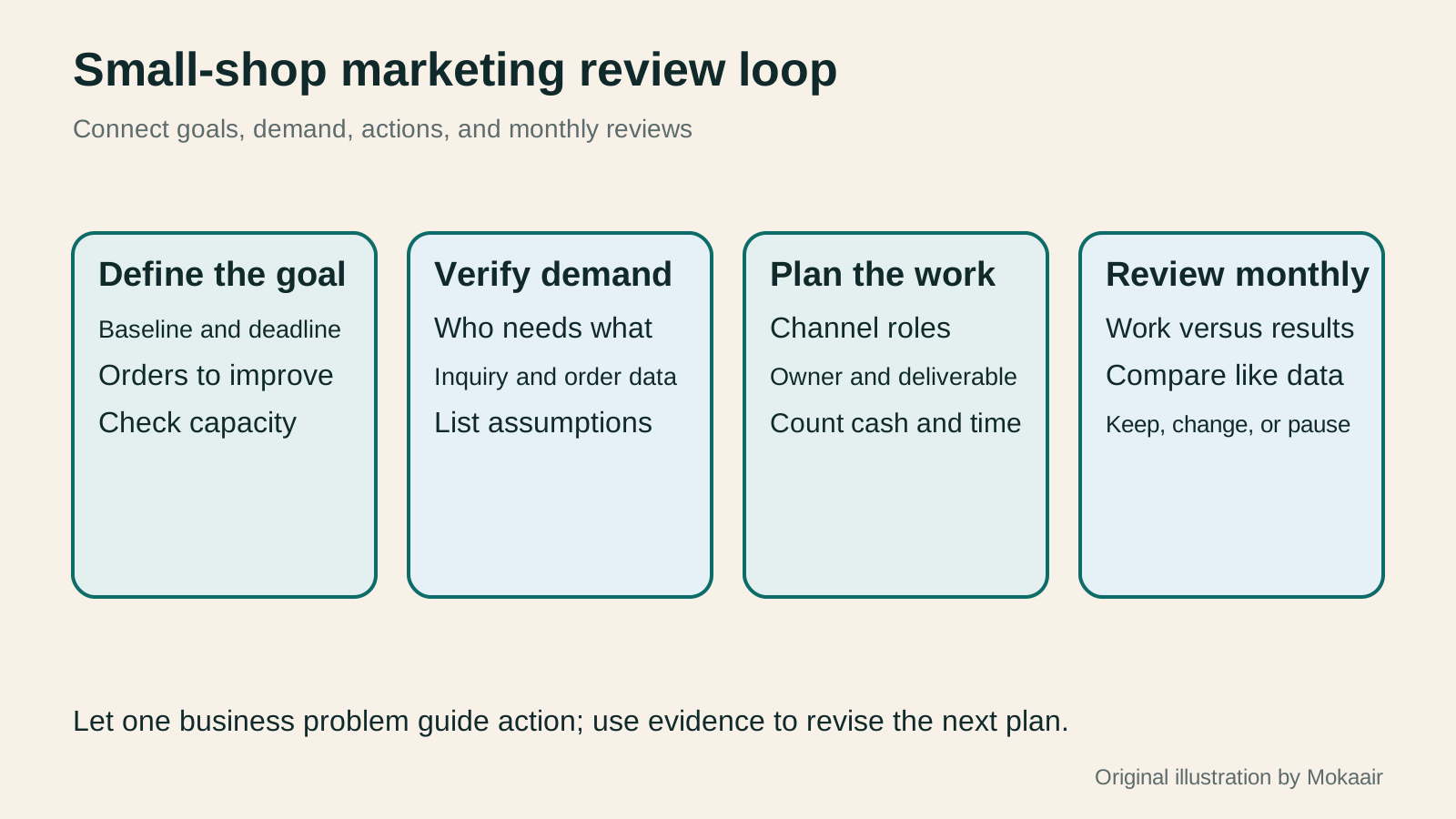
A small-shop marketing plan can begin with one clear business problem; there is no need to schedule every social channel and ad at once. Using an original example about a florist's weekday orders, this guide works through goals, customers, channel roles, budgets, and monthly reviews. It provides practical worksheet fields, a comparison table, and an original diagram so owners can turn ideas into assigned, trackable actions they can revise. Completing a campaign is not a promise of sales.
About 7 min read
Contents
A flower shop is busy on weekends but has plenty of quiet time on weekdays. The owner might want to start a short-video account, buy ads, or issue coupons. Unless the shop first decides what kind of orders it wants to increase, another channel will only add work. A marketing plan starts by focusing limited time on a specific business problem.
This guide adapts government small-business marketing guidance consulted on September 14, 2026 for shops in Taiwan. The flower shop, order target, and budget are original examples, not market averages or actual business results. Readers should enter figures based on their own costs and service capacity.
Turn a business problem into a goal you can check
Write down the current situation, the desired result, and the period you will observe. If the florist wants more weekday pickup orders, first check the actual weekday order count, available pickup hours, and staffing. Do not use 'more exposure' as a substitute for every goal, or redefine the problem as a need for more accounts simply because another shop joined a new platform.
The Australian government's small-business guidance recommends specific, measurable, reasonably achievable marketing goals tied to the business and a time frame. An original example could aim to raise completed weekday orders next month from 30 to 38. That is a target to test, not a forecast; the shop still needs to confirm that flowers, production, and pickup capacity can support it.
Separate the outcome from the actions. Orders are the desired outcome; finishing a flower-ordering flowchart or updating a service page are actions. Completing an action does not mean the goal was met. If you also track inquiries, define what counts as a qualified inquiry first, rather than adding repeat messages, customer-service follow-ups, and new customer needs together.
Choose a group with a clear need
The audience does not need a complete fictional biography at the start; describe the situation behind the need. Someone collecting a small thank-you bouquet after work and someone planning a large wedding make decisions on different schedules and need different information. The florist should start with a group it can serve and for which it can gather basic evidence of demand.
Review existing inquiries and orders for questions about budget, pickup time, and purpose. Then ask customers willing to share their experiences to check those findings. Ask about a recent actual purchase, not just whether they like a proposed offer. Keep answers that challenge your expectations so you do not collect only evidence supporting your own idea.
When comparing alternatives, include other solutions customers might choose, such as a potted plant, gift card, or no gift. The florist's message should explain which specific need it meets and how to place an order; it need not claim to be best at everything. Treat unsupported advantages as hypotheses to check later.
Give each channel a role in the purchase journey
Each action should name its audience, message, channel, and next step. The florist might use photos of its work to show styles, a service page to explain price ranges and ordering terms, and an existing contact method to confirm details. Pickup information should agree across entry points; otherwise interested people may get stuck asking the same questions repeatedly.
Start with a few channels the shop can maintain and give each a job. Search and complete service information can answer needs people actively look for, while suitable images help them judge appearance. This is not a fixed ranking of channels. Use records of how actual customers discover, compare, and order to decide which entry point needs improvement now.
The U.S. Small Business Administration also includes sales steps and after-sales service in its marketing guidance. For a florist, response times, approval of flower substitutions, and pickup arrangements all affect the experience. Before scheduling a campaign, confirm that someone can handle extra inquiries so promotional promises match the shop's operating capacity.
Budget both cash and work time
Set an affordable spending ceiling for the period, then assign amounts to specific work. An original exercise uses NT$10,000 in total: NT$3,000 for materials, NT$4,000 to test promotion, NT$2,000 for in-store explanations, and NT$1,000 as a reserve. These figures show how to divide the worksheet; they are not a recommendation that every florist use the same proportions.
List staff time as well, including filming, editing, replying, and organizing data. Work done by the owner is not free of cost. Keep separate columns for estimated, committed, and actually paid amounts for every item. Budget not yet committed is not money already spent, and there is no need to add a campaign just to use it up.
Set review and pause conditions. Fix a broken process, lack of capacity for orders, or a reached spending cap before proceeding. If a channel brings only exposure and no interpretable demand, check the audience and entry point first. Do not change the audience, copy, and price all at once because the first few days are inconclusive; that would make later differences hard to explain.
- Confirm the business problem, baseline, and service capacity, then write a time-bound goal.
- Use existing data to select a need situation and list audience assumptions that still need checking.
- For each action, record its channel, deliverable, owner, cost, and completion date.
- Check execution problems weekly; review results against the same measure monthly and adjust the next period.
Make a worksheet everyone can understand
The worksheet can hold the goal, audience, main message, activities, owners, deadlines, budget, and measures. Put one deliverable task in each row, such as completing a weekday pickup information page, rather than 'improve the whole brand.' Note prerequisites and confirmation dates for work that depends on others.
An original four-week schedule might verify demand and fix ordering information in week one, prepare content and check links in week two, run a limited promotion in week three, and summarize inquiries and orders in week four. This is an example rhythm, not a promise of results in four weeks. Revise the schedule first if materials or service are not ready.
Weekly checks mainly resolve execution problems such as broken pages, unanswered messages, or overspending. Monthly checks return to the original business goal. Separating the two prevents every meeting from merely counting posts while nobody checks whether weekday orders, pickup experience, or workload improved.
Use identifiable results to update the next plan
At month-end, make sure the data periods and definitions match before comparing inquiries, completed orders, cancellations, and actual costs. Record the effects of holidays, weather, or large group orders; do not credit every additional order to the campaign. Keep orders with unknown sources as unknown, and label a customer's self-reported discovery source for what it is.
Revenue and profit also need separating. In an original example, NT$2,000 spent on ads is associated with NT$6,000 in order revenue. Revenue divided by ad spend is three times, but that excludes flowers, labor, and other costs and does not prove every order was incremental. State what the calculation includes instead of using an attractive multiple in place of business judgment.
Finally, decide whether to keep, change, pause, or gather more data for each activity, and write down why. If the goal was missed, investigate the demand assumption, message, ordering process, and capacity before deciding what failed. Carry verifiable lessons into the next plan and reduce uncertainty step by step instead of chasing a different tactic every month.
| Plan field | Original florist example | What to check |
|---|---|---|
| Goal | Raise completed weekday orders next month from 30 to 38 | Definition, baseline, and service capacity |
| Audience | People collecting a thank-you bouquet after work | Whether real data supports the need |
| Action | Complete pickup instructions and style descriptions | Owner, deadline, and deliverable |
| Budget | NT$10,000 cash ceiling; list time separately | Separate estimates, commitments, and payments |
| Review | Check execution weekly and outcomes monthly | Reasons to keep, change, or pause |
Planning a website budget: separate first-year, renewal and maintenance costsPlanning a website budget: separate first-year, renewal and maintenance costsA website budget needs more than a promotional monthly price. Group spending into setup, ongoing use, renewal and migration; list hosting, domains, email, themes, plugins and maintenance time. Learn to distinguish long-term monthly equivalents, automatic renewal and outsourced quotes, then practise with clearly hypothetical figures. Build a cost list, decide what is needed now or later, and know which terms to keep before paying.Read the full article
How to Build a Small Business Website: Service Pages, Trust Signals, and InquiriesHow to Build a Small Business Website: Service Pages, Trust Signals, and InquiriesA small business website should help visitors understand the services, decide whether they are a good fit, and send an inquiry. Using WordPress and a fictional local design studio, this guide plans the home, service, portfolio, about, and contact pages. It provides a practical content checklist and acceptance criteria, including form fields, error messages, notification delivery, and ownership after handoff, so the site becomes a usable entry point for clients.Read the full article
What to Do When Searches Get No Clicks: Rethinking Traffic Value Through Reader TasksWhat to Do When Searches Get No Clicks: Rethinking Traffic Value Through Reader TasksReaders may find opening hours, phone numbers or brief answers on a search page without visiting a website. A non-click is not always a success, and site CTR cannot reveal the overall zero-click search rate. Using an original clothing alterations shop scenario, this article covers checks for search displays, business interactions and actual tasks, from finding information and comparing services to booking, with a comparison table, practical steps and original SVG diagrams.Read the full article
Found this guide helpful? Share it with someone who needs it
Lifestyle
How to Read the BCG Matrix: Uses and Limits of Product Portfolio Analysis
The BCG matrix maps product portfolios by market growth and relative share; stars, cash cows, question marks and dogs do not establish actual profit. An original home goods store example shows how to define markets, check comparison periods and denominators, understand model assumptions, and allocate resources using costs, turnover and customer needs. Includes a four-category table, practical steps, original diagrams and options when reliable market data is lacking.
Lifestyle
How to Use the Ansoff Matrix: Four Options for Expanding Products and Markets
The Ansoff matrix maps four growth paths using existing or new products and markets: market penetration, market development, product development and diversification. An original canvas goods studio example shows how to define the current business and compare the capabilities and evidence each path needs. A comparison table, steps and original diagrams turn growth ideas into small, testable plans, without treating the model as a success-rate table.
Lifestyle
How to Write Marketing Copy: Clarify Value, Conditions, and Next Steps
Marketing copy should explain who it suits, its value, conditions, and what happens next. Using an original journal-binding workshop example, this article revises information hierarchy, features and benefits, evidence for claims, and action buttons step by step. A before-and-after table and original diagrams show how to retain appeal without overstating promises, and check that prices, limits, images, and links align before publication.
Lifestyle
Customer Journeys and Marketing Funnels: Find Where Readers Drop Off
Customer journeys explain touchpoints and needs; marketing funnels count people at each step using consistent criteria. Using an original bicycle repair booking example, this article explains how to map online and offline contacts, define completion events, calculate step conversion rates, and set up GA4 open or closed funnels. A calculation table, practical steps, and original diagrams help identify improvement hypotheses to test without mistaking data gaps for causes of customer drop-off.
Articles that cite this one
- SEO or paid ads? Allocate by demand, timing, and budget
- Customer Journeys and Marketing Funnels: Find Where Readers Drop Off
- STP and Personas: Use Interview Evidence to Decide Whom to Serve
- Planning a Content Marketing Calendar Around Reader Questions and Updates
- SWOT and TOWS: From Strengths and Weaknesses Analysis to an Action List
- How to Use PESTLE: Turn External Changes into Business Risks
- How to use 4P, 7P and 4C: turn a product list into customer questions
Sources
- Australian Government guide to developing a marketing planChecked:
- U.S. Small Business Administration guide to marketing and salesChecked:
Compiled from the references and verification dates listed above; fares, schedules, product features, and terms can change, so please confirm the latest details on the relevant official website before travelling, booking, or purchasing.