Lifestyle
Planning a Content Marketing Calendar Around Reader Questions and Updates
A content marketing calendar does more than assign publication dates to headlines. It also schedules reader questions, asset production, fact-checking and ownership of updates. Using a fictional fabric shop, this guide turns customer-service questions into an idea bank and plans articles, diagrams and short posts together. A four-week schedule, production steps and an original diagram show how to allow time for review and maintenance, then test whether each piece helps readers complete a task.
About 8 min read
Contents
- 1. Define the content goal before choosing the number of articles
- 2. Build an idea bank from questions instead of copying popular headlines
- 3. Schedule assets and verification, not just publication dates
- 4. One research effort can support several formats, but each answer must stand up
- 5. Review content against a reader task before publishing
- 6. Put updates and new articles on the same schedule
It is easy to fill a calendar with weekly posts while leaving readers' questions unanswered, especially if the team only starts looking for a topic near the deadline. A small team can begin with a narrower question: whom will we help accomplish what during this period? Then schedule the content, assets and checks each article needs so that every piece has a clear purpose.
This article draws on official guidance from the Content Marketing Institute, GOV.UK and Google consulted on September 14, 2026 to outline an editorial process that teams can adapt. The fabric shop, reader questions and four-week schedule are original hypothetical examples, not actual operating records or a posting formula that guarantees traffic.
Define the content goal before choosing the number of articles
Content marketing should serve a defined audience; a content plan turns that aim into work. The Content Marketing Institute distinguishes strategy from execution and asks teams to understand why they are creating content and whom it should help before deciding what to make, how to distribute it and who will do the work. A calendar comes later and cannot make those decisions for you.
A fictional fabric shop might first focus on people buying fabric for the first time. Its goal could be to help them understand product specifications and ask sufficiently clear questions. That is easier to act on than 'make everyone aware of the brand.' The team can then list what readers should be able to do afterward, such as identify the dimensions to have ready before making an inquiry.
One plan can cover recognizing a need, comparing options and using a purchase afterward. It need not ask for an immediate order in every article. If a piece helps readers interpret specifications, the next step could be a size chart; if it explains the scope of a service, it could point to the inquiry form. The action should match the reader's current task.
Build an idea bank from questions instead of copying popular headlines
Look for topics in customer-service records, frequently asked questions in the shop, on-site search and gaps in existing articles. Record the context of each question, the evidence already available and what still needs checking. Do not publish raw messages that could identify customers. Questions from a few people can be useful clues, but they do not represent the whole market on their own.
Suppose the fictional shop notices that customers do not understand the width shown on a product page. It could start with a piece on how to read fabric dimensions. If another question uses a different fabric name but asks about the same label, it can usually belong in that article. A task such as preparing a price inquiry or caring for fabric after purchase needs a separate decision.
For every idea, note the reader's question, the article's angle, the answer it should deliver and any page that already addresses it. Check whether existing content can be updated before writing a near-duplicate for a new keyword. A genuinely new piece should address a different task or missing information, not merely give an old article a more enticing title.
Schedule assets and verification, not just publication dates
Getting an article from idea to publication may involve drafting, checking specifications, photography or illustration, editing and page review. Put that preparation in the calendar and assign an owner. If someone else supplies an asset, allow time for delivery and revisions; do not assume every task can happen on publication day.
The fictional shop's four-week example starts with a dimensions guide, then an inquiry checklist, an improved service-process page and finally a review of new reader questions. Each week can have one main task, but that does not require a new long article every week. Updating an old diagram or correcting inaccurate information can also be valuable content work.
Record sources, verification dates and the rights status of each asset as well. Product claims should be checked against actual specifications or the manufacturer's instructions; confirm the permitted use of photos and diagrams. If evidence is insufficient, mark the item as awaiting verification and change its schedule or angle. Do not turn an assumption into a definite answer merely to fill the calendar on time.
One research effort can support several formats, but each answer must stand up
Long articles can provide a complete explanation; a diagram can clarify dimensions or steps; a short post can answer a narrow question. GOV.UK's content design guidance also recommends deciding the amount, format and placement of content according to user needs. This is a useful planning principle, not a requirement for commercial sites to copy a government site's format.
The fictional shop could finish its main article on fabric dimensions first, then create its own diagram of where to find the labels and a short question prompt. Each format uses the same checked facts but has its own task. If the short piece needs more context, provide a clear link rather than hiding every important limitation on another page.
Record which main article and version each derivative asset uses. If product specifications or the service change, the team can then find the cards and posts that need corrections too. Reusing research saves repeated searches, but copying the same paragraph into every channel does not mean the team has covered different topics.
Review content against a reader task before publishing
During review, ask whether the article answers the question promised by its title, whether readers can follow the steps and whether examples are labelled as assumptions. Then check sources, captions, links and calls to action. If readers must prepare information first, spell out what they need; they should not discover missing details only after reaching the form.
In the hypothetical example, someone who did not draft the article could use it to identify what to record before asking about dimensions. If they still do not know where to begin, revising the wording or diagram may help more than adding length. This is a test a team can arrange, not a reader test it may claim has passed without actually running it.
Put the definition of done into workflow states such as awaiting verification, awaiting assets, awaiting review, ready to publish and published. These labels help scheduling and handoffs, but the team must still confirm that the public page is readable. A finished draft, a calendar entry and a published page are different outcomes and should not be combined in reporting.
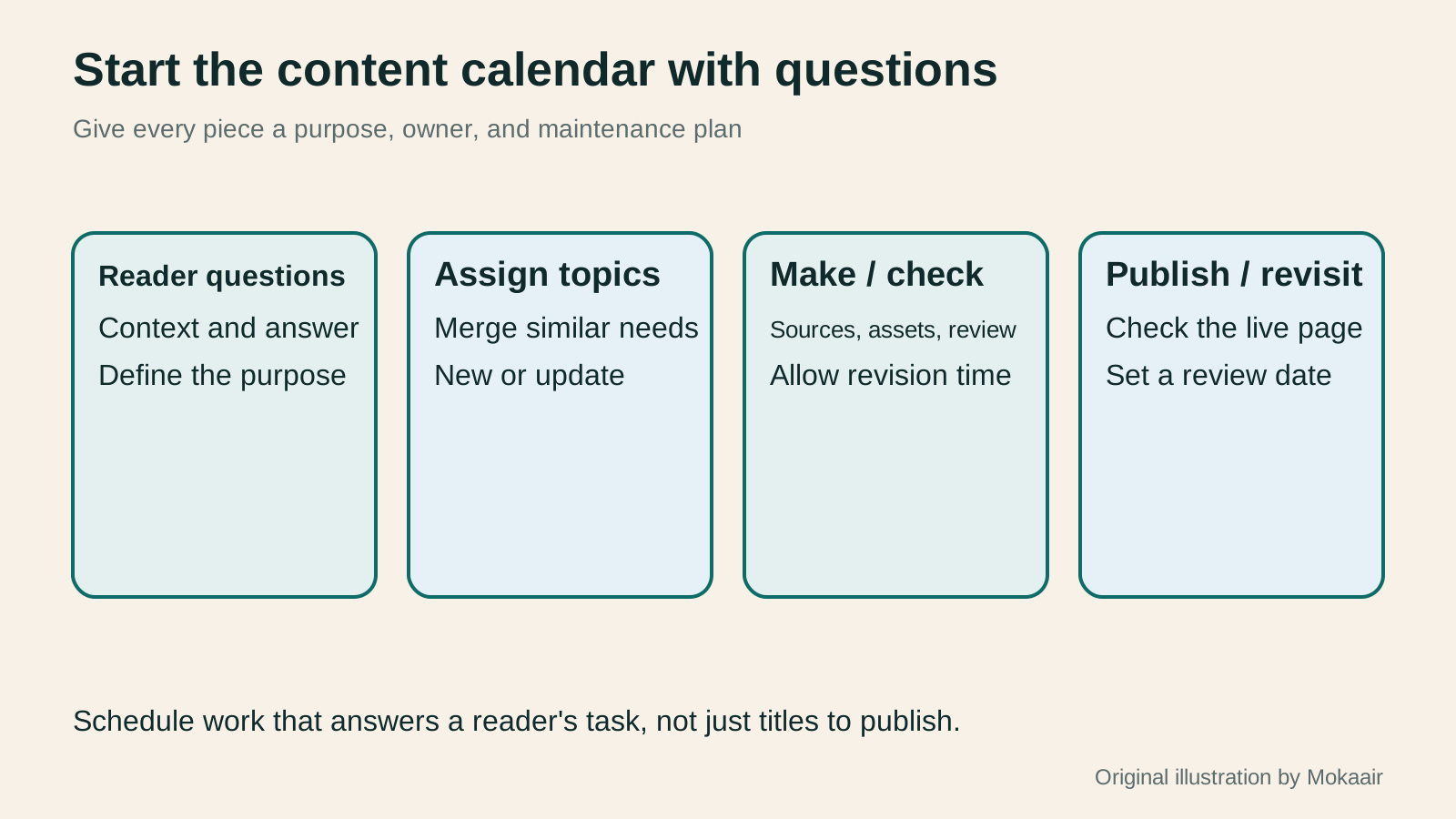
- State the audience, the problem to solve and the reader's next step for this period.
- Organize questions and existing content, combine matching needs and give each article a distinct angle.
- Schedule evidence, assets, writing and review, allowing time for revisions and maintenance.
- Check the reader task before publication and revisit content as questions or facts change afterward.
Put updates and new articles on the same schedule
When reviewing content, look beyond page views. Can readers find what they need? Which questions does customer service still receive? Do important links work? Different goals call for different observations; one traffic threshold cannot judge every article. A necessary explanation with few views can still matter greatly to completing a service.
GOV.UK's maintenance guidance recommends checking regularly whether content is useful and correcting errors. Google also cautions against changing only a date to make content appear fresh. An update should correspond to an actual information change or a problem found. A punctuation edit should not imply that every feature and fact has been checked again.
The fictional shop might review fast-changing product and service information sooner, while checking more stable explanatory material as needed. Keep an owner, next verification date and change record, and decide separately what to do with pages that can no longer be maintained or duplicate other content. Keeping this work on the calendar helps content remain trustworthy after publication.
| Example week | Main content task | Delivery and acceptance check |
|---|---|---|
| Week 1 | Prepare the dimensions article and original diagram | Labels are clear and facts have sources |
| Week 2 | Make a pre-inquiry checklist | Readers can identify the information they must provide |
| Week 3 | Update the service process and related links | Entry point, eligibility and contact point agree |
| Week 4 | Review new questions and revise derivative assets | Record changes and set the next verification date |
How to write a small-shop marketing plan: goals, customers, and monthly reviewsHow to write a small-shop marketing plan: goals, customers, and monthly reviewsA small-shop marketing plan can begin with one clear business problem; there is no need to schedule every social channel and ad at once. Using an original example about a florist's weekday orders, this guide works through goals, customers, channel roles, budgets, and monthly reviews. It provides practical worksheet fields, a comparison table, and an original diagram so owners can turn ideas into assigned, trackable actions they can revise. Completing a campaign is not a promise of sales.Read the full article
Place content at the right stage of the customer journeyCustomer Journeys and Marketing Funnels: Find Where Readers Drop OffCustomer journeys explain touchpoints and needs; marketing funnels count people at each step using consistent criteria. Using an original bicycle repair booking example, this article explains how to map online and offline contacts, define completion events, calculate step conversion rates, and set up GA4 open or closed funnels. A calculation table, practical steps, and original diagrams help identify improvement hypotheses to test without mistaking data gaps for causes of customer drop-off.Read the full article
SEO Article Quality Checklist: Sources, Useful Detail and MaintenanceSEO Article Quality Checklist: Sources, Useful Detail and MaintenanceA content quality review checks whether evidence, interpretation, instructions and images agree. Using a comparison of digital note-taking tools, this guide shows how to map claims to sources, distinguish official features from hands-on tests, add the details readers need to compare options, and check image rights, titles, summaries and update ownership. An editorial checklist and correction workflow make ‘finished’ mean verifiable, readable and maintainable, not merely long enough.Read the full article
Found this guide helpful? Share it with someone who needs it
Lifestyle
How to Read the BCG Matrix: Uses and Limits of Product Portfolio Analysis
The BCG matrix maps product portfolios by market growth and relative share; stars, cash cows, question marks and dogs do not establish actual profit. An original home goods store example shows how to define markets, check comparison periods and denominators, understand model assumptions, and allocate resources using costs, turnover and customer needs. Includes a four-category table, practical steps, original diagrams and options when reliable market data is lacking.
Lifestyle
How to Use the Ansoff Matrix: Four Options for Expanding Products and Markets
The Ansoff matrix maps four growth paths using existing or new products and markets: market penetration, market development, product development and diversification. An original canvas goods studio example shows how to define the current business and compare the capabilities and evidence each path needs. A comparison table, steps and original diagrams turn growth ideas into small, testable plans, without treating the model as a success-rate table.
Lifestyle
How to Write Marketing Copy: Clarify Value, Conditions, and Next Steps
Marketing copy should explain who it suits, its value, conditions, and what happens next. Using an original journal-binding workshop example, this article revises information hierarchy, features and benefits, evidence for claims, and action buttons step by step. A before-and-after table and original diagrams show how to retain appeal without overstating promises, and check that prices, limits, images, and links align before publication.
Lifestyle
Customer Journeys and Marketing Funnels: Find Where Readers Drop Off
Customer journeys explain touchpoints and needs; marketing funnels count people at each step using consistent criteria. Using an original bicycle repair booking example, this article explains how to map online and offline contacts, define completion events, calculate step conversion rates, and set up GA4 open or closed funnels. A calculation table, practical steps, and original diagrams help identify improvement hypotheses to test without mistaking data gaps for causes of customer drop-off.
Articles that cite this one
- How to Write Marketing Copy: Clarify Value, Conditions, and Next Steps
- How to Start a Web Design Project: Requirements, Content, and Acceptance Testing in Order
- Plan Social Content: Topics, Conversation, and Moderation Boundaries
- A Kit newsletter workflow: forms, segments, and automated emails
- Evaluating Influencer Partnerships: KOLs, KOCs and Deliverable Reviews
- Starting a newsletter: consent, content, and delivery metrics
- Brand voice and atmosphere marketing: stay consistent while answering real questions
Sources
- Content Marketing Institute: content strategy and execution planningChecked:
- GOV.UK: understanding content design and user needsChecked:
- GOV.UK: managing and maintaining existing contentChecked:
- Google: creating helpful, people-first contentChecked:
Compiled from the references and verification dates listed above; fares, schedules, product features, and terms can change, so please confirm the latest details on the relevant official website before travelling, booking, or purchasing.