Lifestyle
Evaluating Influencer Partnerships: KOLs, KOCs and Deliverable Reviews
Influencer partnerships take more than follower counts: check audience fit, formats and follow-up service capacity. Using an original illustrated postcard brand example, this guide covers practical KOL and KOC selection, briefs, asset rights and performance checks. A comparison table, steps and original diagram help small teams agree separately on deliverables and observed results, avoiding vague quotes and unverifiable traffic promises.
About 8 min read
Contents
- 1. Translate KOL and KOC Labels into the Roles You Need
- 2. Assess Recent Relevant Content and Available Data
- 3. Define Verifiable Deliverables in the Brief
- 4. Discuss Pricing, Usage Rights and Disclosures Separately
- 5. Verify Deliverables Before Evaluating Results
- 6. Use the Wrap-Up to Inform Your Next Choice
A sponsored video might introduce a new brand, demonstrate a product or directly invite viewers to register for an event. Different purposes call for different creators, scripts and evidence for reviewing delivery. To compare partnership proposals, first clarify what you want viewers to understand and what they should do next.
This article outlines how brands can evaluate partnerships, based on official information from Taiwan's Fair Trade Commission and YouTube consulted on September 14, 2026. The illustrated postcard brand, candidate comparisons and partnership arrangements are all original examples. No real creators were contacted, and no claims are made about verified quotes or measured conversion results.
Translate KOL and KOC Labels into the Roles You Need
In influencer marketing, KOL commonly refers to someone with influence or authority in a particular field, while KOC often emphasizes sharing experiences from a consumer's perspective. This article uses these two partnership roles to explain the labels, without setting universal follower-count thresholds. The same creator may combine expertise, everyday experience and community influence.
The example postcard brand could look for creators skilled in paper goods, illustration or handwriting content to introduce layouts suited to writing. If the aim is to publicize a weekend market location, it must also check whether viewers have a connection to the event's area. Beautiful content cannot replace a good fit between the audience and the area the brand serves.
Start the shortlist with the partnership's purpose, relevant work and information that needs follow-up, without rushing to rank candidates. Smaller accounts are not necessarily more trustworthy, and larger accounts may offer value beyond exposure. Compare what each creator can deliver against the same requirements, and assess whether the team can provide samples, review materials and handle subsequent inquiries.
Assess Recent Relevant Content and Available Data
First review candidates' recent work on topics close to this partnership. Check whether explanations are clear, comments address real questions and previous partnership disclosures are easy to identify. A single popular video can offer a clue, but it cannot represent performance across every partnership. Nor can a few comments alone establish that an account is fraudulent.
When you need data, ask creators for aggregate information covering an appropriate period, in a suitable format and with its source identified. For example, YouTube audience reports include geography and other information, but its official guidance notes that some data may not be fully available. Record whether the information covers the entire channel or a specific video, and whether it measures watch time, viewer counts or another metric.
The example brand can compare relevant work over the same recent period and ask whether the figures include paid promotion. Mark missing information as unknown, rather than multiplying follower counts by an assumed percentage and presenting the result as guaranteed reach. Do not request account passwords, individual viewer data or commercial secrets unrelated to this evaluation.
Define Verifiable Deliverables in the Brief
A short brief can cover the audience, message, product information, content format, quantity, publication location, dates and next step. Separate facts that must be accurate from areas open to creative freedom. For example, the brand supplies verified paper specifications, while the creator decides how to arrange the visuals and describe their actual experience using the product.
The example brand could agree on one demonstration video and one event information post, with separate dates for the first draft, fact-checking and publication. Agree in advance on revision rounds, reshoot conditions and schedule adjustments if the brand responds late. Do not keep adding requirements after submission while treating the extra work as already included.
Content reviews should avoid inventing experiences for creators. If samples have not arrived or there has not been enough time to use them, adjust the schedule or content plan rather than asking creators to claim long-term use in advance. Taiwan's Fair Trade Commission's principles for handling online advertising require brands to ensure that collaborative promotional content is factual. Brands cannot abandon fact-checking simply because a partner wrote the copy.
Discuss Pricing, Usage Rights and Disclosures Separately
When comparing quotes, separate the scope of planning and production, publication, sample shipping, extra revisions, asset reuse and paid advertising. There is no universally reasonable price per thousand followers that applies to every partnership. First confirm the work, duration and fee terms included in each proposal to understand why the totals differ.
Publishing a video on a creator's account does not mean the brand has obtained the source files, editing rights or perpetual advertising rights. If you want to use it on a product page, run it as an advertisement or let retail partners use it, agree on the channels, duration and permitted edits for each use. In-platform advertising partnership permissions also cannot be treated as the entirety of the parties' asset licensing agreement.
Taiwan's Fair Trade Commission requires full disclosure of material relationships that the general public could not reasonably expect. YouTube also requires creators to notify the platform when videos contain paid promotion. Check both platform labeling requirements and applicable local obligations, rather than treating a single checkbox as resolving everything. Explain arrangements involving gifts, payment or revenue sharing in terms readers can easily understand.
Verify Deliverables Before Evaluating Results
Deliverable reviews can confirm whether content was published as agreed, information and links are correct, partnership disclosures are complete and reports arrived on time. These checks usually have clear, verifiable evidence. Views, engagement and sales depend on multiple factors and require separately defined goals and observation methods. They should not be combined with the question of whether the work was delivered.
If the example brand provides an event-page link, it can first check that the destination opens correctly, then observe relevant visits and inquiries during the specified period. If a partnership tracking code is used, explain the counting rules and what it can capture. Codes may be shared, and viewers may return later through another route, so trackable orders do not represent the full causal effect.
When agreeing on reports, specify the dates, platform, content URL, metric names and whether additional paid advertising is included. To compare engagement rates, explicitly state the numerator and denominator. Do not mix rates calculated using reach with those calculated using follower counts. Where data is insufficient, state the limitations; do not substitute polished screenshots for records that identify their source and reporting period.
- Define the partnership's purpose and audience, and list relevant work and information gaps.
- Review data using the same period and format, and confirm the workload and total cost scope.
- Agree on deliverables, reviews, asset use, partnership disclosures and how changes will be handled.
- Check publication and reporting evidence, then review results and limitations against the original goals.
Use the Wrap-Up to Inform Your Next Choice
After the partnership ends, document communication, information accuracy, revision efficiency and actual delivery. If results fall short, first examine the audience, content, access points and supply capacity rather than immediately concluding that the creator offers no value. If the content attracts inquiries but the event is already full or the website lacks information, the brand also needs to adjust how it handles customers.
If schedules change, products are discontinued or content contains errors, communicate and make corrections as agreed, recording which versions remain in use. Taiwan's Fair Trade Commission's online advertising principles also require attention to whether information remains accurate after publication. Agreeing on contacts and correction procedures in advance can prevent responsibility from falling through the cracks after the partnership ends.
The example brand can classify the outcome into three categories: suitable for another partnership, needs a different angle or no renewal for now. Record the reasons rather than just assigning scores. Before renewing, reconfirm asset usage periods, data periods and service terms. A successful past partnership is a reference point, not a guarantee of the same traffic or orders every time.
Read the full description
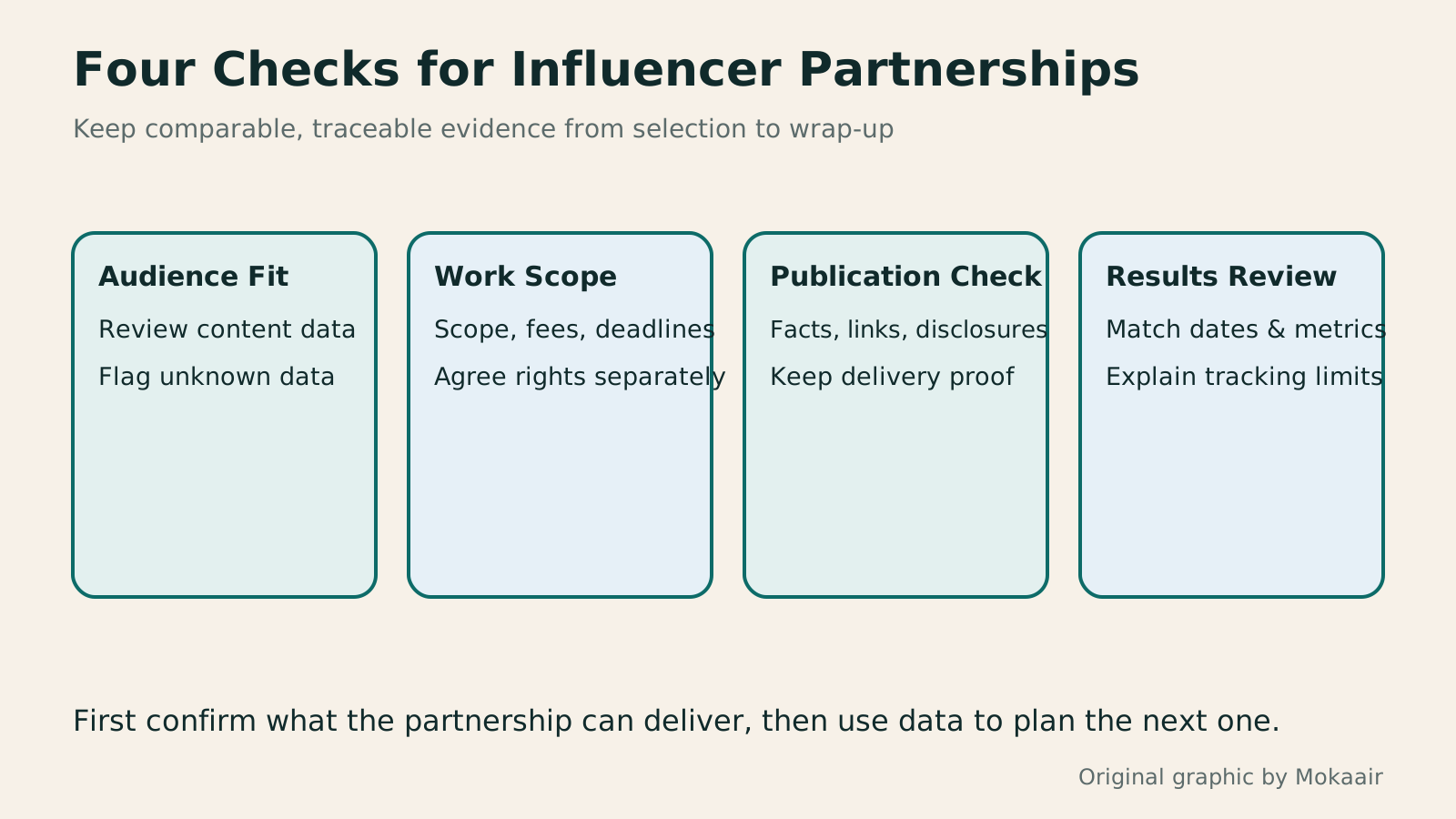
Four cards show audience fit, work scope, publication checks and results reviews, separating partnership deliverables from subsequent observation.
| Comparison Item | Required Data or Agreement | Assumption to Avoid |
|---|---|---|
| Audience fit | Topics, geography and recent relevant content | More followers guarantee a good fit |
| Deliverables | Format, quantity, publication location and revision scope | A flat fee includes all subsequent work |
| Asset use | Channels, duration, editing and advertising uses | Paying production fees grants permanent ownership |
| Partnership disclosure | Platform settings and explanations readers can understand | Platform labels replace all disclosure obligations |
| Results review | Period, metric definitions and paid advertising scope | Tracked orders equal all incremental orders |
Confirm the scope of permissions for customer testimonials and assets
STP and Personas: Use Interview Evidence to Decide Whom to ServeSTP and Personas: Use Interview Evidence to Decide Whom to ServeSTP helps a team decide whom to serve; personas help it understand customers' tasks and obstacles. Both need evidence. Using a fictional home-organizing service, this guide covers interview planning, separating observations from assumptions, segmenting by need, selecting a target, and testing a position. An evidence table, practical steps, and an original diagram help you avoid inventing a convincing customer from age and imagination alone.Read the full article
Planning a Content Marketing Calendar Around Reader Questions and UpdatesPlanning a Content Marketing Calendar Around Reader Questions and UpdatesA content marketing calendar does more than assign publication dates to headlines. It also schedules reader questions, asset production, fact-checking and ownership of updates. Using a fictional fabric shop, this guide turns customer-service questions into an idea bank and plans articles, diagrams and short posts together. A four-week schedule, production steps and an original diagram show how to allow time for review and maintenance, then test whether each piece helps readers complete a task.Read the full article
Found this guide helpful? Share it with someone who needs it
Lifestyle
SEO or paid ads? Allocate by demand, timing, and budget
SEO and paid ads each require content, maintenance, and the ability to interpret data. There is no budget split that fits every website. Using an original floral-workshop example, this guide assigns roles to organic search, search ads, and social content based on how clear demand is, event deadlines, website readiness, and the full cost of each approach. A comparison table, practical steps, and an original diagram help small teams plan spending they can review later.
Lifestyle
How affiliate marketing works: Links, disclosures, and checking results
Affiliate marketing pays commissions for qualifying purchases or actions under a program's terms. Using an original desk cable-management guide, this article covers applications, link creation, disclosure, tracking windows, returns, and validation. It distinguishes clicks, pending commissions, withdrawable balances, and actual bank receipts. A workflow, comparison table, and original diagram help creators assess rules and costs before choosing reader-appropriate partnerships.
Lifestyle
Agentic Retrieval-Augmented Generation (Agentic RAG): When to Search Again
Agentic RAG lets models make retrieval decisions, choosing sources, rewriting queries or searching further based on the question and available evidence. Using a concrete LangGraph workflow and a comparison of venue-use conditions, this article contrasts it with fixed RAG and explains stopping criteria, permissions, query logs and cost control. Learn to judge whether a task needs dynamic exploration or a predictable fixed workflow is enough.
Lifestyle
Graph Retrieval-Augmented Generation (GraphRAG): Understanding a Document Collection Through Relationships
GraphRAG uses entities and relationships in retrieval to answer questions about cross-document connections and overall themes. Drawing on Microsoft's original paper and official docs, this article explains entity extraction, community summaries, and local and global search, using local event records to show why different questions need different paths. It also shows how missing links, mistaken name merges, and distorted summaries affect answers: a pretty graph is not verified fact.
Articles that cite this one
Sources
- Taiwan Fair Trade Commission: Principles for Handling Online Advertising CasesChecked:
- Taiwan Fair Trade Commission: Explanation of Endorsement Advertising RulesChecked:
- YouTube: Disclosing Paid Product Placements, Sponsorships and EndorsementsChecked:
- YouTube: Audience Reports and Data LimitationsChecked:
Compiled from the references and verification dates listed above; fares, schedules, product features, and terms can change, so please confirm the latest details on the relevant official website before travelling, booking, or purchasing.