Lifestyle
STP and Personas: Use Interview Evidence to Decide Whom to Serve
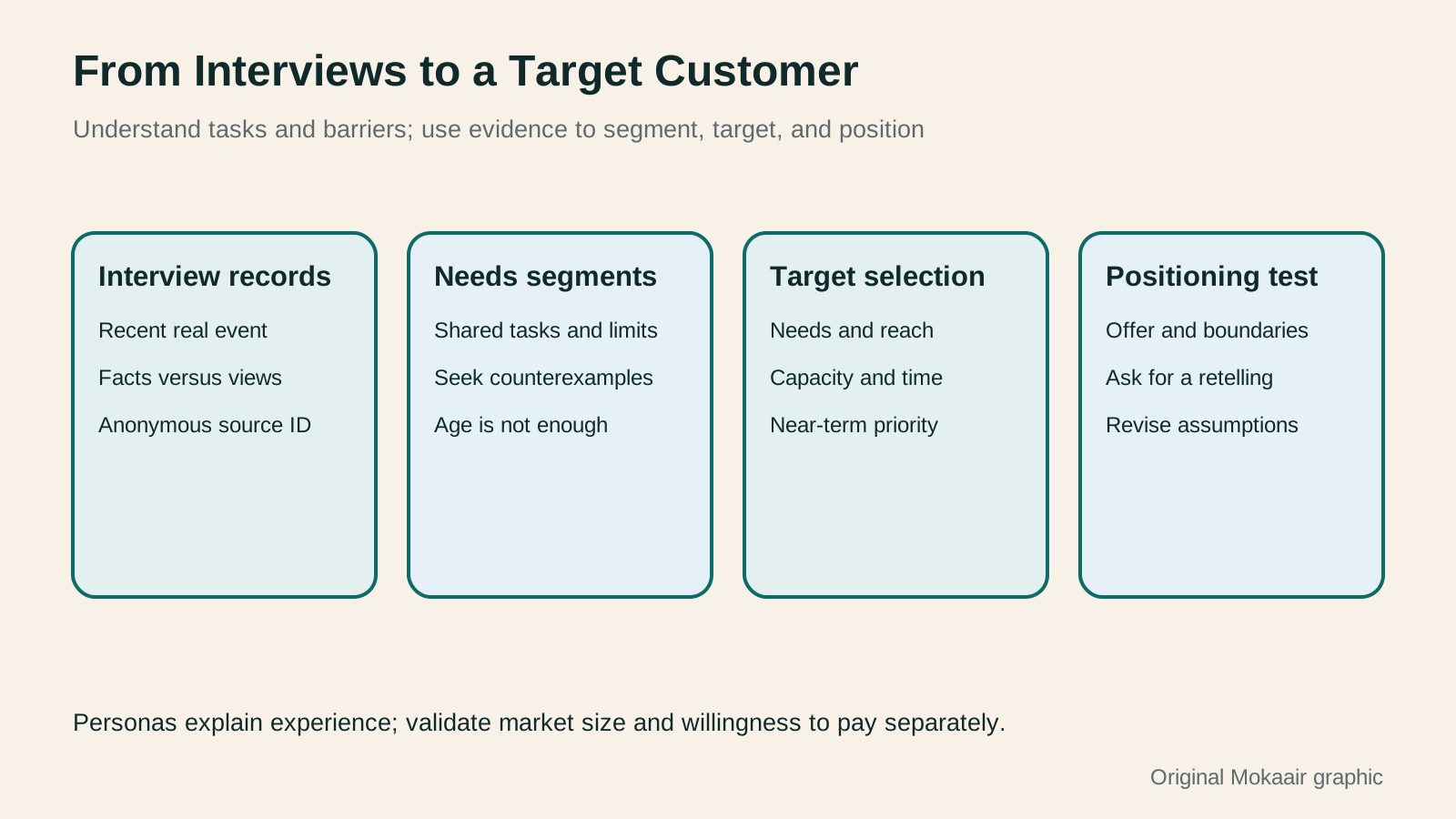
STP helps a team decide whom to serve; personas help it understand customers' tasks and obstacles. Both need evidence. Using a fictional home-organizing service, this guide covers interview planning, separating observations from assumptions, segmenting by need, selecting a target, and testing a position. An evidence table, practical steps, and an original diagram help you avoid inventing a convincing customer from age and imagination alone.
About 7 min read
Contents
- 1. Keep segmentation, targeting, and positioning distinct
- 2. Ask about recent behavior and specific difficulties
- 3. Separate evidence, interpretation, and open questions
- 4. Segment by tasks and constraints, then choose a priority
- 5. Keep evidence sources and uncertainty in the persona
- 6. Test a positioning statement against real tasks
A home-organizing service wants to launch a new package, but the team has only written down ‘busy office workers.’ That group is too broad: some people are moving, others need to organize a workspace, and still others want help dealing with a family member's long-accumulated belongings. Different tasks may call for entirely different services.
This guide draws on market and user research materials checked on September 14, 2026, to explain the path from interviews to choosing a customer group. The home-organizing scenario, personas, and questions are original teaching examples. No interviews were conducted, and they do not establish the share of demand in Taiwan's market.
Keep segmentation, targeting, and positioning distinct
STP stands for segmentation, targeting, and positioning. First, identify groups with shared needs. Second, decide which group to serve first. Third, explain how that group should understand your service and what meaningful difference you offer. The steps connect, but a single persona portrait cannot replace them.
A persona organizes the situation, goals, and behaviors of a type of user into a profile that a team can discuss. It can inform service design, but it does not automatically show how many such people exist or what they would pay. Use interviews to understand why people act; use suitable quantitative evidence to assess scale. Otherwise, a vivid story can be mistaken for market share.
Start with the decision the research must support, such as ‘Should we launch pre-move sorting or everyday workspace organizing first?’ Gather only information that bears on that choice. A participant's favorite film or drink need not appear just to make the persona look complete if it has no bearing on the service task.
Ask about recent behavior and specific difficulties
Recruit through different points of contact: people who have bought, people who asked but did not buy, and people who may currently need the service. Interviewing only familiar, satisfied customers can miss reasons for leaving or being a poor fit. Record recruitment criteria and sources, offer an accessible interview method, and explain how the data will be used and whether the conversation will be recorded.
Ask someone to recall the last time they organized a space: what prompted them, where they started, what help they sought, and where they stopped. Following up on a concrete event is more likely to reveal actual behavior than asking ‘Would you buy our new service?’ Do not insert your expected answer into the question and invite agreement.
For example, ‘How did you decide what to keep before your last move?’ can reveal the decision process. ‘Don't you really need a professional organizer?’ suggests an answer. If someone says they ran out of time, ask which step and how they handled it then; do not immediately classify everyone as willing to pay to save time.
Separate evidence, interpretation, and open questions
Give each record an anonymous ID, date, and context. Put what the participant said in a different field from the researcher's interpretation. If no verbatim recording was checked, label the account a summary rather than placing it in quotation marks as a direct quote. Keep stored contact details separate from research summaries and restrict access to people who need it.
In this invented example, a record might say, ‘Before moving, I sorted twice but still boxed the things I could not decide about.’ A researcher might infer that decisions about what to keep are harder than moving the items. That inference needs follow-up and comparison with other people. One record is a clue, not a trait shared by everyone who moves.
Keep contrary cases too: someone may have finished sorting and need only brief packing help. Separating these situations can be more useful than forcing them into a single persona. If an idea is supported only by team discussion, mark it as an assumption to test, not as a confirmed customer need.
Segment by tasks and constraints, then choose a priority
Group records by goals, triggering events, current alternatives, and obstacles, then check whether the groups actually need different services. Age and location may be background details, but they do not establish motivation. People of the same age can have different tasks, and one person's needs can change over time.
The organizing service could provisionally compare ‘help deciding what to keep before a move’ with ‘a daily storage system for remote workers.’ These are research directions, not proven market segments. Next, investigate each group's frequency of need, ways to reach them, service hours, delivery capacity, and payment conditions. Do not choose a group merely because its story is more vivid.
If the team is good at guided sorting but cannot transport items, its positioning should say so. Choose one group as a near-term service priority and record why others are deferred. Targeting is a resource decision. It does not mean other people can never buy, or that the team has covered the entire market.
- Define one service decision and list the evidence and assumptions you already have.
- Recruit people with different experiences and ask about recent real events.
- Use anonymous records to identify shared tasks, contrary evidence, and open questions.
- Compare needs with delivery capacity, choose a near-term group, and test the position.
Keep evidence sources and uncertainty in the persona
A useful persona can include the task name, the situation in which it arises, the desired outcome, main obstacles, current alternatives, and IDs of records supporting those details. Add an update date and open questions so the team can trace the content to evidence instead of seeing only an untraceable story.
A working label such as ‘pre-move decision support’ can remind the team what the customer wants to accomplish. If you use a fictional name, explain that the profile combines observations and does not portray one real participant. There is no need to invent an exact birthday, income, family details, or shopping preferences to create the illusion of complete data.
NN/g distinguishes provisional personas built from existing assumptions, qualitative research personas, and personas informed by quantitative analysis. With limited resources, you can record assumptions first, but label their status clearly. A small set of interviews can illuminate experiences and uncover questions; its participant count alone cannot estimate market share or support a statistical confidence level.
Test a positioning statement against real tasks
A draft position might read: ‘We help people who struggle to decide what to keep before moving create a sorting and disposal plan; transport is outside the service.’ This is a hypothetical example. Next, ask people who fit the criteria to read it and check whether they understand the offer, can tell if it suits them, and can identify missing information.
Do not ask only whether they like the sentence. Ask what they expect to receive and what problem would prompt them to get in touch. If a reader assumes the package includes a moving company, the message is still unclear. Feed new questions back into the persona and service description, then arrange a small-scale test of actual demand.
Whenever new evidence arrives, check whether the original segments are still useful. Adjust personas when service conditions change, you reach different customers, or contrary evidence appears. Do not ignore new information to preserve an attractive layout. Good research makes the next decision clearer and shows the team where it still cannot draw a conclusion.
| Persona field | What to record | What to avoid |
|---|---|---|
| Task and context | When help is needed and the desired outcome | Only ‘busy office worker’ |
| Behavioral evidence | Anonymous ID, date, and event summary | Presenting a summary in quotes as verbatim speech |
| Research interpretation | Possible reasons and supporting records | Treating one person's view as universal |
| Assumptions to test | Unconfirmed needs and how to validate them | Inventing income, preferences, and market shares |
Put the target group into a small-business marketing planHow to write a small-shop marketing plan: goals, customers, and monthly reviewsA small-shop marketing plan can begin with one clear business problem; there is no need to schedule every social channel and ad at once. Using an original example about a florist's weekday orders, this guide works through goals, customers, channel roles, budgets, and monthly reviews. It provides practical worksheet fields, a comparison table, and an original diagram so owners can turn ideas into assigned, trackable actions they can revise. Completing a campaign is not a promise of sales.Read the full article
Check your service with 4P, 7P, and 4CHow to use 4P, 7P and 4C: turn a product list into customer questionsThe 4P, 7P and 4C frameworks can organize marketing questions, but filling in their labels does not reveal customer needs. Using an original beginner photography workshop example, this guide examines product, price, place and promotion alongside people, process and physical evidence, then revisits the offer through customer needs, total cost, convenience and communication. A comparison table, practical steps and original diagram turn the analysis into a service improvement that can be checked.Read the full article
Organize the service description on a business websiteHow to Build a Small Business Website: Service Pages, Trust Signals, and InquiriesA small business website should help visitors understand the services, decide whether they are a good fit, and send an inquiry. Using WordPress and a fictional local design studio, this guide plans the home, service, portfolio, about, and contact pages. It provides a practical content checklist and acceptance criteria, including form fields, error messages, notification delivery, and ownership after handoff, so the site becomes a usable entry point for clients.Read the full article
Found this guide helpful? Share it with someone who needs it
Lifestyle
How to Read the BCG Matrix: Uses and Limits of Product Portfolio Analysis
The BCG matrix maps product portfolios by market growth and relative share; stars, cash cows, question marks and dogs do not establish actual profit. An original home goods store example shows how to define markets, check comparison periods and denominators, understand model assumptions, and allocate resources using costs, turnover and customer needs. Includes a four-category table, practical steps, original diagrams and options when reliable market data is lacking.
Lifestyle
How to Use the Ansoff Matrix: Four Options for Expanding Products and Markets
The Ansoff matrix maps four growth paths using existing or new products and markets: market penetration, market development, product development and diversification. An original canvas goods studio example shows how to define the current business and compare the capabilities and evidence each path needs. A comparison table, steps and original diagrams turn growth ideas into small, testable plans, without treating the model as a success-rate table.
Lifestyle
How to Write Marketing Copy: Clarify Value, Conditions, and Next Steps
Marketing copy should explain who it suits, its value, conditions, and what happens next. Using an original journal-binding workshop example, this article revises information hierarchy, features and benefits, evidence for claims, and action buttons step by step. A before-and-after table and original diagrams show how to retain appeal without overstating promises, and check that prices, limits, images, and links align before publication.
Lifestyle
Customer Journeys and Marketing Funnels: Find Where Readers Drop Off
Customer journeys explain touchpoints and needs; marketing funnels count people at each step using consistent criteria. Using an original bicycle repair booking example, this article explains how to map online and offline contacts, define completion events, calculate step conversion rates, and set up GA4 open or closed funnels. A calculation table, practical steps, and original diagrams help identify improvement hypotheses to test without mistaking data gaps for causes of customer drop-off.
Articles that cite this one
- How to Use the Ansoff Matrix: Four Options for Expanding Products and Markets
- How to Write Marketing Copy: Clarify Value, Conditions, and Next Steps
- Customer Journeys and Marketing Funnels: Find Where Readers Drop Off
- Evaluating Influencer Partnerships: KOLs, KOCs and Deliverable Reviews
- SWOT and TOWS: From Strengths and Weaknesses Analysis to an Action List
- How to Use Porter's Five Forces: Competition and Bargaining Power
- How to Use PESTLE: Turn External Changes into Business Risks
- B2B, B2C and D2C: Customers, Sales Processes and Marketing Priorities
Sources
- Australian Government: Identify your target marketChecked:
- GOV.UK: Conducting in-depth interviewsChecked:
- GOV.UK: Learning about user needs and evidenceChecked:
- NN/g: Three types of personas and their research basisChecked:
- OpenStax: STP and product positioningChecked:
Compiled from the references and verification dates listed above; fares, schedules, product features, and terms can change, so please confirm the latest details on the relevant official website before travelling, booking, or purchasing.