Lifestyle
How to use 4P, 7P and 4C: turn a product list into customer questions
The 4P, 7P and 4C frameworks can organize marketing questions, but filling in their labels does not reveal customer needs. Using an original beginner photography workshop example, this guide examines product, price, place and promotion alongside people, process and physical evidence, then revisits the offer through customer needs, total cost, convenience and communication. A comparison table, practical steps and original diagram turn the analysis into a service improvement that can be checked.
About 7 min read
Contents
- 1. Define the problem before choosing a framework
- 2. Use 4P to check what you offer and how people get it
- 3. Use 7P to find gaps in service delivery
- 4. Use 4C to see the participant's perspective
- 5. Combine the frameworks into one small improvement
- 6. Do not mistake a complete worksheet for a complete strategy
A photography workshop has a course outline and promotional offer, yet prospective participants keep asking whether they need their own camera, what happens if it rains, and whether complete beginners can join. These questions remind the organizer that marketing includes the service and how people access it, not only promotion.
This guide draws on marketing professional-body material and a republication of Lauterborn's original 4C text, consulted on September 14, 2026. The workshop is an original example, not a real enrollment experiment. The frameworks help us ask questions; they do not guarantee sales results.
Define the problem before choosing a framework
Before using a framework, write one concrete problem, such as: ‘Interested readers still cannot tell whether the workshop suits them after viewing the course page.’ Then separate what you know from what you suspect. Inquiry messages and the registration flow are evidence; a high price, inconvenient schedule or unclear description may only be hypotheses. Do not treat the two as interchangeable.
The 4P framework generally organizes decisions about product, price, place and promotion. The 7P framework also examines the people, process and physical evidence involved in service delivery. The 4C framework used here is Lauterborn's customer-oriented version, not another field's model with the same initials. Name the version when citing it to avoid confusion.
These tools complement one another; there is no need to claim that one has entirely replaced the others. A small team does not need fifteen completed worksheets at once. Use one workshop to inspect the provider's arrangements, then switch to the participant's perspective to find information and service conditions that do not line up.
Use 4P to check what you offer and how people get it
Product means the product or service offered; Price is what it costs; Place covers channels and access; Promotion covers promotional and communication activities. The product need not be physical: a course can be assessed this way too. Place means more than a street address; it includes where customers book and how they receive the service.
For a photography workshop, product questions include whether the course teaches basic operation or creative work and whether practice and feedback are included. Price questions include what the fee covers and what costs extra. If those points are unclear, a claim of high quality in the copy will not help readers judge whether the course meets their needs.
For Place, check whether registration, payment confirmation and meeting instructions form a coherent journey. For Promotion, check whether the message explains who can join and what they will learn. Do not attract absolute beginners and only after registration require experience with advanced equipment. Review all four decisions together so the promotional promise does not contradict the service conditions.
Use 7P to find gaps in service delivery
The 7P framework adds People, Process and Physical evidence to the original four. These cover the people customers deal with, the steps through which the service is delivered, and tangible signs customers can observe. They are especially useful in service settings and can also help assess physical products that need after-sales support.
For People, ask who answers equipment questions, who leads practice and how the teacher and assistants divide the work. Process includes registration confirmation, preparation, the meeting on the day and questions afterward. If every message waits until the teacher finishes class, the problem may be the service arrangement rather than insufficient exposure.
Physical evidence is not limited to classroom decor. It may include a clear schedule, authentic photos of the venue, a sample handout and a confirmation notice. Such material helps readers understand what they will receive, but invented outcomes or someone else's photos must not be used to manufacture experience. Keep it aligned with the actual offer and review it when the offer changes.
Use 4C to see the participant's perspective
Lauterborn's 4C framework focuses on consumer needs, the cost of satisfying them, convenience and communication. It asks organizers to look beyond what they want to provide and understand what the other person needs to accomplish. One workshop participant may want clear product photos; another may want to document family life. Their needs need not be the same.
Cost includes more than the listed course fee. Travel, time, equipment preparation and the effort of understanding the information may also matter. This does not mean every burden can be reduced to one monetary figure; it means the team should identify obstacles. If a learner worries that their camera is unsuitable, a verifiable equipment explanation may address the problem better than an immediate discount.
Convenience includes how participants register, arrive and later use what they learned. Communication needs a way to ask and answer questions. Check whether the course page addresses common concerns and how the team responds to requests it cannot serve. Bringing customer questions back into service design is more useful for identifying improvements than merely posting promotions more often.
Combine the frameworks into one small improvement
Suppose the original workshop receives many questions about compatible equipment. First identify the actual concerns: some people do not know whether a phone is enough; others fear they must buy a new lens. These concerns touch product scope, the pre-class process, customer cost and communication at once. Debating which letter owns the problem matters less than finding a decision you can act on.
The teacher can first confirm supported equipment and alternatives. Put that explanation on the course page, and have support staff and the registration email use the same information. If loan equipment is available, state its quantity, how to confirm availability and the conditions of use. That is a complete improvement; writing ‘improve communication’ alone is not an assigned task.
Set an acceptance question for the change: after reading the information, can people correctly tell whether they can join, and do they still need to ask the same question repeatedly? Check with a small group before expanding the change. This is an instructional design exercise; it does not prove that equipment guidance will increase enrollment.
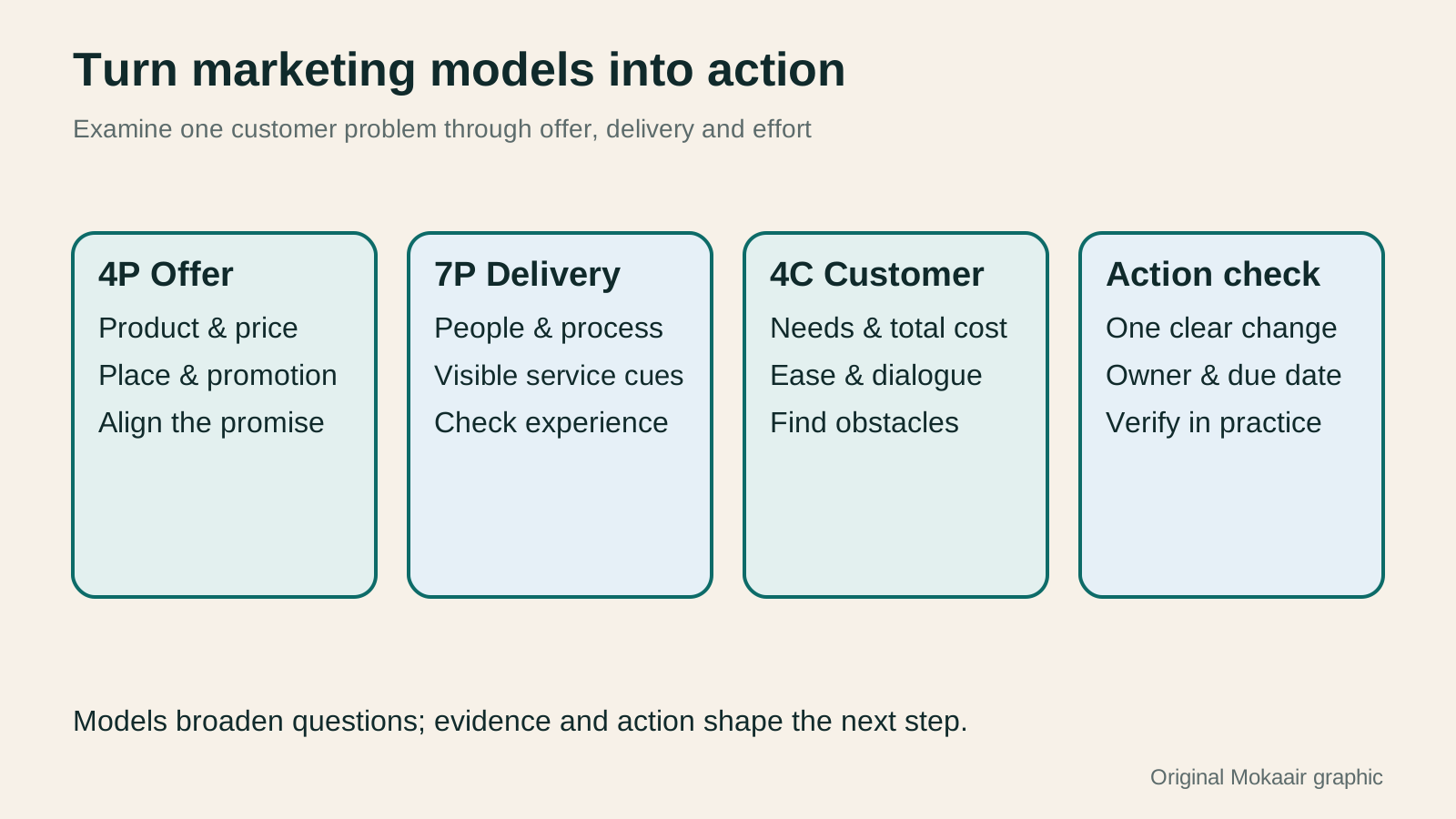
- Write down a specific customer question, separating known evidence from untested assumptions.
- Use 4P to review the offer and transaction, then 7P to inspect delivery.
- Use 4C to revisit needs, total cost, convenience and two-way communication.
- Choose one feasible improvement, assign an owner and verify it with a real task.
Do not mistake a complete worksheet for a complete strategy
A framework does not choose your audience or automatically supply market-size or demand evidence. If the audience is unclear, return to interviews, inquiry records and actual purchasing experience. Do not invent a plausible customer group simply to fill every box and then present its imagined preferences as confirmed facts.
Nor must you invest in every dimension at once. If pre-class information is clear but people wait too long on site, fix the process and staffing first. If the service itself misses the need, more promotion may only attract more unsuitable inquiries. Rank issues using both importance and current evidence so resources do not scatter across irrelevant work.
At each review, retain the original problem, the changes made and the observed results. Even if enrollments rise after an improvement, seasonality, scheduling or other activities may have contributed. Record the trend without claiming the framework produced a fixed growth rate. The value of the models is that they help a team ask fuller questions and take coordinated action.
| Framework | Main perspective | Workshop questions |
|---|---|---|
| 4P | Product, price, place and promotion | What is taught, what is charged, and how do people book and learn the terms? |
| 7P | 4P plus people, process and physical evidence | Who replies, how is the service delivered, and what can participants see? |
| 4C (Lauterborn) | Needs, total cost, convenience and communication | What do participants hope to do, and which burden blocks them? |
How to write a small-shop marketing plan: goals, customers, and monthly reviewsHow to write a small-shop marketing plan: goals, customers, and monthly reviewsA small-shop marketing plan can begin with one clear business problem; there is no need to schedule every social channel and ad at once. Using an original example about a florist's weekday orders, this guide works through goals, customers, channel roles, budgets, and monthly reviews. It provides practical worksheet fields, a comparison table, and an original diagram so owners can turn ideas into assigned, trackable actions they can revise. Completing a campaign is not a promise of sales.Read the full article
Compare online course platforms with delivery needs
WordPress booking systems: time slots, confirmation emails, and cancellation rulesWordPress booking systems: time slots, confirmation emails, and cancellation rulesA WordPress booking system must handle service hours, staff capacity, notifications, and cancellations together. This guide compares Amelia, Bookly, and WooCommerce Bookings for a Taiwanese studio, explains operating hours, buffers, and exceptional closures, then tests confirmation, rescheduling, and refunds as an ordinary customer so both staff and customers know when a booking is final.Read the full article
Found this guide helpful? Share it with someone who needs it
Lifestyle
How to Read the BCG Matrix: Uses and Limits of Product Portfolio Analysis
The BCG matrix maps product portfolios by market growth and relative share; stars, cash cows, question marks and dogs do not establish actual profit. An original home goods store example shows how to define markets, check comparison periods and denominators, understand model assumptions, and allocate resources using costs, turnover and customer needs. Includes a four-category table, practical steps, original diagrams and options when reliable market data is lacking.
Lifestyle
How to Use the Ansoff Matrix: Four Options for Expanding Products and Markets
The Ansoff matrix maps four growth paths using existing or new products and markets: market penetration, market development, product development and diversification. An original canvas goods studio example shows how to define the current business and compare the capabilities and evidence each path needs. A comparison table, steps and original diagrams turn growth ideas into small, testable plans, without treating the model as a success-rate table.
Lifestyle
How to Write Marketing Copy: Clarify Value, Conditions, and Next Steps
Marketing copy should explain who it suits, its value, conditions, and what happens next. Using an original journal-binding workshop example, this article revises information hierarchy, features and benefits, evidence for claims, and action buttons step by step. A before-and-after table and original diagrams show how to retain appeal without overstating promises, and check that prices, limits, images, and links align before publication.
Lifestyle
Customer Journeys and Marketing Funnels: Find Where Readers Drop Off
Customer journeys explain touchpoints and needs; marketing funnels count people at each step using consistent criteria. Using an original bicycle repair booking example, this article explains how to map online and offline contacts, define completion events, calculate step conversion rates, and set up GA4 open or closed funnels. A calculation table, practical steps, and original diagrams help identify improvement hypotheses to test without mistaking data gaps for causes of customer drop-off.
Articles that cite this one
Sources
- CIM: the marketing mix and 7PChecked:
- CIM: definition of marketing and the 4P, 7P and 4C frameworksChecked:
- Republication of Bob Lauterborn's original 1990 article on 4C (PDF)Checked:
Compiled from the references and verification dates listed above; fares, schedules, product features, and terms can change, so please confirm the latest details on the relevant official website before travelling, booking, or purchasing.