Lifestyle
How to Write Marketing Copy: Clarify Value, Conditions, and Next Steps
Marketing copy should explain who it suits, its value, conditions, and what happens next. Using an original journal-binding workshop example, this article revises information hierarchy, features and benefits, evidence for claims, and action buttons step by step. A before-and-after table and original diagrams show how to retain appeal without overstating promises, and check that prices, limits, images, and links align before publication.
About 8 min read
Contents
- 1. Start with Five Things Readers Need to Know
- 2. Connect Features to Practical Uses, Not Guarantees
- 3. Every Objective Claim Needs Traceable Support
- 4. Present Prices and Restrictions Alongside Appealing Messages
- 5. Action Buttons Should Describe What Happens After Clicking
- 6. Assess Revisions Through Understanding and Follow-Up Quality
“Give yourself the best experience life has to offer” may evoke emotion, but it does not tell readers what they will do, how long it takes, or whether experience is required. Good copy can have style while helping people make suitable choices. Explaining the service clearly before refining rhythm and wording makes it easier to identify improvements than continually piling on adjectives.
Based on Fair Trade Commission rules and the GOV.UK button design guide reviewed on 2026-9-14, this article outlines a writing process for general marketing copy. The journal-binding workshop, prices, and sentences are original hypothetical examples, with no actual offering for sale. They do not imply that effectiveness testing or a case-specific legal review has been completed.
Start with Five Things Readers Need to Know
Before writing, list who the readers are, what situation they face, what the service provides, the participation requirements, and the next step. This information is the foundation for your copy, not yet a slogan. If you cannot answer any of these questions, check with the person responsible for the service first. Do not fill gaps in actual information with words such as “professional” or “premium.”
The original example is a journal-binding workshop for people trying bookbinding for the first time, with an introduction to the materials and on-site guidance. The copy requires confirmation of the workshop's time, location, what participants will make, and tool arrangements. These details are illustrative only; when publishing a real offering, replace them with what the workshop can actually provide.
Next, separate what readers need to know immediately from the details they need to consult before deciding. Explain the core service in the headline and opening paragraph, add the process and conditions below, and end with a clear way to proceed. Do not omit important restrictions simply because they look less appealing. Information hierarchy should aid reading, not cause people to miss essential details.
Connect Features to Practical Uses, Not Guarantees
Features explain what is provided; value explains how it helps the user. For example, “Bookbinding tools are provided on-site” can lead to “You do not need to buy a full set of tools just to try bookbinding for the first time.” This reasoning must reflect the actual arrangements. If participants still need to bring some supplies, list those too, so the stated benefits do not exceed the facts.
The original workshop example could say, “Follow the on-site demonstration and practice making a journal in the specified format,” but should not become “Everyone becomes a bookbinding expert in one session.” The latter turns a single experience into a guarantee of everyone's ability. Claims about ease or suitability for beginners must also reflect the teaching content and the help available.
Emotional wording can appear where appropriate, such as expressing the anticipation of creating a handmade record of everyday life, but it should not replace information about the offering. Readers should be able to distinguish an invitation or stylistic expression from a specific promise about results. After writing, check each sentence for unsupported absolutes and implications.
Every Objective Claim Needs Traceable Support
Article Twenty-One of the Fair Trade Act prohibits false or misleading representations about matters that could affect transaction decisions, and services also fall within the relevant rules. Writers can start by creating a claims list: who verifies prices, quantities, content, eligibility, and effects, and where the evidence is kept. Do not skip verification simply because the writing was outsourced.
If the original workshop example claims small classes, first confirm the actual capacity and teaching arrangements. If you use the sample wording “a maximum of six people,” the workshop setup must match. Do not invent figures for completion rates, satisfaction, or comparisons that have not actually been measured. Even genuine feedback requires checking the scope and context of the quotation; it must not be rewritten as an outcome shared by everyone.
Keep a simple claims record containing each sentence, its supporting evidence, scope of applicability, and verification date. If the evidence only establishes what happened at one event, do not extend the claim to all sessions. When sufficient evidence is unavailable, remove the claim or replace it with a verifiable description of the service. Do not assume that adding a line of fine print resolves the issue.
Present Prices and Restrictions Alongside Appealing Messages
The Fair Trade Commission's handling principles consider the overall impression, along with the layout, placement, typeface, and disclosure of restrictions for important transaction information. This means checking more than whether individual sentences are true: consider whether the entire graphic or page could easily mislead. A prominent headline and disproportionately small fine print may convey entirely different messages.
In the original hypothetical example, if a single workshop session costs nine hundred eighty New Taiwan dollars and includes specified materials and in-class tool use, present these details together. If there are additional purchases, clearly distinguish whether they are required and how they are priced. This figure only illustrates how to write the copy; it is not a market price survey or a purchasing recommendation.
Offer deadlines, eligible sessions, and availability must also be verifiable. Do not display a repeatedly resetting countdown without a real deadline, or claim that only one place remains without confirming availability. Readers should understand the conditions before choosing, rather than click under pressure only to discover that the option they imagined does not exist.
Action Buttons Should Describe What Happens After Clicking
The GOV.UK button guide recommends wording that describes the actual action. Apply this principle to registration, inquiry, and download links: if clicking only opens a list of dates, use “View available sessions”; if submitting a form sends a request, use “Send a workshop inquiry.” Do not describe something as completed when it has not yet happened.
A page can offer entry points for different needs, but make the main path easy to identify. The original workshop page could place the session lookup after the workshop details and conditions, then provide contact information for people who cannot decide. If every paragraph asks readers to share, subscribe, buy, and add a contact all at once, they may struggle to know what to do next.
Explain necessary follow-up steps near the button, such as selecting a session, entering details, or completing payment. When linking to another platform, tell people where the next steps will take place. Check the copy and process together; do not merely make the button wording more compelling while the actual page does something different.
- Outline the audience, service details, conditions, and next step, filling information gaps first.
- Explain value through practical uses, and remove unsupported guarantees sentence by sentence.
- Check the evidence for claims, the scope of quoted prices, and where important restrictions appear.
- Follow the actual links and button flows, then ask readers to explain their understanding of the offering and conditions.
Assess Revisions Through Understanding and Follow-Up Quality
Before publication, ask someone who was not involved in writing to answer a few questions: What is the service? Who is it suitable for? What does the fee include? What happens after clicking the button? If the answers differ from the actual arrangements, first revise the sentences causing misunderstanding. This check cannot replace legal review, but it can help reveal gaps in how information is communicated.
When comparing two versions of copy, retain both versions and record the observation period and any other changes. Increased clicks may be influenced by traffic sources, layout, or promotional activities, so they cannot be attributed directly to a particular verb. Also examine whether inquiries better match the service's scope, whether readers misread conditions less often, and what still needs further explanation.
When service details or prices change, check articles, graphic cards, ads, and registration pages together. Maintain an updatable claims record so the next person taking over knows which sentences need reconfirmation. Good copy not only encourages people to keep reading; it also ensures that, when they take the next step, they can still receive the service they originally understood.
Read the full description
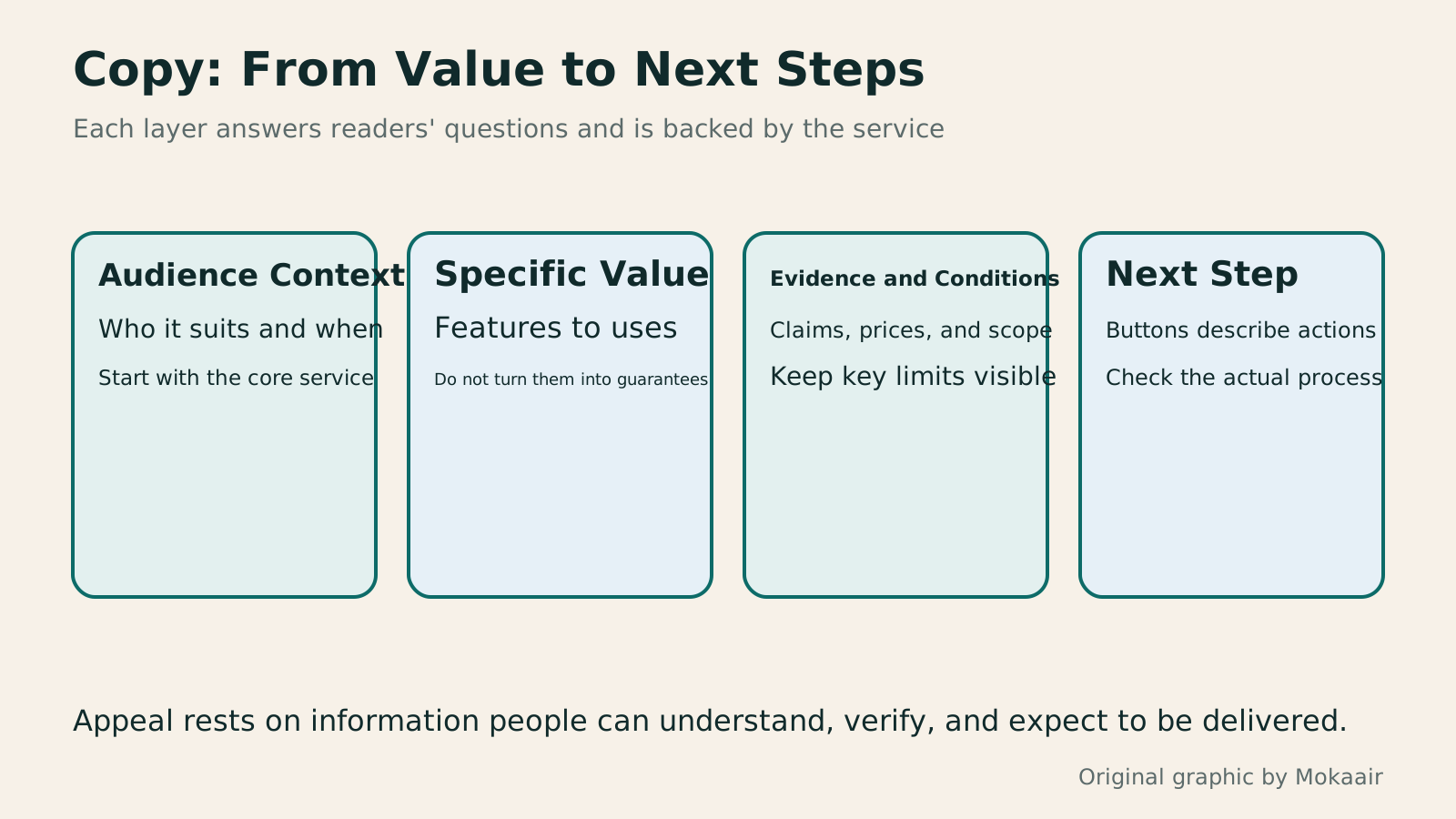
Four cards show audience context, specific value, evidence and conditions, and ways to act, reminding writers that copy must match what is delivered.
| Original Draft to Revise | Clearer Example | Verify Before Use |
|---|---|---|
| The most perfect crafting experience | An in-person journal-binding workshop for first-timers | Actual workshop content and intended participants |
| Finish easily with zero preparation | Specified materials and tools provided on-site | Whether anything must still be brought or purchased separately |
| Everyone becomes an expert in one session | Practice the specified binding format by following the on-site demonstration | Teaching scope and available assistance |
| Grab your place now | View available sessions | Whether the button actually links to the session list |
| Great value at just nine hundred eighty | Nine hundred eighty dollars per session and what is included | Price, pricing unit, and eligible sessions |
Schedule copywriting in your content calendarPlanning a Content Marketing Calendar Around Reader Questions and UpdatesA content marketing calendar does more than assign publication dates to headlines. It also schedules reader questions, asset production, fact-checking and ownership of updates. Using a fictional fabric shop, this guide turns customer-service questions into an idea bank and plans articles, diagrams and short posts together. A four-week schedule, production steps and an original diagram show how to allow time for review and maintenance, then test whether each piece helps readers complete a task.Read the full article
First understand readers' needs and use contextsSTP and Personas: Use Interview Evidence to Decide Whom to ServeSTP helps a team decide whom to serve; personas help it understand customers' tasks and obstacles. Both need evidence. Using a fictional home-organizing service, this guide covers interview planning, separating observations from assumptions, segmenting by need, selecting a target, and testing a position. An evidence table, practical steps, and an original diagram help you avoid inventing a convincing customer from age and imagination alone.Read the full article
Make article titles accurately describe the contentHow to write article titles: Show search readers the scope and purposeA useful title tells readers before they click what problem an article addresses, when it applies, and what information they will get. Using original rewrites of everyday tutorials, this guide checks the topic, purpose, limits, and evidence behind title promises. It explains why the page heading, HTML title, and Google search title may differ, then offers prepublication checks and post-change observation without stuffing keywords, claiming tests that never happened, or adding an unverified year.Read the full article
Found this guide helpful? Share it with someone who needs it
Lifestyle
How to Read the BCG Matrix: Uses and Limits of Product Portfolio Analysis
The BCG matrix maps product portfolios by market growth and relative share; stars, cash cows, question marks and dogs do not establish actual profit. An original home goods store example shows how to define markets, check comparison periods and denominators, understand model assumptions, and allocate resources using costs, turnover and customer needs. Includes a four-category table, practical steps, original diagrams and options when reliable market data is lacking.
Lifestyle
How to Use the Ansoff Matrix: Four Options for Expanding Products and Markets
The Ansoff matrix maps four growth paths using existing or new products and markets: market penetration, market development, product development and diversification. An original canvas goods studio example shows how to define the current business and compare the capabilities and evidence each path needs. A comparison table, steps and original diagrams turn growth ideas into small, testable plans, without treating the model as a success-rate table.
Lifestyle
Customer Journeys and Marketing Funnels: Find Where Readers Drop Off
Customer journeys explain touchpoints and needs; marketing funnels count people at each step using consistent criteria. Using an original bicycle repair booking example, this article explains how to map online and offline contacts, define completion events, calculate step conversion rates, and set up GA4 open or closed funnels. A calculation table, practical steps, and original diagrams help identify improvement hypotheses to test without mistaking data gaps for causes of customer drop-off.
Lifestyle
Planning Brand Identity: CIS, Logos and Website Colors
Brand identity connects business ideas, public-facing behavior and visuals; a logo is only one part. Using an original example of a desk-side stationery studio, this guide covers CIS, MI, BI and VI basics, brand briefs, logo use and website color rules, with steps, a comparison table and original diagrams. It helps small brands clarify uses and acceptance criteria before commissioning design, avoiding a delivery of image files without guidelines they can keep using.
Articles that cite this one
Sources
- Fair Trade Commission: Article Twenty-One of the Fair Trade ActChecked:
- Fair Trade Commission: Principles for Handling Article Twenty-One CasesChecked:
- GOV.UK Design System: Button Text and ActionsChecked:
Compiled from the references and verification dates listed above; fares, schedules, product features, and terms can change, so please confirm the latest details on the relevant official website before travelling, booking, or purchasing.