Lifestyle
How to Use the Ansoff Matrix: Four Options for Expanding Products and Markets
The Ansoff matrix maps four growth paths using existing or new products and markets: market penetration, market development, product development and diversification. An original canvas goods studio example shows how to define the current business and compare the capabilities and evidence each path needs. A comparison table, steps and original diagrams turn growth ideas into small, testable plans, without treating the model as a success-rate table.
About 8 min read
Contents
- 1. First, define what counts as existing products and markets
- 2. Market penetration: identify the remaining barriers to existing demand
- 3. Market development: the product stays the same, but service requirements may change
- 4. Product development: make new ideas address existing customers' problems first
- 5. Diversification: learn about both new products and new markets
- 6. Compare the assumptions that need to be demonstrated next
A canvas goods studio wants to increase revenue. Some suggest promoting its existing bag designs more, others want to sell in other cities and counties, and others propose developing new products. These all count as growth, but they pose different challenges: some require understanding new customers, some require learning new production methods, and some require both.
Drawing on AQA's Ansoff model teaching guide and a government product development guide accessed on 2026/9/14, this article outlines the four options and ways to validate them. The studio, products and customer groups form an original example that has not undergone real market testing. No fixed success rate or revenue forecast is provided for any direction.
First, define what counts as existing products and markets
The Ansoff matrix distinguishes growth options along two dimensions: products and markets. Existing products in existing markets mean market penetration; existing products in new markets mean market development; new products in existing markets mean product development; and new products in new markets mean diversification. Before classifying a plan, specify which part of the business and which period define what is “existing.”
The studio in this original example currently retails several canvas bag designs to individual commuters in Taichung. This is the baseline for the example; it does not mean everyone in the existing market must have bought a bag before. An existing market can also include people who have not purchased but fit the same customer profile. A market cannot simply be equated with a list of individual customers.
A new market may be a different region or a new user group, rather than merely a different sales channel. Listing the same bag designs on a website does not automatically become market development if they still target the same people. Conversely, even with the same products, serving a new region may add requirements for shipping, communication, or handling returns and exchanges.
Market penetration: identify the remaining barriers to existing demand
Market penetration means increasing sales of existing products in an existing market. The studio could first check whether commuters understand the bags' dimensions, capacity and carrying options, and whether the current ways to buy are convenient. These improvements still focus on the current products and customer group, without immediately adding more items.
A plan for this original example could involve preparing size comparisons and examples of everyday items that fit in each bag, then letting people with those needs decide which design suits them. Next, observe whether their inquiries and the purchasing process become clearer. If customers' main problem is that the specifications they need are unavailable, more promotion may still fail to close the gap between the products and their needs.
Although this direction uses familiar products and markets, demand and execution costs still need to be checked. Do not describe “relative familiarity” as an absence of risk, or assume that lower prices will necessarily improve overall results. If discounts attract more orders but also sharply increase the workload per order, revisit the original goal.
Market development: the product stays the same, but service requirements may change
Market development takes existing products into new markets. Suppose the studio wants to offer the same bag range to commuters in another city. It should first examine their usage situations, ways to reach them and available alternatives. A new region is not simply a list to which existing promotion can be applied unchanged; research is needed to see whether differences affect purchasing.
Start by choosing an area the studio can serve, checking whether shipping, customer service, product information, and return and exchange procedures can work, then arranging a limited showcase or interviews about customer needs. Validation here involves more than counting likes: do people understand the products, do they have matching needs, and can the studio fulfill the orders?
If entering a new market requires changes to product design, the plan may also involve product development. Record the changes separately; there is no need to overlook actual work merely to fit the plan into one cell. The matrix highlights what is new, rather than requiring every complex plan to have a single, permanently correct label.
Product development: make new ideas address existing customers' problems first
Product development means offering new products or substantially improved services to an existing market. Starting with commuters' organization problems, the studio might try developing accessories that fit inside its existing canvas bags. Even with a familiar customer group, it still needs to establish what they want to solve. Easily available materials alone do not establish demand.
Simple samples can first help check dimensions, ease of access and usage situations, followed by an assessment of materials, production, packaging and support needs. The government product development guide recommends researching ideas, building prototypes and gathering user feedback first. Only general development methods are adopted here; applicable specifications and safety requirements still need to be checked separately for the actual products.
A validation question for this original example could be: “Does the accessory make frequently used items easier to find, and is the existing bag still easy to carry with it inside?” Observing use gets closer to functional needs than merely asking about color preferences. A sample that performs the task does not establish mass-production costs, durability or actual willingness to pay. Each still needs to be checked.
Diversification: learn about both new products and new markets
Diversification involves both new products and new markets. Suppose the studio, which currently retails commuter bags, considers making custom fabric display props for shops. It would need to understand different buyers, usage environments, specification approval and delivery methods. Knowing how to sew canvas may help, but it cannot replace research into these new requirements.
First, list which capabilities can and cannot be carried over. Material-handling skills or some equipment may be reusable, while on-site measurements, installation methods, business procurement and ongoing maintenance may require new arrangements. Finding partners or making a limited set of samples could be options to assess at this point. Other people's capabilities should not be treated as resources already secured.
Diversification may reduce dependence on a single market, but it can also expose a limited workforce to more unknowns at once. Do not simplify it into either the worst option or the most promising one. What matters is identifying the additional assumptions, whether the existing business will be affected, and whether the team can handle validation and delivery.
- Write down the current products, customer groups served, regions and analysis period.
- Map growth ideas against existing and new products and markets, separating mixed plans into their components.
- List gaps in understanding demand and in production, sales channels and delivery capabilities.
- Choose a small-scale validation exercise, setting resources, completion criteria and stopping conditions in advance.
Compare the assumptions that need to be demonstrated next
Write a one-page plan for each of the four directions, covering what needs to be done, existing evidence, the most important unknown, staffing needs and acceptance criteria. Compare not only projected sales but also where information is lacking. If the product itself has not yet been shown to be viable, it is unwise to spend most resources on expanding promotion first.
The studio in this original example could begin with a test it can complete using its current capabilities, such as observing commuters' organization needs with samples or checking the process for small-batch deliveries to a new region. Set a limited number of working hours and a clear review date, and specify in advance which results would prompt adjustments. Test size should match the question; there is no fixed number of participants suitable for every business.
Finally, record what the results support and what they do not yet support. Willingness to try a product does not mean people will keep buying it, and smooth small-scale delivery does not mean costs will stay the same when scaled up. The Ansoff matrix helps compare growth directions, but actual choices still require evidence of demand, confirmation of capabilities and an affordable execution plan.
Read the full description
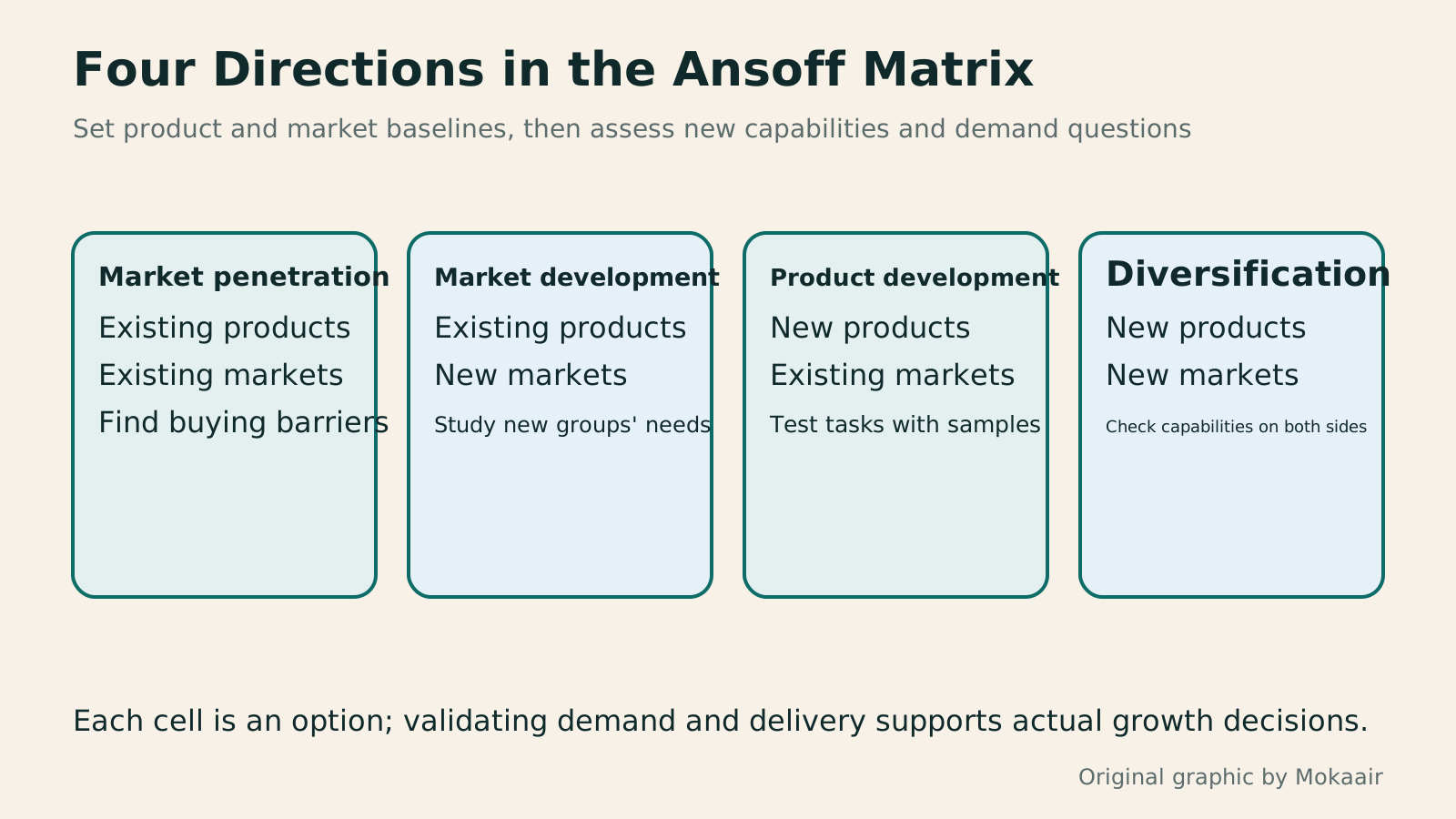
Four columns show product and market conditions for market penetration, market development, product development and diversification, with the unknowns to check for each.
| Growth direction | Product / market | Validation priorities for the example studio |
|---|---|---|
| Market penetration | Existing / existing | Can information about existing bag designs remove purchasing barriers? |
| Market development | Existing / new | Can the same bag designs serve customers in a new city? |
| Product development | New / existing | Do organizing accessories meet the existing customer group's tasks? |
| Diversification | New / new | Demand for shop display props and the capability to deliver them |
STP and Personas: Use Interview Evidence to Decide Whom to ServeSTP and Personas: Use Interview Evidence to Decide Whom to ServeSTP helps a team decide whom to serve; personas help it understand customers' tasks and obstacles. Both need evidence. Using a fictional home-organizing service, this guide covers interview planning, separating observations from assumptions, segmenting by need, selecting a target, and testing a position. An evidence table, practical steps, and an original diagram help you avoid inventing a convincing customer from age and imagination alone.Read the full article
SWOT and TOWS: From Strengths and Weaknesses Analysis to an Action ListSWOT and TOWS: From Strengths and Weaknesses Analysis to an Action ListSWOT maps strengths, weaknesses, opportunities and threats, but filling its four boxes still leaves actions to choose. Using an original small print studio example, this article separates internal and external factors, adds evidence to each judgment, and develops options with the four TOWS pairings. A strategy comparison table, practical steps and original diagrams turn vague adjectives into a task list with owners, deadlines and acceptance criteria.Read the full article
How to Use PESTLE: Turn External Changes into Business RisksHow to Use PESTLE: Turn External Changes into Business RisksPESTLE checks political, economic, social, technological, legal and environmental change; sorting news into six boxes is not enough. Using an original example of a camping gear rental shop, this guide sets scope, selects primary sources, separates announcements from assumptions and links signals to demand, costs and service processes. A six-factor comparison table, practical steps and original diagram help build a watchlist with indicators, owners and review dates.Read the full article
Found this guide helpful? Share it with someone who needs it
Lifestyle
How to Read the BCG Matrix: Uses and Limits of Product Portfolio Analysis
The BCG matrix maps product portfolios by market growth and relative share; stars, cash cows, question marks and dogs do not establish actual profit. An original home goods store example shows how to define markets, check comparison periods and denominators, understand model assumptions, and allocate resources using costs, turnover and customer needs. Includes a four-category table, practical steps, original diagrams and options when reliable market data is lacking.
Lifestyle
How to Write Marketing Copy: Clarify Value, Conditions, and Next Steps
Marketing copy should explain who it suits, its value, conditions, and what happens next. Using an original journal-binding workshop example, this article revises information hierarchy, features and benefits, evidence for claims, and action buttons step by step. A before-and-after table and original diagrams show how to retain appeal without overstating promises, and check that prices, limits, images, and links align before publication.
Lifestyle
Customer Journeys and Marketing Funnels: Find Where Readers Drop Off
Customer journeys explain touchpoints and needs; marketing funnels count people at each step using consistent criteria. Using an original bicycle repair booking example, this article explains how to map online and offline contacts, define completion events, calculate step conversion rates, and set up GA4 open or closed funnels. A calculation table, practical steps, and original diagrams help identify improvement hypotheses to test without mistaking data gaps for causes of customer drop-off.
Lifestyle
Planning Brand Identity: CIS, Logos and Website Colors
Brand identity connects business ideas, public-facing behavior and visuals; a logo is only one part. Using an original example of a desk-side stationery studio, this guide covers CIS, MI, BI and VI basics, brand briefs, logo use and website color rules, with steps, a comparison table and original diagrams. It helps small brands clarify uses and acceptance criteria before commissioning design, avoiding a delivery of image files without guidelines they can keep using.
Articles that cite this one
Sources
- AQA Ansoff Matrix Teaching GuideChecked:
- Australian Government: Product Research, Prototyping and the Development ProcessChecked:
Compiled from the references and verification dates listed above; fares, schedules, product features, and terms can change, so please confirm the latest details on the relevant official website before travelling, booking, or purchasing.