Lifestyle
SWOT and TOWS: From Strengths and Weaknesses Analysis to an Action List
SWOT maps strengths, weaknesses, opportunities and threats, but filling its four boxes still leaves actions to choose. Using an original small print studio example, this article separates internal and external factors, adds evidence to each judgment, and develops options with the four TOWS pairings. A strategy comparison table, practical steps and original diagrams turn vague adjectives into a task list with owners, deadlines and acceptance criteria.
About 8 min read
Contents
- 1. Define the question this analysis needs to answer
- 2. Turn adjectives into traceable facts
- 3. Separate environmental changes from your own limitations
- 4. Use TOWS pairings to develop feasible plans
- 5. Address prerequisites before setting priorities
- 6. Every strategy needs completion and stop conditions
A small print studio is preparing to take on printing for community events. During a meeting, the team writes down “good quality, low visibility, more events, intense competition.” All four boxes are filled, yet nobody knows what to do next week. The reason is usually not that the model is too difficult, but that the judgments lack specific conditions and are not connected to the actual decision.
Drawing on government business guides and Weihrich's original TOWS research accessed on 2026-9-14, this article demonstrates how to move from taking stock to taking action. The print studio, event demand and supply scenarios are original hypothetical examples; they do not describe a real business or market changes that have occurred.
Define the question this analysis needs to answer
Start with a decision question in one sentence, such as “Should we try taking small print orders for community events over the next two months?” Then confirm which business, product range and time frame the analysis covers. Discussing expansion, equipment purchases, social media management and pricing changes all at once can easily produce a long list of unrelated factors, making every item seem important.
The S, W, O and T in SWOT stand for strengths, weaknesses, opportunities and threats. Strengths and weaknesses mainly concern the organization's current resources and capabilities, while opportunities and threats concern how the external environment affects this decision. Classify factors according to the defined subject of the analysis, rather than simply sorting everything into “good things” and “bad things.”
Whether a capability counts as a strength also depends on the task. For example, handling small print orders quickly may suit events arranged at short notice, but it does not mean the cost of large print runs is also lower. Specify the conditions under which a capability is useful to avoid treating a self-assessment such as “we are highly professional” as a competitive advantage in every market.
Turn adjectives into traceable facts
Add evidence, a date and an impact to each factor. If the studio considers small print runs a strength, it can review turnaround times, reprints and the specifications it can handle for recent similar orders. If preparing quotes seems time-consuming, record the process from receiving a request to confirming specifications. Where data is missing, mark the factor as an assumption and arrange further checks.
An external opportunity should not simply say “the market is large.” You could check event organizers' publicly announced plans or learn about the needs of people who previously made inquiries. However, an event announcement does not mean the organizer will necessarily buy from you. A supplier's notice that a paper type now has a longer lead time can be a clue to an external threat, but you still need to confirm which items are affected and for how long.
When information conflicts, retain the differences and investigate further. If the owner feels turnaround times are stable but production staff frequently work overtime on rush jobs, separate regular orders from special requests. Involving people in different roles broadens what the team can see. Evidence still needs checking; a majority vote is not a fact check.
Separate environmental changes from your own limitations
A supplier's delivery delay is an external factor, while the studio's lack of a backup paper plan is an internal limitation. Both may contribute to a problem, but record them separately. This makes it clear which parts you can adjust yourself and which require monitoring or coordination, rather than labeling every cause of failure an external threat.
Likewise, “preparing to launch an event package” is an action idea, not an external opportunity. “Nearby organizations need printing for upcoming events” is an external condition you can investigate. Separate the environment from actions first so that the later pairings are meaningful; otherwise, the four boxes may simply become a task list written in advance.
Keep a small number of factors most relevant to the decision in each box; the counts do not need to match. You can label factors, such as S1 small-run production capability, W1 repeated specification clarification, O1 event demand and T1 unreliable lead times for specified paper. These labels help trace the basis of later plans, rather than making the table look more complicated.
Use TOWS pairings to develop feasible plans
TOWS considers internal and external factors together. SO uses strengths to seize opportunities; WO addresses weaknesses to take advantage of opportunities; ST uses strengths to respond to threats; and WT reduces the combined impact of weaknesses and threats. These approaches can coexist. They are not four mutually exclusive types of company.
In this original example, SO could mean testing small event packages with existing equipment; WO could mean improving the requirements form to reduce repeated specification clarification; ST could mean compiling paper alternatives based on production experience; and WT could mean setting limits on accepting rush jobs without backup options. Every plan should explain which factors it connects.
After pairing factors, you still need to check whether the plans can be executed. Being able to handle small print runs does not mean being able to take many rush jobs at once, and paper substitutions still require checking finished-product requirements and obtaining customer agreement. If two factors have no reasonable connection, do not force a strategy. TOWS helps generate options; it does not prove market demand for the team or guarantee results.
- Define the decision's scope, the subject of the analysis and the time frame, then list the information needed.
- Separate internal capabilities from external conditions, attaching evidence and a date to every factor.
- Use SO, WO, ST and WT pairings to develop concrete plans, retaining the labels of the supporting factors.
- Compare impacts, costs and limitations, then assign owners, deadlines and acceptance criteria.
Address prerequisites before setting priorities
Business Queensland notes that SWOT does not automatically prioritize problems or provide solutions. When scheduling work, first identify conditions that would prevent it from starting, then compare the extent of the impact, resources needed and reversibility. Without confirming equipment capacity or material supply, you should not commit to a large volume of rush work.
The studio could first complete a specification confirmation form and a list of paper alternatives, then test the event package with a small number of samples. If quoting data is still insufficient, gathering it first will answer the original question better than rushing to buy new equipment. This is the sequencing logic for this article's example; other businesses should reorder their priorities based on their own bottlenecks and evidence.
If the team uses a scoring sheet, first define what high and low scores mean and retain any uncertain supporting information. Do not multiply subjective scores and present the result as a precise probability of success. For a potentially high-impact plan with insufficient information, arrange research or a small trial first to give the next decision a more reliable basis.
Every strategy needs completion and stop conditions
Turn “improve the quoting process” into work that can be checked against acceptance criteria. For example, have order-taking staff prepare a requirements form by a specified date, then test it with several different specifications to see whether it captures dimensions, quantities, deadlines and file information. Acceptance depends on whether the information is sufficient to use, not simply whether the form has been created.
When trying out event printing work, set limits on the volume accepted and work hours available, along with a review date, and record which needs cannot be met. If material lead times remain unconfirmed or the extra work exceeds the capacity originally available, hold off on expanding. Stop conditions help the team make early corrections without waiting for problems to arise with orders already promised.
At each review, update the original factors as well: whether the opportunity still exists, whether weaknesses have improved and whether new constraints affect existing strengths. SWOT is an assessment at a particular point in time, and TOWS generates options based on it. When the environment changes, revisit the evidence and actions instead of copying the same four-box table every quarter.
Read the full description
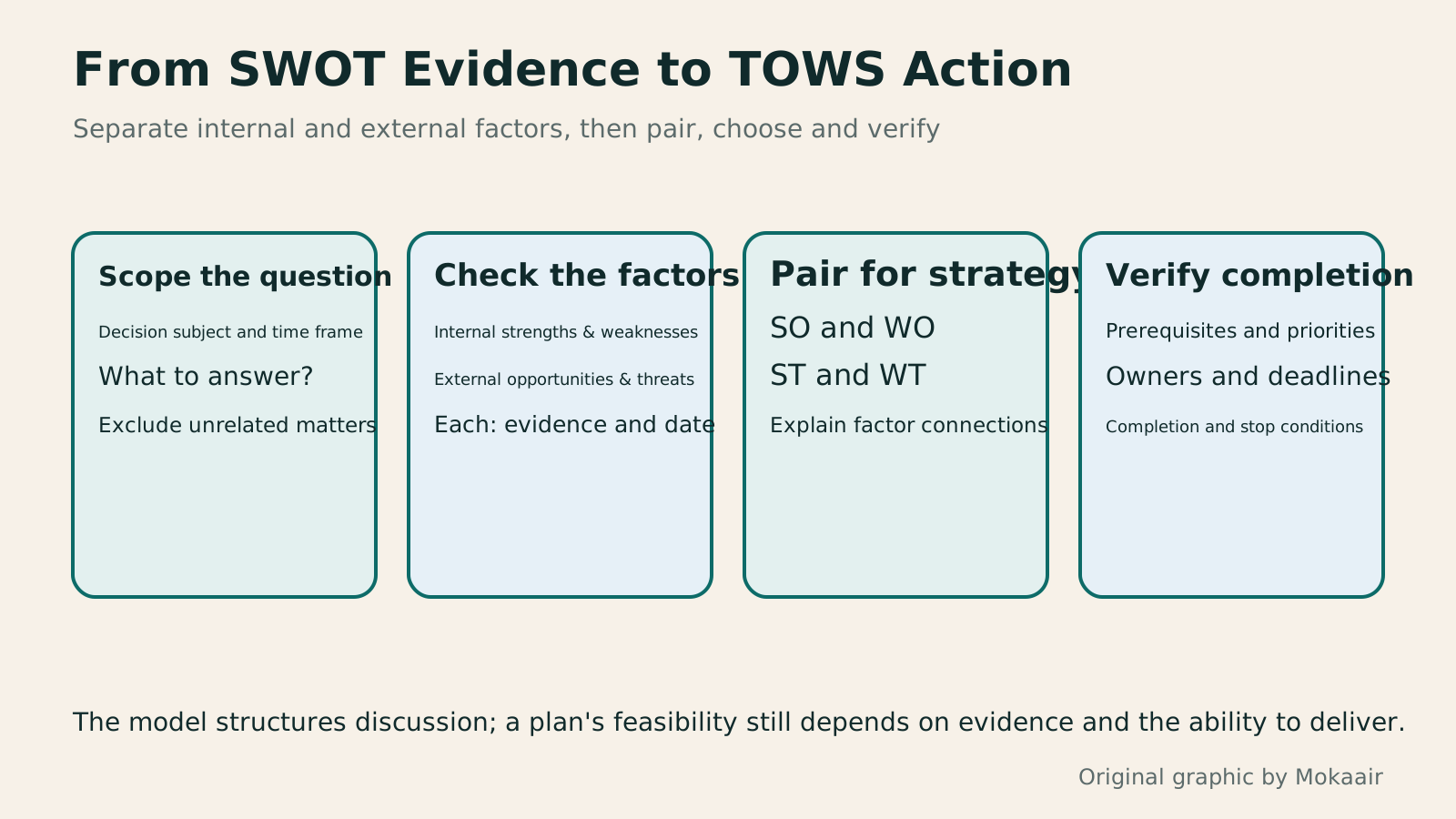
Four columns show question scoping, factor checks, TOWS pairings and completion checks, explaining why priorities and execution responsibilities are still needed after the four-box analysis.
| TOWS pairing | Plans in the original print studio example | What to confirm first |
|---|---|---|
| SO: Strengths and opportunities | Test event packages using existing small-run capabilities | Whether suitable demand actually exists |
| WO: Weaknesses and opportunities | Improve event printing quotes with a requirements form | Whether specification details are sufficient to accept an order |
| ST: Strengths and threats | Compile paper alternatives based on production experience | Quality requirements and customer acceptance |
| WT: Weaknesses and threats | Limit acceptance of rush jobs without backup options | Limits on materials, work hours and turnaround times |
Use STP to research whom you really want to serveSTP and Personas: Use Interview Evidence to Decide Whom to ServeSTP helps a team decide whom to serve; personas help it understand customers' tasks and obstacles. Both need evidence. Using a fictional home-organizing service, this guide covers interview planning, separating observations from assumptions, segmenting by need, selecting a target, and testing a position. An evidence table, practical steps, and an original diagram help you avoid inventing a convincing customer from age and imagination alone.Read the full article
Build strategies into a small shop's marketing planHow to write a small-shop marketing plan: goals, customers, and monthly reviewsA small-shop marketing plan can begin with one clear business problem; there is no need to schedule every social channel and ad at once. Using an original example about a florist's weekday orders, this guide works through goals, customers, channel roles, budgets, and monthly reviews. It provides practical worksheet fields, a comparison table, and an original diagram so owners can turn ideas into assigned, trackable actions they can revise. Completing a campaign is not a promise of sales.Read the full article
Use the customer journey to identify service barriersCustomer Journeys and Marketing Funnels: Find Where Readers Drop OffCustomer journeys explain touchpoints and needs; marketing funnels count people at each step using consistent criteria. Using an original bicycle repair booking example, this article explains how to map online and offline contacts, define completion events, calculate step conversion rates, and set up GA4 open or closed funnels. A calculation table, practical steps, and original diagrams help identify improvement hypotheses to test without mistaking data gaps for causes of customer drop-off.Read the full article
Found this guide helpful? Share it with someone who needs it
Lifestyle
How to Read the BCG Matrix: Uses and Limits of Product Portfolio Analysis
The BCG matrix maps product portfolios by market growth and relative share; stars, cash cows, question marks and dogs do not establish actual profit. An original home goods store example shows how to define markets, check comparison periods and denominators, understand model assumptions, and allocate resources using costs, turnover and customer needs. Includes a four-category table, practical steps, original diagrams and options when reliable market data is lacking.
Lifestyle
How to Use the Ansoff Matrix: Four Options for Expanding Products and Markets
The Ansoff matrix maps four growth paths using existing or new products and markets: market penetration, market development, product development and diversification. An original canvas goods studio example shows how to define the current business and compare the capabilities and evidence each path needs. A comparison table, steps and original diagrams turn growth ideas into small, testable plans, without treating the model as a success-rate table.
Lifestyle
How to Write Marketing Copy: Clarify Value, Conditions, and Next Steps
Marketing copy should explain who it suits, its value, conditions, and what happens next. Using an original journal-binding workshop example, this article revises information hierarchy, features and benefits, evidence for claims, and action buttons step by step. A before-and-after table and original diagrams show how to retain appeal without overstating promises, and check that prices, limits, images, and links align before publication.
Lifestyle
Customer Journeys and Marketing Funnels: Find Where Readers Drop Off
Customer journeys explain touchpoints and needs; marketing funnels count people at each step using consistent criteria. Using an original bicycle repair booking example, this article explains how to map online and offline contacts, define completion events, calculate step conversion rates, and set up GA4 open or closed funnels. A calculation table, practical steps, and original diagrams help identify improvement hypotheses to test without mistaking data gaps for causes of customer drop-off.
Articles that cite this one
Sources
- Business Queensland: SWOT methods and limitationsChecked:
- Australian Government: SWOT analysis and applicationChecked:
- Heinz Weihrich: The TOWS Matrix, 1982 original study (university-hosted PDF)Checked:
Compiled from the references and verification dates listed above; fares, schedules, product features, and terms can change, so please confirm the latest details on the relevant official website before travelling, booking, or purchasing.