Lifestyle
How to Use Porter's Five Forces: Competition and Bargaining Power
Porter's Five Forces goes beyond nearby competitors: it asks how rivals, new entrants, suppliers, buyers, and substitutes shape a business's room to operate. Using a fictional small recording studio, this guide defines an industry boundary, identifies verifiable structural factors, and compares customer groups and supply conditions. A question table, steps, and an original diagram connect the analysis to service positioning and operations, while explaining what the model cannot answer.
About 7 min read
Contents
- 1. Define the industry boundary and the customer's job first
- 2. Examine existing rivals and new entrants separately
- 3. Assess supplier power through alternatives and switching conditions
- 4. Buyers differ, and bargaining involves more than price
- 5. Find substitutes by looking for different ways to meet the same need
- 6. Connect the structural analysis to your own choices
A small recording studio trying to understand competitive pressure might first search for other studios nearby. But customers might record at home, equipment repairs might depend on only a few providers, and large clients might demand more complex delivery terms. A list of rival studios misses these other relationships that shape the business.
This guide draws on Harvard Business School strategy materials and a government market-research guide consulted on September 14, 2026. The studio, customer groups, and supply situations are fictional examples. We did not measure actual competition in any location or forecast investment returns.
Define the industry boundary and the customer's job first
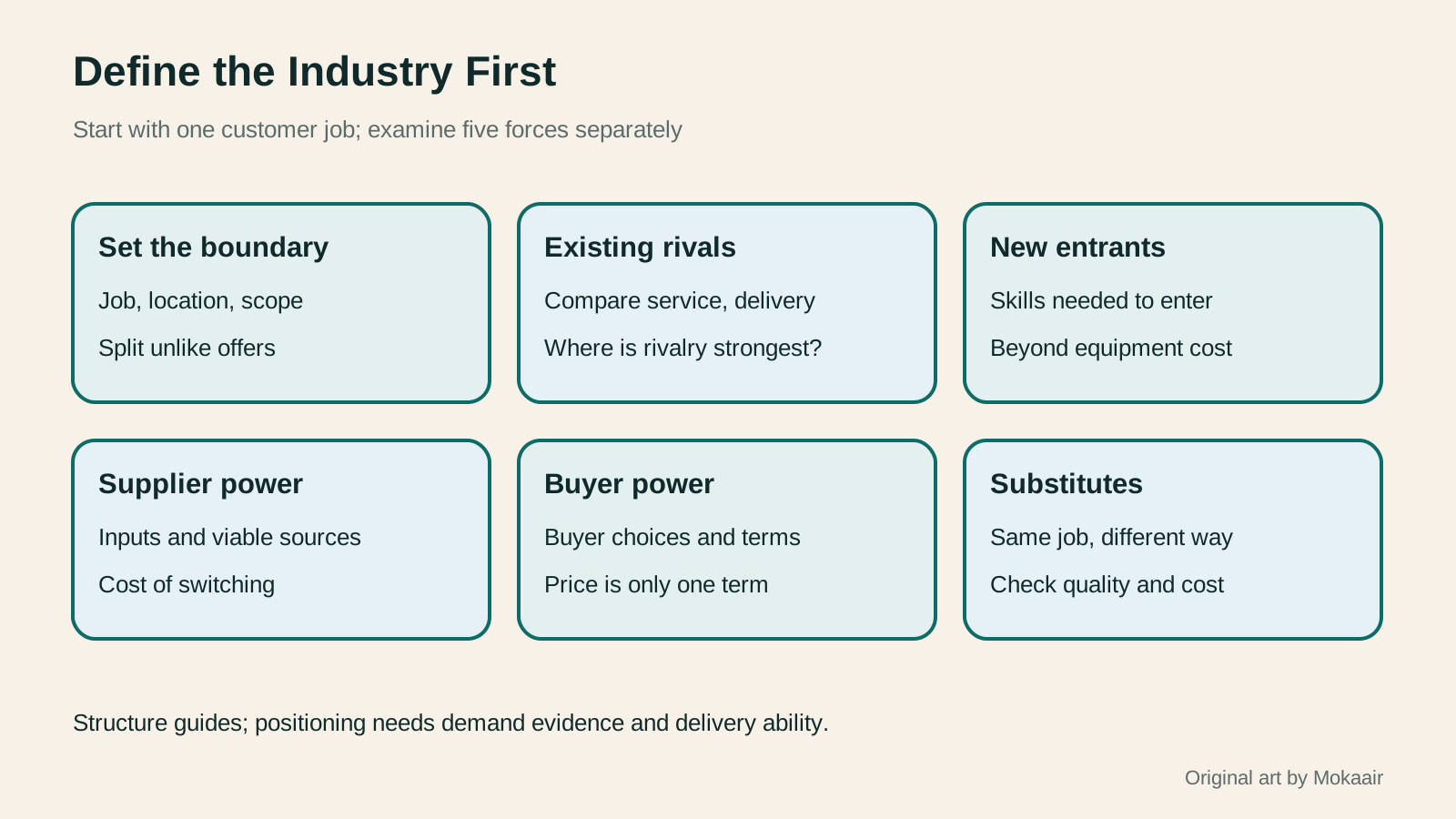
The five forces are rivalry among existing competitors, the threat of new entrants, the bargaining power of suppliers, the bargaining power of buyers, and the threat of substitute products or services. The framework examines how industry structure affects the distribution of value. It is not a five-part scorecard of one company's abilities. Different scopes and time periods can lead to different conclusions.
For this fictional example, start with 'small studios offering in-person vocal recording and basic post-production in a specified city.' That boundary does not include every music school, concert producer, or large audiovisual company. Then state the job the customer needs done, such as producing a deliverable audio recording, before deciding which services actually compete.
Treat that scope as a working definition you can revise. If research shows that customers routinely cross city lines to buy the service, revisit the geographic boundary. If different uses require entirely different equipment and delivery processes, analyze them separately. Do not exclude relevant alternatives simply to make competition look weaker.
Examine existing rivals and new entrants separately
When examining existing rivals, compare service content, available times, delivery methods, and public pricing terms rather than just counting studios. Two packages with the same recording hours may include different engineering help and revision allowances. Comparing headline prices without matching those terms can misidentify the cheaper option and obscure where rivalry is concentrated.
Define a comparable customer scenario, such as a creator who needs a short voice-over, and record each provider's publicly available offer and any information gaps. Mark unstated terms as unknown instead of guessing. If customers value file organization and efficient communication, examine those benefits too, rather than looking only at discounts.
For new entrants, ask who could enter and which barriers they would face. Buying equipment is only one condition in this fictional example; premises, technical skills, customer access, and service arrangements also matter. Cheap equipment does not prove that everyone can easily provide the same service, and the absence of new studios today does not prove that entry poses no threat.
Assess supplier power through alternatives and switching conditions
Suppliers may provide equipment, repairs, premises, or other essential inputs. List which inputs are indispensable, what suitable alternatives exist, and what switching to another source would require. Few options or high switching costs may give suppliers more bargaining room, but the conclusion still needs to be checked against the specific circumstances.
The fictional studio could first review repairs and backups for critical equipment: Would a failed component disrupt scheduled work? Could another device take its place? How long would it take to confirm the process after a change? These questions reveal practical dependencies better than saying, 'There are many suppliers, so there is no risk.'
When collecting quotes, compare specifications, support, warranties, and delivery times on like-for-like terms, and record when each quote was viewed or requested. Do not treat the lowest price as an equivalent-quality alternative by default. If planning a second option, verify its availability and operating requirements before deciding whether to invest in it. Writing 'backup available' in a table is not enough.
Buyers differ, and bargaining involves more than price
Buyer power depends on alternative services customers can choose, the conditions for switching, and the scale of their demand. An individual creator and a production team that regularly commissions substantial work may purchase differently and ask for different terms. Analyzing them in groups reveals how service promises, revision counts, and scheduling affect the work in practice.
In the fictional example, a client that brings more projects might also ask for longer payment terms or last-minute scheduling. Compare those terms together. Conversely, a small customer may be price-sensitive because the service is easy to replace. Customer size is a clue, not enough by itself to establish bargaining power.
Record inquiries, completed sales, and reasons for lost sales separately to see what customers are actually comparing. If someone chooses another studio because its time slots work better, do not attribute the whole decision to price. The aim is to make offers and delivery terms clearer and show the team which promises exceed what it can reasonably provide today.
Find substitutes by looking for different ways to meet the same need
A substitute meets the same basic need in a different way; it is not quite the same as a rival offering a similar service. In this example, recording at home could replace part of the demand for studio sessions. Another business offering similar in-person recording would usually be treated as a rival. The original industry boundary guides the classification.
Do not assume every customer will switch to home recording because the equipment appears cheaper. Compare the required quality, time to operate the setup, environment, post-production help, and purpose of the deliverable. An alternative that works for simple practice may not meet the demands of another project; evaluate it against the customer's job.
The fictional studio could study when customers choose to do the work themselves and when they want in-person help. If customers want to save time organizing files, the studio could first test a clear file-delivery service. It should not use fear-based copy to disparage alternative tools. Understanding the reasons for a choice makes it possible to design a suitable service.
- Define the industry, location, customer job, and analysis period.
- List existing rivals, new entrants, suppliers, buyers, and substitutes separately.
- For each force, record structural factors, evidence, counterexamples, and information gaps.
- Identify the most relevant pressures, plan service or operational changes, and check the results.
Connect the structural analysis to your own choices
Write a short conclusion for each force, but include its reasons and evidence. For example, 'Repair sources for a particular device are limited; we are checking alternatives' is clearer than giving supplier power four stars. If information is missing, gather it first. Do not add five subjective scores together and present the result as an industry's probability of success.
Harvard Business School's positioning material emphasizes the value a strategy offers and how its activities differ from rivals'. For the fictional studio, begin with one service arrangement that fits its current capabilities, then check the workflow, cost, and customers' understanding. A difference has to be deliverable; a slogan such as 'more professional' is not enough.
Five Forces also cannot replace an assessment of internal capabilities, cash planning, or customer research. Even if a type of demand appears promising, the team must check whether it can fulfill it. Revisit the analysis when conditions and technology change. Keep review dates, sources, and unverified assumptions so the framework informs decisions without becoming the only answer.
| Force | Research question for the fictional studio | Common misreading |
|---|---|---|
| Existing rivals | How do offers serving the same need compare? | Counting studios or comparing prices with different terms |
| New entrants | What capabilities and customer channels are needed to enter? | Looking only at whether equipment can be bought |
| Suppliers | What alternatives and switching conditions apply to essential inputs? | Assuming a long supplier list means many usable sources |
| Buyers | How do requirements and choices differ by customer group? | Judging power from customer size alone |
| Substitutes | Can the same job be done in another way? | Assuming every alternative offers the same quality |
Use PESTLE to examine the wider operating environmentHow to Use PESTLE: Turn External Changes into Business RisksPESTLE checks political, economic, social, technological, legal and environmental change; sorting news into six boxes is not enough. Using an original example of a camping gear rental shop, this guide sets scope, selects primary sources, separates announcements from assumptions and links signals to demand, costs and service processes. A six-factor comparison table, practical steps and original diagram help build a watchlist with indicators, owners and review dates.Read the full article
Use STP to research the needs of different buyer groupsSTP and Personas: Use Interview Evidence to Decide Whom to ServeSTP helps a team decide whom to serve; personas help it understand customers' tasks and obstacles. Both need evidence. Using a fictional home-organizing service, this guide covers interview planning, separating observations from assumptions, segmenting by need, selecting a target, and testing a position. An evidence table, practical steps, and an original diagram help you avoid inventing a convincing customer from age and imagination alone.Read the full article
Turn internal and external factors into SWOT actionsSWOT and TOWS: From Strengths and Weaknesses Analysis to an Action ListSWOT maps strengths, weaknesses, opportunities and threats, but filling its four boxes still leaves actions to choose. Using an original small print studio example, this article separates internal and external factors, adds evidence to each judgment, and develops options with the four TOWS pairings. A strategy comparison table, practical steps and original diagrams turn vague adjectives into a task list with owners, deadlines and acceptance criteria.Read the full article
Found this guide helpful? Share it with someone who needs it
Lifestyle
How to Read the BCG Matrix: Uses and Limits of Product Portfolio Analysis
The BCG matrix maps product portfolios by market growth and relative share; stars, cash cows, question marks and dogs do not establish actual profit. An original home goods store example shows how to define markets, check comparison periods and denominators, understand model assumptions, and allocate resources using costs, turnover and customer needs. Includes a four-category table, practical steps, original diagrams and options when reliable market data is lacking.
Lifestyle
How to Use the Ansoff Matrix: Four Options for Expanding Products and Markets
The Ansoff matrix maps four growth paths using existing or new products and markets: market penetration, market development, product development and diversification. An original canvas goods studio example shows how to define the current business and compare the capabilities and evidence each path needs. A comparison table, steps and original diagrams turn growth ideas into small, testable plans, without treating the model as a success-rate table.
Lifestyle
How to Write Marketing Copy: Clarify Value, Conditions, and Next Steps
Marketing copy should explain who it suits, its value, conditions, and what happens next. Using an original journal-binding workshop example, this article revises information hierarchy, features and benefits, evidence for claims, and action buttons step by step. A before-and-after table and original diagrams show how to retain appeal without overstating promises, and check that prices, limits, images, and links align before publication.
Lifestyle
Customer Journeys and Marketing Funnels: Find Where Readers Drop Off
Customer journeys explain touchpoints and needs; marketing funnels count people at each step using consistent criteria. Using an original bicycle repair booking example, this article explains how to map online and offline contacts, define completion events, calculate step conversion rates, and set up GA4 open or closed funnels. A calculation table, practical steps, and original diagrams help identify improvement hypotheses to test without mistaking data gaps for causes of customer drop-off.
Sources
- Harvard Business School: The Five ForcesChecked:
- Harvard Business School: Strategic PositioningChecked:
- Australian Government: Do market researchChecked:
Compiled from the references and verification dates listed above; fares, schedules, product features, and terms can change, so please confirm the latest details on the relevant official website before travelling, booking, or purchasing.