Lifestyle
B2B, B2C and D2C: Customers, Sales Processes and Marketing Priorities
B2B, B2C and D2C are not three unrelated business models. Using a fictional wooden organizer brand, this guide explains business purchasing, consumer sales and direct brand sales by asking who buys, who uses the product and who handles delivery. A comparison table, website planning steps and original diagram help small teams design product pages, quotation requests and after-sales responsibilities without treating sales cycles or profit as fixed formulas.
About 7 min read
Contents
- 1. Identify the buyer, then trace the sales channel
- 2. In business purchasing, identify users and decision-makers
- 3. The purchasing situation determines the sales cycle
- 4. Count the extra work that direct sales bring
- 5. Organize website information around readers’ tasks
- 6. Compare outcomes against orders and service costs
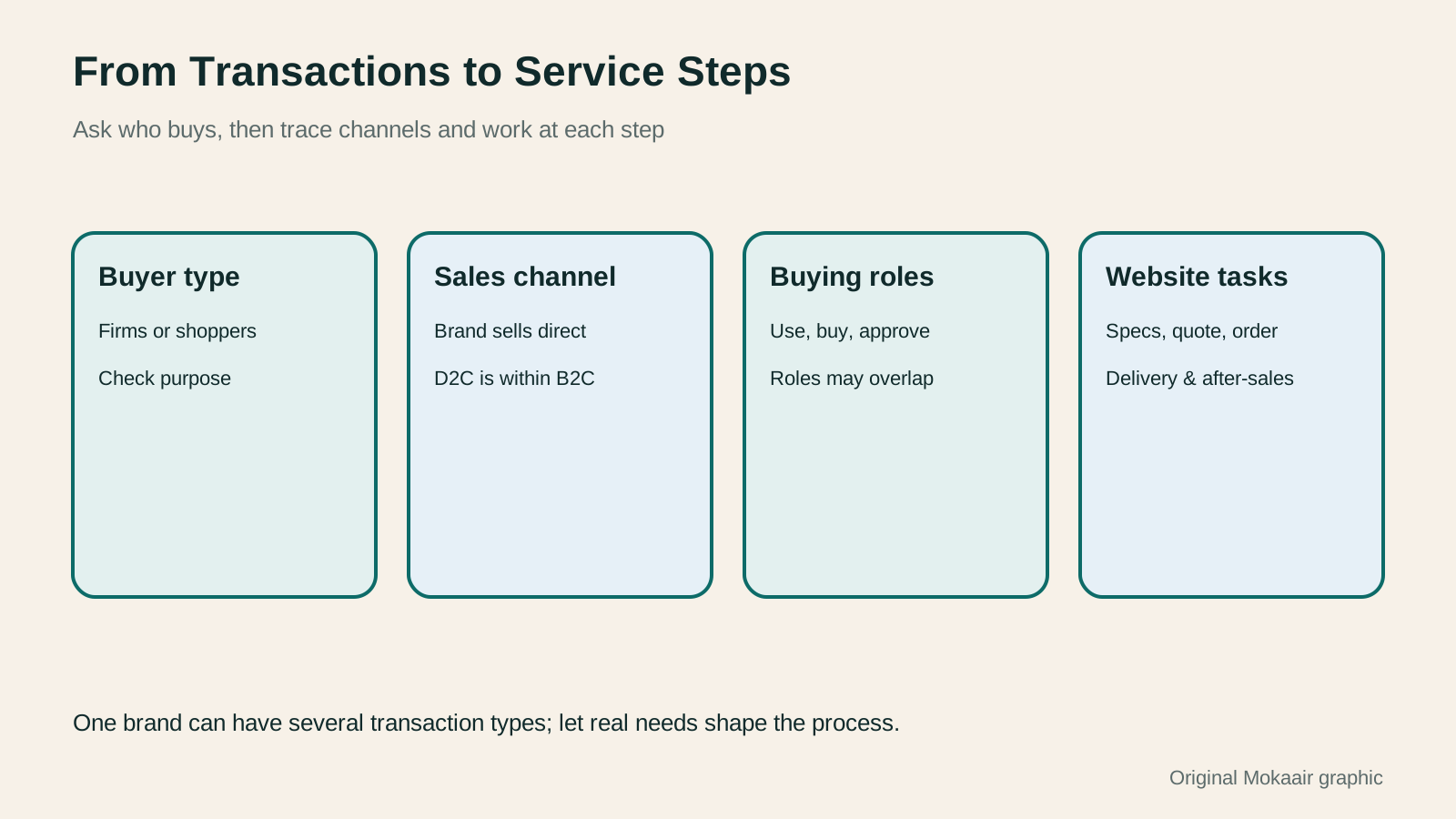
The same wooden organizer brand might sell desk organizers to households, fulfill bulk office orders and sell through partner stores. These transactions can coexist. To plan a website and marketing content, it is more useful to understand whom each transaction serves than to label the whole company with one acronym.
This guide draws on Shopify and OpenStax materials checked on September 14, 2026, to explain the basic relationships among B2B, B2C and D2C. The wooden organizer brand, purchasing situations and processes are fictional teaching examples. No store was opened, no particular commerce platform was tested, and no revenue is estimated for any model.
Identify the buyer, then trace the sales channel
B2B describes transactions between businesses; B2C describes a business selling goods or services to consumers. D2C means a brand sells directly to end consumers, so it falls within B2C. B2C and D2C are therefore not mutually exclusive categories, and B2B does not always mean wholesale in large quantities.
If the fictional wooden organizer brand sells one organizer to a household for its own use, that is a consumer transaction. If a company buys organizers for its employees, that is a business transaction. Taking household orders on the brand’s own website can be described as D2C. Supplying a partner retailer that then sells to consumers involves a different set of transaction relationships.
Record the purpose of the purchase, the parties to the transaction and who is responsible for the sale. Quantity, order value or placing an order on a phone is not enough to classify it. A brand can operate direct and reseller channels at the same time; do not hide real channels and customer needs just to fit an acronym.
In business purchasing, identify users and decision-makers
A business purchase may involve the person who uses the product, the person who buys it and the person who approves the transaction. One person may also fill several roles. OpenStax cautions that not every purchase involves every role. An owner ordering for a small studio and an organization requiring approval across departments may need different information.
Suppose an office wants custom desk organizers. Employees may care about size and access to their items; the purchasing contact needs specifications, quantities and delivery details; an approver wants to know whether the order fits the need and budget. These are questions to check in this example, not a claim that every company divides purchasing the same way.
A website can provide a downloadable specification sheet and a quotation form with clear fields so the contact can pass information along. Ask first about use, quantity and desired timing, then confirm whether customization is needed. Do not ask for unrelated internal data up front. Every field should have a clear role in evaluating or delivering the order.
The purchasing situation determines the sales cycle
A first purchase of an unfamiliar product usually needs more checking than a routine repeat order, but that does not make every B2B sale slow. A business replenishing an agreed specification may move quickly. A consumer buying something that must fit a particular space may compare options several times before deciding.
The fictional brand can observe new business buyers, repeat business buyers and household buyers separately. A new buyer may need to confirm wood type, dimensions and delivery; a repeat buyer may just need the previous specification; a household buyer may need to know whether the item fits a drawer. Content should answer the immediate question, not impose a long or short process based only on business versus consumer.
Record why each stage takes time, such as waiting for dimensions, internal approval or a workable delivery date. A longer interval does not necessarily mean poor copy; a necessary step may still be unfinished. Identify information gaps you can fix before adding explanations, reminders or personal help. Repeated sales nudges can create frustration instead.
Count the extra work that direct sales bring
D2C lets a brand design the consumer purchase process directly, but it does not mean doing every task alone. Payment, shipping and website systems may still come from partners, and direct sales can include the brand’s own physical store. The question is how the brand sells directly, not whether it uses any outside provider.
If the fictional brand adds its own website, it must plan product information, order confirmation, shipping notices and an after-sales contact. Work previously handled by a partner retailer does not disappear when sales move online. List who handles each task, which records they use and who replies when something goes wrong before deciding whether the team can take it on.
When comparing channels, put website and tool costs, payment processing, shipping, customer support and content production in one table, checking for double counting. Direct contact with customers does not guarantee higher profit. It also does not mean contact details collected for one purpose can be reused freely for another. Check data use and service promises separately.
Organize website information around readers’ tasks
One website can have both consumer product pages and a business purchasing entry point, provided their jobs are clear. Product pages explain dimensions, use, options and purchase terms. The business section adds bulk requirements, information needed for a quote and a follow-up contact method. A household buyer should not need to read a full partnership proposal to buy one item.
For customized orders, clearly separate standard products that can be ordered directly from work requiring a person to confirm details. The fictional brand could create its own dimension diagram to help buyers measure and prompt them to provide the available space in the quote form. Do not promise production capacity or delivery dates that have not been confirmed.
Ask people in different roles to complete a small task, such as finding an organizer’s outside dimensions, requesting a bulk quote or locating after-sales help. Watch where they get stuck, then adjust the page. This checks whether the information is usable without assuming that one business model requires a particular page layout.
- List the actual buyers and purposes of each transaction, and map the brand’s relationship with each channel.
- Identify user, purchasing and approval roles, and record the information each needs.
- Plan new-buyer, repeat-buyer and special-request flows separately, including delivery responsibilities.
- Check whether people can find specifications, request a quote and reach after-sales support on the website.
Compare outcomes against orders and service costs
In a review, distinguish inquiries, qualified needs, confirmed orders and completed delivery. Do not count every form submission as a sale. A business quote may need more information, and a consumer order may run into a stock shortage. Clear status definitions show which part of the process has actually improved.
Compare the questions different buyers ask, how often they need help and what they say after delivery before choosing the next improvement. If repeat business buyers cannot find an earlier specification, make that easier to identify. If household buyers often misread dimensions, fix the diagram first. Those actions fit the service task better than simply pursuing more page views.
Finally, keep channel responsibilities and data boundaries clear. The same customer may buy in different roles at different times; do not merge records or change service terms based only on a label. Business acronyms are a starting point. Verifiable needs, delivery capacity and partner arrangements should shape the actual content and process.
| Question to examine | Business purchasing scenario | Brand selling directly to households |
|---|---|---|
| Who helps decide? | Users, buyers and approvers may all be involved | An individual or household may decide together |
| What information is needed? | Specifications, quantity needs and delivery arrangements | Dimensions, use and purchase terms |
| Is a long process necessary? | Depends on a new purchase or familiar repeat order | Depends on comparison and use needs |
| Useful website entry point | Business needs and quotation request | Product selection and after-sales help |
| Who handles the service? | Spell out supply and partner responsibilities | The brand allocates direct-sale and partner tasks |
Use STP to clarify the needs of different customer groupsSTP and Personas: Use Interview Evidence to Decide Whom to ServeSTP helps a team decide whom to serve; personas help it understand customers' tasks and obstacles. Both need evidence. Using a fictional home-organizing service, this guide covers interview planning, separating observations from assumptions, segmenting by need, selecting a target, and testing a position. An evidence table, practical steps, and an original diagram help you avoid inventing a convincing customer from age and imagination alone.Read the full article
Map purchasing questions across the customer journeyCustomer Journeys and Marketing Funnels: Find Where Readers Drop OffCustomer journeys explain touchpoints and needs; marketing funnels count people at each step using consistent criteria. Using an original bicycle repair booking example, this article explains how to map online and offline contacts, define completion events, calculate step conversion rates, and set up GA4 open or closed funnels. A calculation table, practical steps, and original diagrams help identify improvement hypotheses to test without mistaking data gaps for causes of customer drop-off.Read the full article
Compare an independent store with marketplace channelsSelf-hosted store or marketplace: choose by product, traffic, and upkeep costsA self-hosted store, a hosted branded storefront, and a marketplace solve different operating needs. This guide gives small brands in Taiwan a way to compare product fit, customer acquisition, payments and delivery, per-order costs, and customer data. It uses a limited trial and data-export checks to assess tools such as Shopify, SHOPLINE, and WooCommerce, helping you build a channel mix you can maintain instead of comparing only monthly fees or templates.Read the full article
Found this guide helpful? Share it with someone who needs it
Lifestyle
How to Read the BCG Matrix: Uses and Limits of Product Portfolio Analysis
The BCG matrix maps product portfolios by market growth and relative share; stars, cash cows, question marks and dogs do not establish actual profit. An original home goods store example shows how to define markets, check comparison periods and denominators, understand model assumptions, and allocate resources using costs, turnover and customer needs. Includes a four-category table, practical steps, original diagrams and options when reliable market data is lacking.
Lifestyle
How to Use the Ansoff Matrix: Four Options for Expanding Products and Markets
The Ansoff matrix maps four growth paths using existing or new products and markets: market penetration, market development, product development and diversification. An original canvas goods studio example shows how to define the current business and compare the capabilities and evidence each path needs. A comparison table, steps and original diagrams turn growth ideas into small, testable plans, without treating the model as a success-rate table.
Lifestyle
How to Write Marketing Copy: Clarify Value, Conditions, and Next Steps
Marketing copy should explain who it suits, its value, conditions, and what happens next. Using an original journal-binding workshop example, this article revises information hierarchy, features and benefits, evidence for claims, and action buttons step by step. A before-and-after table and original diagrams show how to retain appeal without overstating promises, and check that prices, limits, images, and links align before publication.
Lifestyle
Customer Journeys and Marketing Funnels: Find Where Readers Drop Off
Customer journeys explain touchpoints and needs; marketing funnels count people at each step using consistent criteria. Using an original bicycle repair booking example, this article explains how to map online and offline contacts, define completion events, calculate step conversion rates, and set up GA4 open or closed funnels. A calculation table, practical steps, and original diagrams help identify improvement hypotheses to test without mistaking data gaps for causes of customer drop-off.
Sources
- Shopify: How B2C and D2C relateChecked:
- Shopify Help: B2B and D2C terminologyChecked:
- OpenStax: Buying roles and situations in business marketsChecked:
Compiled from the references and verification dates listed above; fares, schedules, product features, and terms can change, so please confirm the latest details on the relevant official website before travelling, booking, or purchasing.