Lifestyle
Agentic Retrieval-Augmented Generation (Agentic RAG): When to Search Again
Agentic RAG lets models make retrieval decisions, choosing sources, rewriting queries or searching further based on the question and available evidence. Using a concrete LangGraph workflow and a comparison of venue-use conditions, this article contrasts it with fixed RAG and explains stopping criteria, permissions, query logs and cost control. Learn to judge whether a task needs dynamic exploration or a predictable fixed workflow is enough.
About 7 min read
Contents
Agentic Retrieval-Augmented Generation, or Agentic RAG, usually refers to a RAG system in which the model decides when and where to search, and whether further retrieval is needed after obtaining information. It expands retrieval decision-making; it does not automatically make information correct or necessarily require multiple agents. Questions that can be answered with one search may still need only one; extra steps are justified only when a gap is found.
The term has no single, universally accepted algorithmic specification. This article uses the operational meaning in the official LangGraph tutorial: the model can choose to call a retrieval tool, the workflow checks passage relevance, rewrites the question if necessary, and then generates an answer. The Self-Reflective Retrieval-Augmented Generation (Self-RAG) paper also studies on-demand retrieval and self-checking, but it trains a specific mechanism using reflection tokens. Not all Agentic RAG can therefore be called Self-RAG.
Actively Choosing the Next Query
Fixed RAG often sends the user's question to a predefined retriever and then passes the retrieved content to a generator. An agentic workflow allows the model to change subsequent actions based on intermediate results. For example, if the original question concerns two event venues, the model might find venue descriptions in the first search, notice that equipment rules are missing, and then query a regulations index. The value lies in filling gaps in the evidence, rather than having the model repeatedly restate what it already knows.
From an engineering perspective, the areas where decisions can be made freely must be explicit. The model can choose query wording and permitted data sources, but the application still controls read permissions, maximum runtime and which errors require termination. Treating the model's decisions as a complete workflow specification can turn a simple question-and-answer task into an unpredictable exploration. Agent flexibility and programmatic limits are both necessary design requirements.
Returning to Retrieval to Fill Evidence Gaps
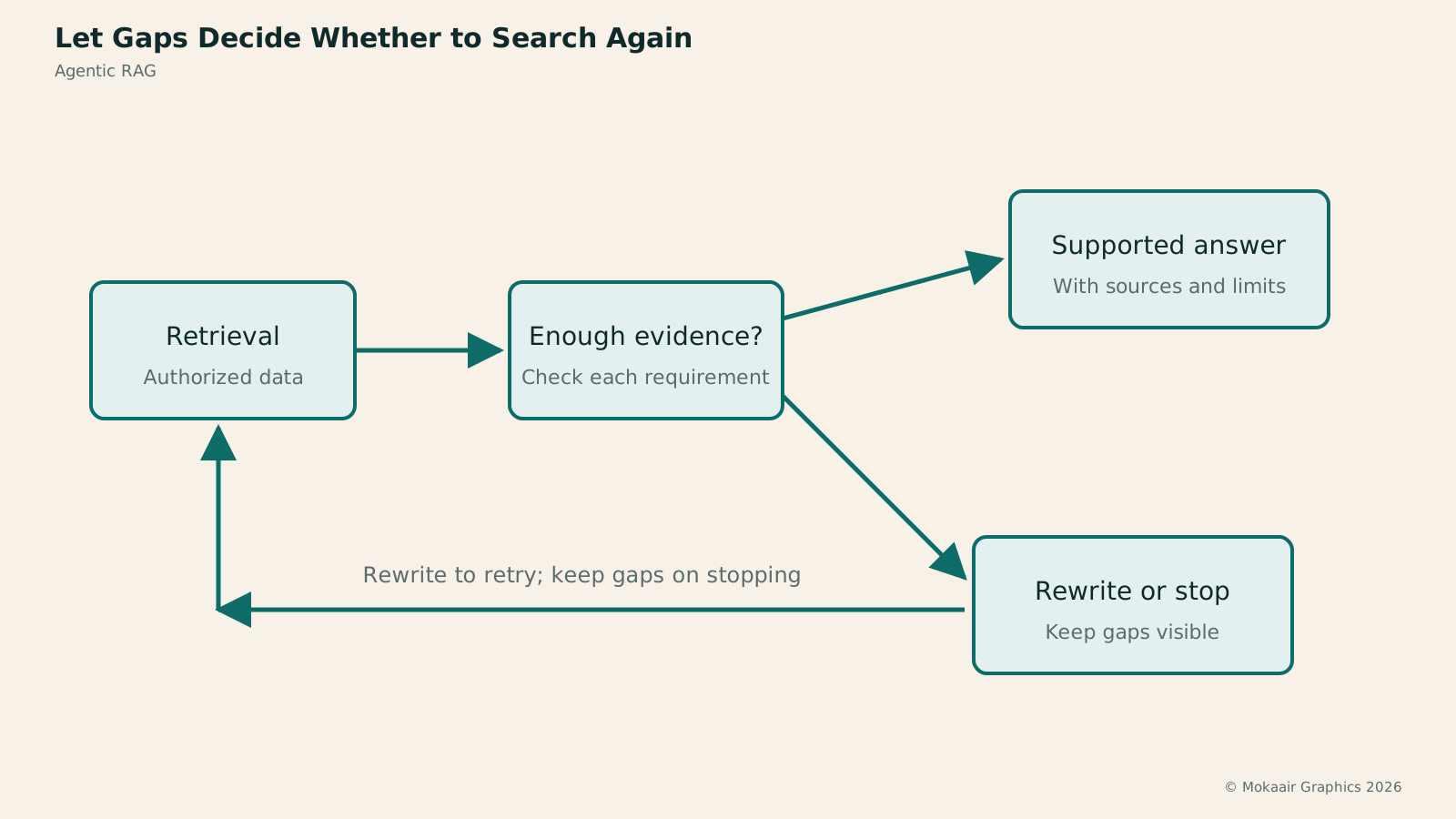
An understandable loop includes listing the subquestions to answer, selecting tools to retrieve information, checking which claims the new information supports, and finally deciding whether to answer, search further or stop. A relevance check asks, "Does this passage discuss the question?" A sufficiency check asks, "Is there enough information to reach a conclusion?" A venue description may be highly relevant yet omit capacity, so these two checks must remain distinct.
Stopping criteria are best defined alongside the task. If all required fields have sources, the system can generate a comparison. If information conflicts, it should disclose the conflict. If queries keep returning only the same document, it can stop and list the missing items. Success does not mean continuing until the model says, "I am very confident." It means that the information the reader requested in advance has supporting evidence. Tool failures must also retain their failure status; a connection error must not be misreported as no information found.
Read the full description
After retrieving evidence, check its sufficiency: answer if sufficient, rewrite the query and retrieve again if not, and stop if the gaps cannot be filled.
Example: Comparing Venues for Community Events
Suppose the input is, "Compare Riverside Classroom and Mountain Town Hall. Which would suit a book club that needs projection equipment and an accessible entrance?" This is a fictional teaching scenario. The first retrieval may return equipment lists for both venues, with projection equipment listed for Riverside Classroom but only photos of the space for Mountain Town Hall. The agent should identify the missing equipment evidence for Mountain Town Hall and then consult its venue-use manual. Entrance conditions should be checked against venue layouts or official descriptions, not guessed from photos.
The expected output is an item-by-item comparison: whether projection equipment is provided, whether the entrance meets the question's requirements, the sources for each field, and any matters that still need confirmation from venue management. If the manual only says "assistance is available," that does not establish that a particular entrance is usable; it should be marked unconfirmed. An additional query may help find information, but more model reasoning cannot fill in facts that the documents do not record.
If the question changes to "Find Mountain Town Hall's contact phone number," fixed retrieval may be enough. Having an agent plan, check and then search could instead increase waiting time and opportunities for error. The same system can choose a path based on task complexity: clear, single-item queries take a short workflow, while comparisons across sources activate dynamic follow-up searches. This is a design trade-off; no source guarantees that an agentic approach is better for every question.
Hallucinations Are Not the Only Risk
A common failure in agentic retrieval is query drift: a search that begins with entrance conditions turns into a general search for accessible travel after several rewrites. Another failure is repeatedly searching synonymous queries, retrieving the same content and treating it as multiple independent pieces of evidence. Keep the original question, completed fields and document identifiers so duplicate information can be recognized, and require every follow-up search to explain the specific gap it aims to resolve.
The model may also be overly optimistic when judging whether information is sufficient. For important fields, a program can check whether a valid source is attached, or a person can spot-check whether citations support the claims. A program can verify only the conditions it was designed to check; it does not automatically understand every semantic nuance. Missing information, contradictions and source dates must therefore remain part of the evaluation. Every tool read should respect the same user's permissions; access must not expand simply because an agent decides the next step.
Evaluating Whether Extra Loops Are Worthwhile
When comparing approaches, use the same document versions and questions, and separately record answer completeness, citation support, tool-call counts and waiting time for fixed RAG and the agentic workflow. If improvements occur only on questions spanning multiple documents, targeted routing can be retained without replacing the entire system. Evaluation should also include unanswerable questions to see whether the agent can stop, avoiding optimistic conclusions based solely on demonstration questions that can succeed.
When reading a product introduction, readers can ask to see a complete query log: what was found initially, why another search was needed, what it added and when the process stopped. Only with this information can they begin to judge whether the system's extra steps are useful. The core of Agentic RAG is adjusting retrieval in response to evidence. Scheduling, retries, monitoring and collaboration among people are engineering work that supports its operation; they should not all be lumped together as the agent's reasoning ability.
If a system displays query progress, an on-screen "Verifying" status must also correspond to actual activity. A scheduled search does not mean the tool has successfully returned results, and returned results do not mean the evidence has been fully read. Preserving these distinctions helps users understand why they are waiting and helps engineering teams identify whether the process is stuck at tool connectivity, document parsing or model judgment.
| Method | Focus | What to Keep in Mind |
|---|---|---|
| Fixed RAG | Retrieves along a predefined path | The workflow is easy to predict |
| Agentic RAG | Chooses the next step based on intermediate evidence | Requires stopping criteria and budget limits |
| Self-RAG | Trains on-demand retrieval and reflection mechanisms | A specific research method |
What Is Retrieval-Augmented Generation (RAG)? Giving Answers Verifiable SupportWhat Is Retrieval-Augmented Generation (RAG)? Answers with Verifiable EvidenceRetrieval-augmented generation retrieves relevant external content for a language model to compose an answer. Using Q&A on event registration rules, this article explains indexing, retrieval, generation and source checking, compares it with search and fine-tuning, and shows why cited answers can still be wrong. Learn to distinguish outdated data, missing documents and overinterpreted evidence, and when to retain “I don't know.”Read the full article
What Is an Agent Loop? Judgment, Action and Feedback
What Is Agent Orchestration? Assigning Work and Sequencing Deliveries
AI Terminology Index: From Loop Engineering to Generative AI
Found this guide helpful? Share it with someone who needs it
Lifestyle
Graph Retrieval-Augmented Generation (GraphRAG): Understanding a Document Collection Through Relationships
GraphRAG uses entities and relationships in retrieval to answer questions about cross-document connections and overall themes. Drawing on Microsoft's original paper and official docs, this article explains entity extraction, community summaries, and local and global search, using local event records to show why different questions need different paths. It also shows how missing links, mistaken name merges, and distorted summaries affect answers: a pretty graph is not verified fact.
Lifestyle
Knowledge Graphs: Making Entities and Relationships Clear
Knowledge graphs organize entities and relationships to trace who took part in what, where and when through links. Using community events, this article covers entity identity, relationship direction, sources and time; compares Resource Description Framework (RDF) and property graphs; and explains why graphs are not equivalent to visualizations or reliable facts. Learn when to build one and how it works with tables, vector search and graph retrieval-augmented generation (GraphRAG).
Lifestyle
Hybrid Search: Balancing Exact Terms and Meaning
Hybrid search merges full-text, vector and other retrieval results to cover exact codes and natural-language needs. An equipment-manual query explains candidate retrieval, deduplication, rank fusion and reranking, including how Reciprocal Rank Fusion (RRF) merges results by rank. Hybrid search is not always more accurate. Learn to test quality with code, paraphrase and no-answer queries and spot biases from permissions, filters and duplicate content.
Lifestyle
What Is Retrieval-Augmented Generation (RAG)? Answers with Verifiable Evidence
Retrieval-augmented generation retrieves relevant external content for a language model to compose an answer. Using Q&A on event registration rules, this article explains indexing, retrieval, generation and source checking, compares it with search and fine-tuning, and shows why cited answers can still be wrong. Learn to distinguish outdated data, missing documents and overinterpreted evidence, and when to retain “I don't know.”
Sources
- LangGraph: Build a custom RAG agentChecked:
- Asai et al.: Self-RAGChecked:
Compiled from the references and verification dates listed above; fares, schedules, product features, and terms can change, so please confirm the latest details on the relevant official website before travelling, booking, or purchasing.