Lifestyle
Knowledge Graphs: Making Entities and Relationships Clear
Knowledge graphs organize entities and relationships to trace who took part in what, where and when through links. Using community events, this article covers entity identity, relationship direction, sources and time; compares Resource Description Framework (RDF) and property graphs; and explains why graphs are not equivalent to visualizations or reliable facts. Learn when to build one and how it works with tables, vector search and graph retrieval-augmented generation (GraphRAG).
About 7 min read
Contents
A knowledge graph organizes knowledge through entities and their relationships. Entities can be people, organizations, places, documents or events. Relationships describe who participates in what, where something is located or where information comes from. The focus is on giving links explicit meaning and traceable identifiers, not merely drawing data as dots and lines.
The term has no single definition that restricts it to one storage technology. This article uses the W3C Resource Description Framework (RDF) concepts specification and Neo4j's explanation of property graphs as concrete foundations for introducing two common representations. The examples use fictional community event data; the relationships in the graph are teaching examples, not investigations into real people or organizations. Readers will learn to distinguish connections supported by data from guesses made after viewing a graph.
Establish Identity Before Relationships
If two documents both mention “Shancheng Bookshop,” first determine whether they refer to the same bookshop. Identical names may refer to different branches, while different names may reflect an organization changing its name. A graph needs stable entity identifiers, with names and aliases retained as properties. Without this step, subsequent queries following relationships may conflate different entities, producing formally coherent answers with misattributed facts.
Relationships also need explicit types and directions. “The bookshop organizes the event” and “The event takes place at the bookshop” express different responsibilities; appearing together in the same report does not mean jointly organizing an event. When building a graph, define relationships according to evidence and preserve uncertainty. Where necessary, represent “a document claims there was collaboration” as a claim with a source, rather than promoting it directly to an unconditional fact.
How RDF and Property Graphs Represent Data
A basic RDF statement can be understood as a subject, predicate and object: for example, “Event A, held at, Venue B.” The W3C specification defines RDF graphs and related identification mechanisms and data types, giving different sources a shared basis for representation. This is only a conceptual example; it does not mean that arbitrary Chinese phrases satisfy a complete data-exchange specification. Actual systems must still choose appropriate vocabularies and identification methods.
Property graphs commonly represent data as nodes, typed relationships and properties attached to nodes or relationships. An event node can have a date, while an organizing relationship can have a role or validity period. Both approaches organize connections, but their data models, query languages and interoperability mechanisms differ. Neither is simply a newer replacement for the other. The choice depends on existing tools, data-exchange requirements and how the team manages data.
Read the full description
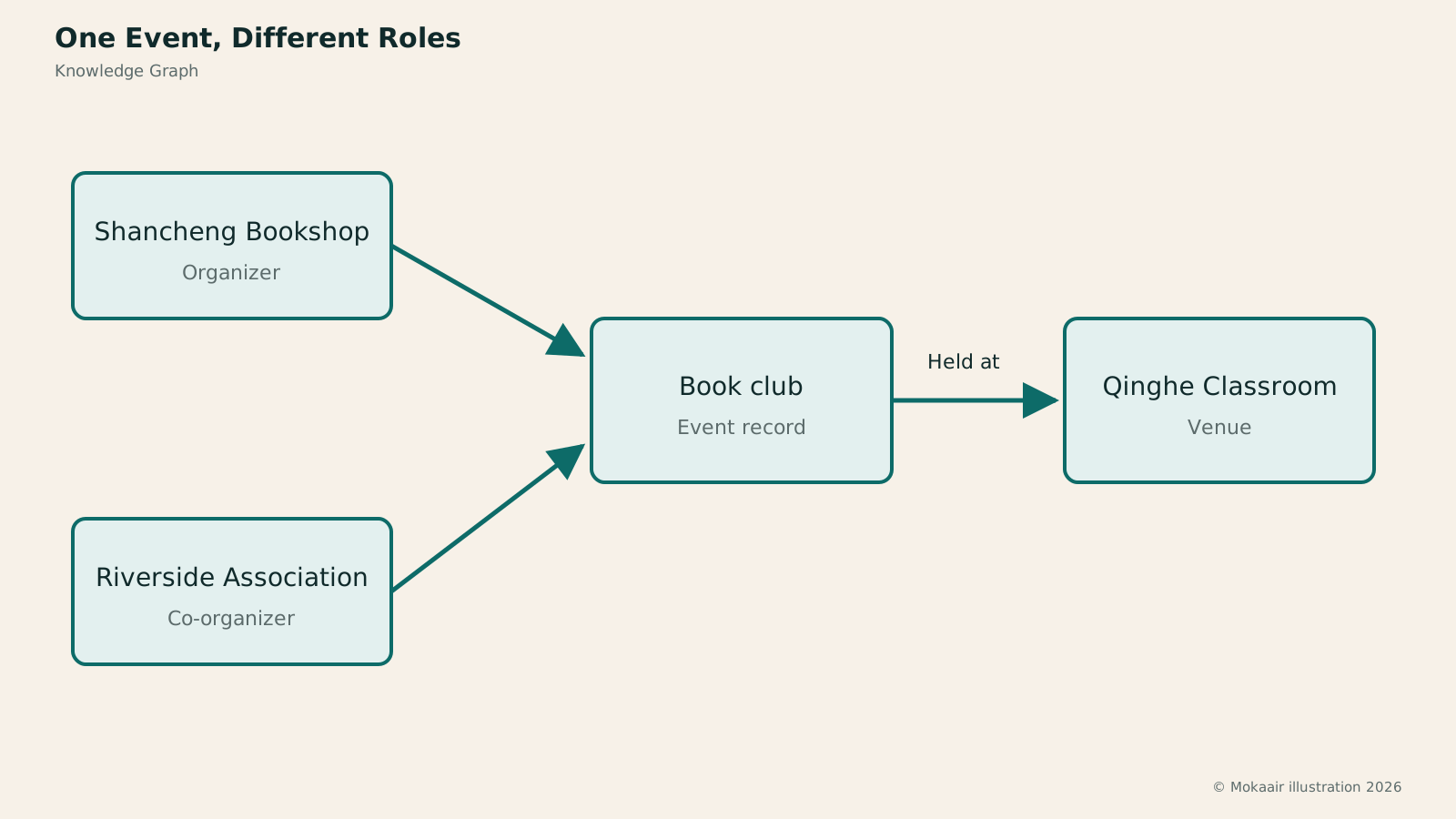
Shancheng Bookshop organizes a book club meeting, Riverside Association co-organizes it, and Qinghe Classroom is the venue; a venue is not automatically a co-organizer.
Example: Who Took Part in the Same Event?
Suppose the data states that Shancheng Bookshop organized a book club meeting, Riverside Association co-organized it, and the venue was Qinghe Classroom. For the query “Which groups have organized events with Shancheng Bookshop?”, the system can first find the bookshop, follow links to the events it organized to find other co-organizing groups, and finally return the events and sources. The expected results include Riverside Association, but Qinghe Classroom only served as the venue and cannot automatically be treated as a co-organizer.
If an event record also says “the speaker is from Riverside Association,” that still does not establish that the association co-organized the event. In this case, retain the speaker's affiliation relationship or note that the information remains unconfirmed. This example illustrates a graph's advantage: relationship types let queries distinguish between connections with different meanings. Connecting everyone mentioned with a generic “related to” link may produce a dense graph, but it makes precise questions like this difficult to answer.
Now change the question to “Who are the current long-term partners?” A single joint event is insufficient to answer this. The data must explicitly state a collaboration period or an ongoing relationship; “previously organized an event together” cannot be converted directly into “current partner.” Time and relationship status should therefore be stored alongside the evidence, and answers should explain the scope of the data. These judgments must be handled responsibly during modeling and querying; graph storage does not make them happen automatically.
A Graph Cannot Vouch for Its Sources
Graphs may be curated manually, extracted using rules or built by language models. Every approach can produce errors. If the original document is wrong, even perfect extraction merely stores an incorrect claim faithfully; model-based extraction may also misinterpret references or miss negation. The source's credibility, the extraction's faithfulness and the correctness of entity merging need separate checks. Errors at these stages have different causes and cannot be captured by a single overall confidence score.
Graphs also need updating when sources are withdrawn or revised. If several sources support a relationship, deleting one does not necessarily mean the entire relationship should disappear, but the change cannot simply be ignored. Retaining source links and validity periods helps track which conclusions are affected. For data requiring review, distinguish candidate relationships from confirmed ones so that unverified extraction results are not used directly in public-facing answers.
When to Use Graphs and How to Combine Them with Other Methods
When common questions require tracing relationships across multiple entities, such as event participation, content citations or organizational collaboration, graph structures readily express these paths. But if the data mainly requires filtering and aggregation within a single table, a relational database may be more straightforward. Graph storage is not a necessary replacement for every join (JOIN) query, and a large data volume does not automatically make graph modeling appropriate. Start by writing down the actual questions to answer, then choose the structure.
Vector search is good at finding semantically similar starting points, while graphs are good at following explicit relationships. The two can work together. For example, use text to find a potentially matching bookshop, then use its identifier to query formally recorded event relationships. GraphRAG goes further by passing the graph and related text to a generation workflow to produce answers. These steps still need to retain the original text; a link extracted by a model is not sufficient as a citation.
A small acceptance test can begin with a manually verified set of entities and relationships, including different people with the same name, name changes, expired relationships and conflicting sources. Check whether queries follow the correct relationship types, identify the evidence for each result and avoid forcing connections when data is absent. Evaluate a graph by the verifiable questions it supports, not simply by growth in node count or a more complex-looking visualization. Visualization is just one interface for reading a graph. Dense lines, nearby nodes or matching colors may reflect choices made by a layout algorithm rather than formal meanings in the data itself. When sharing a graph, include a relationship legend and a scope description so readers know which visual features carry meaning and which merely improve the layout.
| Method | Focus | Considerations |
|---|---|---|
| Tables | Organize records into rows and columns | Suited to clearly defined filtering and statistics |
| Knowledge graphs | Entities and meaningful relationships | Require identity and source governance |
| Vector representations | Content similarity | Do not directly provide explicit relationship types |
Graph Retrieval-Augmented Generation (GraphRAG): Understanding Document Collections Through RelationshipsGraph Retrieval-Augmented Generation (GraphRAG): Understanding a Document Collection Through RelationshipsGraphRAG uses entities and relationships in retrieval to answer questions about cross-document connections and overall themes. Drawing on Microsoft's original paper and official docs, this article explains entity extraction, community summaries, and local and global search, using local event records to show why different questions need different paths. It also shows how missing links, mistaken name merges, and distorted summaries affect answers: a pretty graph is not verified fact.Read the full article
What Is an Embedding? Placing Content in a Space Where It Can Be ComparedWhat Is an Embedding? Mapping Content into a Space for ComparisonEmbeddings are numeric representations that models create from text and other content, often for semantic search, classification and clustering. Using “Where can I go when it rains?”, this article covers encoding, similarity and candidates; why vector distance does not indicate truth and dimensions may lack clear labels; and the effects of model versions, language ability and long-text truncation. Learn the distinct roles of embeddings, vector databases and answer generation.Read the full article
What Is Retrieval-Augmented Generation (RAG)? Giving Answers Verifiable SupportWhat Is Retrieval-Augmented Generation (RAG)? Answers with Verifiable EvidenceRetrieval-augmented generation retrieves relevant external content for a language model to compose an answer. Using Q&A on event registration rules, this article explains indexing, retrieval, generation and source checking, compares it with search and fine-tuning, and shows why cited answers can still be wrong. Learn to distinguish outdated data, missing documents and overinterpreted evidence, and when to retain “I don't know.”Read the full article
AI Terms Index: From Loop Engineering to Generative AI
Found this guide helpful? Share it with someone who needs it
Lifestyle
Agentic Retrieval-Augmented Generation (Agentic RAG): When to Search Again
Agentic RAG lets models make retrieval decisions, choosing sources, rewriting queries or searching further based on the question and available evidence. Using a concrete LangGraph workflow and a comparison of venue-use conditions, this article contrasts it with fixed RAG and explains stopping criteria, permissions, query logs and cost control. Learn to judge whether a task needs dynamic exploration or a predictable fixed workflow is enough.
Lifestyle
Graph Retrieval-Augmented Generation (GraphRAG): Understanding a Document Collection Through Relationships
GraphRAG uses entities and relationships in retrieval to answer questions about cross-document connections and overall themes. Drawing on Microsoft's original paper and official docs, this article explains entity extraction, community summaries, and local and global search, using local event records to show why different questions need different paths. It also shows how missing links, mistaken name merges, and distorted summaries affect answers: a pretty graph is not verified fact.
Lifestyle
Hybrid Search: Balancing Exact Terms and Meaning
Hybrid search merges full-text, vector and other retrieval results to cover exact codes and natural-language needs. An equipment-manual query explains candidate retrieval, deduplication, rank fusion and reranking, including how Reciprocal Rank Fusion (RRF) merges results by rank. Hybrid search is not always more accurate. Learn to test quality with code, paraphrase and no-answer queries and spot biases from permissions, filters and duplicate content.
Lifestyle
What Is Retrieval-Augmented Generation (RAG)? Answers with Verifiable Evidence
Retrieval-augmented generation retrieves relevant external content for a language model to compose an answer. Using Q&A on event registration rules, this article explains indexing, retrieval, generation and source checking, compares it with search and fine-tuning, and shows why cited answers can still be wrong. Learn to distinguish outdated data, missing documents and overinterpreted evidence, and when to retain “I don't know.”
Articles that cite this one
Sources
Compiled from the references and verification dates listed above; fares, schedules, product features, and terms can change, so please confirm the latest details on the relevant official website before travelling, booking, or purchasing.