Lifestyle
Hybrid Search: Balancing Exact Terms and Meaning
Hybrid search merges full-text, vector and other retrieval results to cover exact codes and natural-language needs. An equipment-manual query explains candidate retrieval, deduplication, rank fusion and reranking, including how Reciprocal Rank Fusion (RRF) merges results by rank. Hybrid search is not always more accurate. Learn to test quality with code, paraphrase and no-answer queries and spot biases from permissions, filters and duplicate content.
About 7 min read
Contents
Hybrid Search combines the results of different search methods into a single ranked list. In AIWhat Is Artificial Intelligence?AI covers many technologies and uses; it is not synonymous with chatbots and need not generate text. Starting with the OECD system definition, this article uses photo classification and community resource recommendations to link inputs, inference, outputs and human goals, and explains AI's relationship to machine learning, deep learning and generative AI. Learn to ask concrete questions about what an AI feature does and distinguish capability, autonomy and trustworthiness.Read the full article applications, a common pairing is full-text search and vector search: the former preserves exact names and lexical signals, while the latter handles synonyms and natural-language paraphrases. Simply displaying the two searches in separate columns is not enough; the core design also covers how results are combined, how duplicates are handled, and how the final order is determined.
This article follows common usage in the official Elastic and Azure AI Search documentation to explain the fusion of full-text and vector results, without treating every vendor's implementation details as a universal standard. The example uses a fictional equipment manual to show what each retrieval path can contribute. Hybrid search must be evaluated empirically; adding more types of technology does not guarantee higher accuracy.
Why Use Two Types of Search Signals?
Suppose someone searches for “The projector displays E-CODE. How do I get the picture back?” Here, E-CODE is an error code invented for this article. Exact terms can narrow the documents down to passages that actually discuss that code, while semantic matching might connect “get the picture back” to “troubleshooting signal loss.” Using only one path might find the code but overlook the need for a solution, or find troubleshooting instructions that apply to a different device.
Both search methods can also make mistakes. The full-text path is affected by tokenization, synonyms and spelling; the vector path may overlook subtle version differences or negated conditions. The reason for combining them is to make them complement each other, not to treat every input equally. If the task consists almost entirely of exact identifier queries, full-text or structured queries may already suffice, and additional vector results could introduce irrelevant candidates.
Different Scores: How Do They Become One List?
Full-text search scores and vector similarity scores are usually on different scales, so simply adding the two numbers does not make for a fair comparison. One approach is to calibrate or normalize the scores before weighting them; another uses ranking information. Reciprocal Rank Fusion, or RRF, often introduced in official documentation, accumulates ranking signals based on each item's position in each result list, avoiding the requirement that raw scores be directly comparable.
The intuition behind RRF is that a document ranking highly across multiple paths has a chance to move up after fusion; a document found by only one path does not automatically disappear. Still, fusion involves choices about the candidate pool and parameters, and the results cannot extend beyond what the individual paths originally retrieved. Different products may offer different weights or fusion options. Consult the documentation for the implementation you are using, rather than treating an algorithm's name as a guarantee that no tuning is needed.
Read the full description
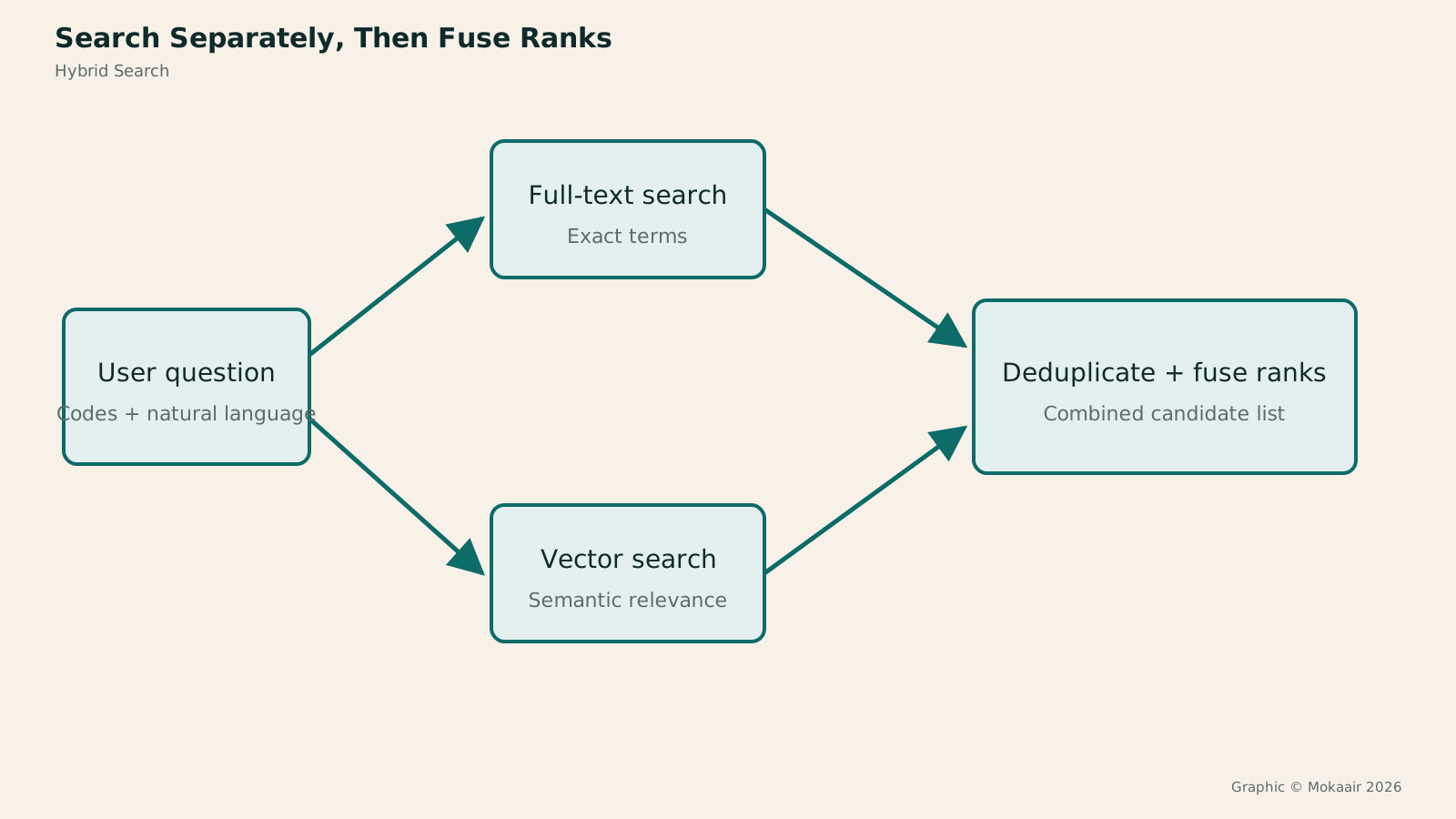
The same question goes to full-text and vector search; results are deduplicated by ID and fused by rank into a shared candidate list
Example: Keep the Code and Understand the Problem
For the earlier projector query, the full-text path first finds instructions containing E-CODE, while the vector path finds passages about signal loss and reconnecting. The system merges duplicates using stable document IDs, then fuses the rankings using the chosen method. The expected list should prioritize content for the same device and code that includes troubleshooting steps, while also allowing relevant instructions that do not directly use the user's wording to appear.
Next, change the question to “The screen stays black after connecting to a computer.” There is no error code this time, so the semantic path may be more helpful, but the device model and input-port conditions still need to be checked. If the user has not provided a model, the search can show the scope of applicability or request more details; it must not treat a seemingly complete set of instructions as the only answer. These are expected behaviors, not measured rankings from any particular engine.
Finally, add a test case: none of the documents mentions a particular new model. Good results should acknowledge that no document directly applies, even if both paths find similar content for older models. Together, the two searches provide “relevant candidates”; they do not automatically create evidence for operating the new model. If answer generation is added after fusion, it must still avoid presenting similarity between candidates and the query as a definitive conclusion that they apply.
Fusion Is Not Reranking
Rank fusion addresses how multiple retrieval lists are combined, while reranking typically performs a deeper relevance assessment of candidates already retrieved. The two can be used together: first combine search methods to obtain a more complete candidate pool, then use a cross-encoder or another ranking model to assess the question and documents. They operate at different stages; a change in the final list's order does not make every operation the same technology.
The granularity of deduplication also matters. Documents with different IDs but nearly identical content may occupy multiple positions in the list, crowding out other useful information. Conversely, passages in the same document that separately address prerequisites and exceptions must not all be collapsed into one entry merely because they share a document. Deduplication rules should reflect whether the final display presents documents or passages, and retain information that leads back to the original text.
How Can You Tell What Hybrid Search Adds?
When comparing methods, divide questions into at least exact-term queries, natural paraphrases, mixed conditions and no-answer scenarios, and examine the full-text, vector and fused results separately. Reporting only an overall average may hide a sharp decline on code queries. Also record candidate counts, filtering methods and data versions: expanding the candidate pool alone may improve recall, so not every change can be credited to the fusion algorithm.
Permissions and applicability conditions must be handled consistently across retrieval paths. If full-text search covers only public documents but vector search includes internal repair records, fusion may expose content the reader is not authorized to see. A final check before releasing results cannot fully replace access controls at the retrieval layer. When the system updates documents, both indexes should follow a consistent versioning strategy so that old and new content do not gain advantages on different paths.
General readers evaluating a search product can try two phrasings of the same need, then add an exact model number and check whether results stay within the applicable scope. Engineering teams should record which path each candidate came from and its rank before and after fusion to identify which signal helped. The value of hybrid search lies in verifiable complementarity, not in packing more technology names into one search box. If both paths use the same document, use stable IDs to confirm that they point to the same version, so old and new passages are not treated as separate evidence that accumulates weight. You can also inspect the candidates unique to each path separately. If semantic search results are consistently pushed to the bottom by the fusion rules, users effectively still see only full-text results, even though both indexes were searched. First establish whether the additional candidates are useful, then adjust the fusion method.
| Method | Focus | Caveat |
|---|---|---|
| Full-text path | Preserves names, codes and terms | May miss natural paraphrases |
| Vector path | Finds content with similar meaning | May overlook exact differences |
| Rank fusion | Combines candidate lists | Still limited to the original candidate pool |
Semantic Search: Find Relevant Content with Different WordingSemantic Search: Finding Relevant Content Through Different WordingSemantic search seeks data by query and content meaning, not just matching words. Customer support examples explain query encoding, document representations and candidate ranking; distinguish similarity from meeting actual needs; and show limits with negation, specific codes, cross-language search and unanswerable queries. Learn where to improve search—embedding models, data preparation, hybrid search or reranking—without mistaking natural-language answers for search itself.Read the full article
Reranking: From Finding Results to Putting Good Answers FirstReranking: From Finding Results to Putting Good Answers FirstReranking reassesses first-pass search candidates for relevance and is often used to improve search lists and RAG context quality. Using library loan rules, this article shows how retrievers and cross-encoders share the work and explains missing candidates, input truncation, and relevance scores versus truth checks. Learn when to broaden retrieval, fix chunks, or add reranking, and use suitable tests to avoid needless waiting for better rankings.Read the full article
Vector Database: How Similar Content Is Stored and Found
AI Terminology Index: From Loop Engineering to Generative AI
Found this guide helpful? Share it with someone who needs it
Lifestyle
Agentic Retrieval-Augmented Generation (Agentic RAG): When to Search Again
Agentic RAG lets models make retrieval decisions, choosing sources, rewriting queries or searching further based on the question and available evidence. Using a concrete LangGraph workflow and a comparison of venue-use conditions, this article contrasts it with fixed RAG and explains stopping criteria, permissions, query logs and cost control. Learn to judge whether a task needs dynamic exploration or a predictable fixed workflow is enough.
Lifestyle
Graph Retrieval-Augmented Generation (GraphRAG): Understanding a Document Collection Through Relationships
GraphRAG uses entities and relationships in retrieval to answer questions about cross-document connections and overall themes. Drawing on Microsoft's original paper and official docs, this article explains entity extraction, community summaries, and local and global search, using local event records to show why different questions need different paths. It also shows how missing links, mistaken name merges, and distorted summaries affect answers: a pretty graph is not verified fact.
Lifestyle
Knowledge Graphs: Making Entities and Relationships Clear
Knowledge graphs organize entities and relationships to trace who took part in what, where and when through links. Using community events, this article covers entity identity, relationship direction, sources and time; compares Resource Description Framework (RDF) and property graphs; and explains why graphs are not equivalent to visualizations or reliable facts. Learn when to build one and how it works with tables, vector search and graph retrieval-augmented generation (GraphRAG).
Lifestyle
What Is Retrieval-Augmented Generation (RAG)? Answers with Verifiable Evidence
Retrieval-augmented generation retrieves relevant external content for a language model to compose an answer. Using Q&A on event registration rules, this article explains indexing, retrieval, generation and source checking, compares it with search and fine-tuning, and shows why cited answers can still be wrong. Learn to distinguish outdated data, missing documents and overinterpreted evidence, and when to retain “I don't know.”
Articles that cite this one
Sources
- Elastic: Hybrid searchChecked:
- Microsoft: Hybrid Search OverviewChecked:
Compiled from the references and verification dates listed above; fares, schedules, product features, and terms can change, so please confirm the latest details on the relevant official website before travelling, booking, or purchasing.