Lifestyle
Reranking: From Finding Results to Putting Good Answers First
Reranking reassesses first-pass search candidates for relevance and is often used to improve search lists and RAG context quality. Using library loan rules, this article shows how retrievers and cross-encoders share the work and explains missing candidates, input truncation, and relevance scores versus truth checks. Learn when to broaden retrieval, fix chunks, or add reranking, and use suitable tests to avoid needless waiting for better rankings.
About 8 min read
Contents
Reranking means adding another ranking step after the first search retrieves candidates to decide which items should come first. It is often used in search and RAGWhat Is Retrieval-Augmented Generation (RAG)? Answers with Verifiable EvidenceRetrieval-augmented generation retrieves relevant external content for a language model to compose an answer. Using Q&A on event registration rules, this article explains indexing, retrieval, generation and source checking, compares it with search and fine-tuning, and shows why cited answers can still be wrong. Learn to distinguish outdated data, missing documents and overinterpreted evidence, and when to retain “I don't know.”Read the full article, letting a faster retriever narrow the scope before passing a limited set of candidates to a more thorough relevance model. This allocates resources in stages: first find the material, then spend effort deciding what to read first.
Reranking is no guarantee of greater accuracy, and it is not limited to large language models. Cross-encoders, learning-to-rank models, and other scoring methods can all serve this role. Based on Sentence Transformers' Retrieve and Re-Rank documentation and Elastic's explanation of ranking, this article uses fictional library rules to demonstrate the mechanism, clearly distinguishing expected behavior from actual test results.
Why the Initial Ranking May Not Be Enough
First-pass retrieval often needs to find candidates quickly within large amounts of data, so it may use precomputed vectors or a full-text index. These methods are good at narrowing the scope, but fine details about applicability, who or what a rule concerns, and exceptions sometimes require careful comparison of the question and document together. Reranking spends more computation on fewer candidates to try to improve the relevance of the top few results, without expensively processing every document in the database.
For example, “Can I still renew loans if my student ID has expired?” is close in topic to the general question “How do I renew loans?”, so the first pass may rank ordinary renewal steps first. But the document actually needed may concern account eligibility and expiration restrictions. If that document is already among the candidates, reranking has a chance to move it up; if it was never retrieved, even the most sophisticated later scoring cannot create source text for a missing candidate.
How a Cross-Encoder Examines a Pair of Texts
A typical bi-encoder encodes the question and document separately, then compares their vectors. Document representations can be built in advance, avoiding the need to reprocess every pair at query time. A cross-encoder instead feeds the question and candidate document into the model together to directly assess the relevance of that pair of texts. It can use finer interactions between the two, but each candidate usually requires fresh computation, which is why it is often used in the second stage.
The output scores depend on the model and its training objective. Some are uncalibrated values; others are transformed to fall within a particular range. A score should not be treated as the probability of a correct answer merely because it looks like a percentage. The model may judge a passage highly relevant even though the source text is outdated, the user lacks permission to view it, or the content itself is incorrect. Relevance assessment and source quality need to be handled separately.
Read the full description
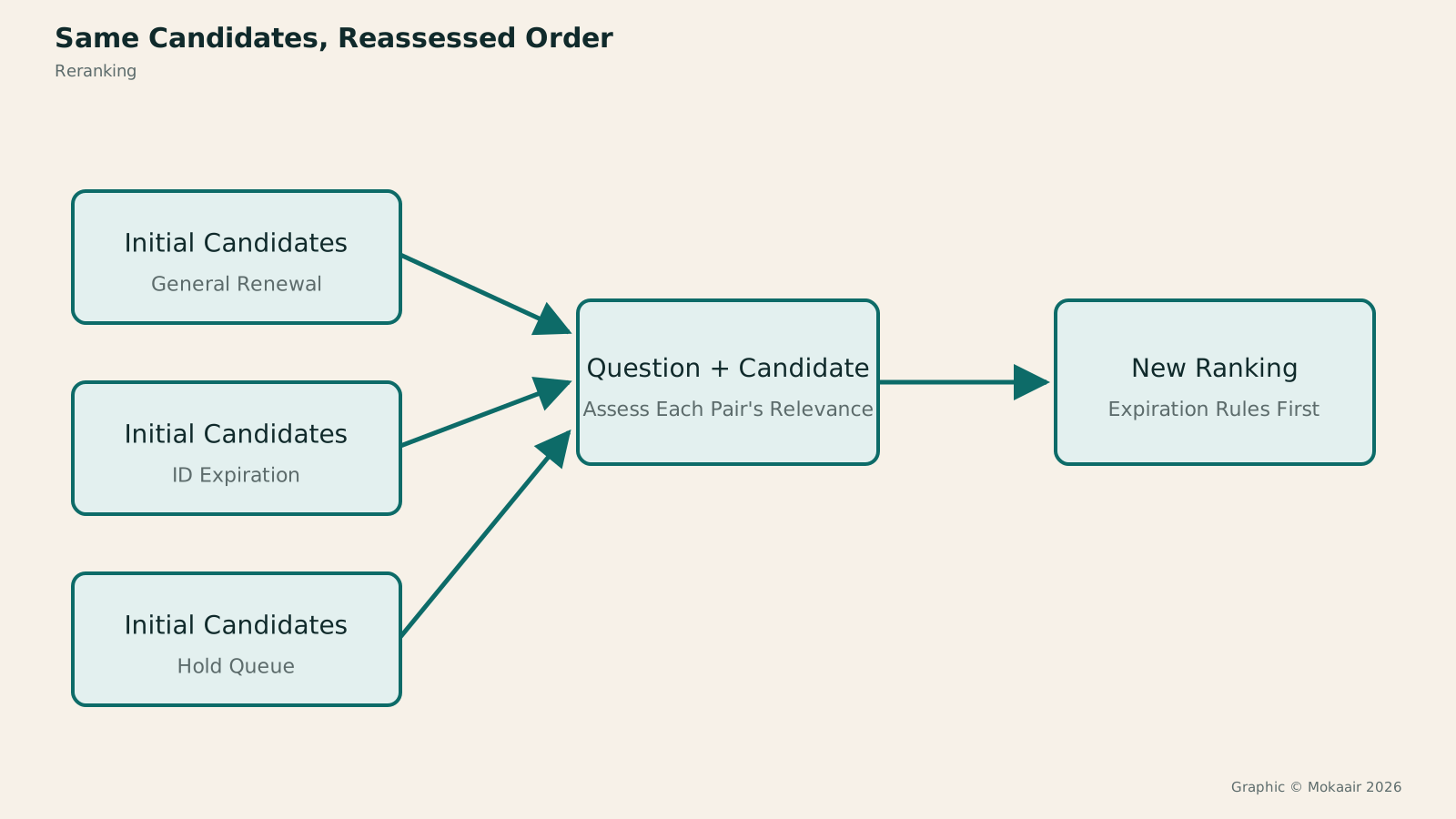
First-pass retrieval finds general renewal, hold-queue, and ID-expiration passages; scoring the question with each candidate moves expiration conditions to the front
Example: Moving Expiration Rules to the Front
Suppose the input is “My student ID has expired. Can I still renew my borrowed books online?” Candidates include general renewal steps, an explanation of hold queues, procedures for expired IDs, and an introduction to the library's collection. The reranker evaluates the question against each passage. A reasonable expectation is that it will move ID-expiration conditions and renewal-related rules to the front, so downstream readers or generative models first see the constraints that determine the answer. These candidates and results form a teaching scenario devised for this article.
A good final answer still needs to follow what the source text says. If the document on expired IDs only says that new borrowing is suspended, without stating whether this affects renewals of books already on loan, the answer should not invent a ban on renewals. In this case, reranking may have successfully found the most relevant document, yet the information remains insufficient. This example shows that improved search quality and a complete answer are two outcomes that need to be evaluated separately.
You can also deliberately exclude the correct rule from the candidates, then rerun the test for comparison. If the answer does not improve, that is a reasonable limit of the mechanism, not necessarily a sign of a poor reranking model. Conversely, if the correct passage is already among the candidates but consistently gets pushed down, you need to check input length, question format, language capabilities, and whether the model suits rule retrieval. Test design needs to distinguish these sources of failure.
Cost and Document Processing Matter Too
More candidates generally mean more computation across question–document pairs, increasing waiting time and computing requirements. Fewer candidates may mean missing the correct information, so applications need to find a suitable candidate count rather than copy someone else's fixed number. If the first pass already reliably ranks the answer near the top, adding reranking may offer little benefit while making every request take longer.
Overly long documents are another common obstacle. Reranking models have input length limits, so if a key exception falls beyond the truncation point, it is invisible to the scoring process. You can adjust chunking, retain document titles and necessary context, and then test the results. Treating an entire manual as one candidate is not necessarily better than using meaningful passages; splitting every sentence into tiny pieces may also prevent the model from identifying what a restriction applies to.
When Is This Extra Layer Worth Adding?
Start by checking candidate recall in the first search pass: is the correct information often already found, but poorly ranked? If so, reranking has clearer room for improvement. If it is not found at all, address the index, queries, chunking, or hybrid search first. During evaluation, keep the same candidate set and compare rankings before and after adding reranking, so improvements caused by changes to the candidate pool are not mistakenly attributed to the ranking model.
Test questions should include comparisons with similar topics but different conditions, such as expired IDs, overdue books, and books already on hold for someone else. Include unanswerable questions too, to check that the model does not present the closest-matching passage as sufficient evidence. For RAG, beyond examining rankings, check whether the final answer cites the correct rules and preserves what remains unknown. Upstream improvements only fulfill the service's goal when they reach the answer delivered to the reader.
The system can store candidate IDs, first-pass rankings, reranked positions, and model versions to support spot checks. If a model update makes a category of questions perform worse, you can return to the same data for further analysis. Reranking directs limited attention toward more relevant content; it strengthens the ranking stage without replacing data governance, access controls, fact-checking, or final human judgment. If the reranking service becomes temporarily unavailable, the application also needs to decide in advance whether to fall back to the original ranking and log which path each request took, so fallback results are not mistaken for the new model's performance. You should also check the actual span of text the ranking model received. If a long rule is truncated before input, its exceptions may never reach the model; in that case, a ranking error does not mean the model understood the text but judged it incorrectly. Recording the passages submitted and their truncation points helps distinguish whether to fix document chunking or candidate content, or change the ranking method.
| Method | Main Focus | What to Watch |
|---|---|---|
| First-pass retrieval | Retrieve candidates quickly | Prioritize whether all relevant material was found |
| Reranking | Carefully compare candidates with the question | Prioritize relevance among the top results |
| Answer verification | Check claims against evidence | Relevance does not mean truth or sufficient evidence |
Hybrid Search: Combining Exact Terms and MeaningHybrid Search: Balancing Exact Terms and MeaningHybrid search merges full-text, vector and other retrieval results to cover exact codes and natural-language needs. An equipment-manual query explains candidate retrieval, deduplication, rank fusion and reranking, including how Reciprocal Rank Fusion (RRF) merges results by rank. Hybrid search is not always more accurate. Learn to test quality with code, paraphrase and no-answer queries and spot biases from permissions, filters and duplicate content.Read the full article
Document Chunking: How Long Should Chunks Be to Avoid Cutting Answers Apart?
Semantic Search: Finding Relevant Content with Different WordingSemantic Search: Finding Relevant Content Through Different WordingSemantic search seeks data by query and content meaning, not just matching words. Customer support examples explain query encoding, document representations and candidate ranking; distinguish similarity from meeting actual needs; and show limits with negation, specific codes, cross-language search and unanswerable queries. Learn where to improve search—embedding models, data preparation, hybrid search or reranking—without mistaking natural-language answers for search itself.Read the full article
AI Terms Index: From Loop Engineering to Generative AI
Found this guide helpful? Share it with someone who needs it
Lifestyle
Agentic Retrieval-Augmented Generation (Agentic RAG): When to Search Again
Agentic RAG lets models make retrieval decisions, choosing sources, rewriting queries or searching further based on the question and available evidence. Using a concrete LangGraph workflow and a comparison of venue-use conditions, this article contrasts it with fixed RAG and explains stopping criteria, permissions, query logs and cost control. Learn to judge whether a task needs dynamic exploration or a predictable fixed workflow is enough.
Lifestyle
Graph Retrieval-Augmented Generation (GraphRAG): Understanding a Document Collection Through Relationships
GraphRAG uses entities and relationships in retrieval to answer questions about cross-document connections and overall themes. Drawing on Microsoft's original paper and official docs, this article explains entity extraction, community summaries, and local and global search, using local event records to show why different questions need different paths. It also shows how missing links, mistaken name merges, and distorted summaries affect answers: a pretty graph is not verified fact.
Lifestyle
Knowledge Graphs: Making Entities and Relationships Clear
Knowledge graphs organize entities and relationships to trace who took part in what, where and when through links. Using community events, this article covers entity identity, relationship direction, sources and time; compares Resource Description Framework (RDF) and property graphs; and explains why graphs are not equivalent to visualizations or reliable facts. Learn when to build one and how it works with tables, vector search and graph retrieval-augmented generation (GraphRAG).
Lifestyle
Hybrid Search: Balancing Exact Terms and Meaning
Hybrid search merges full-text, vector and other retrieval results to cover exact codes and natural-language needs. An equipment-manual query explains candidate retrieval, deduplication, rank fusion and reranking, including how Reciprocal Rank Fusion (RRF) merges results by rank. Hybrid search is not always more accurate. Learn to test quality with code, paraphrase and no-answer queries and spot biases from permissions, filters and duplicate content.
Articles that cite this one
Sources
Compiled from the references and verification dates listed above; fares, schedules, product features, and terms can change, so please confirm the latest details on the relevant official website before travelling, booking, or purchasing.